

The strategic shift from wholesale asset replacement to engineered structural life-extension is no longer a matter of preference but a financial and regulatory necessity for modern infrastructure. As the Building Safety Regulator (BSR) transitions into an independent body in 2026, the burden of proof regarding structural integrity rests more heavily than ever upon the shoulders of asset controllers. Selecting from the available structural strengthening companies UK requires a rigorous assessment of engineering competence rather than a simple comparison of material costs. You likely recognise that as infrastructure ages under increased loading, the complexity of remediation grows, often outstripping the capabilities of general contractors.
In this guide, an expert analysis of the methodologies required to evaluate potential partners is provided, ensuring that technical compliance with standards such as BS EN 1504 and TR55 is maintained. It’s intended that asset managers gain the insights necessary to secure evidence-based engineering solutions that extend the functional lifespan of critical assets whilst minimising operational disruption. A methodical examination of the criteria for assessing composite material specifications and the integration of proprietary systems into long-term maintenance strategies will be conducted.
Key Takeaways
- Understand the impact of increased loading and deteriorating masonry on aging infrastructure, necessitating a strategic shift towards engineered life-extension.
- Identify the critical benchmarks for selecting structural strengthening companies UK, specifically regarding professional indemnity insurance and specialist design expertise.
- Evaluate the technical performance of Carbon Fibre Reinforced Polymer (CFRP) and the proprietary Tyfo® Fibrwrap® system in enhancing the load-bearing capacity of structural elements.
- Recognise the necessity for bespoke engineering calculations and rigorous site testing to maintain compliance with Eurocodes and ensure long-term asset integrity.
- Discover the sustainability benefits of the “repair over replacement” methodology in prolonging the functional lifespan of national infrastructure portfolios whilst minimising operational disruption.
The Evolving Requirements for Structural Strengthening in the UK
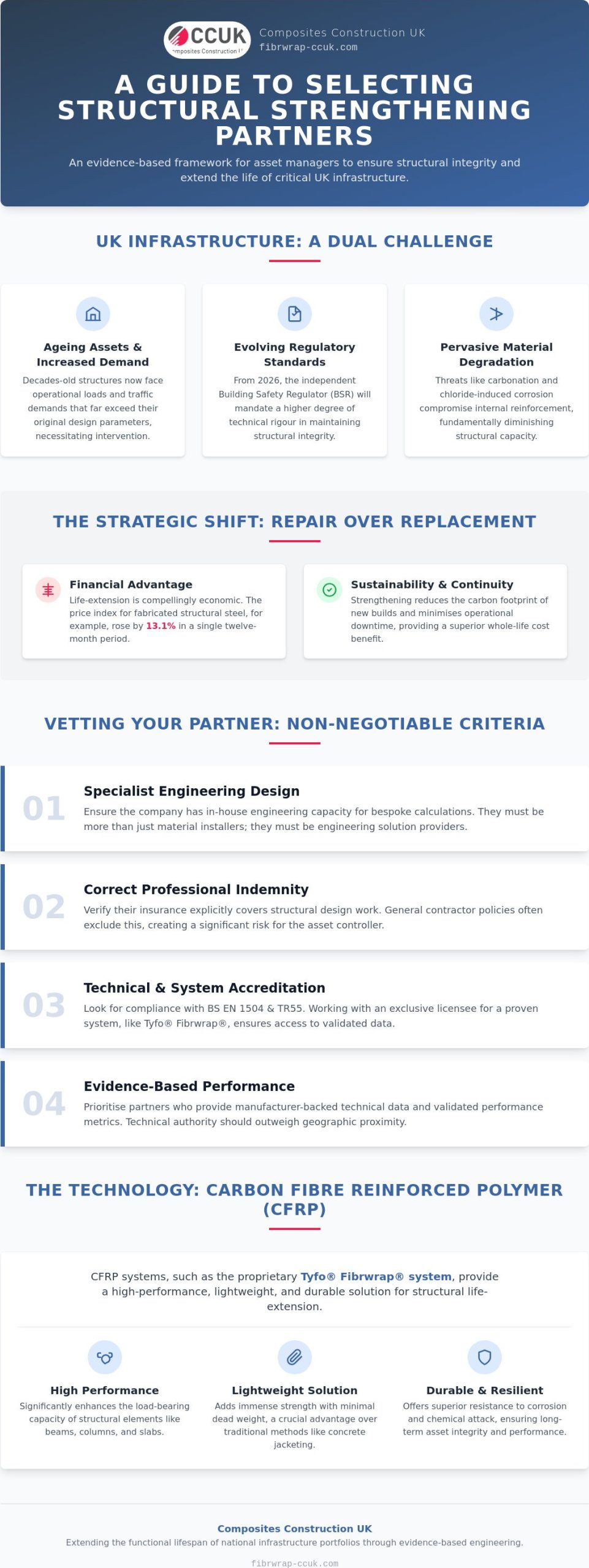
The UK’s built environment is currently facing a dual challenge of legacy deterioration and stringent new regulatory frameworks. With the Building Safety Regulator (BSR) operating as an independent body as of January 2026, asset managers are required to demonstrate a higher degree of technical rigour in maintaining structural integrity across their portfolios. Much of the national infrastructure relies on reinforced concrete principles established decades ago. However, these structures are now subjected to traffic loads and operational demands that far exceed their original design parameters. This environment has led to a significant increase in the demand for specialised structural strengthening companies UK that can provide more than just material application, focusing instead on integrated engineering solutions.
Drivers for Structural Remediation
The primary impetus for structural intervention often stems from the necessity to upgrade highway and bridge infrastructure to meet modern load-bearing standards. Beyond simple wear, critical assets frequently require seismic retrofitting or blast mitigation to protect against modern threats. Structural defects, particularly carbonation and chloride-induced corrosion in reinforced elements, represent a pervasive threat to longevity. When these chemical processes compromise the internal reinforcement, the structural capacity of the member is fundamentally diminished. This requires the application of bespoke engineering calculations and high-performance composite solutions to restore or enhance its performance without adding excessive dead weight.
The Sustainability of Strengthening
The decision to rehabilitate rather than demolish is increasingly driven by both economic pragmatism and environmental mandates. In an era where the price index for fabricated structural steel rose by 13.1% in the twelve months to May 2026, the financial argument for life-extension is compelling. By utilising Carbon Fibre Reinforced Polymer (CFRP) systems, asset managers can achieve structural upgrades whilst significantly reducing the carbon footprint associated with new-build construction. This approach aligns with the objective of prolonging the functional lifespan of essential assets, a core focus for leading structural strengthening companies UK. Remediation also offers the distinct advantage of minimising operational downtime. In industrial settings, the ability to strengthen beams or columns whilst the facility remains active provides a whole-life cost benefit that total reconstruction simply cannot match.
Key Criteria for Evaluating Structural Strengthening Companies
The process of selecting from the various structural strengthening companies UK requires a strategic shift from traditional procurement to a model based on technical validation. It’s essential that any prospective partner demonstrates not only the requisite CSCS accreditations and health and safety certifications but also specific professional indemnity insurance that explicitly covers structural design work. Many contractors operate as approved installers for generic systems, yet they may lack the internal engineering capacity to validate the suitability of a material for a complex load-case. For high-consequence infrastructure, the ability to provide evidence-based performance data is the primary benchmark of a contractor’s reliability.
Accreditation and Technical Compliance
Specialist training and adherence to rigorous industry standards are non-negotiable when managing critical assets. In the context of UK infrastructure policy, where the focus is increasingly on the resilience and longevity of national assets, the reliability of the intervention is paramount. Working with an exclusive licensee for advanced composite systems, such as the Tyfo® Fibrwrap® system, ensures that the contractor has direct access to manufacturer-backed technical data and validated performance metrics. Technical authority should be weighted more heavily than geographic proximity; the risks associated with structural failure far outweigh any perceived logistical savings. Reliability is built upon a history of successful execution in demanding environments, from rail bridges to industrial silos.
Integrated Design and Installation
Fragmented liability is a significant risk when the structural design phase is separated from the installation phase. A consulting contractor model is preferred, where the specialist provides bespoke engineering calculations as part of a unified technical package. This integration ensures that the structural survey, material specification, and installation methodology are perfectly aligned. Asset managers should seek partners who offer end-to-end feasibility and testing services, providing a single point of accountability for the long-term performance of the remediation. If you require a detailed assessment of your asset’s current performance, it’s advisable to discuss your technical requirements with a specialist who understands the nuances of composite application and structural behaviour.
Past performance on complex projects provides the necessary validation for future success. When evaluating structural strengthening companies UK, asset managers should request detailed case studies that illustrate the resolution of specific engineering challenges, such as restricted access or time-sensitive remediation. A contractor’s ability to manage the complexity of modern composite material specifications whilst maintaining site safety is a clear indicator of their professional standing. This methodical approach to selection ensures that the chosen partner is not just a provider of materials, but a guardian of the structure’s long-term integrity.
Advanced Composite Technology: The Tyfo® Fibrwrap® Advantage
Carbon Fibre Reinforced Polymer (CFRP) is a high-strength, lightweight composite used to increase load-bearing capacity without significant mass addition. In the evolving landscape of UK infrastructure, this material has become a cornerstone for structural strengthening companies UK seeking to remediate deteriorating assets. Unlike traditional steel plate bonding, which adds substantial dead weight and requires intensive mechanical fixing, CFRP systems are bonded directly to the substrate using high-performance resins. The absence of heavy lifting equipment and the inherent corrosion resistance of the material make it particularly suited for environments where long-term durability is a priority. It’s an engineering solution that addresses the fundamental weaknesses of legacy materials whilst offering a life-extension strategy that is both technically superior and economically viable.
When comparing CFRP to steel, the technical benefits are stark. Steel plates are susceptible to interfacial corrosion and require regular maintenance to prevent section loss over time. Conversely, the Tyfo® Fibrwrap® system is inert and provides a seamless, non-corrosive reinforcement layer that effectively wraps the structural element. This methodology is particularly advantageous for column and beam reinforcement, where the confinement provided by the wrap significantly enhances the axial and flexural capacity of the member. The speed of application is another critical factor; composite systems can often be installed in a fraction of the time required for traditional steelwork, reducing the period of operational disruption.
Tyfo® Fibrwrap® Performance Metrics
The performance of the Tyfo® Fibrwrap® system is defined by its exceptional tensile strength and modulus properties, which are tailored to meet the specific requirements of each project. This versatility allows for effective application across concrete, masonry, timber, and steel substrates. It’s been proven in demanding seismic retrofitting and pipeline rehabilitation projects globally, providing a level of reliability that generic composite materials cannot match. Each system is engineered to provide the exact degree of reinforcement required, ensuring that the structural integrity is restored without unnecessary material wastage. Just as infrastructure requires advanced protection, the longevity of timber elements often depends on high-quality finishes; for instance, FVCreations provides expert advice on using specialised oils and waxes to preserve wooden surfaces.
Application Techniques and Quality Control
Achieving the design intent of a composite system depends entirely on the precision of the installation process. Surface preparation is the most critical phase; the substrate must be mechanically abraded to ensure a robust bond between the material and the structure. Leading structural strengthening companies UK must decide between wet-lay and pre-cured systems based on the specific geometry and loading requirements of the asset. A technical guide to Tyfo® Fibrwrap® installation provides deeper insight into these specialist methodologies. Rigorous quality control, including pull-off testing and resin sample analysis, is essential to verify that the installed system meets the bespoke engineering specifications and regulatory standards.
The Critical Role of Engineering Design and Feasibility
Every successful structural intervention is predicated on the accuracy of the initial diagnostic phase. The most proficient structural strengthening companies UK recognise that application without rigorous design is a fundamental risk to asset safety. It’s essential that the remediation strategy is supported by bespoke engineering calculations that ensure full compliance with Eurocodes and relevant British Standards. This methodical approach allows for the development of a solution that is technically sound and economically justified through a detailed feasibility analysis. By prioritising the engineering phase, asset managers can mitigate the risk of unforeseen complications during the installation process, ensuring that the chosen intervention provides the required enhancement to load-bearing capacity.
Structural Surveys and Testing
Determining the current state of a substrate is the first step in any strengthening programme. Substrate integrity is assessed through a combination of carbonation testing and pull-off tests, which provide the empirical data necessary to validate the bond strength of future composite applications. It’s vital to identify the root cause of structural failure, such as reinforcement corrosion or fatigue, before any reinforcement is applied. Without this diagnostic rigour, the application of even the most advanced materials may only mask underlying issues. For a deeper understanding of these diagnostic processes, you may explore our technical guide to structural repairs, which details the intersection of repair and reinforcement.
Bespoke Engineering Solutions
Complex geometries and restricted access environments require tailored strengthening schemes that cannot be addressed with off-the-shelf solutions. Specialist software is utilised to predict the behaviour of composite-reinforced structures under various loading scenarios, allowing for the optimisation of material thickness and fibre orientation. This precision is a hallmark of the design features and engineering consultancy services provided by specialist contractors. Furthermore, the management of design liability is a critical consideration; by integrating design and installation, the specialist contractor assumes responsibility for the performance of the entire system, providing a layer of security for stakeholders. This consulting contractor model ensures that the technical specifications are translated accurately into site-specific methodologies.
Justifying the investment in advanced remediation requires a transparent cost-benefit analysis. Whilst the initial expenditure on engineering design and high-performance materials may be higher than traditional methods, the long-term savings in maintenance and the avoidance of total replacement provide a superior return on investment. The ability to extend the functional life of a bridge or industrial building by decades whilst maintaining operational continuity is a powerful economic driver. If you’re currently managing a structure that requires a technical evaluation, you should consult with our engineering team to initiate a formal feasibility study.
Partnering for National Infrastructure Life-Extension
Managing a multi-site asset portfolio across different regional jurisdictions requires a partner with national service capability and consistent technical standards. For asset controllers, the selection of structural strengthening companies UK is often influenced by the need for a unified engineering approach that can be scaled across bridges, tunnels, and industrial facilities. This consistency is vital to ensure that every intervention, regardless of location, adheres to the same rigorous safety protocols and material performance benchmarks. By integrating specialised materials with bespoke engineering, a seamless journey from the initial defect diagnosis to a certified structural upgrade is achieved, providing long-term security for essential infrastructure.
This integrated approach often begins with essential civil engineering and site preparation, where specialists like GCS Contractors Ltd provide the necessary groundworks to support subsequent structural strengthening and remediation efforts across diverse construction sites.
Comprehensive Asset Protection
True infrastructure guardianship extends beyond the application of Carbon Fibre Reinforced Polymer (CFRP). A holistic remediation strategy often requires the integration of concrete repair, cathodic protection, and resin injection for leak sealing to address the multifaceted nature of structural decay. For instance, the electrochemical prevention of reinforcement corrosion is often a necessary precursor to strengthening. Detailed insights into these processes can be found in our guide to concrete repairs and remediation. Similarly, for subterranean or water-conveyance assets, asset life-extension through pipeline rehabilitation offers a non-disruptive alternative to excavation, utilising cured-in-place methodologies to restore hydraulic and structural capacity whilst maintaining the utility of the original asset.
Initiating Your Strengthening Project
The value of early engagement with a specialist engineering contractor shouldn’t be overlooked. When a specialist is involved during the preliminary feasibility stage, the strengthening scheme can be optimised for both performance and cost-effectiveness. Asset managers should ensure that tenders for structural strengthening work include a clear brief that specifies the required load enhancement, the environmental conditions, and the necessity for comprehensive professional indemnity insurance. This clarity allows for the comparison of technical solutions based on empirical evidence rather than just material volumes. A methodical approach at this stage prevents the common pitfalls of scope creep and regulatory non-compliance. To begin the process of securing your infrastructure and extending its functional lifespan, you’re invited to contact CCUK for a technical consultation to discuss your specific asset remediation requirements.
The ultimate goal of any strengthening programme is to ensure that the structure remains fit for purpose under modern demands. By choosing a partner that understands the intersection of advanced material science and structural engineering, asset managers can fulfill their obligations to both safety and sustainability. The transition from a deteriorating asset to a reinforced, compliant structure is a complex process that requires the disciplined approach of an industry leader. Through the application of proprietary systems and bespoke design, the longevity of the UK’s critical infrastructure can be preserved for decades to come.
Securing the Future of UK Infrastructure through Engineered Life-Extension
The long-term resilience of the built environment is predicated on the transition from reactive maintenance to proactive, engineered life-extension. It’s been established that the efficacy of structural remediation is dependent upon the integration of rigorous diagnostic surveys with bespoke engineering calculations that adhere to Eurocode standards. By prioritising technical compliance and manufacturer-backed performance data, asset managers can ensure that their portfolios remain secure under the scrutiny of the Building Safety Regulator. Selecting from the available structural strengthening companies UK should therefore be a methodical process of validating specialist design capabilities and professional indemnity coverage for high-consequence projects.
As the exclusive UK licensee for the Tyfo® Fibrwrap® system, CCUK provides a comprehensive design and installation service that addresses the complex requirements of bridge, building, and pipeline strengthening. This integrated approach ensures that every intervention is grounded in empirical evidence and material science, effectively prolonging the functional lifespan of essential assets whilst fulfilling sustainability mandates. To ensure your infrastructure remains resilient under increasing operational demands, you’re encouraged to discuss your structural strengthening requirements with our engineering team. Proactive technical engagement today provides the necessary foundation for the enduring safety of the nation’s critical infrastructure.
Frequently Asked Questions
What are the main advantages of using CFRP over traditional steel strengthening?
Carbon Fibre Reinforced Polymer (CFRP) offers a superior strength-to-weight ratio compared to traditional steel plate bonding, which adds substantial dead weight to the structure. Unlike steel, composite systems are inherently resistant to corrosion, eliminating the risk of interfacial section loss over time. The installation process is significantly more efficient; it’s common for composite remediation to require half the construction programme of traditional mechanical fixing methods.
How do structural strengthening companies ensure compliance with UK building regulations?
Leading structural strengthening companies UK ensure compliance by adhering to Concrete Society Technical Report 55 (TR55) and relevant Eurocodes. Every project is supported by bespoke engineering calculations that validate the design intent against current regulatory standards. This technical rigour is essential for meeting the requirements of the Building Safety Regulator (BSR) and ensuring the long-term integrity of the nation’s critical infrastructure.
Is CFRP suitable for strengthening masonry and timber structures as well as concrete?
CFRP is highly versatile and is frequently utilised for the reinforcement of masonry and timber structures in addition to reinforced concrete. The material is particularly effective for masonry reinforcement, where it can be applied to provide flexural and shear enhancement without altering the building’s aesthetic profile. Its lightweight nature allows for significant capacity increases in timber beams where traditional steel reinforcement would be logistically prohibitive.
What is the typical lifespan of a Tyfo® Fibrwrap® structural strengthening system?
The Tyfo® Fibrwrap® system is engineered to last for the remaining design life of the structure, provided it’s installed according to bespoke technical specifications. With over 25 years of industry expertise, these systems have demonstrated exceptional durability in diverse environments. The inert nature of the carbon fibres ensures that the reinforcement does not degrade over time, offering a permanent solution for structural life-extension.
Can structural strengthening be carried out whilst a building or bridge remains in use?
Structural strengthening can typically be executed whilst a building or bridge remains fully operational, as the process is non-intrusive and requires minimal heavy plant. The use of composite materials allows for remediation in restricted access areas without the need for extensive site closures. This capability is a primary driver for asset managers who must maintain operational continuity whilst addressing critical structural defects.
How much does a structural survey and strengthening feasibility study cost in the UK?
The cost of a structural survey and feasibility study varies based on the complexity of the asset, the required testing protocols, and the scale of the structure. Factors such as the necessity for carbonation testing, pull-off tests, and bespoke engineering calculations will influence the final fee. Asset managers should seek detailed proposals from specialist structural strengthening companies UK to ensure all technical parameters are accurately scoped.
What technical accreditations should I look for in a specialist engineering contractor?
Asset managers should prioritise specialist engineering contractors who hold comprehensive professional indemnity insurance specifically covering structural design work. It’s essential that site teams possess relevant CSCS cards and have undergone specialist training for the application of proprietary composite systems. Accreditations such as ISO 9001 and ISO 45001 further validate a contractor’s commitment to quality management and health and safety standards.
Does structural strengthening require planning permission or building control approval?
Most structural strengthening projects require building control approval to verify that the proposed design meets current safety standards and Eurocodes. Whilst internal remediation rarely necessitates planning permission, external interventions on listed buildings or within conservation areas may require local authority consent. It’s advisable to consult with a specialist engineer during the feasibility stage to determine the specific regulatory requirements for your asset.