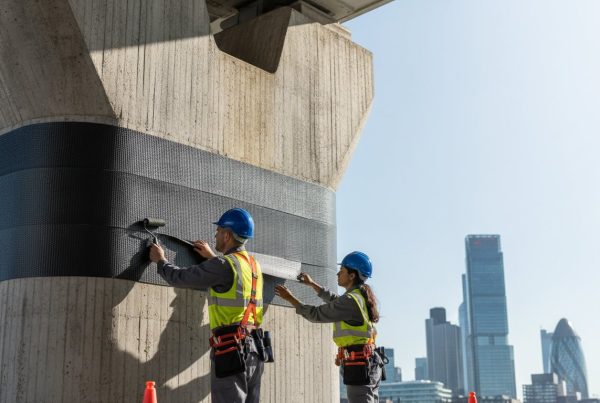

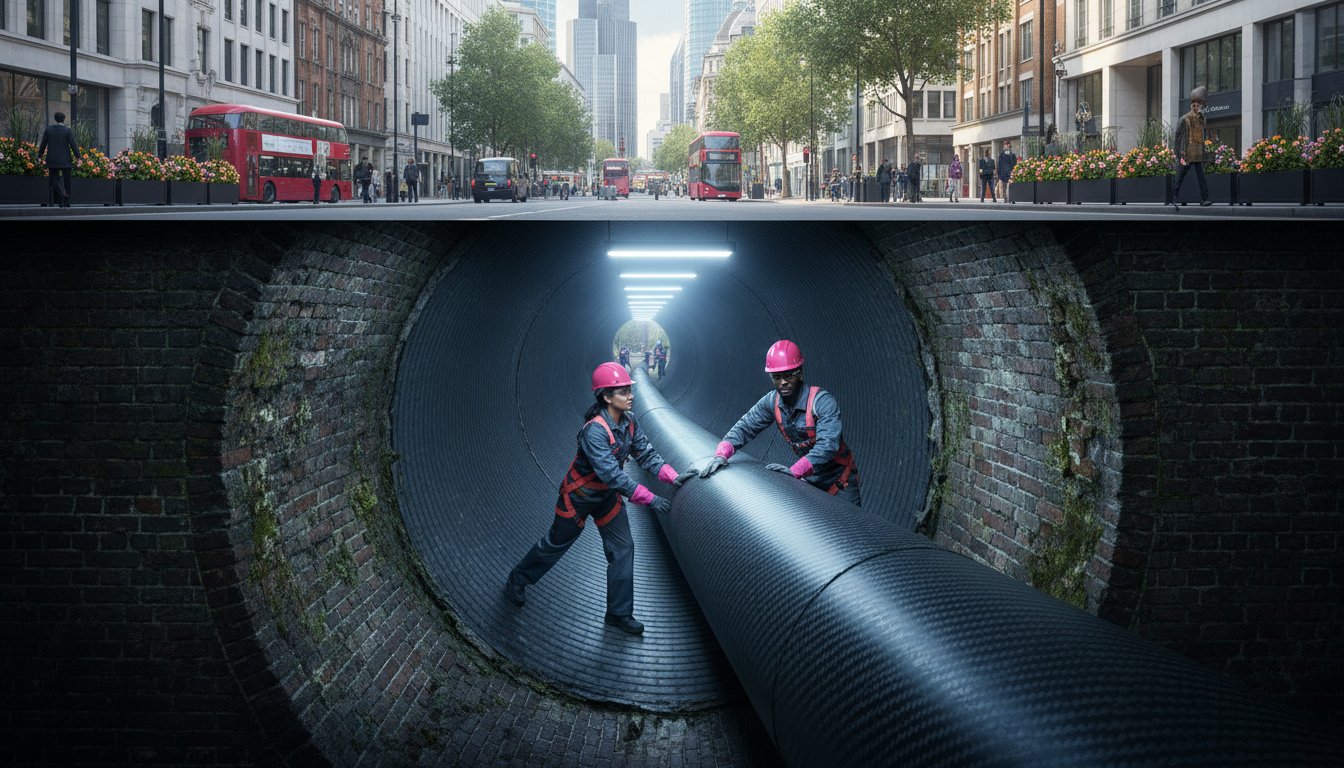
Whilst wastewater infrastructure accounted for 61.70% of the UK trenchless market in 2025, the challenge of managing assets that are often over 100 years old remains a primary concern for civil engineers. Traditional excavation methods are increasingly viewed as inefficient due to the high costs and significant disruption they impose upon densely populated areas. Modern pipeline rehabilitation must therefore transcend simple leak-sealing to focus on comprehensive structural strengthening. It’s understood that the preservation of aging cast iron and concrete mains is essential for maintaining the £718 billion of planned UK infrastructure investment projected through 2026.
This technical guide provides an expert-led analysis of advanced trenchless methodologies, specifically focusing on the application of Carbon Fibre Reinforced Polymer (CFRP) and the proprietary Tyfo® system. You’ll learn how these bespoke composite solutions achieve an asset life-extension exceeding 50 years whilst ensuring full compliance with the Pipelines Safety Regulations 1996 and BS EN 14161 standards. The following sections detail the engineering rigour required to restore structural integrity and enhance hydraulic capacity without the requirement for invasive open-cut replacement.
Key Takeaways
- Analyse the technical requirements for maintaining aging UK infrastructure, focusing on the preservation of Victorian-era cast iron and early concrete assets.
- Compare trenchless pipeline rehabilitation methodologies to determine the most effective strategy for specific pipe diameters and host materials.
- Establish the critical distinction between temporary leak remediation and Class IV fully structural strengthening for long-term asset integrity.
- Utilise advanced condition assessment data from sonar and ultrasonic testing to develop bespoke engineering solutions that meet UK safety standards.
- Explore the application of Tyfo® Fibrwrap® systems to create an independent “pipe-within-a-pipe” capable of extending asset life by over 50 years.
Understanding Pipeline Rehabilitation in the Context of UK Infrastructure
Pipeline rehabilitation is defined as the systematic methodology employed to restore or enhance the functional and structural performance of existing conduits without the requirement for total replacement. In the United Kingdom, this approach has transitioned from a secondary maintenance option to a primary strategic necessity. This shift is driven by the critical state of the nation’s aging infrastructure; much of the current network consists of Victorian-era cast iron and early concrete assets that have long exceeded their original design lives. National utility providers now prioritise asset life-extension to manage the £718 billion of planned infrastructure investment across 734 projects projected through 2026. The economic and environmental transition from a “replace by default” philosophy to “rehabilitate by design” reflects a sophisticated understanding of the inherent value remaining within buried assets. Engineering focus is increasingly directed toward reinforcing and supplementing existing structural capacity through advanced material science rather than discarding it.
The Drivers of Rehabilitation: Age, Demand, and Environment
Unprecedented hydraulic and structural stress is placed upon existing networks by increased urbanisation amongst major UK population centres. These systems are frequently subject to complex degradation mechanisms such as carbonation, sulphate attack, and internal corrosion, all of which compromise the integrity of the pressure vessel. Asset life-extension is defined as the strategic prolongation of a structure’s operational utility through technical intervention. By addressing failure modes through bespoke engineering, the service life of critical mains can be extended by 50 years or more. This process requires a deep understanding of advanced materials science to ensure that the intervention is compatible with the host structure’s remaining strength and environmental conditions.
Trenchless Technology vs Traditional Excavation
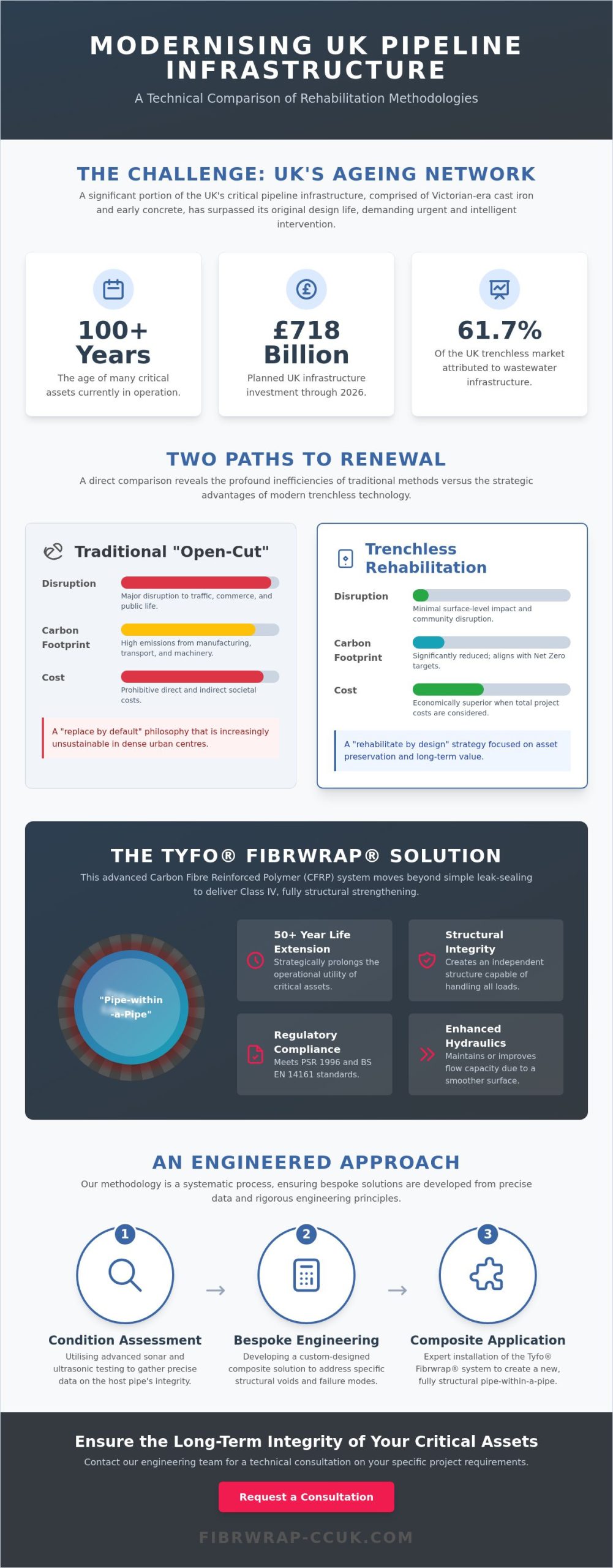
The social and economic costs associated with traditional “open-cut” replacement are often prohibitive in modern, densely populated environments. Beyond the direct financial expenditure, the disruption to local commerce and transport networks represents a significant hidden cost to the UK economy. It’s for this reason that Trenchless Rehabilitation Methodologies have emerged as the modern standard for minimal-disruption engineering. These methods significantly reduce the carbon footprint of a project when contrasted with the manufacture, transport, and installation of new pipe sections. For organisations seeking to align with Net Zero targets, pipeline rehabilitation offers a sustainable alternative that preserves existing materials whilst upgrading structural performance. It’s a method that prioritises safety and proven results above all else. Detailed technical consultations regarding these systems can be initiated through our contact portal to ensure the most appropriate methodology is selected for specific site requirements.
Comparative Analysis of Trenchless Rehabilitation Methodologies
Selecting the correct pipeline rehabilitation methodology requires a rigorous evaluation of the host pipe’s residual strength and the specific hydraulic requirements of the network. Whilst wastewater conduits represented 61.70% of the UK trenchless market in 2025, the technical approach varies significantly between gravity-fed systems and high-pressure mains. Engineers must account for the Manning’s roughness coefficient; whilst a liner may reduce the internal diameter, the smoother surface of composite or polymer materials often maintains or even improves flow characteristics. However, standard lining solutions frequently encounter limitations when addressing severe structural voids or complex geometries where the host pipe has suffered significant deformation. The efficacy of trenchless rehabilitation technologies is therefore dependent on a precise alignment between material properties and the specific degradation state of the asset.
Sliplining and Cured-in-Place Pipe (CIPP)
CIPP remains a prevalent choice for smaller diameter assets, with 57.66% of the UK market focused on pipes under 18 inches in 2025. This process relies on a flexible, resin-impregnated tube that’s inverted or pulled into the host pipe and subsequently cured using ambient temperature, steam, or UV-light methods. Whilst effective for leak sealing and internal corrosion protection, CIPP is often categorised as a semi-structural repair, meaning it may still rely on the host pipe for certain load-bearing capacities. Conversely, sliplining involves the insertion of a new, smaller-diameter pipe into the existing conduit. This method is technically straightforward but results in a substantial reduction in cross-sectional area, which may be unacceptable for high-demand networks unless the improved flow coefficient offsets the loss of diameter.
Pipe Bursting and Close-Fit Liners
Pipe bursting is a mechanical intervention designed to replace the host pipe whilst simultaneously increasing hydraulic capacity. A bursting head is pulled through the existing line, fracturing the old material and pushing it into the surrounding soil to make room for a new pipe of equal or larger diameter. This methodology carries inherent risk profiles, specifically regarding ground heave and vibration, which must be carefully managed in sensitive UK urban environments to avoid damage to adjacent utilities. Close-fit technology, such as swagelining, offers a middle ground by temporarily deforming a polymer liner for insertion, allowing it to return to its original shape and form a tight fit against the host wall. For projects requiring a more sophisticated analysis of material performance, asset managers often review the bespoke engineering design features required for high-pressure applications.
Structural Strengthening vs Leak Remediation: Addressing Asset Integrity
The distinction between simple leak remediation and comprehensive structural strengthening is fundamental to the long-term viability of high-pressure networks. Whilst many traditional repair methods focus on the immediate cessation of infiltration or leakage, they often fail to address the underlying loss of structural integrity within the pressure vessel. In the context of pipeline rehabilitation, a clear hierarchy of repair is established by international standards, with “Class IV” fully structural liners representing the highest level of intervention. These bespoke systems are engineered to withstand all internal hydraulic pressures and external soil or traffic loads independently of the host pipe. By treating the existing conduit merely as a temporary formwork, engineers can install a new, high-performance structure that ensures absolute reliability even if the original pipe continues to degrade or suffers a total structural collapse.
The application of Carbon Fibre Reinforced Polymer (CFRP) systems has transformed the capabilities of modern pipeline rehabilitation by providing high-tensile reinforcement for weakened assets. Detailed technical insights regarding these materials can be found in our guide to pipeline strengthening, which outlines the performance characteristics of structural composites. These systems don’t just patch holes; they restore the structural safety factor of the entire asset, providing a solution that’s grounded in engineering rigour and empirical evidence.
The Role of Carbon Fibre Reinforced Polymers (CFRP)
CFRP is distinguished by an exceptional strength-to-weight ratio and high modulus of elasticity, making it ideal for the structural remediation of large-diameter mains. These composite systems are typically applied as internal linings or external structural wraps, depending on site accessibility and the specific failure modes identified during the survey phase. The material’s inherent chemical resistance is particularly advantageous amongst aggressive industrial effluents or in saline environments where traditional metallic or concrete repairs would be susceptible to rapid secondary degradation. Because the Tyfo® system is lightweight and requires minimal equipment for installation, it’s frequently utilised in confined spaces where traditional mechanical reinforcement would be physically impossible to implement. Asset managers seeking a broader understanding of expert-led remediation strategies may also benefit from reviewing our technical guide to structural repairs and asset life-extension, which examines CFRP interventions across a range of infrastructure applications.
Addressing Longitudinal and Hoop Stress
The physics of internal pressure necessitates a precise management of hoop stress, which is the tangential force acting on the pipe wall. When a pipeline suffers from wall-thinning due to corrosion, its ability to contain these forces is compromised, leading to a high risk of catastrophic burst failure. Advanced composites are bespoke-engineered to take the full internal load, effectively neutralising the stress on the host structure. This engineering approach often incorporates principles from seismic retrofitting to ensure the pipeline remains stable during ground movement or thermal expansion. By calculating the exact fibre orientation required to resist both longitudinal and hoop stresses, a comprehensive structural solution is achieved that meets the most stringent UK safety and engineering standards.
The Engineering Design and Condition Assessment Framework
The success of any pipeline rehabilitation programme is contingent upon a rigorous and methodical assessment of the asset’s current state. It’s not sufficient to rely on historical records; instead, empirical data must be gathered to quantify the extent of structural degradation. Every project requires a bespoke engineering approach, as the interaction between the host pipe, the rehabilitation material, and the surrounding environment is unique to each site. By integrating various design features, the resulting solution is tailored to account for specific environmental variables, ensuring the long-term reliability of the infrastructure. This expert-led process transitions the project from a standard repair to a sophisticated structural strengthening exercise.
Data Collection and Asset Inspection
A comprehensive inspection protocol typically involves the deployment of non-destructive testing (NDT) technologies, including high-definition CCTV, sonar profiling, and ultrasonic wall-thickness testing. These methods allow for the precise determination of the residual strength of the host pipe by identifying areas of significant corrosion or thinning. Beyond internal degradation, the design must evaluate the impact of external loads, such as fluctuating groundwater pressure and heavy vehicle surcharge in densely populated urban areas. Structural surveys provide the empirical foundation for all remediation strategies, ensuring that the proposed intervention is grounded in physical reality rather than theoretical assumptions. This data is essential for determining whether the host pipe can still contribute to the system’s overall capacity or if a fully independent “Class IV” liner is required.
Bespoke Engineering Calculations
Once the assessment data is verified, the engineering phase involves complex calculations to define the composite system’s architecture. The variables involved in composite design are extensive, encompassing specific resin types, fibre orientation, and the required layer count to resist anticipated stresses. Adherence to UK standards, such as BS EN 1594 for high-pressure gas or BS PD 8010 for land-based steel pipelines, is a non-negotiable requirement for regulatory compliance. These designs are frequently validated through finite element analysis (FEA) to simulate performance under extreme conditions, whilst physical pull-off testing is conducted on-site to confirm the bond strength between the CFRP and the host material. This methodical approach ensures that the pipeline rehabilitation meets the highest levels of safety and performance. Asset managers can access our full range of technical consultancy via our engineering design services to ensure project specifications meet these rigorous criteria.
Advanced Composite Solutions: The Role of Tyfo® Fibrwrap® in Pipeline Renewal
The Tyfo® Fibrwrap® system is established as the industry-leading solution for structural pipeline rehabilitation, offering a sophisticated alternative to traditional lining materials. This proprietary system facilitates the creation of a “pipe-within-a-pipe” that operates entirely independently of the host structure’s residual capacity. Whilst standard CIPP resins often lack the structural modulus required for high-pressure water or gas applications, Tyfo® composites are bespoke-engineered to meet Class IV fully structural requirements. The rapid installation process is a critical advantage for UK infrastructure providers, as it significantly reduces the downtime of strategic assets compared to traditional excavation and replacement. Technical details regarding specific application methods can be reviewed in our guide to trenchless pipeline repair.
Performance Characteristics of Tyfo® Systems
The performance characteristics of the Tyfo® system are defined by an exceptional strength-to-weight ratio and inherent resistance to the corrosion mechanisms that typically degrade metallic and concrete conduits. These properties are particularly vital when rehabilitating assets that convey aggressive industrial effluents or are situated in saline-rich coastal environments. Engineering calculations ensure the composite handles the coefficient of thermal expansion amongst varying UK climate conditions, preventing delamination during seasonal temperature shifts. The longevity of the system is a central component of asset life-extension strategies. It’s common for the rehabilitated pipe to possess a service life exceeding 50 years, which often surpasses the original design life of the host asset. This durability is essential for managing the UK’s trenchless market, which is projected to grow to £625.70 million in 2026. Engaging a specialist engineering contractor with proven expertise in composite systems is critical to ensuring these performance benchmarks are consistently achieved across complex infrastructure projects.
Case Studies in Structural Integrity
Successful applications of the Tyfo® system are frequently documented in high-consequence environments such as power generation facilities and large-diameter strategic trunk mains. In these critical utility nodes, the system is often specified to mitigate complex risks, including the integration of blast mitigation systems to ensure structural survival during overpressure events. Such projects illustrate the system’s ability to provide a comprehensive safety margin that extends beyond simple leak prevention. This level of engineering rigour provides asset managers with the long-term security required for national infrastructure protection. The use of carbon fibre reinforced polymers ensures that even the most severely degraded assets can be restored to full operational capacity. To initiate a technical review of a specific network challenge, please contact our engineering team to discuss your pipeline rehabilitation requirements.
Securing the Future of UK Pipeline Networks
The strategic implementation of structural strengthening is no longer merely a maintenance option but a fundamental requirement for the preservation of the UK’s aging utility networks. By moving beyond temporary leak remediation toward fully independent, Class IV liners, asset managers can ensure long-term security and regulatory compliance. As the exclusive UK licensee for the Tyfo® Fibrwrap® system, we provide comprehensive bespoke engineering and design services backed by a proven track record in critical infrastructure life-extension. It’s essential to address these challenges with empirical rigour and engineering precision to safeguard the £718 billion of planned national investment through 2026. This disciplined approach to pipeline rehabilitation provides the most sustainable path for modern infrastructure management. To ensure your assets meet these rigorous standards, consult with our specialist engineers for your next pipeline rehabilitation project. We look forward to supporting your structural requirements.
Frequently Asked Questions
What is the typical lifespan of a rehabilitated pipeline using CFRP?
A rehabilitated pipeline using Carbon Fibre Reinforced Polymer (CFRP) typically achieves a design life-extension exceeding 50 years. This longevity is supported by empirical evidence from accelerated aging tests and the material’s inherent resistance to chemical degradation. Unlike traditional metallic solutions, these composite systems don’t suffer from corrosion; this ensures that the structural safety factor remains constant throughout the asset’s extended operational utility.
Can trenchless rehabilitation be performed on high-pressure gas mains?
Trenchless rehabilitation is frequently performed on high-pressure gas mains provided the chosen methodology meets Class IV structural requirements. For systems operating at pressures exceeding 16 bar, compliance with BS EN 1594 is mandatory. The use of bespoke CFRP liners allows for the creation of an independent pressure vessel within the host pipe, ensuring safety and integrity without the requirement for extensive excavation in sensitive areas.
How does pipeline rehabilitation affect the hydraulic flow capacity?
Hydraulic flow capacity is typically maintained or even enhanced following pipeline rehabilitation due to the superior surface characteristics of composite liners. Whilst the internal diameter is slightly reduced, the Manning’s roughness coefficient is significantly improved compared to aged cast iron or concrete. This reduction in friction often compensates for the cross-sectional area loss, allowing the network to meet or exceed its original design flow rates.
Is pipeline rehabilitation suitable for pipes with significant structural deformation?
Pipeline rehabilitation is suitable for conduits with significant structural deformation when a fully independent, load-bearing liner is utilised. In scenarios where the host pipe has partially collapsed or suffered severe wall-thinning, a bespoke CFRP solution is engineered to withstand all internal and external loads. The existing structure serves merely as a conduit for installation, whilst the new composite system provides the necessary structural integrity to ensure long-term stability.
What are the main regulatory standards for pipeline repair in the UK?
The primary regulatory standards in the UK include the Pipelines Safety Regulations 1996 and BS EN 14161 for petroleum and gas industries. Additionally, BS PD 8010 Part 1 provides a code of practice for steel pipelines on land. All rehabilitation works must demonstrate that risks have been reduced to levels that are as low as reasonably practicable (ALARP), ensuring full alignment with current engineering expectations.
How much time is saved by choosing rehabilitation over traditional replacement?
Choosing rehabilitation over traditional replacement typically reduces project timelines by 50% to 70% due to the elimination of extensive excavation and backfilling. By avoiding the requirement for major traffic management and utility diversions, critical infrastructure can be restored to service much faster. This efficiency is vital for meeting the demands of the UK’s 734 planned infrastructure projects valued at £718 billion through 2026, where minimising disruption is a priority.
Can the Tyfo® Fibrwrap® system be used for internal and external strengthening?
The Tyfo® Fibrwrap® system is designed for both internal structural lining and external strengthening of pipeline assets. Internal applications are preferred for trenchless pipeline rehabilitation in densely populated areas, whilst external wrapping is utilised for accessible sections or during structural surveys that identify external degradation. This versatility allows for a comprehensive remediation strategy that addresses the specific failure modes and accessibility constraints of each project.
What is the environmental impact of trenchless pipeline rehabilitation?
Trenchless pipeline rehabilitation significantly reduces the environmental impact of infrastructure projects by minimising carbon emissions and waste to landfill. Because the process requires less heavy machinery and avoids the manufacture of entirely new pipe sections, the overall carbon footprint is substantially lower than traditional open-cut methods. This approach aligns with the UK’s Net Zero targets and the increasing focus on sustainable asset management within the construction industry. To support the growing need for qualified tradespeople in this evolving sector, you can learn more about YTA Training and their intensive construction programmes.