

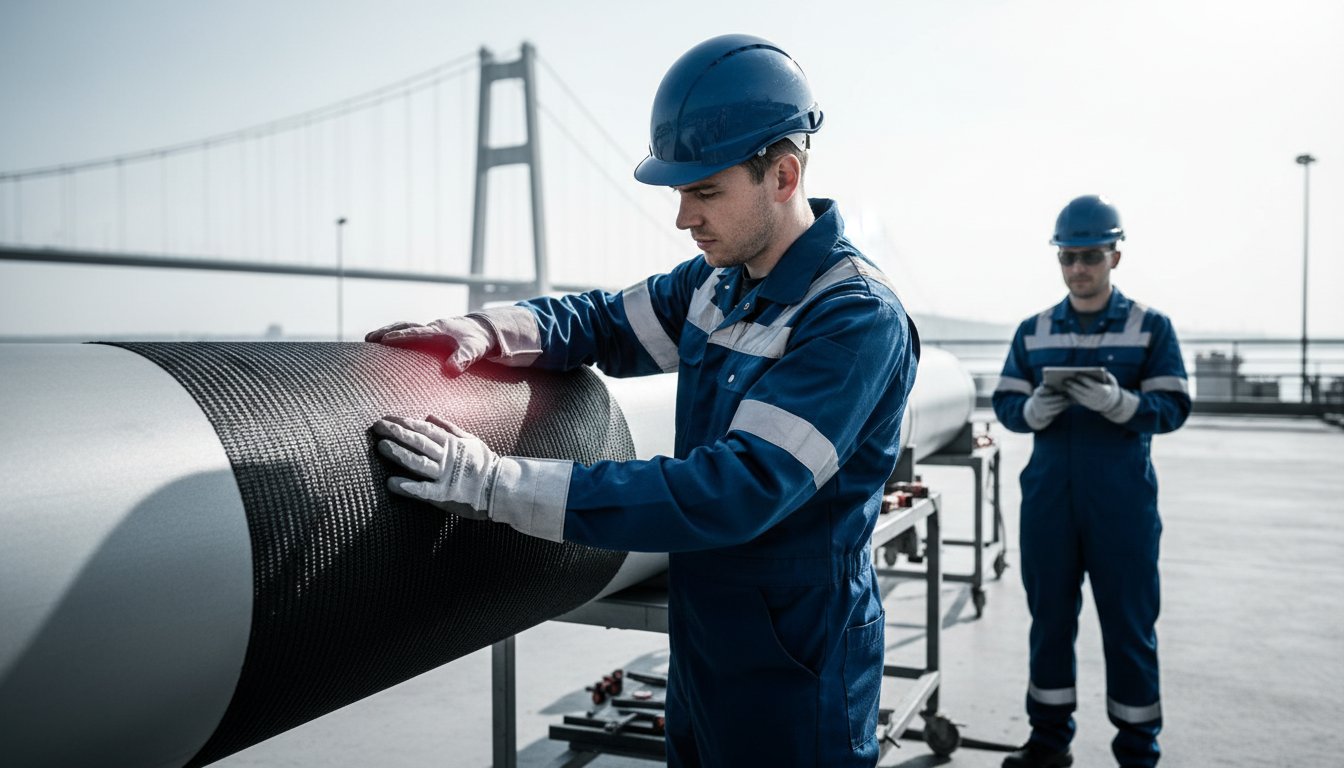
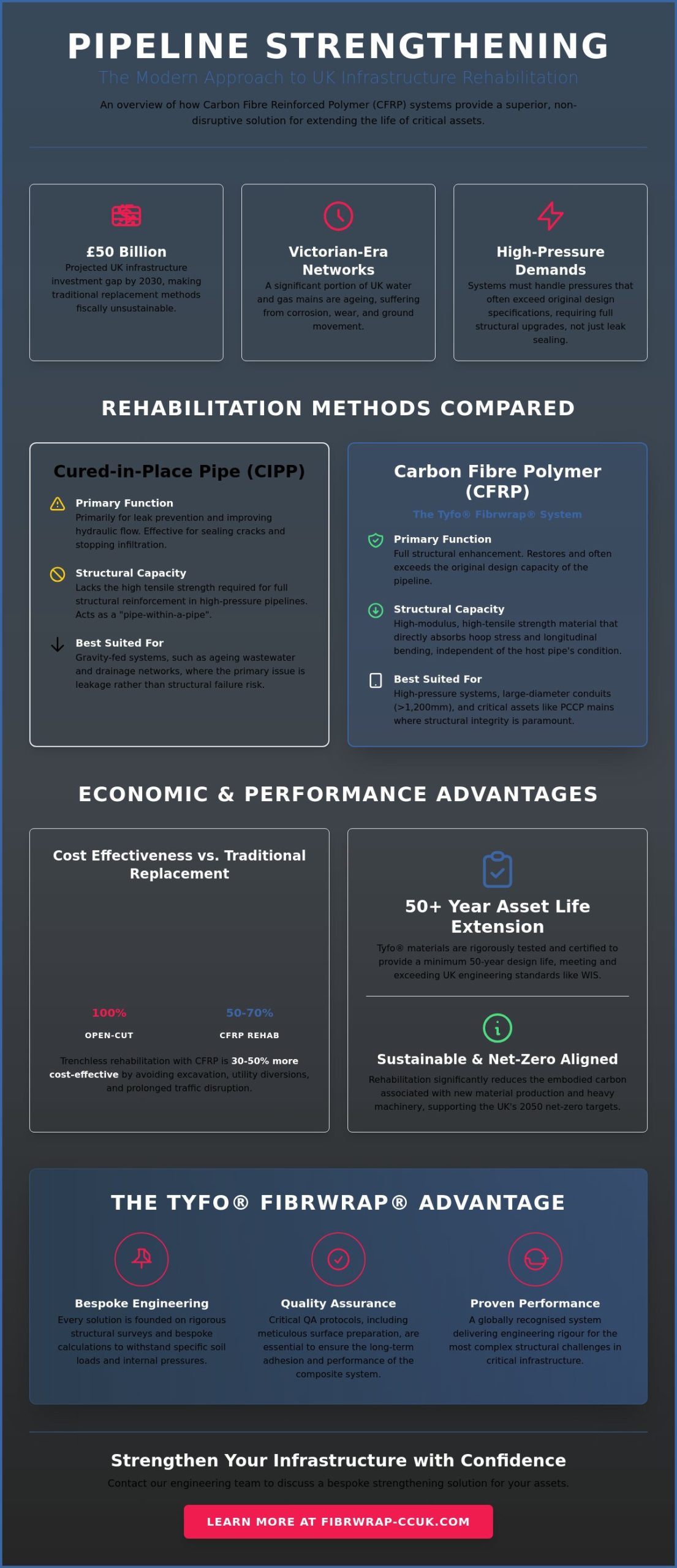
With the UK infrastructure sector facing a projected £50 billion investment gap by 2030, the traditional reliance on open-cut replacement has become an unsustainable fiscal burden. It’s widely understood amongst asset managers that the logistical complexity and societal cost of excavating critical mains in high-density urban environments often exceed the direct material costs of the pipe itself. For engineers, the challenge of pipeline strengthening is compounded by corrosion-induced wall thinning and the requirement to accommodate internal pressures that frequently surpass original design specifications.
This technical exploration details how advanced composite solutions, such as the proprietary Tyfo® system, provide a non-disruptive pathway to structural strengthening. By utilising carbon fibre reinforced polymers, the structural integrity of a failing asset can be restored to meet or exceed current UK engineering standards. Readers will gain an understanding of how these bespoke engineering applications facilitate an asset life extension of 50 years or more, effectively transforming degraded conduits into high-performance systems without the environmental or economic impact of traditional construction.
Key Takeaways
- Understand how structural enhancements facilitate asset life-extension, aligning critical UK infrastructure with national sustainability and net-zero objectives.
- Evaluate the technical distinctions between CIPP and CFRP, specifically regarding the superior tensile capacity required for comprehensive structural remediation.
- Learn how bespoke engineering calculations and structural surveys form the foundation of a robust pipeline strengthening strategy designed to withstand specific soil loads and internal pressures.
- Identify the critical quality assurance protocols for trenchless implementation, including the rigorous surface preparation essential for the long-term adhesion of composite materials.
- Discover the performance advantages of the proprietary Tyfo® Fibrwrap® system and its role in delivering engineering rigour for complex structural challenges.
Understanding Pipeline Strengthening in Modern Infrastructure
Pipeline strengthening is defined as the systematic structural enhancement of existing conduits, designed to restore or increase the capacity of a system to withstand internal hydrostatic pressures and external soil or traffic loads. Within the context of the United Kingdom’s ageing infrastructure, where a significant portion of the water and gas networks dates back to the Victorian era, asset life-extension is a critical strategy for meeting net-zero targets by 2050. By rehabilitating rather than replacing, the embodied carbon associated with new material production and heavy machinery operation is significantly reduced, aligning technical engineering goals with environmental mandates.
Primary failure modes amongst these networks include chemical corrosion, particularly in cast iron and steel pipes, mechanical wear from abrasive flows, and ground movement caused by seasonal soil shifts. Whilst traditional methods might focus on simple leak sealing, high-pressure systems require comprehensive structural rehabilitation to maintain long-term integrity. Systems like the Tyfo® system provide a bespoke solution that reinforces the pipe wall itself, ensuring the conduit can operate at its original or uprated design pressure. This approach is distinct from methods such as Cured-in-place pipe (CIPP), which, whilst effective for leak mitigation, may not always provide the full structural reinforcement required for high-pressure applications without specific composite enhancements.
The Economic Case for Structural Rehabilitation
The financial rationale for structural strengthening is rooted in the avoidance of open-cut replacement, which often involves prohibitive capital expenditure. Research indicates that trenchless pipeline repair can be 30% to 50% more cost-effective than traditional excavation, especially when considering the indirect costs of social disruption. Reducing the footprint of the worksite shortens project timelines and minimises the expense of traffic management in congested urban centres. The primary financial advantage of structural rehabilitation is the total avoidance of expensive and time-consuming utility diversions that are typically required during the installation of new pipeline routes.
Regulatory and Safety Standards for UK Pipelines
Adherence to stringent UK health and safety protocols is mandatory when performing works on live gas or water mains to ensure operative safety and supply continuity. Materials must comply with specific engineering codes, such as the Water Industry Specifications (WIS) or relevant British Standards, ensuring that composite systems are chemically compatible and structurally sound for their intended environment. Rigorous testing and certification of carbon fibre reinforced polymers are essential to guarantee a 50-year design life, providing asset managers with the empirical evidence needed for long-term reliability. Every project requires a bespoke engineering design to ensure the pipeline strengthening solution accounts for the specific site conditions and load requirements of the UK network.
Comparing Pipeline Strengthening Methods: CFRP vs CIPP
Selecting the appropriate rehabilitation strategy requires a rigorous assessment of the asset’s structural requirements versus its hydraulic function. Cured-in-Place Pipe (CIPP) is frequently utilised for leak prevention and hydraulic restoration in gravity-fed systems, particularly within the UK’s ageing wastewater networks. Whilst CIPP effectively seals cracks and prevents infiltration, it often lacks the inherent tensile strength necessary for fully structural pipeline strengthening in high-pressure environments. Carbon Fibre Reinforced Polymer (CFRP), specifically the Tyfo® system, provides a high-modulus solution that restores the structural integrity of the host pipe without relying on its remaining wall thickness.
The management of hoop stress and longitudinal bending in large-diameter pipelines, such as those exceeding 1,200mm, demands a material capable of resisting significant internal pressures. CIPP systems generally act as a “pipe-within-a-pipe” that may struggle with the transfer of loads in pressure-rated assets. In contrast, CFRP wraps are engineered to absorb these stresses directly. This distinction is critical when rehabilitating Prestressed Concrete Cylinder Pipes (PCCP) or metallic lines where corrosion has compromised the original reinforcement. The application of CFRP allows the rehabilitated section to function as a standalone structural element.
Performance Characteristics of Advanced Composites
The primary advantage of CFRP lies in its exceptional strength-to-weight ratio, which significantly exceeds that of traditional steel or concrete jackets. This allows for a minimal reduction in the internal diameter of the pipe, often less than 10mm, which preserves hydraulic capacity. Because these materials are non-metallic, they offer total immunity to the electrochemical corrosion that plagues traditional infrastructure. The thermal expansion coefficients of the Tyfo® epoxy resins are also specifically formulated to align with concrete and metallic substrates, preventing delamination during thermal cycling across the UK’s variable seasonal temperatures. The same advanced composite technology that underpins pipeline rehabilitation has also been validated for blast mitigation systems, where structural ductility and resistance to dynamic loading are equally critical performance requirements.
Operational Limitations and Selection Criteria
Bespoke engineering is essential to determine whether a lining or a structural wrap is required for a specific project. Selection criteria include the operating pressure, which can exceed 15 bar in water transmission mains, and the presence of complex geometries like elbows or tees. Resin chemistry plays a pivotal role here; high-performance epoxies provide superior chemical resistance and predictable curing times, often within 24 to 48 hours, even in damp conditions. Engineers must evaluate the specific design features of each asset to ensure the reinforcement system matches the predicted load cases over a 50-year design life. This precision ensures that the structural remediation is both permanent and cost-effective compared to full asset replacement.
The Engineering Design Phase for Pipeline Reinforcement
Before any physical intervention occurs, a rigorous structural survey establishes the empirical baseline required for effective pipeline strengthening. This phase isn’t merely a preliminary check; it’s a critical data-gathering exercise where the current state of the asset is quantified against its original design specifications. Engineers must identify the precise rate of section loss or wall thinning to ensure the subsequent rehabilitation strategy is mathematically sound. By integrating bespoke design features early in the process, the project team ensures that the structural solution addresses the specific failure modes of the individual asset.
Advanced computational tools are central to this phase. Engineers employ Finite Element Analysis (FEA) to simulate the interaction between the composite system and the host pipe. This modelling predicts how the strengthened section’ll behave under complex stress states, including thermal expansion and cyclic loading. It’s a methodical approach that replaces guesswork with simulation, allowing for the optimisation of material thickness and fibre orientation. This level of precision is vital when the pipeline must remain operational during the repair process, as it accounts for the live stresses present within the system.
Structural Calculations and Load Modelling
The determination of the required composite layers is a function of the residual strength of the host pipe and the intended design life of the repair. Engineers calculate these requirements by assessing the degree of degradation, often using a limit state design approach. This process accounts for internal operating pressures, which may include surge pressures that exceed standard limits, alongside external soil loads. In urban environments, traffic loads must be factored in, particularly where pipelines run beneath primary arterial roads. The long-term efficacy of the reinforcement relies entirely on the integrity of the bond strength between the cured composite and the prepared substrate of the original pipe. Without a high-performance bond, the pipeline strengthening system cannot effectively transfer loads away from the damaged areas.
Feasibility Studies and Asset Inspection
Asset inspection relies on sophisticated Non-Destructive Testing (NDT) to diagnose hidden structural defects that aren’t visible to the naked eye. Techniques such as ultrasonic testing or pulsed eddy current are utilised to map wall thickness across the entire affected zone. These findings dictate the selection of resin and fibre combinations. For instance, a pipeline exposed to aggressive chemical runoff requires a different resin matrix than one buried in stable, dry soil. Site conditions also influence the choice of specialised solutions like seismic retrofitting for assets located in areas prone to ground movement or subsidence. A thorough feasibility study ensures the chosen materials are compatible with the local environment, preventing premature degradation of the composite wrap and extending the asset’s service life by several decades.
Implementation and Quality Assurance in Trenchless Strengthening
The efficacy of pipeline strengthening projects is fundamentally contingent upon the precision of the installation phase, where the theoretical design is translated into a physical structural solution. Surface preparation represents the most critical determinant of long-term bond integrity. For metallic conduits, abrasive blasting to Sa 2.5 standards is typically required to achieve a surface profile between 50 and 80 microns. In concrete assets, high-pressure water jetting at pressures exceeding 10,000 psi is utilised to remove laitance and expose the aggregate. This ensures the carbon fibre reinforced polymer (CFRP) achieves a robust mechanical interlock with the substrate. Surface preparation is vital.
The application of the Tyfo® system is executed through either wet-layup or pre-preg methodologies, depending on the specific geometry and access constraints of the asset. Whilst wet-layup allows for maximum flexibility in complex junctions, pre-preg systems provide enhanced consistency in resin-to-fibre ratios. Environmental parameters, specifically ambient temperature and relative humidity, are monitored continuously. If temperatures fall below 10°C, external heat sources are deployed to facilitate the exothermic reaction necessary for the epoxy resin to reach its full glass transition temperature. Whilst laboratory results provide a baseline, they don’t replace the necessity of on-site witness testing.
Site Preparation and Substrate Management
Active groundwater infiltration or hydrostatic pressure can compromise the curing process of structural composites. Before the pipeline strengthening process commences, active leaks are arrested using chemical grouting or rapid-setting hydraulic mortars. Moisture content in concrete substrates is verified using electronic impedance meters, with a maximum threshold of 4% typically required to prevent delamination. Surface temperature must be maintained at least 3°C above the dew point throughout the application and initial cure period to prevent condensation from forming on the substrate.
Quality Control and Performance Validation
Rigorous validation protocols are essential to confirm that the installed system meets the engineered performance criteria. Witness panels are fabricated on-site using the same batch of resin and fibre as the primary installation; these are subsequently tested in laboratory conditions to verify tensile strength and modulus as per ASTM D3039 standards. Bond integrity is assessed via pull-off tests (ASTM D4541), where a minimum requirement of 1.4 MPa or substrate failure is generally expected. Post-installation inspections utilise CCTV or 3D laser scanning to identify any voids or delaminations in the lining, ensuring the asset complies with the bespoke design specifications required for its intended service life. All data is then compiled into a comprehensive quality assurance report for the asset owner.
The Tyfo® Fibrwrap® Advantage for UK Infrastructure
The Tyfo® Fibrwrap® system has established a thirty-year record of performance in the global structural remediation sector. It’s been applied to thousands of kilometres of critical assets worldwide, providing a verified alternative to traditional replacement methods. In the United Kingdom, Fibrwrap Construction UK (CCUK) holds the exclusive licence for this technology, combining global research with local engineering precision. This partnership ensures that pipeline strengthening projects are executed by a specialist team that understands the unique regulatory and environmental constraints of the UK water and energy sectors.
Why Tyfo® Fibrwrap® is the Specified Choice
The system is preferred by asset managers because its material properties exceed standard industry requirements for durability and chemical resistance. Tyfo® composites are supported by extensive long-term testing data, including 10,000-hour environmental durability studies that confirm performance in harsh conditions. Its versatility allows for the internal or external reinforcement of diverse materials such as Prestressed Concrete Cylinder Pipe (PCCP), steel, and cast iron. For a detailed technical overview of the application process, engineers should refer to this guide on Tyfo® Fibrwrap® installation.
In a recent project involving a high-pressure water main located in a densely populated urban area, the Tyfo® system enabled structural repair without the need for extensive excavation. By utilising internal carbon fibre reinforced polymer (CFRP) lining, the project team restored the pipe’s integrity whilst maintaining a 95% flow capacity. This approach mitigated the need for extensive road closures, saving an estimated £150,000 in traffic management and social disruption costs. The ability to work within tight footprints makes it an essential tool for structural trenchless pipeline repair in constrained environments.
Partnering for Asset Life-Extension
CCUK works alongside utility providers to identify and prioritise critical infrastructure at risk of failure. This collaborative model focuses on asset life-extension, where the objective is to avoid the massive capital expenditure and carbon footprint associated with full replacement. The commitment to innovation involves using bespoke resin formulations tailored to specific chemical environments or temperature fluctuations. This methodology ensures that the structural solution is as durable as the original host pipe, often exceeding its original design life.
Engineers and asset managers are encouraged to contact the specialist engineering contractor to discuss feasibility studies or bespoke design advice for upcoming rehabilitation frameworks. Early engagement allows for the development of precise structural models that ensure the long-term security of the UK’s essential utility networks.
Securing Longevity for Critical National Infrastructure
The transition towards advanced structural remediation signifies a pivotal shift in how critical water and energy assets are maintained across the United Kingdom. Whilst traditional methods often necessitate disruptive excavation, the application of carbon fibre reinforced polymers (CFRP) provides a non-invasive alternative that ensures asset life-extension without compromising hydraulic capacity. It’s essential that the engineering design phase adheres to rigorous standards to guarantee the long-term integrity of the reinforcement project. This methodical approach to structural strengthening prioritises safety and performance over short-term repairs.
As the exclusive UK licensee for the Tyfo® Fibrwrap® system, our specialist team leverages over 10 years of composite engineering experience to deliver solutions on critical national infrastructure projects. Reliability in structural performance is achieved through meticulous quality assurance and a proven track record of successful interventions in complex environments. Contact our engineering team for a bespoke pipeline strengthening consultation to discuss your specific requirements. We look forward to supporting your next infrastructure challenge with engineered precision and technical excellence.
Frequently Asked Questions
What is the primary difference between pipeline lining and pipeline strengthening?
Pipeline lining primarily addresses leak prevention and internal corrosion protection, whereas pipeline strengthening involves the application of structural composites to restore or enhance the load-bearing capacity of the host pipe. While traditional liners provide a hydraulic seal, carbon fibre reinforced polymer (CFRP) systems are engineered to resist internal hoop stress and external loads. This distinction is critical for assets suffering from structural degradation where a simple liner wouldn’t prevent a catastrophic burst.
How long does a CFRP pipeline strengthening solution typically last?
A CFRP pipeline strengthening solution typically offers a design life exceeding 50 years, as evidenced by long-term durability testing conducted in accordance with ISO 24817 and ASME PCC-2 standards. These composite systems are engineered to withstand fatigue and environmental degradation over half a century without significant loss of mechanical properties. It’s an approach that ensures long-term asset life-extension, providing a sustainable alternative to the repeated maintenance cycles required by traditional metallic repairs.
Can pipeline strengthening be performed whilst the system remains under pressure?
Pipeline strengthening can be performed whilst the system remains under pressure through the application of external composite wraps, although specific design considerations must account for the existing strain in the pipe wall. For internal repairs, the system is typically depressurised to ensure the Tyfo® system achieves full bond integrity with the substrate. External structural remediation allows for continuous operation, which is vital for critical UK infrastructure where service interruptions result in significant economic penalties.
What pipeline materials are suitable for carbon fibre reinforcement?
Carbon fibre reinforcement is suitable for a diverse range of pipeline materials including prestressed concrete cylinder pipe (PCCP), cast iron, ductile iron, and steel. The Tyfo® Fibrwrap® system is particularly effective for PCCP, where it’s been utilised since 1988 to mitigate the risk of wire snap failures. Each material requires bespoke surface preparation to ensure the composite system provides the necessary pipeline strengthening to meet current UK safety regulations and load requirements.
How much does trenchless pipeline strengthening cost compared to replacement?
Trenchless pipeline strengthening typically costs between 40% and 60% less than full asset replacement when accounting for excavation, disposal, and reinstatement expenses. According to industry data from UK water utilities, the reduction in social costs, such as traffic disruption and carbon emissions, further increases the economic viability of composite repairs. By avoiding the requirement for extensive trenching, project timelines are frequently reduced by 50% compared to traditional open-cut replacement methods.
Are composite materials resistant to chemical corrosion in industrial pipelines?
Composite materials demonstrate exceptional resistance to a broad spectrum of chemical agents, including sulphuric acid, hydrocarbons, and saline environments commonly found in industrial processing. The epoxy resins used in the Tyfo® system are specifically formulated to maintain structural integrity when exposed to pH levels ranging from 2 to 12. This chemical stability ensures that the reinforcement doesn’t suffer from the accelerated corrosion that often compromises traditional steel or concrete infrastructure in aggressive environments.
What are the main benefits of using the Tyfo® Fibrwrap® system for water mains?
The main benefits of the Tyfo® Fibrwrap® system for water mains include its high strength-to-thickness ratio and its approval for use in contact with potable water under Regulation 31 of the Water Supply (Water Quality) Regulations. Because the composite is thin, it preserves the internal diameter and hydraulic capacity of the pipe. Its lightweight nature allows for rapid installation in confined spaces, making it a preferred choice for the structural strengthening of ageing urban water networks.
How is the quality of a composite pipeline repair verified on-site?
Quality verification of a composite pipeline repair is achieved through a rigorous regime of on-site testing, including witness panel fabrication, pull-off adhesion tests, and Shore D hardness measurements. Witness panels are cured under identical conditions to the main installation and subsequently tested in a laboratory to confirm that tensile strength and modulus meet the design specifications. These empirical results ensure that every structural remediation project adheres to the highest safety standards required by UK engineering consultants.


