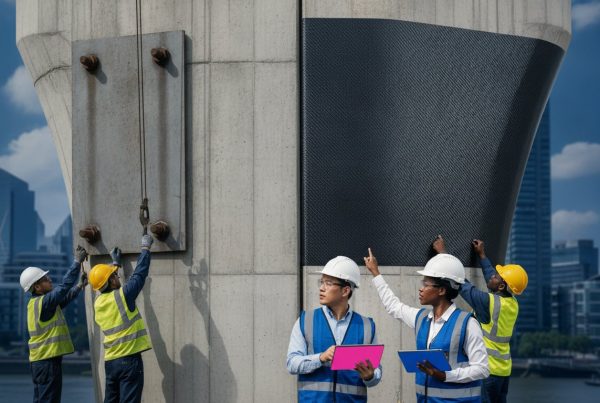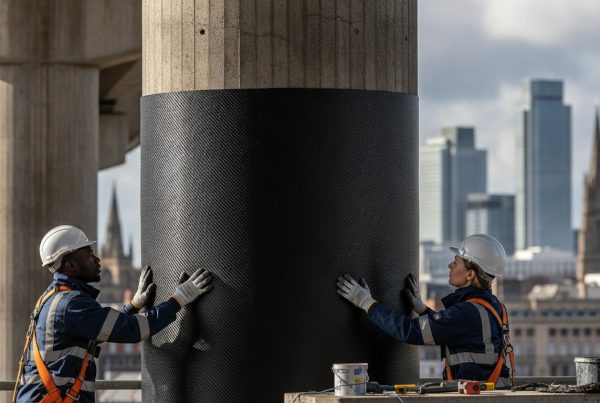

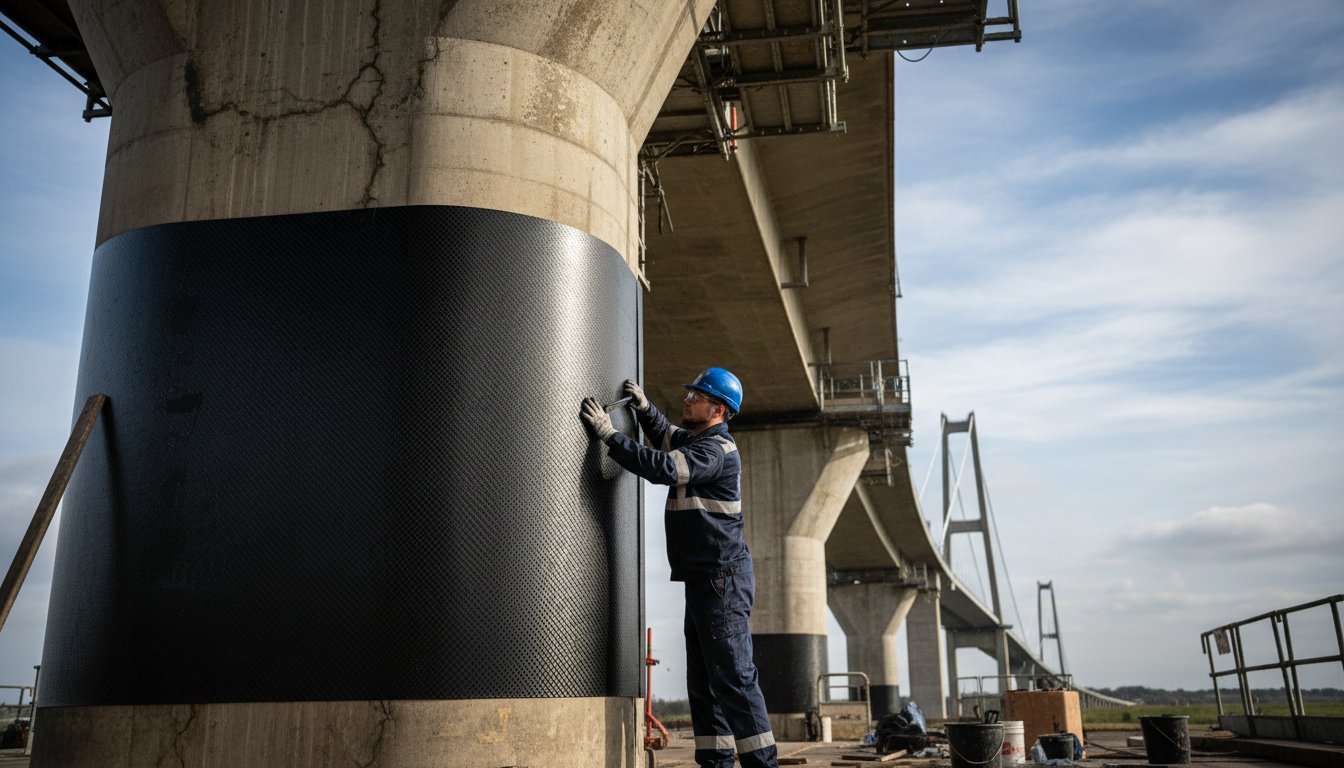
Can the structural integrity of a 50-year-old reinforced concrete bridge be restored to modern load-bearing requirements without a single day of closure or the addition of heavy steel plates? Asset managers across the UK recognise that the traditional cycle of demolition and reconstruction is increasingly unsustainable, both financially and environmentally, when faced with the accelerated carbonation of aging infrastructure. You’re likely managing assets where traditional repair methods are deemed too intrusive or simply insufficient to meet contemporary safety standards.
This guide provides a rigorous technical examination of Tyfo Fibrwrap installation, detailing how advanced carbon fibre reinforced polymers (CFRP) provide a bespoke, non-intrusive methodology for structural remediation while ensuring total adherence to CS 463 and other stringent UK safety regulations. By opting for these advanced composite materials, the necessity for costly demolition is bypassed. We’ll explore the chemical properties of the Tyfo® system, the precision required during surface preparation, and the rigorous quality assurance protocols that guarantee a 30-year design life extension for critical infrastructure.
Key Takeaways
- Appreciate the technical distinction between generic carbon fibre reinforced polymers and the proprietary Tyfo® Fibrwrap® system within the context of high-performance structural remediation.
- Analyse the critical synergy between Tyfo® S Epoxy and specific fibre architectures to ensure precise load transfer and long-term composite integrity.
- Examine the rigorous step-by-step engineering protocols required for a compliant Tyfo Fibrwrap installation, focusing on substrate preparation and the achievement of specific ICRI profiles.
- Understand the essential quality assurance frameworks and UK-specific regulatory standards, such as CS 455 and TR55, required to verify bond strength and structural performance.
- Recognise the importance of selecting specialist engineering contractors to deliver end-to-end asset life-extension through sophisticated structural strengthening methodologies.
Defining the Tyfo® Fibrwrap® System in Structural Remediation
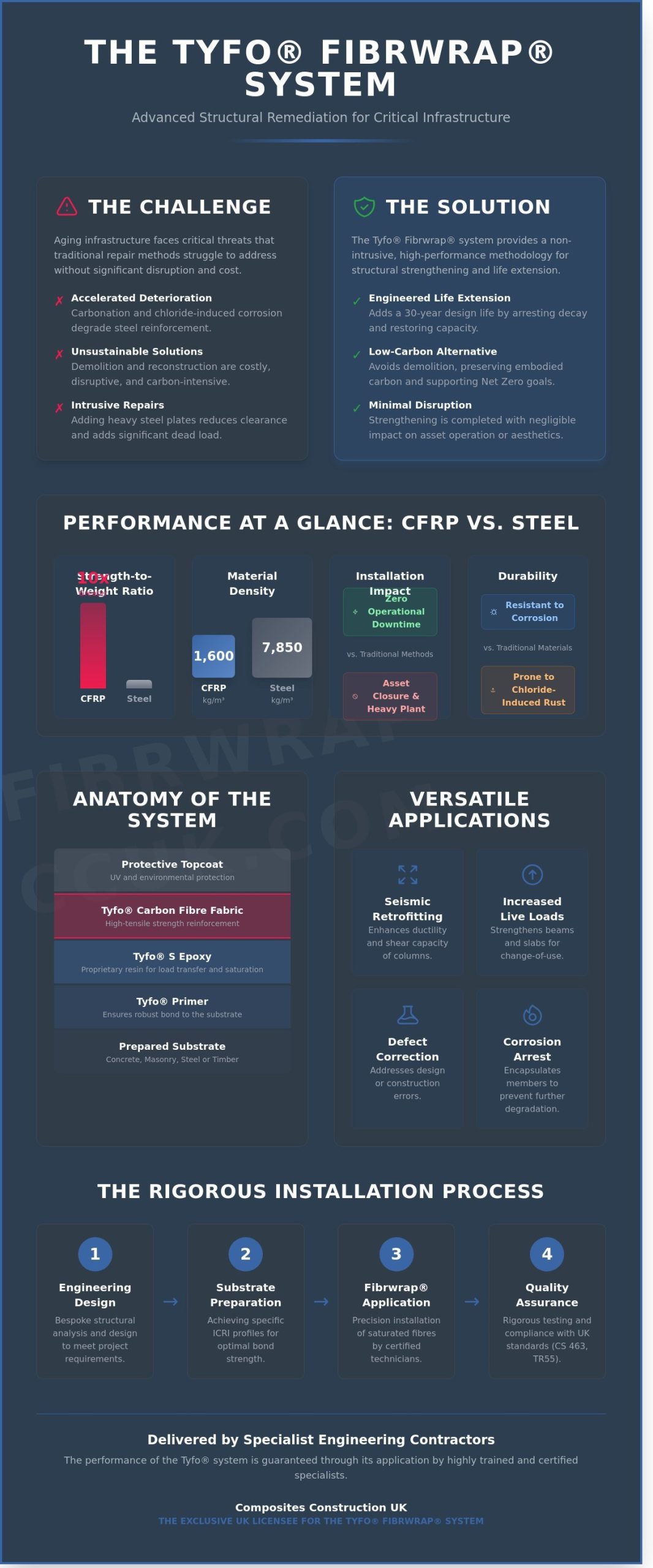
The Tyfo® Fibrwrap® system represents a sophisticated evolution in the field of structural remediation, moving beyond the capabilities of generic composite patches to provide a fully engineered solution. At its core, the system utilizes high-performance carbon, glass, or aramid fibres combined with proprietary epoxy resins to create a bespoke Fibre-Reinforced Plastic (FRP) matrix. While generic Carbon Fibre Reinforced Polymer (CFRP) products are often available on the open market, the Tyfo® system is distinguished by its rigorous empirical validation and the specific chemical compatibility of its saturants and primers. Since its initial development in 1988 for seismic applications, the system has been subjected to over 500 independent laboratory tests, ensuring that every Tyfo Fibrwrap installation adheres to strict performance criteria that exceed standard building codes.
Composites Construction UK (CCUK) operates as the exclusive UK licensee for this technology, providing a direct link between global material innovation and local engineering requirements. The system is primarily deployed to address three critical structural challenges: seismic retrofitting, the accommodation of increased live loads due to building change-of-use, and the correction of design or construction defects. By wrapping structural members such as columns, beams, or slabs in these high-tensile materials, engineers can achieve significant increases in shear, flexural, and axial capacity without the mass penalties associated with traditional methods. The precision of the Tyfo Fibrwrap installation process ensures that the composite material works in perfect unison with the underlying substrate, whether that be reinforced concrete, masonry reinforcement applications, or timber.
The Rationale for Composite Strengthening
The primary engineering justification for selecting the Tyfo® system lies in its exceptional strength-to-weight ratio, which is typically ten times greater than that of structural steel. While steel is a dense material at approximately 7,850 kg/m³, the CFRP components of the Tyfo® system weigh roughly 1,600 kg/m³, allowing for substantial strengthening with negligible impact on the dead load of the structure. This lightweight profile is essential for maintaining architectural aesthetics and structural clearances, particularly in historic UK infrastructure where space is often at a premium. From a sustainability perspective, the system provides a low-carbon alternative to demolition; by reinforcing existing assets, the embodied carbon inherent in new concrete and steel production is avoided, supporting the industry’s drive toward Net Zero targets.
Asset Life-Extension and Economic Value
Investing in the Tyfo® Fibrwrap® system offers a compelling economic case by mitigating the need for disruptive and costly full-scale demolition. The system’s inherent resistance to corrosion makes it particularly valuable in aggressive environments, such as coastal bridges or industrial facilities, where traditional steel reinforcement is prone to chloride-induced degradation. By applying a protective, high-strength layer, the rate of structural decay is arrested, and the service life of the asset is significantly prolonged. Asset life-extension is the strategic application of advanced composite materials to restore or enhance structural capacity, effectively deferring capital expenditure and ensuring the long-term operational safety of essential infrastructure. This approach allows asset managers to reallocate budgets from emergency repairs to proactive maintenance, securing the value of the built environment for decades to come.
Material Specification and the Composite Synergy
The structural efficacy of the Tyfo® Fibrwrap® system is predicated on the precise interaction between the epoxy matrix and the reinforcement fibres. This synergy creates a composite material where the whole exceeds the sum of its individual parts. Engineers must view the system not as a topical coating, but as a fundamental modification of the element’s structural capacity. The load path is redirected through the composite, requiring a deep understanding of the interlaminar shear properties and the interface bond between the polymer and the substrate. In the context of FRP Composite Strengthening of Concrete, the performance of the system is governed by the ability of the resin to distribute stresses evenly across thousands of individual filaments.
Tyfo® S Epoxy: More Than Just an Adhesive
Tyfo® S Epoxy isn’t merely a bonding agent; it’s a high-elongation, structural saturant designed to encapsulate the fibre architecture completely. Its chemical composition is formulated for low viscosity, which allows it to penetrate the concrete capillary pores, creating a mechanical interlock that’s essential for long-term durability. In the UK climate, environmental factors like humidity and temperature play a decisive role in the curing cycle. At a standard temperature of 20°C, the epoxy typically offers a pot life of 2 to 3 hours. However, British site conditions often fluctuate; if the ambient temperature drops towards 5°C, the cure rate slows significantly, requiring specific thermal management. Conversely, installers must monitor the dew point closely, ensuring the substrate temperature remains at least 3°C above the dew point to prevent moisture interference during a Tyfo Fibrwrap installation. This rigorous control ensures the ‘saturated’ state is achieved, where every fibre is fully wetted out to prevent dry spots that could lead to premature delamination under cyclic loading.
Custom Fibre Weaves for Bespoke Strengthening
Material selection is dictated by the specific deficiency identified during the structural assessment. Tyfo® SCH Carbon fibre systems are generally prioritised for flexural and shear strengthening due to their exceptional tensile strength, which can reach up to 3,790 MPa in laminate form. For projects requiring axial confinement or where ductility is the primary concern, Tyfo® SEH Glass fibre systems offer a lower modulus of elasticity that’s often more compatible with masonry or lower-strength concrete. The choice between unidirectional and multidirectional weaves allows engineers to tailor the reinforcement to the exact stress vectors of the asset. Unidirectional wraps are standard for strengthening of concrete beams, while bi-directional weaves might be specified for blast mitigation or seismic retrofitting. For those managing complex portfolios, it’s often beneficial to consult with a structural specialist to determine the optimal fibre orientation for specific load requirements.
The “wet-layup” methodology is preferred over pre-cured plates for complex structural geometries. While pre-cured systems are restricted to flat surfaces, the wet-layup process allows the Tyfo® system to conform to circular columns, flared pier heads, and irregular beam sections without the risk of air voids. This flexibility is vital for maintaining the integrity of the bond across varied surfaces. Physical properties such as the coefficient of thermal expansion must also be considered; carbon fibres have a coefficient near zero, which differs from concrete’s typical 10-12 x 10^-6/°C. The Tyfo® S Epoxy is specifically engineered to accommodate these differential movements, ensuring the Tyfo Fibrwrap installation remains robust through seasonal thermal cycles in the UK infrastructure network.
- Tensile Modulus: Carbon systems offer approximately 230 GPa, providing high stiffness for deflection control.
- Durability: The system is resistant to a wide range of chemicals, including salts and acids, making it ideal for bridge decks.
- Versatility: Suitable for use on concrete, timber, masonry, and metallic structures.
The Installation Methodology: A Step-by-Step Engineering Process
The efficacy of the Tyfo Fibrwrap installation depends entirely on the integrity of the bond between the advanced composite and the host structure. If the substrate fails to provide sufficient tensile strength, the composite system cannot achieve its design capacity. Engineers specify a minimum pull-off strength, often exceeding 1.5 MPa (218 psi), to ensure the structural strengthening project meets safety requirements. It’s a fundamental principle that the composite is only as robust as the surface to which it’s adhered; any residual laitance or contamination will compromise the entire reinforcement scheme.
Phase 1: Substrate Preparation and Repair
Mechanical preparation is mandated to remove laitance and surface contaminants. Grit blasting or high-pressure water jetting is employed to achieve a Concrete Surface Profile (CSP) of 3 to 5, as defined by ICRI 310.2R guidelines. Sharp corners represent a primary failure point for carbon fibre; therefore, all external edges are ground to a minimum radius of 20mm. This radius prevents stress concentrations that would otherwise lead to premature fibre rupture. Spalled sections are reinstated using polymer-modified mortars, and concrete repairs to cracks wider than 0.25mm are completed by injecting epoxy resins to restore monolithic integrity before the wrap’s application.
Phase 2: The Saturation and Layup Procedure
Precision in the resin-to-fibre ratio is non-negotiable for achieving the mechanical properties assumed in the design phase. On large-scale UK infrastructure projects, mechanical saturators are utilised to ensure uniform resin distribution. These machines use calibrated rollers to force the Tyfo® epoxy into the fibre matrix at a controlled rate, typically maintaining a resin-to-fibre weight ratio of 1:1 or as specified by the material data sheet. For intricate geometries or confined spaces where machinery is impractical, hand-saturation techniques are applied with rigorous oversight. The Tyfo Fibrwrap installation is completed using a wet-on-wet methodology. This approach ensures that subsequent layers bond chemically to the previous ones, creating a unified composite plate that functions as a single structural element.
Phase 3: Final Inspection and Finishing
Quality control begins immediately after the final layer is consolidated. Technicians perform visual inspections and acoustic sounding to identify any air voids or delaminations exceeding 1,300 square millimetres. The Tyfo® system is then protected from environmental degradation using a variety of specialised finishes:
- Tyfo® FC (Finish Coat): Applied to provide essential UV protection and tinted to match existing masonry.
- Fire-Resistant Coatings: Specialised intumescent layers are integrated to meet UK building regulations for fire-rating.
- Aesthetic Renderings: Textured finishes that allow the strengthening system to blend seamlessly with the historic or architectural fabric.
For reinforced concrete structures suffering from chloride ingress, the installation can be designed to accommodate galvanic anodes or other cathodic protection systems. This ensures long-term asset life-extension and structural durability in aggressive environments.
Quality Control, Testing, and Compliance with UK Standards
The structural strengthening of UK infrastructure necessitates strict adherence to rigorous regulatory frameworks. The management of bridge structures is governed by CS 455, while Concrete Society Technical Report 55 (TR55) provides the definitive design and application criteria for fibre reinforced polymers. Successful Tyfo Fibrwrap installation depends on these standards to ensure the long-term durability of the asset. Every component, from the epoxy resins to the high-strength carbon fibres, undergoes rigorous batch testing to maintain total material traceability. CCUK provides a comprehensive audit trail for every project, ensuring that the physical properties of the materials used on-site match the engineering specifications exactly. For a broader understanding of how composite reinforcement systems are evaluated against current UK compliance frameworks, the comprehensive guide to CFRP structural strengthening UK systems provides detailed analysis of standards including BS EN 1504-4:2004 and CD 371.
Compliance is not merely a bureaucratic requirement; it’s a safety imperative. The following protocols are implemented to maintain the integrity of the Tyfo® system:
- Material Traceability: Every roll of fibre and batch of resin is logged with unique identifiers.
- Standardised Application: Procedures are strictly aligned with the manufacturer’s technical data sheets.
- Certified Personnel: Only manufacturer-trained installers like CCUK are permitted to apply the system.
- Independent Verification: Third-party testing is often employed to validate the results of on-site assessments.
Verifying Bond Integrity via Pull-Off Testing
The efficacy of a composite reinforcement system is fundamentally reliant on the quality of the bond between the substrate and the laminate. In-situ pull-off testing is conducted according to ASTM D4541, which has been adapted to meet the specific demands of UK site conditions. This process involves bonding a steel dolly to the cured composite and applying a tensile load until failure occurs. A pull-off result of 1.5 MPa is considered the typical industry benchmark because it demonstrates that the bond strength of the composite exceeds the internal tensile strength of the concrete substrate. If failure occurs within the concrete itself, the bond is deemed successful, confirming that the Tyfo Fibrwrap installation is fully integrated with the host structure.
Environmental Monitoring During Installation
The UK climate presents unique challenges for the curing of advanced resins. Moisture and temperature fluctuations can significantly alter the chemical reaction of the epoxy, potentially compromising the final strength of the wrap. Engineers at CCUK monitor the ambient temperature, substrate temperature, and relative humidity at hourly intervals. A critical requirement is that the substrate temperature remains at least 3°C above the dew point to prevent latent moisture from forming on the concrete surface. All data points are recorded in a Quality Assurance Pack, which serves as a permanent record for asset owners. This methodical approach ensures that the structural remediation remains effective for the intended design life of the project.
To ensure your project meets these exacting standards, you can consult with our technical team for a detailed compliance review.
Selecting a Specialist Engineering Contractor for Tyfo® Fibrwrap®
The efficacy of a structural strengthening programme relies heavily on the technical proficiency of the delivery team. While general contractors are often adept at traditional masonry or concrete methodologies, the application of advanced Carbon Fibre Reinforced Polymer (CFRP) systems requires a specialised skillset rarely found in multi-disciplinary firms. The precision required for a Tyfo Fibrwrap installation involves managing complex chemical interactions and environmental variables that, if ignored, can lead to bond failure or insufficient load transfer. CCUK provides the necessary rigour to ensure every layer of composite material performs exactly as the structural engineer intended, adhering to strict ISO 8501-1 standards for surface preparation.
Asset managers frequently face the challenge of coordinating multiple vendors for a single remediation project. This fragmentation creates significant risks in communication and accountability. CCUK mitigates this by offering an end-to-end service that encompasses every stage of the project lifecycle. From the initial feasibility study to the final quality control check, our engineers maintain a direct line of sight on the project’s integrity. By centralising the design, supply, and installation processes, we eliminate the friction typically associated with complex infrastructure repairs in the UK’s most demanding environments.
The CCUK Approach: Design, Supply, and Install
Our methodology is built on a foundation of collaborative engineering. We work alongside structural consultants to provide bespoke engineering calculations that align with the specific requirements of the UK’s CS 462 standards. This ensures that the strengthening solution isn’t just a generic application but a tailored response to the asset’s unique stress profile. Our teams manage all aspects of site logistics, including the design of temporary works and the coordination of access in high-pressure environments like the London Underground or the industrial hubs of Hull. A critical precursor to any work is our Asset Inspection and Testing service, which identifies the root causes of structural distress before the first layer of CFRP is applied.
Securing the Future of Your Infrastructure
Choosing CCUK means partnering with the exclusive Tyfo® licensee for the United Kingdom. This status provides asset managers with access to a proprietary library of performance data and material specifications refined over three decades. Our focus remains on asset life-extension; it’s a sustainable approach that prioritises structural remediation over carbon-intensive replacement. We’ve demonstrated that a targeted Tyfo Fibrwrap installation can extend the service life of a bridge or industrial facility by an additional 30 to 50 years, often at 40% of the cost of new construction. Our commitment doesn’t end at project completion; we offer long-term monitoring and maintenance schedules to ensure the continued performance of the wrapped structures. To begin your feasibility assessment, contact our expert team at CCUK to discuss your strengthening project and secure your infrastructure’s future through proven engineering excellence.
Securing Infrastructure Longevity through Advanced Composite Engineering
The successful execution of Tyfo Fibrwrap installation protocols demands rigorous adherence to material science and British civil engineering standards. By integrating high-performance carbon fibre reinforced polymers with bespoke epoxy resins, structural assets achieve significant load-bearing enhancements and seismic resilience. This methodology prioritises asset life-extension over costly demolition, aligning with sustainability mandates established by the Carbon Trust and UK Building Regulations. Ensuring compliance with CS 462 and other structural remediation codes remains essential for the long-term security of essential infrastructure.
As the exclusive UK licensee for the Tyfo® system, Fibrwrap Construction UK provides a comprehensive service from our specialist offices in London and Hull. Our team delivers full design and installation capability, backed by over 30 years of global technical success. We’ve refined our processes to provide absolute reliability for architects and asset managers across the United Kingdom. It’s vital to partner with engineers who understand the nuances of composite synergy and regulatory compliance. You’re invited to Book a structural survey with CCUK’s expert engineering team to begin your project’s technical assessment. Let’s work together to reinforce the future of your structural assets.
Frequently Asked Questions
How long does a Tyfo® Fibrwrap® installation take to cure?
A Tyfo® Fibrwrap® installation typically achieves its initial set within 24 to 72 hours, though full design strength is formally reached after a 7-day curing period at a mean temperature of 20°C. Ambient conditions significantly influence these durations; lower temperatures extend the chemical reaction time. Engineers must verify that the specific resin system used, such as Tyfo® S, has reached the Shore D hardness specified in the project’s technical data sheet before full structural loading occurs.
Can Tyfo® Fibrwrap® be applied to wet or damp concrete surfaces?
Tyfo® Fibrwrap® can be applied to damp or submerged concrete surfaces when the Tyfo® SW-1 epoxy resin system is specified. While standard epoxy resins require a dry substrate with a moisture content below 4%, the SW-1 variant is engineered for underwater or saturated environments. This specialised resin displaces water during the saturation process, ensuring a high-strength bond is maintained even in tidal zones or high-moisture subterranean structures.
What is the expected lifespan of a Tyfo® Fibrwrap® strengthening system?
The expected service life of a Tyfo® Fibrwrap® strengthening system exceeds 50 years when installed according to manufacturer specifications and protected from UV degradation. Accelerated ageing tests conducted in accordance with ASTM D2247 standards demonstrate that the composite material maintains over 90% of its structural properties after five decades of environmental exposure. This durability facilitates long-term asset life-extension, providing a sustainable alternative to wholesale structural replacement.
How does CFRP compare to steel plate bonding in terms of cost?
Carbon fibre reinforced polymers (CFRP) often present a 20% to 30% reduction in total project expenditure compared to traditional steel plate bonding, despite higher raw material costs. This financial advantage stems from the material’s high strength-to-weight ratio, which eliminates the need for heavy lifting equipment or complex temporary works. A typical bridge project using Tyfo® Fibrwrap® installation methods requires 60% fewer man-hours than equivalent steel reinforcements, significantly reducing site overheads and possession costs.
Is Tyfo® Fibrwrap® fire-resistant?
Tyfo® Fibrwrap® systems aren’t inherently fire-resistant but achieve 2-hour to 4-hour fire ratings when integrated with Tyfo® AFP (Advanced Fire Protection) coatings. These intumescent or cementitious layers protect the epoxy matrix from reaching its glass transition temperature, which typically ranges between 60°C and 82°C. Adherence to BS EN 1363-1 standards ensures that the structural integrity of the reinforced element is maintained during a thermal event.
Do I need to close my bridge or building during the installation process?
Structural strengthening with Tyfo® Fibrwrap® rarely necessitates the complete closure of a bridge or building, as the installation process is non-intrusive and low-profile. Most projects proceed with only localised access restrictions, allowing 90% of the facility to remain operational. Because the system adds less than 5mm to the structural cross-section, there’s no requirement for the heavy plant or extensive scaffolding that typically blocks traffic or pedestrian flow.
What UK regulations govern the use of CFRP in structural strengthening?
The use of CFRP in the United Kingdom is primarily governed by the Concrete Society Technical Report 55 (TR55) and Highways England’s BD 85/04. These documents provide the requisite design codes and safety factors for the application of composites in structural remediation. Compliance with BS EN 1504 is also mandatory for products used in the protection and repair of concrete structures, ensuring all materials meet rigorous European performance criteria. For a detailed technical breakdown of how these standards apply in practice, the engineer’s guide to the strengthening of concrete beams using CFRP provides further guidance on flexural and shear enhancement methodologies. Asset managers overseeing aging brick or stone structures should also review the guidance on masonry reinforcement strategies for structural stabilisation and remediation, which addresses the specific challenges of integrating high-tensile composite materials within traditional masonry infrastructure.