
The traditional reliance on adding mass to restore structural integrity is no longer sufficient for modern infrastructure requirements where load-path efficiency and minimal downtime are paramount. As engineers seek to mitigate the risks of reinforcement corrosion and seismic vulnerability, the selection of concrete column strengthening techniques has evolved into a discipline of precision material science. You’re likely familiar with the logistical constraints of asset remediation, particularly when traditional jacketing threatens to exceed foundation capacities or disrupt critical operations for extended periods.
This guide delivers a technical review of composite and traditional interventions, demonstrating how to achieve significant life-extension while managing dead loads and environmental exposure. We’ll evaluate the efficacy of Carbon Fibre Reinforced Polymer (CFRP) and Tyfo® Fibrwrap® Systems against the benchmarks set by ACI CODE-318-25 and the EN 1994-1-1:2026 standards. By prioritising confinement and advanced material performance, it’s possible to secure the longevity of essential assets without the compromises inherent in conventional masonry or concrete reinforcement. The following analysis explores how these engineered solutions provide the optimal balance of capacity increase and long-term durability.
Key Takeaways
- Identify the primary triggers for structural intervention, including material degradation and increased live loads, which necessitate the enhancement of axial, shear, and flexural capacities.
- Evaluate the performance characteristics of traditional reinforced concrete and steel jacketing in comparison to modern concrete column strengthening techniques for varied infrastructure contexts.
- Examine the technical advantages of Carbon Fibre Reinforced Polymer (CFRP) and Tyfo® Fibrwrap® Systems, specifically their capacity for high-strength confinement with minimal impact on structural dead loads.
- Understand the critical role of a bespoke engineering consultancy phase in determining precise safety factors and ensuring the long-term integrity of the rehabilitated asset.
- Assess the strategic economic and environmental benefits of structural life-extension, prioritising sophisticated engineering interventions over the costs of total demolition and rebuild.
Structural Assessment and the Necessity of Column Strengthening
The process of column strengthening is defined as the engineered enhancement of a member’s axial, shear, and flexural capacity to meet revised performance criteria. It’s often necessitated by a range of factors, including original design deficiencies, the degradation of constituent materials, or the requirement to accommodate increased live loads resulting from occupancy changes. Within the context of ageing infrastructure, the deployment of advanced concrete column strengthening techniques is frequently driven by the deleterious effects of carbonation and chloride ingress. These chemical processes compromise the alkaline environment of the concrete, leading to the depassivation of steel reinforcement and subsequent expansive corrosion. This internal pressure eventually exceeds the tensile strength of the concrete cover, resulting in longitudinal cracking and the eventual loss of the bond between the steel and the surrounding matrix.
Beyond environmental degradation, the requirement for Seismic retrofitting techniques has become increasingly relevant for critical UK infrastructure assets. This is particularly vital for structures classified as high-consequence, where structural resilience is non-negotiable. Modern engineering standards now demand that these assets are capable of withstanding lateral forces that may not have been considered during their original design phase, ensuring that the integrity of the primary load-bearing elements is maintained during extreme events.
Identifying Signs of Structural Distress
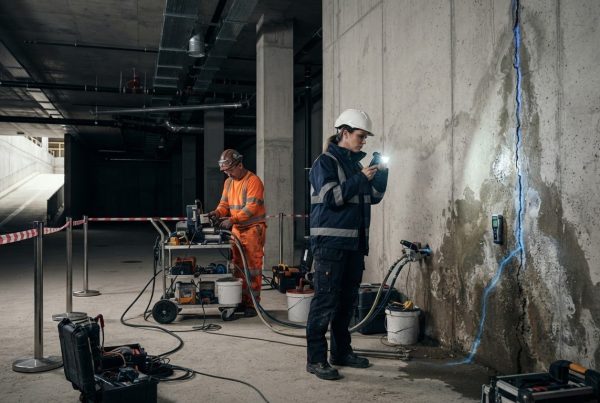
Engineers must conduct a rigorous visual and physical analysis to differentiate between superficial defects and systemic structural failure. Spalling concrete and exposed, corroded reinforcement serve as primary indicators that the internal load-carrying mechanism is compromised. The orientation of fractures provides critical data; vertical cracking often suggests axial overloading or advanced corrosion, whilst diagonal shear cracks indicate a deficiency in lateral reinforcement or an unanticipated shift in load distribution. The selection of appropriate concrete column strengthening techniques is therefore predicated on a precise understanding of the asset’s current state. To accurately quantify these risks, non-destructive testing (NDT), such as ultrasonic pulse velocity or covermeter surveys, is employed to evaluate internal homogeneity and residual strength.
Regulatory Drivers and Eurocode Compliance
The technical framework for these interventions is governed by BS EN 1992 (Eurocode 2), which dictates the standards for structural concrete design and repair within the UK. Compliance with these standards, alongside the requirements of the Building Safety Act, ensures that any remedial work maintains the necessary factor of safety. Structural life-extension is defined as the strategic application of engineering interventions designed to prolong the functional utility of a structure beyond its original design life whilst maintaining absolute safety and performance standards. For complex projects requiring validated outcomes, a comprehensive design and engineering consultancy phase is essential to ensure that the chosen solution aligns with both regulatory expectations and long-term asset management goals.
Traditional Column Strengthening: Reinforced Concrete and Steel Jacketing
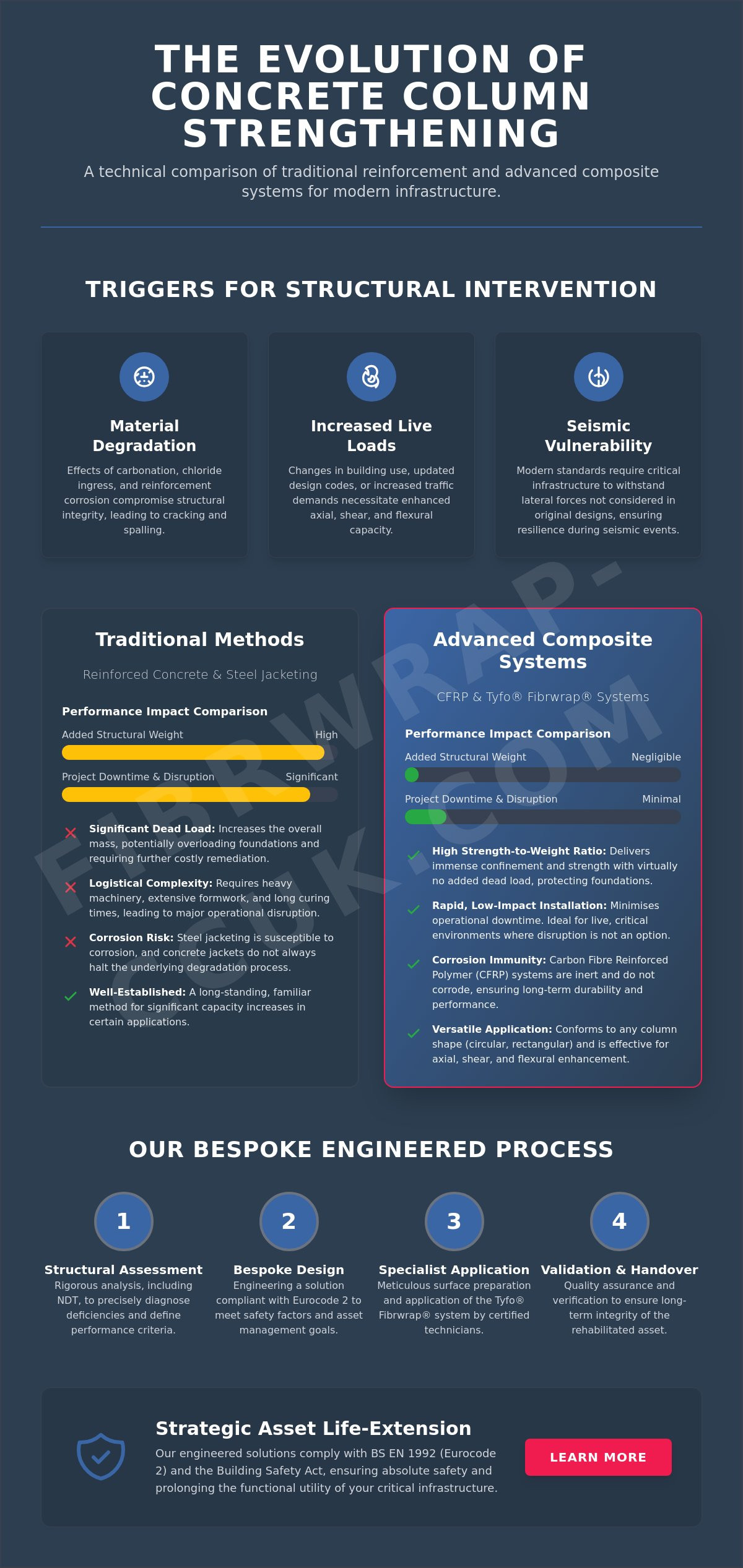
Traditional concrete column strengthening techniques have historically relied upon the principle of increasing the cross-sectional area or providing external confinement through the addition of substantial material mass. Reinforced concrete (RC) jacketing is most frequently utilised when a significant increase in axial, shear, and flexural capacity is required to accommodate revised loading protocols. The application of concrete column jacketing involves encasing the existing member in a new layer of reinforced concrete, effectively creating a composite section. However, this method introduces a considerable increase in the member’s physical footprint. This expansion often encroaches upon usable floor area, which can be a prohibitive constraint in high-density commercial or industrial facilities where every square metre of space is accounted for in operational workflows.
Reinforced Concrete Jacketing Procedures
To ensure the efficacy of RC jacketing, the achievement of a monolithic bond between the existing substrate and the new concrete layer is paramount. This is accomplished through rigorous surface preparation, typically involving mechanical roughening or hydro-demolition to expose the aggregate. New longitudinal bars and transverse ties are then meticulously positioned to form a reinforcement cage that surrounds the original column. Whilst traditional shuttering and vibration techniques remain common, the use of self-compacting concrete is often specified to ensure complete encapsulation and the elimination of voids within highly congested reinforcement zones. This methodical approach ensures that the new jacket behaves as an integral part of the structural system, providing the necessary load-path efficiency.
Steel Plate Jacketing and Confinement
Steel jacketing provides a robust alternative by utilising steel plates and angles to create a confining collar around the concrete core. This technique is particularly effective for enhancing shear capacity and improving the ductility of columns in seismic zones. The mechanics of this method rely on passive confinement; as the concrete core attempts to expand laterally under axial compression, the steel jacket restricts this movement, thereby increasing the effective compressive strength of the concrete. A high-strength, non-shrink grout is injected into the interface between the steel and the concrete to ensure uniform load transfer and to fill any irregularities. In industrial or coastal environments, external steel components must be treated with specialised coatings to mitigate the risk of atmospheric corrosion.
A primary engineering challenge associated with these traditional interventions is the significant increase in dead load. The added weight of the new concrete and steel can exceed the original design capacity of the foundations, potentially necessitating secondary remediation of the footings. This cascading effect on the structural system often leads to increased project costs and extended asset downtime. For projects where maintaining the original column dimensions and minimising weight is critical, it’s advisable to discuss tailored engineering solutions with a specialist to evaluate more efficient composite alternatives. The balance between required capacity gains and the logistical impact of traditional methods remains a central consideration in the selection of a strengthening strategy.
Advanced Composite Solutions: CFRP and Tyfo® Fibrwrap® Systems
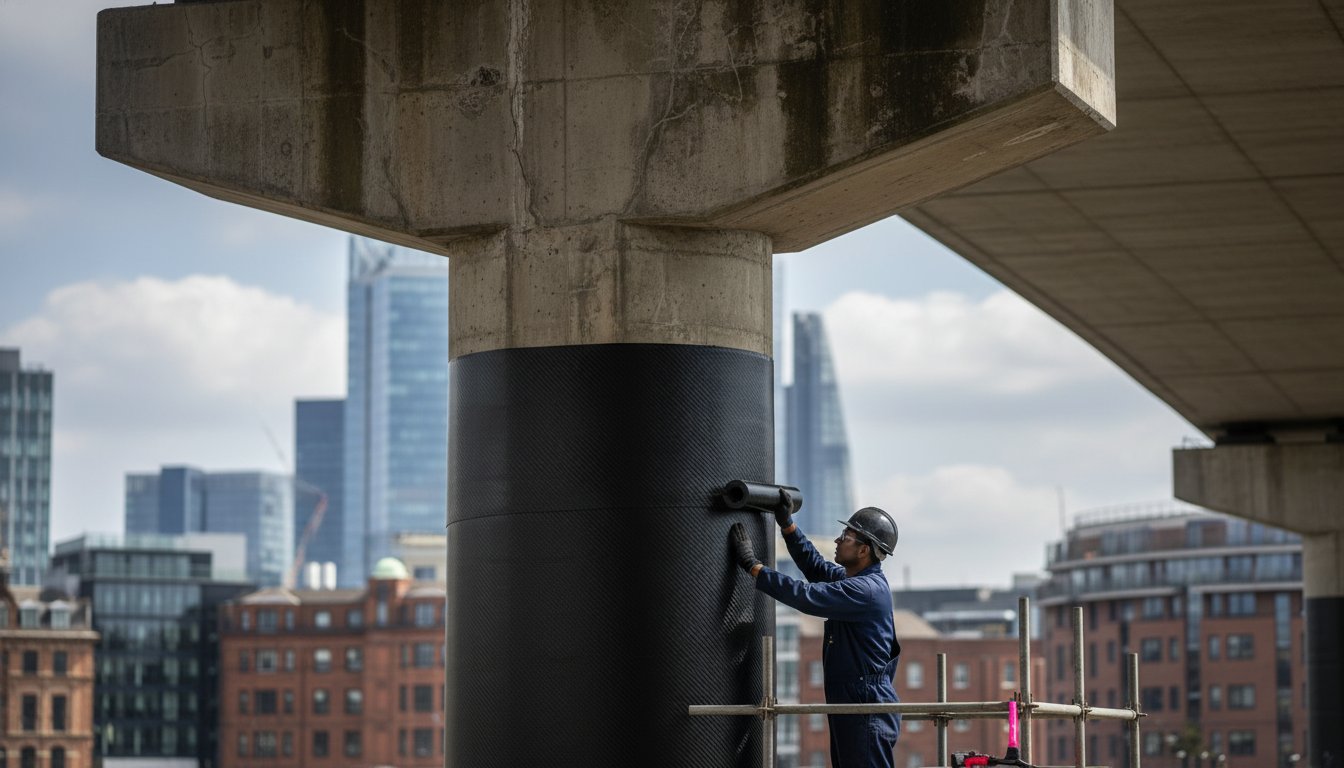
In contrast to the mass-intensive methods previously discussed, the adoption of Carbon Fibre Reinforced Polymer (CFRP) represents a paradigm shift in concrete column strengthening techniques. These advanced materials offer an exceptional strength-to-weight ratio, which allows for substantial capacity increases without the associated dead load penalties that often necessitate foundation remediation. The Tyfo® Fibrwrap® system is specifically engineered to provide high-performance confinement, utilising a range of specialised carbon, glass, and aramid fabrics integrated with proprietary resins. This system is not merely a material application but a bespoke engineering solution tailored to the specific stress profiles of the asset, ensuring that the intervention is both precise and structurally efficient.
Mechanism of Composite Confinement
The efficacy of CFRP is rooted in the induction of a triaxial stress state within the concrete core. As axial loads are applied, the concrete naturally attempts to expand laterally due to the Poisson effect; however, the high-modulus CFRP jacket restricts this expansion. By preventing the lateral expansion of concrete under load, the composite wrap maintains the internal pressure of the core, which significantly enhances the member’s ultimate compressive strength. This passive confinement mechanism is particularly effective in seismic retrofitting, as it improves the ductility of the column and prevents the premature buckling of internal longitudinal reinforcement bars. Academic investigations into advanced composite strengthening techniques have validated that these systems can restore or exceed the original design capacity of degraded columns whilst providing a superior energy dissipation profile during dynamic events.
Application Logistics and Speed of Installation
One of the most compelling advantages of composite systems over traditional jacketing is the streamlined installation process. The ‘wet-layup’ technique involves the precise saturation of fibre fabrics with high-performance epoxy resins prior to or during application to the prepared concrete substrate. This method requires significantly less heavy machinery and temporary shoring than reinforced concrete jacketing, resulting in a minimal site footprint. Consequently, CFRP is often the preferred intervention for occupied buildings, bridges, and industrial facilities where operational continuity is a priority. Beyond the logistical benefits, the chemical composition of the resins ensures that the strengthening layer is immune to the electrochemical corrosion and chloride attack that plague traditional steel-based methods. This inherent durability ensures that the intervention serves as a long-term protective barrier, effectively sealing the column against environmental ingress whilst providing the necessary structural reinforcement. For assets requiring complex multi-axial reinforcement, engaging a design and engineering consultancy ensures that the composite layup is optimised for the specific structural demands of the project.
Engineering Design Considerations for Column Reinforcement
The successful implementation of concrete column strengthening techniques is predicated on a rigorous analytical framework that extends beyond the mere selection of materials. It’s essential that a bespoke design and engineering consultancy phase is undertaken to model the revised load distributions within the structural system. This phase ensures that the enhancement of a specific column doesn’t inadvertently shift the point of failure to adjacent beams, slabs, or footings. A comprehensive load path analysis is required to verify that the entire structural assembly can sustain the increased capacities, particularly when seismic or dynamic loads are a primary concern. The determination of the required factor of safety is similarly critical, as the performance requirements for a healthcare facility or high-consequence infrastructure asset will differ significantly from those of a standard commercial warehouse.
Feasibility Studies and Material Selection
Determining the most appropriate composite system requires a detailed comparison of material properties, specifically the E-modulus and tensile strength of the selected fibres. Whilst Carbon Fibre Reinforced Polymer (CFRP) is often preferred for its exceptional stiffness and high modulus, Glass Fibre (GFRP) may be selected for its dielectric properties or lower cost in applications where extreme stiffness isn’t the primary driver. Aramid fibres offer superior impact resistance, which is vital for columns in high-traffic zones or blast-prone environments. Before any application, the integrity of the concrete substrate must be verified through pull-off testing; a minimum tensile strength, often exceeding 1.5 MPa, is non-negotiable to ensure the bond between the composite and the concrete remains intact under peak loads. This feasibility stage also involves a cost-benefit analysis, weighing the higher material costs of advanced composites against the significant reductions in labour, heavy plant requirements, and asset downtime.
Fire Protection and Finishing
A primary consideration when utilising composite concrete column strengthening techniques is the management of fire resistance. Because the epoxy resins used in CFRP systems are sensitive to high temperatures, specifically the glass transition temperature ($T_g$), the integration of fire protection is a fundamental design requirement. To achieve 2-hour or 4-hour fire ratings in accordance with UK building regulations, the strengthening system is typically encased in specialised intumescent coatings or cementitious renders. These layers act as thermal barriers, maintaining the structural integrity of the composite wrap during a fire event. For visible columns in public spaces, these protective layers can be finished with textured or colour-matched coatings to ensure the rehabilitated member integrates seamlessly with the original architectural aesthetic.
If you’re managing a complex infrastructure project that requires a validated, high-performance solution, it’s recommended that you contact our technical team to arrange a formal structural survey and design feasibility review.
Strategic Asset Management and Life-Extension via Specialist Contracting
The decision to extend the functional lifespan of an asset rather than pursuing total demolition is increasingly driven by both fiscal prudence and environmental mandate. For infrastructure owners, the economic argument for structural life-extension is compelling; it avoids the prohibitive costs of new-build construction whilst minimising the disruption to operational revenue. Risk mitigation is paramount. However, the efficacy of this approach is entirely dependent upon the systematic preparation of the existing substrate. Before any concrete column strengthening techniques are deployed, it’s essential that comprehensive concrete repairs are executed to address delamination, spalling, and reinforcement corrosion. This ensures that the strengthening system is bonded to a sound structural medium, preventing the entrapment of active degradation mechanisms beneath the new reinforcement layer.
The Role of the Specialist Engineering Contractor
Selecting a specialist engineering contractor is a critical step in mitigating the inherent risks of complex structural remediation. An end-to-end delivery model, encompassing design, material supply, and installation, provides a single point of accountability and ensures that the engineered solution is executed with precision. Quality control is maintained through rigorous site testing, including bond strength verification and material certification, to confirm that the installed system meets the design specifications. Additionally, the design of bespoke temporary works is often required during the strengthening phase to ensure the safety of the structure whilst its load-carrying capacity is being modified. This disciplined approach mirrors the rigour required in major infrastructure projects, providing asset controllers with the necessary assurance of long-term security.
Sustainability and the Circular Economy in Engineering
The preservation of existing concrete columns aligns with the principles of the circular economy by significantly reducing the carbon footprint of a project. By avoiding the demolition of structural elements, the embodied carbon within the original concrete is retained, and the substantial emissions associated with the production of new cement and clinker are avoided. Preservation is the objective. Advanced materials play a pivotal role here, as their durability ensures that the functional lifespan of the infrastructure is extended for decades with minimal maintenance requirements. Long-term asset management strategies should include periodic structural surveys and monitoring to ensure the continued performance of the strengthened members. For asset controllers seeking to optimise the longevity of their infrastructure, it’s advisable to contact our technical team for a bespoke structural survey to determine the most viable path for life-extension. Utilising advanced concrete column strengthening techniques within a strategic management framework ensures that essential assets remain safe, functional, and sustainable for future generations.
Advancing Infrastructure Resilience through Engineered Intervention
The evolution of structural remediation has moved decisively away from the addition of redundant mass towards high-performance, confinement-led solutions. By prioritising load-path efficiency and material durability, asset controllers can successfully extend the service life of critical infrastructure whilst avoiding the logistical burdens of traditional demolition. Selecting the appropriate concrete column strengthening techniques is a critical decision that impacts both the immediate project budget and the long-term viability of the asset. As the exclusive UK licensee for Tyfo® Fibrwrap® systems, Composites Construction UK provides a comprehensive design and installation service backed by over 10 years of specialist engineering expertise. Our approach ensures that every intervention is grounded in empirical data and compliant with the latest regulatory standards, including ACI 318-25 and Eurocode 2. Securing the future of your infrastructure requires a partner dedicated to technical rigour and proven results. Contact Composites Construction UK for a bespoke feasibility study on your structural strengthening project. We’re ready to help you optimise the performance and longevity of your essential structural assets.
Frequently Asked Questions
What is the most effective technique for strengthening concrete columns?
The most effective technique is determined by the specific structural deficiency being addressed, whether it’s axial, shear, or flexural in nature. Whilst reinforced concrete jacketing is superior for substantial increases in axial load capacity, Carbon Fibre Reinforced Polymer (CFRP) is generally considered the most efficient method for enhancing confinement and ductility without altering the column’s physical dimensions.
How does CFRP strengthening compare to steel jacketing in terms of cost?
In terms of initial material procurement, CFRP is typically more expensive than steel jacketing, but the total project cost often favours composites due to reduced logistical requirements. Savings are realised through the elimination of heavy lifting equipment and decreased labour hours, whilst the avoidance of asset downtime provides a significant economic advantage for operational facilities.
Can concrete columns be strengthened whilst the building is still in use?
Strengthening can be performed whilst a building remains occupied, especially when utilising advanced concrete column strengthening techniques like CFRP wrapping. Unlike traditional methods that involve heavy vibration and extensive shuttering, composite applications have a minimal site footprint and generate significantly less noise, allowing for the maintenance of business continuity during the remediation process.
How much additional load capacity can be gained from CFRP wrapping?
The gain in load capacity is highly variable and depends on the existing concrete strength and the number of composite layers applied. Engineered confinement can increase the effective compressive strength of the concrete core by 30% to 50% or more, provided the substrate is sound. However, the final capacity increase must be validated through rigorous load-path analysis to ensure structural stability.
What are the fire safety requirements for carbon fibre strengthened columns?
Fire safety requirements necessitate that the composite system is protected by a thermal barrier to prevent the resin from reaching its glass transition temperature. This is typically achieved by applying specialised intumescent coatings or cementitious renders that are rated for specific durations, such as 120 or 240 minutes, ensuring compliance with current UK building safety legislation and fire codes.
How long does a typical column strengthening project take to complete?
The duration of a project depends on the number of columns and the complexity of the design, though CFRP installations are considerably faster than traditional jacketing. Since there’s no requirement for extensive formwork or prolonged curing times for the jacket itself, a single column can often be prepared and wrapped within a few days, significantly accelerating the overall construction programme.
Is it necessary to repair the concrete before applying strengthening materials?
Repairing the substrate is an absolute prerequisite for any strengthening intervention to ensure a monolithic bond and prevent the entrapment of active corrosion. All spalled concrete must be removed and reinforcement treated or replaced, as the effectiveness of concrete column strengthening techniques relies entirely on the integrity of the interface between the existing structure and the new material.
What is the lifespan of a CFRP column strengthening system?
When correctly installed and protected from ultraviolet radiation and fire, a CFRP strengthening system has a design life exceeding 50 years. Because these materials are inherently resistant to electrochemical corrosion and chloride ingress, they provide a long-term, low-maintenance solution that effectively seals the structural member against further environmental degradation whilst maintaining its enhanced load capacity.