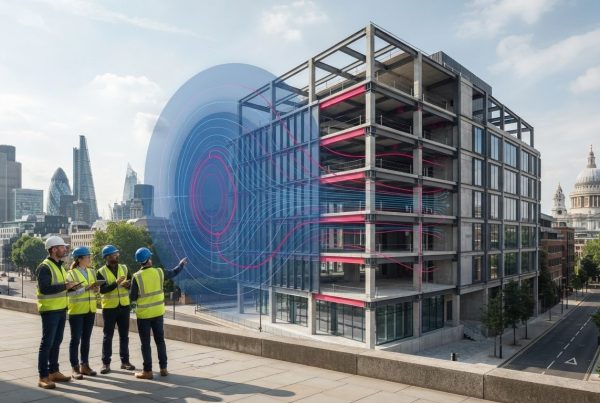

The assumption that a bowing masonry wall necessitates a total reconstruction is a costly misconception that frequently overlooks the sophisticated capabilities of modern structural engineering. For asset managers overseeing expansive industrial infrastructure, the detection of lateral movement represents a critical risk to both life safety and operational continuity; it often precipitates concerns regarding the substantial capital expenditure and disruption associated with bowing wall repair UK projects. It’s understood that the primary objective is to mitigate the risk of sudden structural failure whilst avoiding the prohibitive costs and extended timelines of traditional “knock-down and rebuild” methodologies.
This technical guide provides a rigorous framework for engineers and facility controllers, detailing the transition from basic mechanical pinning to advanced, evidence-based remediation strategies designed for structural life-extension. Readers will gain a comprehensive understanding of the diagnostic protocols required to assess structural integrity, the engineering design principles behind Carbon Fibre Reinforced Polymer (CFRP) systems, and the application of proprietary Tyfo® Fibrwrap® technology. The discussion focuses on achieving long-term stabilisation and ensuring full compliance with the updated 2026 UK Building Regulations, ultimately providing a pathway to secure the functional lifespan of essential assets with minimal operational downtime.
Key Takeaways
- Identify the underlying triggers of lateral instability in commercial masonry, focusing on how eccentricity and inadequate restraint accelerate structural degradation.
- Analyse the comparative performance of mechanical ties and advanced composite strengthening to determine the most robust solution for bowing wall repair UK infrastructure projects.
- Establish a rigorous diagnostic protocol using carbonation testing and structural surveys to inform a bespoke engineering design and load-path analysis.
- Evaluate the unique material properties of Tyfo® Fibrwrap® systems for providing seamless, corrosion-resistant reinforcement in high-stress industrial environments.
- Implement life-extension strategies that prioritise sophisticated engineering remediation over replacement to achieve sustainability targets and reduce operational disruption.
Understanding Bowing Walls in UK Infrastructure
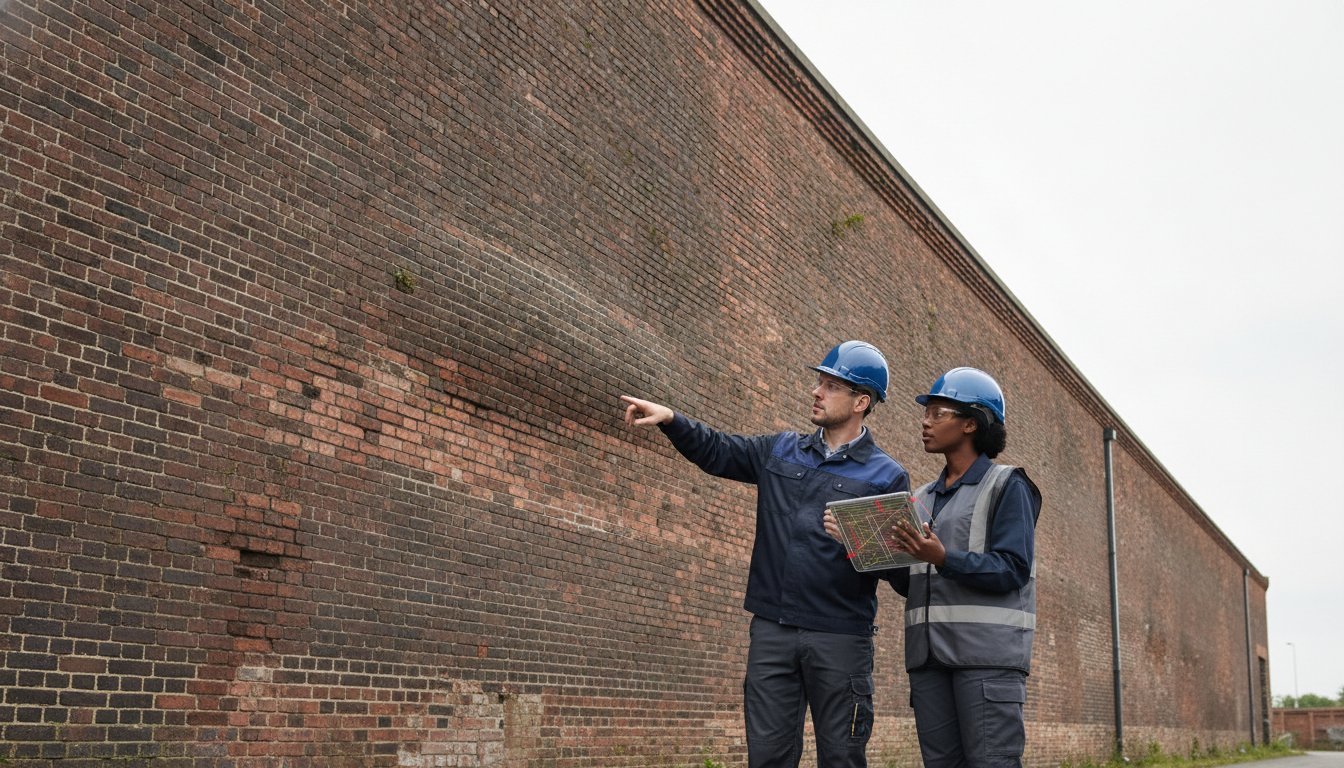
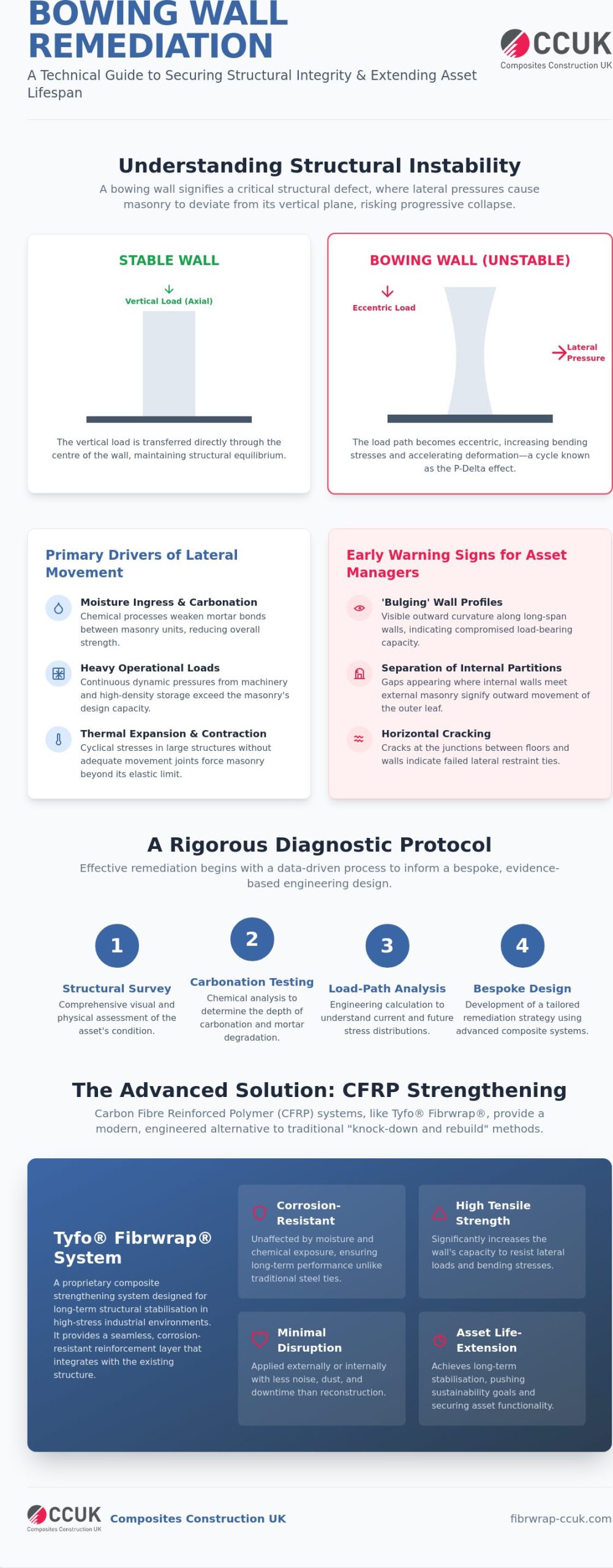
A bowing wall is defined as a significant structural defect where a masonry element deviates from its vertical plane, curving outward as a result of sustained lateral pressure or a loss of internal equilibrium. Within the context of structural repairs in the UK, this phenomenon is frequently observed in aged industrial facilities and commercial infrastructure where the original lateral restraint mechanisms have either degraded or were never designed to accommodate contemporary operational demands. Whilst residential period properties often suffer from bowing due to timber decay in floor joists, commercial assets present a far more complex challenge. These structures require high-specification bowing wall repair UK solutions that account for large-scale masonry spans and non-traditional construction materials. The distinction between a minor cosmetic crack and a critical structural issue lies in the measurement of lateral deflection relative to the wall’s height and thickness.
The fundamental principles of structural integrity and failure dictate that once a wall begins to bow, the vertical load path becomes eccentric. This eccentricity significantly increases the bending stresses within the masonry and accelerates the rate of deformation. Small bows lead to rapid failure. Without timely intervention, the capacity of the wall to support vertical loads is compromised, potentially leading to a progressive collapse of the floor or roof systems it supports.
Primary Drivers of Lateral Movement
Lateral movement in industrial environments is rarely the result of a single factor; rather, it is typically the culmination of environmental and operational stressors. Moisture ingress into the masonry matrix can lead to carbonation, which is a chemical process that reduces the alkalinity of the mortar and weakens the bond between individual masonry units. In parallel, the substantial operational loads found in manufacturing and logistics sectors, such as heavy machinery vibrations or high-density vertical storage, exert continuous dynamic pressures that traditional masonry was not intended to resist. These factors are often exacerbated by the UK’s thermal expansion and contraction cycles. These cycles induce significant stresses in large-scale buildings that lack adequate movement joints or flexible reinforcement, forcing the masonry to expand beyond its elastic limit.
Early Warning Signs for Asset Managers
Asset managers must maintain a rigorous inspection regime to identify the precursors of structural instability before they escalate into catastrophic failures. Horizontal cracking at the junctions between floors and ceilings is a primary indicator that the lateral restraint ties have failed or that the masonry is pulling away from the internal structural frame. Additionally, the observable separation of internal partitions from external masonry walls often signifies that the outer leaf is migrating outward. Visual assessments should focus on identifying ‘bulging’ profiles along long-span walls. Even a slight deviation from the vertical can indicate that the load-bearing capacity of the structure is being compromised by eccentricity. Proactive monitoring ensures that remediation can be designed and implemented before the safety of the asset is jeopardised.
The Mechanics of Lateral Instability and Structural Failure
The structural efficacy of a masonry wall is fundamentally dependent on its ability to maintain vertical alignment under axial compression. In commercial and industrial engineering, the slenderness ratio, defined as the ratio of effective height to effective thickness, dictates the wall’s resistance to buckling. When lateral instability occurs, the wall enters a state of eccentricity. This means the vertical load is no longer applied through the centre of the masonry’s cross-section. This shift initiates a feedback loop where the resulting bending moment increases the lateral deflection, which in turn increases the eccentricity. This P-Delta effect can lead to a rapid acceleration toward failure, even if the initial bow appears marginal to the untrained eye.
The stability of large-scale masonry is often predicated on floor diaphragm action, where floor and roof systems act as rigid horizontal plates that distribute lateral forces to the vertical elements. If the connection between these diaphragms and the masonry is inadequate, the wall becomes an unrestrained vertical cantilever. Under the Building Safety Act 2022, asset managers are under increased scrutiny to ensure that these load paths remain robust. Failure to address these mechanics in bowing wall repair UK schemes can result in legal non-compliance and elevated risk profiles for the entire facility.
Tensile Stress and Masonry Vulnerability
Masonry is an anisotropic material with high compressive strength but negligible tensile capacity. Lateral bowing introduces significant tensile stresses on the convex face of the wall. Once these stresses exceed the bond strength of the mortar, horizontal cracking develops. This cracking further reduces the effective thickness of the wall, exacerbating the slenderness issue. Engineers must calculate the precise degree of deflection to determine whether the masonry can be stabilised or if the tensile stresses have reached a critical threshold requiring advanced bespoke structural design features to restore equilibrium.
Vibration and Dynamic Loading Factors
Industrial assets face unique challenges from dynamic loading that are rarely present in residential settings. High-frequency vibrations from heavy machinery or the constant movement of heavy goods vehicles can induce resonance within a compromised wall. This energy transfer accelerates the degradation of the masonry bonds and can lead to the “walking” of floor joists out of their pockets. The cumulative effect of these environmental factors, combined with the risk of progressive collapse in multi-storey structures, necessitates a methodical approach to remediation. A comprehensive structural survey is often the first step in quantifying these dynamic risks before designing a permanent stabilisation solution.
Comparing Remediation Techniques: Mechanical Ties vs. Composite Strengthening
Selecting a methodology for bowing wall repair UK assets requires a nuanced understanding of both the structural substrate and the intended operational lifespan of the facility. Traditional masonry reinforcement typically relies on mechanical interventions designed to re-establish the connection between the external leaf and the internal floor diaphragm. Whilst these methods remain valid for moderate lateral movement, they often prove insufficient for severely degraded industrial masonry or structures subject to high dynamic loads. Choosing to repair rather than replace isn’t just an economic decision; it’s a sustainability imperative. Retaining the existing masonry significantly reduces the embodied carbon impact by avoiding the demolition and waste disposal cycles associated with partial reconstruction.
Traditional Mechanical Restraints
Mechanical solutions such as lateral restraint straps and helical bars function by transferring lateral loads into the building’s internal structural members. In older industrial buildings, external pattress plates were frequently used to provide a visible anchor point, distributing the load across a wider surface area of the masonry. However, these plates carry significant aesthetic implications and can create localised stress concentrations that lead to further cracking if the substrate is brittle. Durability is another critical concern. Traditional steel reinforcements are susceptible to corrosion, especially in environments where moisture ingress has already compromised the mortar. This oxidation can cause the metal to expand, paradoxically inducing more pressure within the wall it was intended to stabilise; this often results in the very “spalling” that engineers aim to prevent.
Advanced Composite Strengthening (CFRP)
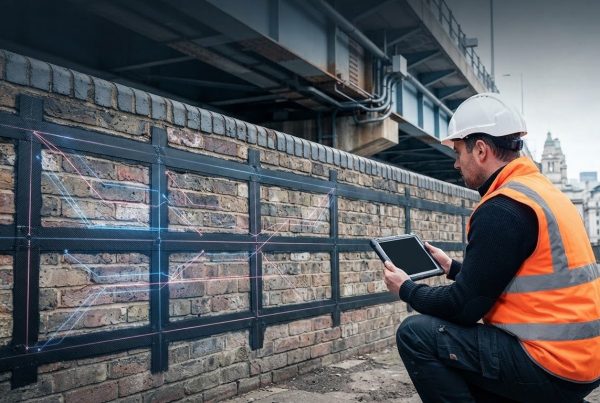
Carbon Fibre Reinforced Polymer (CFRP) strengthening represents a significant advancement in structural remediation, offering a high strength-to-weight ratio that exceeds traditional steel. Unlike mechanical ties that provide point-load restraint, CFRP is applied as a continuous, low-profile reinforcement layer. It effectively creates a ‘second skin’ that is bonded to the masonry surface with high-performance resins. This system is specifically engineered to absorb lateral tensile forces across the entire plane of the wall, preventing the development of horizontal cracking described in previous sections. The installation process is largely non-invasive. It requires no heavy excavation or extensive mechanical fixings, which is essential for preserving the architectural integrity of high-value assets. This method ensures that the structural life-extension is achieved with minimal impact on the building’s footprint or operational capacity, providing a robust alternative to intrusive mechanical pinning. For projects requiring a high level of aesthetic sensitivity, firms such as Finish Touch Enterprises exemplify how integrated architectural design and construction can maintain a building’s original character during essential structural works.
The Design and Implementation Process for Wall Stabilisation
The successful execution of a bowing wall repair UK programme is predicated on a methodical, five-stage engineering workflow. This process ensures that the selected intervention is not merely a reactive measure but a mathematically validated solution tailored to the specific environmental and structural conditions of the asset. Remediation begins with a forensic assessment of the masonry health, followed by a rigorous design phase that aligns with current UK structural standards. The implementation phase demands high levels of technical precision, as the performance of advanced composite systems is heavily dependent on the quality of surface preparation and the integrity of the bond between the substrate and the reinforcement material.
The Importance of Structural Surveys
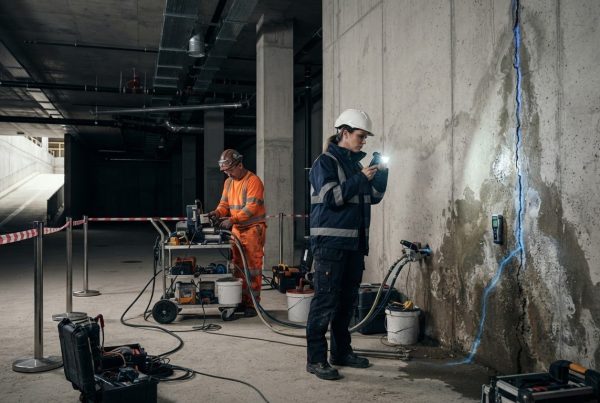
A comprehensive structural survey is the prerequisite for any engineering intervention. This phase involves the use of non-destructive testing (NDT) to map internal voids, cracks, and the presence of embedded metallic elements that may be subject to corrosion. Pull-off tests are conducted to determine the substrate’s bonding capacity, ensuring that the masonry surface possesses the requisite tensile strength to support a Carbon Fibre Reinforced Polymer (CFRP) system. Carbonation testing is also utilised to assess the depth of chemical degradation within the mortar, which informs the surface preparation requirements. For multi-million pound infrastructure assets, a comprehensive feasibility study serves as the critical mechanism for aligning structural remediation requirements with long-term capital expenditure planning.
Engineering Design and Compliance
Following the survey, a detailed engineering design is developed to establish a robust load-path analysis. This phase incorporates bespoke structural design features that account for the eccentricity of the bowing wall and the anticipated lateral loads. Calculations are performed in accordance with Concrete Society Technical Report 55 (TR55) and the 2026 amendments to the Building Regulations to determine the precise number of CFRP layers required. The design must ensure that the repair system integrates seamlessly with the existing building fabric, maintaining the necessary flexibility to accommodate thermal movement whilst providing the requisite stiffness to arrest further lateral deflection.
Once the design is finalised, implementation proceeds through three critical stages. First, surface preparation is carried out using abrasive techniques to remove contaminants and expose a sound masonry profile; this is essential for the adhesion of composite systems. Second, specialist contractors perform the precision installation of the reinforcement, ensuring that the resins are applied under controlled conditions to maintain system integrity. Finally, the strengthening is validated through a quality assurance programme, which includes bond testing and visual inspections to confirm that the design specifications have been met. To discuss the technical requirements of your specific infrastructure project, you should contact our specialist engineering team for a detailed consultation.
Advanced Life-Extension: CFRP and Tyfo® Fibrwrap® Systems
The deployment of Carbon Fibre Reinforced Polymer (CFRP) systems represents the pinnacle of contemporary structural remediation, particularly when addressing the complex requirements of bowing wall repair UK infrastructure. Amongst the most robust solutions available is the Tyfo® Fibrwrap® system, a proprietary composite technology specifically engineered to provide high-performance strengthening for masonry and concrete elements. This system offers a seamless reinforcement layer that is inherently resistant to corrosion, addressing the primary durability failures associated with traditional steel-based methods discussed in previous sections. By utilising these advanced materials, the functional lifespan of critical assets can be extended significantly, ensuring long-term security for facility owners and technical controllers whilst avoiding the catastrophic costs of full-scale demolition.
The Tyfo® Fibrwrap® Advantage
The Tyfo® Fibrwrap® system possesses an unparalleled tensile strength that far exceeds the capacity of traditional steel plates or mechanical ties. This allows for a significant reduction in the volume of material required to achieve necessary stabilisation, resulting in a low-profile finish that doesn’t alter the structural footprint or architectural aesthetics. A primary benefit for asset managers is the speed of application. The lightweight nature of the composite materials allows for rapid installation, which dramatically reduces site time and minimises operational disruption. This versatility extends beyond masonry stabilisation to include concrete repair and industrial pipeline rehabilitation, providing a unified engineering solution for multi-asset facilities across the UK.
Future-Proofing Assets with Composites
The application of advanced composites is a highly technical process that necessitates the involvement of a specialist engineering contractor. Unlike general construction work, the installation of Tyfo® Fibrwrap® requires precise environmental controls and rigorous quality assurance protocols to ensure the chemical bond between the resin and the substrate is optimised. Failure to adhere to these specialist requirements can compromise the entire strengthening system, leading to premature degradation and the return of structural instability.
Investing in advanced material science provides a superior long-term ROI compared to traditional rebuilding. Whilst the initial engineering design is complex, the resulting stabilisation requires minimal ongoing maintenance, typically limited to periodic visual inspections as part of a standard asset management regime. This focus on “repair over replacement” aligns with broader sustainability goals by preserving the embodied carbon of the original structure and extending its utility into the next decade. For those managing complex infrastructure portfolios, it’s recommended to contact our engineering team for a technical consultation to evaluate the suitability of composite systems for your specific structural challenges.
Securing Long-Term Infrastructure Stability through Composite Engineering
The effective remediation of lateral instability in masonry assets requires a strategic transition from rudimentary mechanical pinning to the high-performance capabilities of Carbon Fibre Reinforced Polymer. By prioritising forensic diagnostics and bespoke load-path analysis, asset managers ensure that bowing wall repair UK projects meet the stringent safety requirements of the 2026 Building Regulations whilst significantly extending the functional lifespan of the structure. It’s clear that the integration of proprietary systems like Tyfo® Fibrwrap® provides a level of tensile reinforcement that traditional steel-based methods cannot replicate, particularly in high-stress industrial environments where vibration and dynamic loading are prevalent.
As the exclusive UK licensee for Tyfo® Fibrwrap® systems, CCUK offers a specialist design and installation team with proven national expertise across the UK’s commercial and industrial infrastructure. This disciplined, engineering-led approach ensures that structural life-extension is achieved with maximum precision and minimal operational downtime. It’s possible to secure the future of your essential assets through the application of sophisticated material science and rigorous engineering standards. Request a Technical Site Survey from CCUK’s Engineering Team to initiate a definitive stabilisation strategy for your facility.
Frequently Asked Questions
What is the primary cause of a bowing wall in a commercial building?
The primary cause is typically a loss of lateral restraint between the masonry leaf and the internal structural frame, which is often exacerbated by eccentric vertical loading. In industrial environments, this instability is frequently triggered by sustained vibrations from heavy machinery or significant thermal expansion cycles that exceed the masonry’s elastic limit. These factors induce lateral pressures that the original building ties were not engineered to resist.
Can a bowing wall be repaired without using external pattress plates?
Yes, modern engineering solutions such as Carbon Fibre Reinforced Polymer (CFRP) allow for structural stabilisation without the need for unsightly external pattress plates. By bonding a high-tensile composite skin directly to the masonry surface, the lateral forces are distributed across the entire wall plane rather than at specific anchor points. This methodology provides a low-profile alternative to traditional mechanical anchors whilst maintaining the architectural integrity of the building facade.
Is carbon fibre (CFRP) suitable for repairing heritage masonry walls?
CFRP is highly suitable for heritage assets because it offers a non-invasive and low-profile reinforcement method that preserves the original masonry fabric. Unlike intrusive mechanical pinning, composite systems like Tyfo® Fibrwrap® require minimal substrate removal and can be finished to blend with existing materials. This approach is often preferred by conservation officers for bowing wall repair UK projects where traditional steel reinforcements would be too visually or physically disruptive.
For property owners in West London looking to integrate such advanced techniques into a wider refurbishment project, you can learn more about Horns Construction and their high-quality building services.
How long does a typical structural stabilisation project take to complete?
The duration of a stabilisation project is contingent upon the scale of the deflection and the total surface area requiring reinforcement. However, composite applications are generally significantly faster than traditional masonry reconstruction or heavy steel installation. Most commercial interventions can be completed within a few weeks, with the rapid curing times of high-performance resins allowing for a faster return to full operational capacity.
What is the difference between a lateral restraint tie and CFRP strengthening?
A lateral restraint tie is a mechanical fixing that creates a point-load connection between the wall and a floor joist, whereas CFRP strengthening provides a continuous reinforcement layer across the masonry surface. Whilst ties are effective for minor movement, CFRP absorbs tensile stresses across a wider area, preventing the localised cracking often associated with mechanical anchors. This makes composites superior for high-load industrial applications where the masonry substrate is severely degraded.
Does a bowing wall always mean the building is unsafe?
A bowing wall indicates a compromise in structural equilibrium, but it doesn’t always signify an imminent collapse. The level of risk depends on the degree of eccentricity and the rate of movement; however, even a minor bow creates a P-Delta effect that accelerates the potential for failure. Professional assessment is vital to determine if the safety factor has fallen below the thresholds required by the Building Safety Act 2022.
How much does bowing wall repair cost for a commercial asset?
The capital expenditure for commercial remediation varies significantly based on the structural survey findings, the required material thickness, and the complexity of the access requirements. Because every industrial asset presents unique engineering challenges, costs are calculated following a detailed load-path analysis and design phase. Investing in advanced composite repair is typically more cost-effective than total reconstruction, particularly when considering the reduction in operational downtime and the avoidance of demolition waste.
What professional qualifications should a structural repair contractor hold?
Contractors should possess specialist engineering certifications and, for proprietary systems, must be authorised licensees, such as an exclusive Tyfo® Fibrwrap® licensee. It’s essential that the firm employs qualified structural engineers who can provide validated design calculations in accordance with Concrete Society Technical Report 55. Membership in relevant industry bodies and a documented history of successful infrastructure projects are also critical indicators of technical competence and safety compliance.