
With the UK infrastructure sector projected to grow by up to 3.9% in 2026 whilst private housing contracts, the strategic focus for asset managers has shifted decisively towards the resilience and remediation of existing concrete inventories. It’s widely understood that the financial and environmental costs of total asset replacement are often prohibitive, particularly as the Building Safety Regulator now enforces rigorous standards for higher-risk buildings. Engaging a specialist engineering contractor is no longer merely an operational choice but a structural necessity for ensuring that ageing infrastructure meets modern safety benchmarks without the requirement for extensive demolition.
You’ll discover how the integration of advanced carbon fibre reinforced polymers and bespoke engineering design can facilitate significant life-extension for critical structures. We’ll explore the technical application of the Tyfo® Fibrwrap® system and examine how these sophisticated materials are utilised to enhance structural strengthening whilst ensuring full compliance with BS EN 1504. This overview provides a methodical look at the engineering methodologies used to achieve certainty of delivery and minimal site disruption during complex remediation projects.
Key Takeaways
- Understand the critical distinction between general civil engineering and the technical precision required for complex structural remediation and the preservation of ageing infrastructure.
- Explore the mechanical properties of advanced composites, specifically the Tyfo® Fibrwrap® system, and their role in providing high-strength structural strengthening.
- Identify the essential technical credentials and in-house design capabilities required when selecting a specialist engineering contractor for high-risk infrastructure projects.
- Evaluate the economic and environmental ROI of asset life-extension, prioritising the retention of existing structural mass over carbon-intensive demolition and rebuild.
- Discover how bespoke engineering designs ensure rigorous compliance with UK safety standards whilst significantly reducing operational downtime during remediation works.
What Defines a Specialist Engineering Contractor?
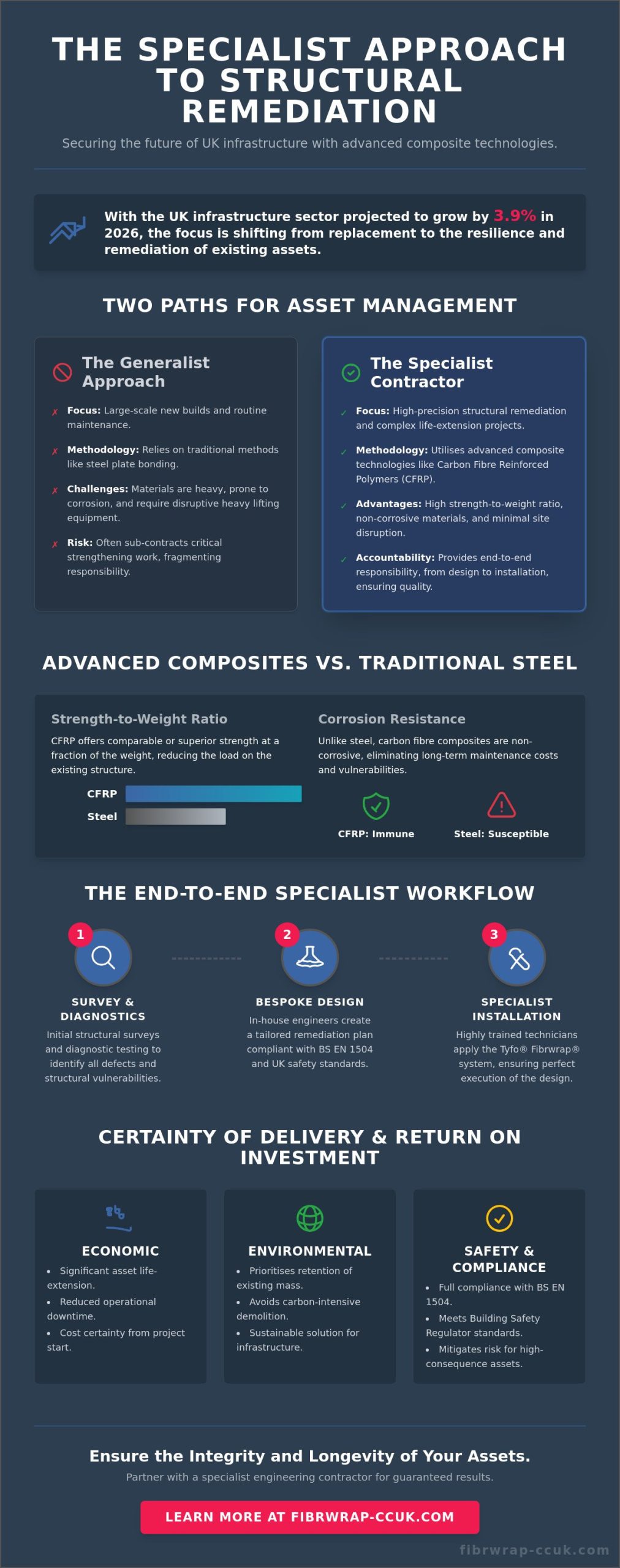
A specialist engineering contractor is defined by the provision of niche technical expertise, proprietary material systems, and bespoke design capabilities tailored to address complex structural challenges. Whilst general civil engineering firms typically focus on large-scale new builds or routine maintenance, the specialist operates within the high-precision field of structural remediation. This role involves a comprehensive understanding of material degradation, load-path analysis, and the application of advanced technologies to restore or enhance the integrity of existing assets. For critical infrastructure, where the margin for error is non-existent, the specialist approach is essential for maintaining regulatory compliance and public safety. This expertise is delivered through a model of end-to-end responsibility. It begins with initial structural surveys and testing, moves through bespoke engineering design, and concludes with the final installation. Such a unified workflow ensures that the technical intent of the design is perfectly executed on-site.
Complexity and Risk Mitigation
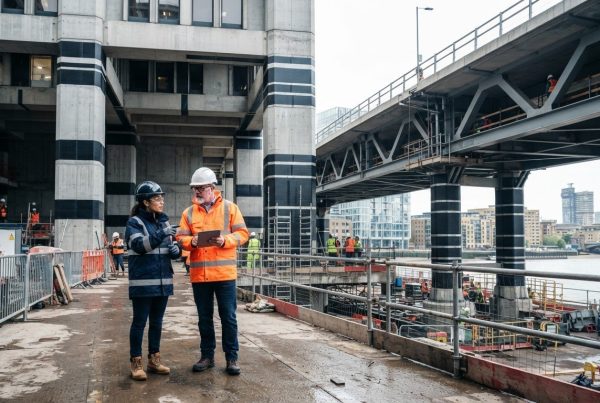
Managing risk in high-consequence environments requires more than just standard construction protocols. It demands early contractor involvement to identify unforeseen structural defects through rigorous diagnostic testing before they escalate into catastrophic failures. By integrating specialist design at the earliest stages, a specialist engineering contractor provides asset managers with cost certainty and a clear roadmap for remediation. This methodical approach ensures that structural vulnerabilities are addressed with empirical precision, mitigating the risks associated with operational downtime or regulatory intervention. In environments like power stations or rail networks, the ability to predict and manage these complexities is the difference between a successful life-extension and a failed asset.
The Specialist Scope of Work
The specialist scope of work encompasses disciplines such as carbon fibre reinforced polymer (CFRP) strengthening, concrete repair, and seismic retrofitting. These tasks require highly trained technicians and specialised plant that generalist firms rarely maintain in-house. Because of the technical complexity involved in applying Advanced Composite Technologies, general contractors often sub-contract these critical path elements to experts who can guarantee the performance of the proprietary systems used. This is particularly relevant when installing the Tyfo® system, where the synergy between the high-strength fibres and specialised resins must be perfect to achieve the desired life-extension. It’s a level of specialisation that demands specific certifications and a deep history of project success in diverse, challenging environments.
Advanced Composite Technologies: The Core of Specialist Strengthening
The evolution of structural remediation is intrinsically linked to the development of Carbon Fibre Reinforced Polymers (CFRP). Unlike traditional materials, these composites offer a high strength-to-weight ratio that allows for significant load-capacity increases without adding substantial dead weight to the structure. This is particularly advantageous in the context of Advanced Composite Technologies, where empirical research confirms the efficacy of fibre-reinforced polymers in arresting crack propagation and enhancing seismic resilience. For a specialist engineering contractor, the selection of these materials isn’t merely a matter of convenience; it’s a calculated engineering decision based on the specific tensile requirements of the asset.
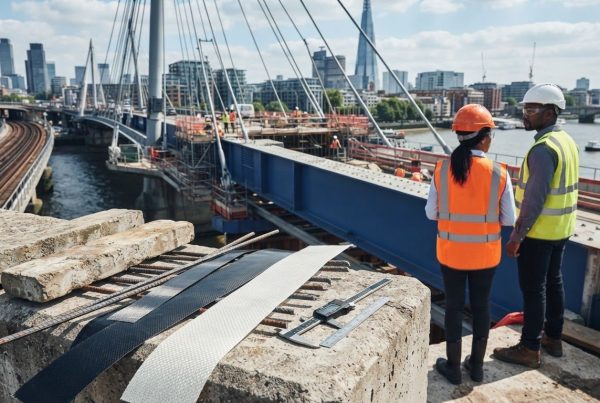
Historically, structural strengthening relied heavily on steel plate bonding. Whilst effective, steel introduces several logistical and long-term maintenance challenges, including susceptibility to corrosion and the requirement for heavy lifting equipment during installation. Advanced composite wrapping, by contrast, utilises non-corrosive carbon or glass fibres saturated in a specialised epoxy resin. This creates a monolithic bond with the existing concrete or masonry. The resulting reinforcement is thin, typically only a few millimetres thick, yet it possesses a tensile strength significantly exceeding that of structural steel. This lightweight profile is essential when working in restricted access environments or on structures where additional weight would compromise the foundation’s integrity. For asset managers overseeing mixed-material inventories, understanding the full range of masonry reinforcement techniques UK professionals now apply alongside CFRP systems is increasingly important for comprehensive remediation planning.
The Tyfo® Fibrwrap® Advantage
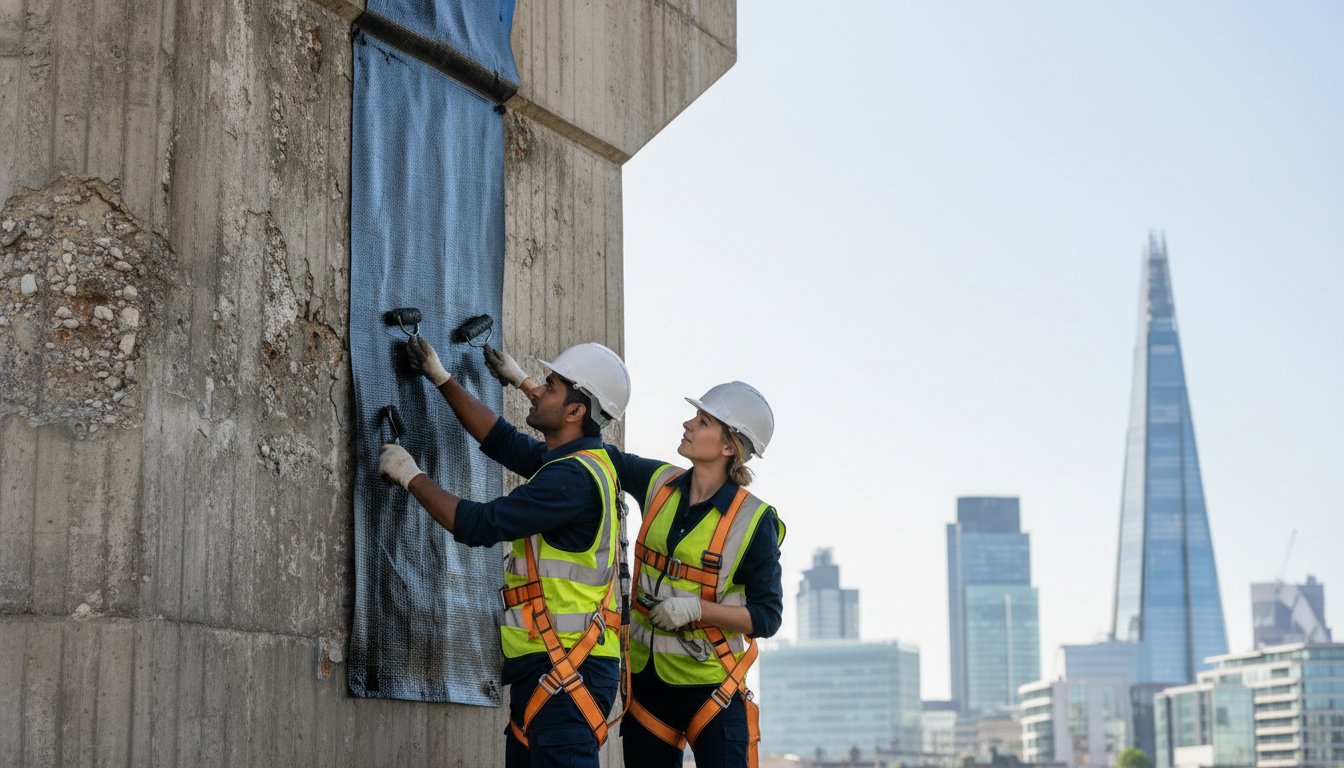
The Tyfo® Fibrwrap® system is distinguished by its ability to conform to complex geometries. Whether it’s the circular profile of bridge columns or the irregular contours of industrial pipelines, the flexibility of the composite fabric ensures uniform confinement. This adaptability is a primary reason why a specialist engineering contractor will specify the Tyfo® system for high-consequence UK infrastructure. The system doesn’t just add strength; it provides a comprehensive protective layer that seals the substrate against moisture ingress and chemical attack, which is vital for the life-extension of assets in aggressive environments.
Material Science and Quality Control
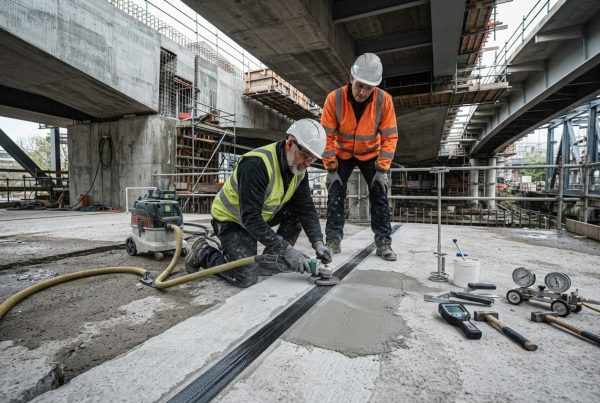
Achieving the design strength of a composite system depends entirely on the precision of the installation and the resin-to-fibre ratio. If the saturation is uneven, the load transfer between the structural element and the reinforcement is compromised. To ensure integrity, rigorous on-site testing protocols are implemented, including pull-off tests to verify bond strength and carbonation depth analysis to assess the condition of the underlying concrete. These methodical checks are non-negotiable for ensuring the long-term performance of the structural strengthening. For those managing complex remediation projects, it’s advisable to consult on bespoke design features to ensure the chosen system aligns with specific load-bearing objectives.
Selecting a Contractor for Complex Infrastructure Projects
The selection of a specialist engineering contractor for complex infrastructure remediation requires an evaluation process that extends far beyond general construction certifications. Whilst standard accreditations provide a baseline of quality management, they don’t guarantee the technical proficiency required for high-consequence structural strengthening. Asset managers must scrutinise a firm’s specific history with relevant asset classes, such as the unique hydraulic pressures inherent in pipeline rehabilitation or the dynamic loading requirements of highway bridge columns. It’s also vital to verify that the contractor utilises certified, proprietary systems, like the Tyfo® range, rather than unproven generic alternatives. Generic materials often lack the rigorous independent testing and long-term empirical data necessary to guarantee structural integrity over the extended lifespan of a critical asset.
Design and Engineering Rigour
Bespoke design is the cornerstone of successful structural remediation. Unlike new construction, where variables are controlled, remediation deals with existing degradation and unforeseen structural anomalies that require immediate technical adaptation. A specialist engineering contractor must maintain in-house design capabilities to develop solutions that account for the current state of the substrate and the specific load-enhancement goals. You can explore our bespoke design features for complex assets to understand how tailored engineering ensures project success. This process typically involves the integration of temporary works design within the permanent solution, ensuring the structure remains stable and operational throughout the strengthening process without compromising safety or service delivery.
Accreditation and Safety Standards
Operating within live infrastructure environments, such as rail networks, highways, or utility facilities, necessitates a rigorous adherence to safety and engineering standards. Essential qualifications include specific composite application certifications and full compliance with BS EN 1504 for concrete repair works. Beyond technical skill, the financial security provided by comprehensive professional indemnity insurance is a critical requirement for high-risk contracting, protecting all stakeholders against the complexities of structural design. Safety records in these sensitive environments are a primary indicator of a contractor’s reliability. A proven history of delivering projects without compromising the safety of the public or the integrity of the surrounding network is a non-negotiable criterion for any organisation responsible for essential infrastructure assets.
Asset Life-Extension: The Economic and Environmental Case
The decision to extend the service life of an asset rather than pursuing total replacement is increasingly driven by a convergence of economic necessity and environmental mandate. Within the UK, the traditional ‘demolish and rebuild’ philosophy is being superseded by a ‘strengthen and retain’ strategy. This shift is supported by the government’s 10-year infrastructure strategy, which prioritises the resilience of the existing £725 billion project pipeline. When a specialist engineering contractor is engaged to perform structural strengthening, the return on investment is immediately apparent. Capital expenditure for new construction often involves significant costs related to demolition, waste disposal, and new material procurement, whereas remediation typically requires a fraction of that investment whilst delivering comparable structural performance. This focus on asset life-extension also aligns with the requirements of the Building Safety Regulator, which became an independent statutory body in January 2026 to oversee the safety of higher-risk buildings throughout their lifecycle.
The Sustainability of Structural Remediation
Carbon fibre reinforced polymer (CFRP) strengthening represents a significant advancement in sustainable civil engineering. By utilising these high-strength materials, the requirement for new concrete and structural steel, both of which carry high embodied carbon, is drastically reduced. This reduction is vital for meeting the rigorous Net-Zero targets currently influencing UK infrastructure projects. Extending the service life of a bridge or industrial facility effectively amortises the original carbon cost over a longer period, preventing the environmental debt associated with new-build construction. For a deeper analysis of these methodologies, refer to our technical guide to structural repairs, which details the role of asset remediation in modern infrastructure management.
Minimising Indirect Project Costs
Indirect costs, particularly those associated with operational downtime, often exceed the direct costs of construction. In the commercial and utility sectors, the ability to maintain service during repairs is a critical requirement. Lightweight composites are advantageous here because they eliminate the need for heavy propping and extensive plant equipment that would otherwise obstruct site access and increase logistical complexity. This streamlined approach is further discussed in our guide on propping in structural engineering, which provides insights into temporary support requirements. By reducing the physical footprint of the repair works, a specialist engineering contractor ensures that the asset remains functional, thereby protecting revenue streams and service continuity. The speed of application for the Tyfo® system allows for rapid project completion, often within timeframes that traditional methods cannot match. For highway structures specifically, understanding how recurrent degradation of bridge deck components drives repetitive expenditure is essential; our guide to bridge deck concrete repair UK interventions and advanced nosing specification provides a detailed technical overview of achieving long-term durability under 44-tonne HGV loading.
To discuss the economic viability of your next remediation project, contact our specialist engineering team for a technical consultation.
CCUK: Delivering Bespoke Engineering Solutions Across the UK
Composites Construction UK (CCUK) operates as a premier specialist engineering contractor, dedicated to the preservation and enhancement of the nation’s built environment through technical rigour and material science. As the exclusive UK licensee for the world-renowned Tyfo® system, the firm provides access to proprietary carbon fibre reinforced polymer (CFRP) technologies that have been validated by decades of global engineering benchmarks. The CCUK workflow is defined by a methodical progression from initial feasibility assessments and bespoke engineering design to professional installation by highly trained technicians. This end-to-end responsibility is critical for maintaining the safety and longevity of essential infrastructure, particularly as regulatory oversight from the Building Safety Regulator has intensified since its transition to an independent statutory body in early 2026.
Comprehensive Structural Services
The service portfolio maintained by CCUK is designed to address the multifaceted nature of structural degradation in high-consequence environments. Core disciplines include CFRP strengthening, concrete repair, blast mitigation, and pipeline rehabilitation. Each project is approached with a commitment to bespoke design, where engineering solutions are tailored to the specific geometric constraints and load-bearing requirements of the asset in question. This precision ensures that structural strengthening is achieved without unnecessary material waste or excessive weight addition. It’s this level of technical authority that leads national asset managers and government agencies to trust CCUK with the remediation of critical transport, energy, and water networks across the United Kingdom.
Partnering for Long-Term Integrity
Specialist contracting is most effective when it’s conducted through a collaborative partnership with asset owners and their consultants. CCUK supports consulting engineers and architects by providing the technical data, material property specifications, and feasibility studies necessary to inform complex decision-making processes. This support ensures that every remediation project is grounded in empirical evidence and meets the highest UK safety standards, including BS EN 1504. By acting as a guardian of infrastructure, CCUK helps to ensure that essential assets remain resilient against the challenges of climate change and increased operational demands. If you require technical assistance or a detailed survey of a deteriorating structure, please contact our engineering team to discuss your structural requirements. Our team is prepared to deliver the certainty of delivery and technical excellence required for the UK’s most challenging structural life-extension projects.
Advancing Infrastructure Resilience through Specialist Engineering
The preservation of the UK’s critical infrastructure requires a decisive departure from traditional demolition in favour of sophisticated remediation. By integrating advanced materials science with meticulous structural analysis, assets once considered near the end of their service life can be restored to full operational capacity. This process is underpinned by the technical precision of the Tyfo® Fibrwrap® system, which provides a non-invasive and highly durable alternative to conventional strengthening methods. It’s a methodology that balances the immediate need for safety with the long-term goals of sustainability and fiscal responsibility.
Selecting a specialist engineering contractor ensures these complex interventions are managed with a high degree of technical authority and certainty. Composites Construction UK (CCUK) combines its status as the exclusive UK licensee for Tyfo® products with a bespoke in-house engineering design team to deliver comprehensive solutions nationwide. This integrated approach prioritises structural integrity whilst meeting the stringent regulatory requirements of the modern built environment. You’re invited to request a technical consultation for your structural project to explore how these advanced technologies can secure the future of your assets. Investing in proven engineering excellence today ensures the long-term reliability and safety of our essential infrastructure for decades to come.
Frequently Asked Questions
What exactly does a specialist engineering contractor do?
A specialist engineering contractor identifies and remediates complex structural defects through the application of proprietary materials and bespoke engineering design. Their remit extends beyond the scope of general construction to include structural strengthening, seismic retrofitting, and pipeline rehabilitation, ensuring that ageing assets meet modern safety standards whilst avoiding the need for total replacement. By managing the entire workflow from diagnostic testing to final installation, they provide asset managers with a single point of responsibility for structural integrity.
How does CFRP strengthening compare to traditional steel plate bonding?
Carbon fibre reinforced polymers (CFRP) offer a superior strength-to-weight ratio compared to traditional steel plate bonding, which often requires heavy lifting plant and remains susceptible to corrosion over time. CFRP systems like Tyfo® are lightweight, non-corrosive, and possess immense tensile strength, allowing for a faster installation process that adds minimal dead weight to the existing structure. This makes composites a more durable and efficient solution for life-extension projects in aggressive environments.
Can specialist repairs be carried out whilst a building or bridge is still in use?
Structural remediation using advanced composites can typically be executed whilst an asset remains fully operational. Because CFRP applications require minimal heavy plant and often eliminate the need for extensive propping, they reduce the physical footprint of the worksite. This allows for service continuity on bridges, industrial facilities, and high-rise buildings, significantly reducing the indirect costs associated with operational downtime during the strengthening process.
What is the typical lifespan of a structural repair using the Tyfo® system?
The Tyfo® system is engineered to provide a service life that matches or exceeds the remaining design life of the host structure, often exceeding 50 years with minimal maintenance requirements. The durability of the specialised resins and carbon fibres ensures long-term resistance to environmental degradation, moisture ingress, and chemical attack. This longevity is a primary factor in the high return on investment seen when choosing composite life-extension over asset replacement.
Is a specialist engineering contractor required for all concrete repair projects?
Whilst minor cosmetic repairs may be handled by general builders, a specialist engineering contractor is essential for any structural remediation that impacts the load-bearing capacity of an asset. For projects involving critical path elements or requiring compliance with BS EN 1504, the technical expertise and certified application of a specialist are necessary to guarantee structural integrity. Their involvement ensures that the repair system is correctly specified for the specific structural demands of the project.
How do specialist contractors manage health and safety on complex sites?
Management of health and safety on complex sites involves the implementation of rigorous, project-specific risk assessments and the use of technicians who are certified in the handling of specialised resins and composites. Specialist contractors also maintain comprehensive professional indemnity insurance, reflecting the high-consequence nature of the structural strengthening works they perform. This methodical approach is vital when working within live infrastructure environments such as rail networks or utility facilities.
What diagnostic tests are required before a strengthening solution can be designed?
Before a bespoke design is finalised, several diagnostic tests are performed to assess the substrate’s condition, including pull-off tests for bond strength and carbonation depth analysis. Other essential evaluations include chloride ion content testing and cover meter surveys to determine the location and condition of the existing steel reinforcement. These empirical data points ensure that the new strengthening system is fully compatible with the host material and capable of meeting the required load enhancements.
How much does it cost to hire a specialist engineering contractor in the UK?
Costs for specialist contracting are determined by the complexity of the structural defect, the access requirements, and the specific volume of proprietary materials required for the remediation. Whilst the initial material costs for advanced composites may be higher than traditional steel, the overall project expenditure is typically lower. This is due to reduced labour hours, minimal plant requirements, and the avoidance of expensive operational downtime, making life-extension a fiscally responsible alternative to new construction.