

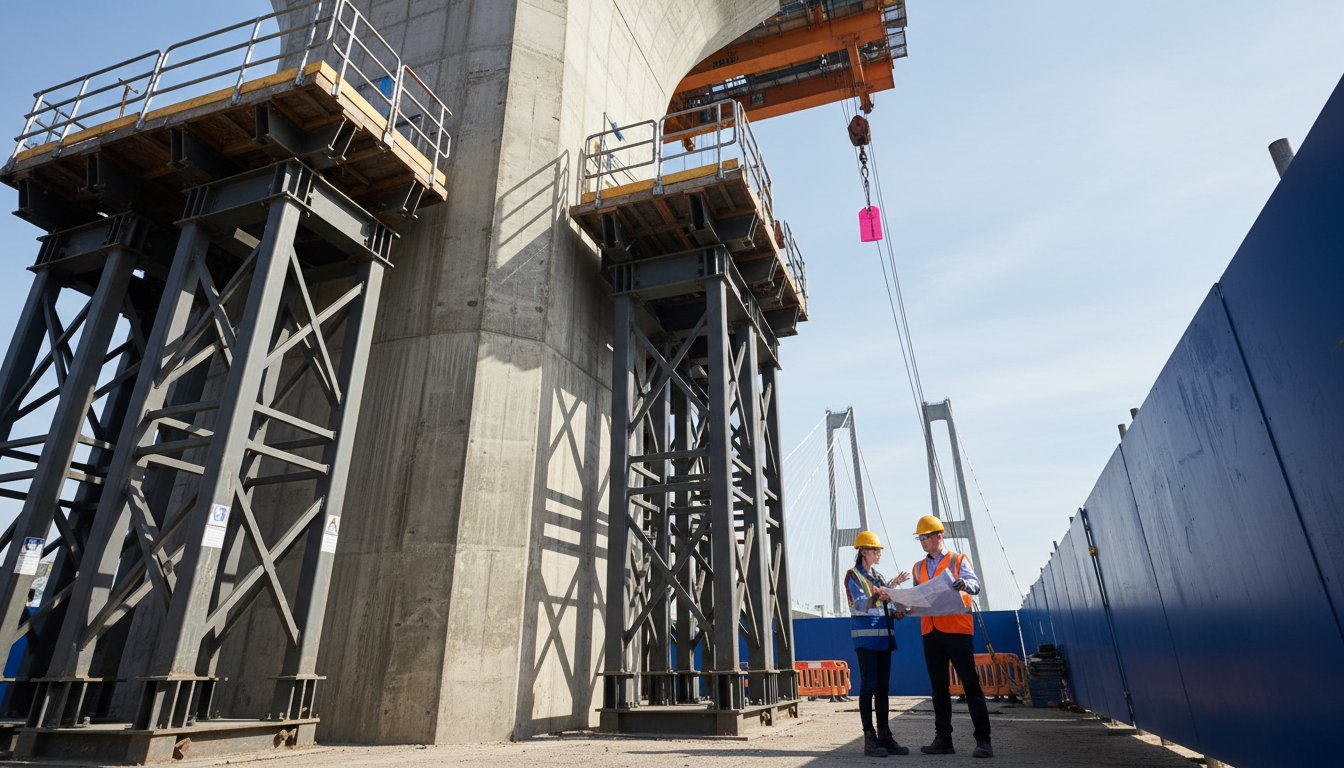
The success of a structural life-extension project is determined not by the final application of composite materials, but by the precision of the initial propping strategy. It’s widely recognised amongst industry professionals that the transition of loads during remediation represents a period of heightened risk where the margin for error is non-existent. Without a methodical approach to temporary works, the integrity of the entire asset remains compromised during the critical phases of structural alteration.
This technical guide provides a rigorous examination of propping systems, focusing on the stringent requirements of BS 5975:2019 and the seamless integration of temporary supports with advanced CFRP strengthening solutions. You’ll gain an expert-led perspective on navigating complex regulatory frameworks whilst ensuring that safety protocols are strictly adhered to throughout the project lifecycle. We will analyse the specific methodologies required to coordinate temporary load-bearing structures with permanent remediation, ensuring that every intervention contributes to the long-term security of the United Kingdom’s essential infrastructure through proven engineering rigour.
Key Takeaways
- Distinguish between vertical propping and lateral shoring systems to ensure that the most appropriate temporary support methodology is selected for complex structural remediation projects.
- Analyse the mechanics of vertical and lateral load transfer, with particular focus on the critical role of axial load capacities and the engineering implications of eccentricity.
- Review the regulatory requirements defined by BS 5975 and the legal imperative for a formal Temporary Works Design (TWD) to maintain safety and compliance throughout the asset lifecycle.
- Evaluate how temporary support systems are integrated with advanced solutions, such as the Tyfo® system, to facilitate structural strengthening and sustainable asset life-extension.
- Gain insights into the application of temporary works within civil infrastructure, specifically concerning bridge bearing replacements and the preservation of historic façades.
Understanding Propping as a Critical Component of Structural Remediation
Within the rigorous discipline of structural remediation, propping is defined as the installation of a temporary support system engineered to resist vertical loads during construction, demolition, or repair phases. This technical intervention is essential for maintaining the equilibrium of a structure when its primary load-bearing capacity is intentionally or accidentally compromised. The implementation of such systems is often categorized under the broader engineering heading of Falsework, which encompasses all temporary structures used to support a permanent asset until it becomes self-supporting.
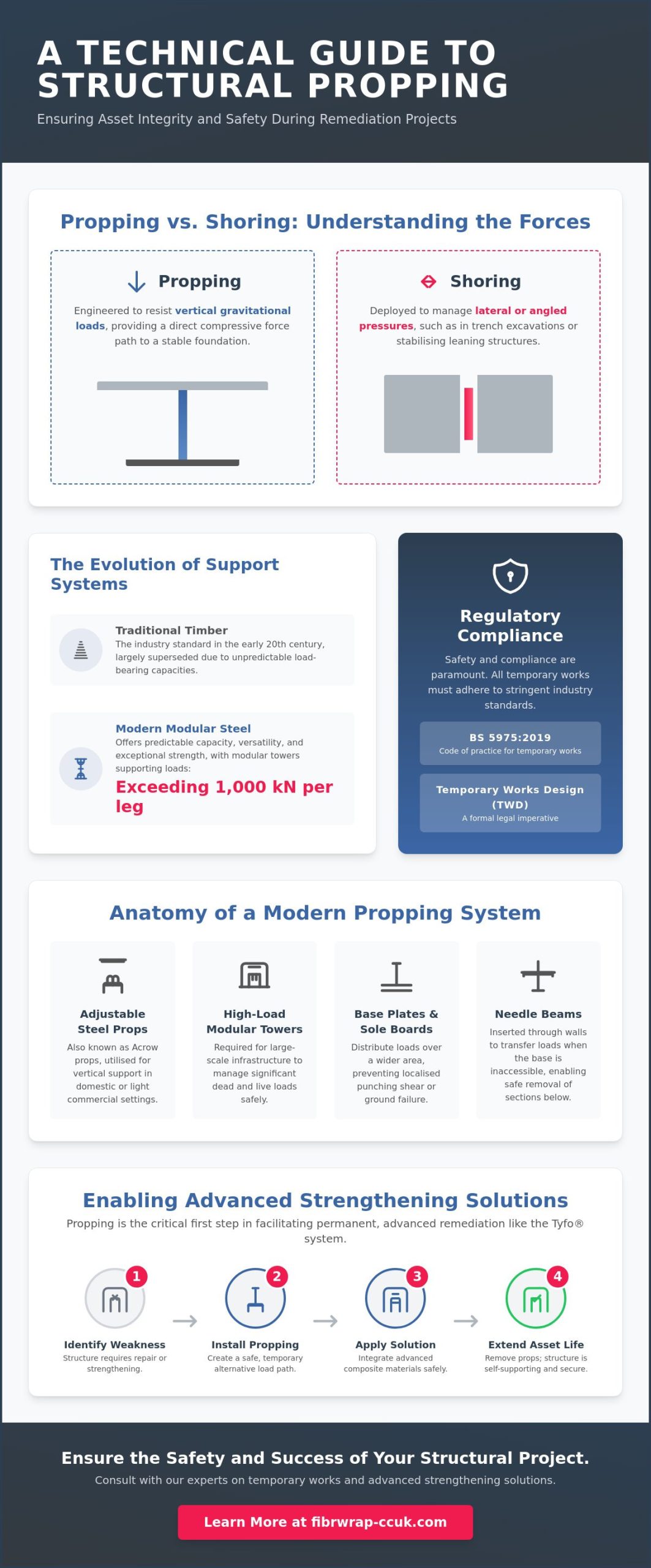
A fundamental distinction must be maintained between propping and shoring. Whilst the terms are occasionally used interchangeably in non-technical contexts, structural engineering standards distinguish them by the direction of the force they counteract. Propping is primarily concerned with vertical gravitational loads, providing a direct path for compressive forces to reach a stable foundation. Conversely, shoring is deployed to manage lateral or angled pressures, such as those encountered in trench excavations or when stabilizing a leaning facade. Understanding this distinction is vital for the development of a safe temporary works design that ensures the integrity of the asset remains uncompromised.
The historical evolution of these systems reflects the broader advancements in material science. Traditional timber shores, which were the industry standard throughout the early 20th century, have largely been superseded by high-capacity modular steel systems. These modern solutions, which emerged prominently following the patenting of the adjustable steel prop in the 1940s, offer predictable load-bearing capacities and greater versatility. Modern modular towers can now support vertical loads exceeding 1,000 kN per leg, allowing for the remediation of heavy infrastructure that was previously considered too high-risk for temporary intervention.
The Functional Necessity of Temporary Support
The primary objective of temporary support is the prevention of structural collapse during the removal or modification of load-bearing elements. This is a critical requirement during the installation of masonry reinforcement, where the existing substrate’s compressive strength is momentarily reduced to facilitate the integration of strengthening components. By providing an alternative load path, the system ensures that the remaining structure does not exceed its ultimate limit state. Furthermore, propping acts as a primary safety measure in aging infrastructure undergoing seismic retrofitting or blast mitigation. In these scenarios, the temporary system provides a redundant support layer that protects the workforce and the asset from unpredictable structural shifts during the application of advanced composite materials like the Tyfo® system.
Key Components of a Propping System
The efficacy of a support system depends on the precise selection of its components. Adjustable steel props, frequently referred to as Acrow props, are utilised for vertical support in domestic or light commercial settings. However, for large-scale infrastructure, high-load modular towers are required to manage the significant dead and live loads. Effective load distribution is achieved through the use of base plates and sole boards. These elements increase the surface area through which the load is transferred to the ground or the supporting slab, preventing localized punching shear or soil failure. When the remediation requires support for a masonry wall where the base cannot be accessed, needle beams are employed. These beams are inserted through small apertures in the wall, allowing the vertical load to be transferred to props on either side of the work area, thereby facilitating the safe removal of the section below.
The Mechanics of Vertical and Lateral Load Transfer
Load transfer in structural propping is governed by the rigorous application of Newtonian physics, ensuring that temporary vertical members maintain equilibrium under both static and dynamic forces. Axial load capacities are determined by a combination of material strength and geometric stability, where the impact of prop eccentricity must be meticulously accounted for. Even a minor deviation of the load from the prop’s central axis can induce significant bending moments, reducing the effective load-bearing capacity by up to 25% in certain high-slenderness configurations. The physics of load paths requires a continuous trajectory from the supported structure, through the propping assembly, and into a verified foundation or substrate.
Lateral stability is a critical consideration, particularly in tall propping towers where P-Delta effects can compromise the entire temporary system. Stability is typically maintained through the strategic integration of cross-bracing, which converts lateral forces into axial tension and compression within the bracing members. Environmental factors, specifically wind loading as defined in BS EN 1991-1-4, exert substantial horizontal pressure on temporary structures. These forces are amplified in urban environments where the “canyon effect” can increase wind speeds at lower levels, necessitating a higher factor of safety in the design of the bracing system. The Health and Safety Executive provides critical oversight through guidelines on Temporary Works, which dictate the management and design requirements for all propping installations on UK sites.
Calculating Load Requirements
Engineers must distinguish between dead loads, comprising the self-weight of the permanent structure, and live loads, which include construction personnel, equipment, and stored materials. Accuracy in these calculations is paramount; underestimating live loads during a concrete pour can lead to catastrophic deflection. To mitigate this, pre-loading props using hydraulic jacks is often employed to induce an initial strain, ensuring the temporary support is fully engaged before the primary structure is altered. Axial capacity is defined as the maximum compressive force a vertical member can support before structural instability occurs, a threshold dictated by the relationship between the prop’s height and its slenderness ratio.
Foundation and Ground Conditions
The efficacy of a propping system is entirely dependent on the bearing capacity of the ground or floor slab upon which it rests. On soft or variable ground, steel grillage or reinforced concrete pads are utilised to distribute concentrated loads over a wider area, preventing localised settlement. In complex multi-storey projects, back-propping techniques are used to transfer loads through multiple levels of the existing structure until a floor with sufficient residual capacity is reached. This methodical approach ensures that the integrity of the building is never compromised during structural remediation. For projects requiring permanent structural strengthening alongside temporary supports, the Tyfo® system provides a high-performance solution that integrates seamlessly with existing engineering designs.
Regulatory Compliance and the Importance of Temporary Works Design
Adherence to BS 5975 is fundamental to the delivery of safe structural interventions in the United Kingdom. This code of practice provides the procedural framework for temporary works, ensuring that propping systems are conceived, designed, and executed with mathematical precision. Under the Construction (Design and Management) Regulations 2015, a formal Temporary Works Design (TWD) isn’t merely a recommendation; it’s a legal necessity for any scheme where structural instability could pose a risk. The management of these risks is overseen by the Temporary Works Coordinator (TWC), who holds primary responsibility for the procedural control of the works. They’re supported by the Temporary Works Supervisor (TWS), who manages the site-level implementation and ensures that the physical installation matches the approved design. Rigorous inspection regimes are essential to avoid propping failure, as even a minor deviation from the engineered plan can lead to catastrophic structural collapse.
The Design Process and Documentation
A bespoke engineering approach begins with a comprehensive site survey to assess load paths and substrate integrity. Engineers produce detailed drawings that integrate the temporary support with the long-term structural remediation strategy, often incorporating the Tyfo® system for permanent reinforcement. BS 5975:2019 dictates that all designs undergo independent verification based on their complexity. Category 1 checks involve a simple review by another member of the design team, whilst Category 3 checks require a completely independent engineering firm to validate calculations for high-risk structures. This tiered approach ensures that every aspect of the load-bearing capacity is scrutinized before any weight is transferred to the temporary supports. Documentation must be meticulous, forming a permanent record of the asset life-extension process.
Health and Safety Executive (HSE) Expectations
The HSE prioritises the prevention of structural collapse and falls from height, which remain the most significant risks in civil engineering. Compliance with CDM 2015 requires that all propping activities are documented within site-specific Risk Assessments and Method Statements (RAMS). These documents must detail the exact sequence of installation and striking, ensuring that structural stability is maintained at every phase of the project. It’s vital that the RAMS reflect the actual site conditions identified during the initial survey. By prioritising asset life-extension through methodical structural strengthening, contractors satisfy regulatory scrutiny and ensure the safety of all site personnel. The HSE expects a clear audit trail that links the TWD to the physical inspections carried out by the TWS, leaving no room for ambiguity in the safety chain.
Strategic Applications Across Civil Infrastructure and Commercial Assets
The deployment of temporary support systems remains a critical phase in the life-cycle management of UK infrastructure. In bridge engineering, hydraulic propping systems facilitate the controlled lifting of spans to allow for bearing replacement or deck strengthening. These operations require millimetre-level precision to ensure that live loads are safely redistributed without inducing secondary stresses in the primary girders. This methodology is equally vital in façade retention projects where historic masonry must be preserved whilst internal floor plates are completely reconfigured. By transferring vertical and lateral loads to a temporary steel frame, the architectural heritage of a site is maintained during significant structural remediation.
Emergency interventions represent another high-stakes application of these systems. Following vehicular impacts on bridge parapets or fire damage in commercial warehouses, immediate structural stabilisation is mandatory to prevent progressive collapse. Engineering teams often deploy rapid-response solutions to secure compromised elements until a permanent repair programme is established. For water and gas utility infrastructure, support systems are integrated into pipeline rehabilitation and culvert repairs, providing the necessary stability for technicians to work within confined spaces during the application of reinforced liners or protective coatings.
Infrastructure and Transport Sector Applications
Managing structural supports within rail environments necessitates rigorous adherence to Network Rail standards, particularly regarding vibration monitoring and track safety. It’s essential that any temporary works don’t interfere with the sensitive signalling equipment or the dynamic stability of the permanent way. These systems are frequently utilised to support bridge piers during Tyfo Fibrwrap installation. By temporarily relieving the axial load, engineers can remove degraded concrete and prepare the substrate for carbon fibre reinforced polymer (CFRP) application, ensuring the new composite material achieves full bond strength under optimal conditions. Where bridge deck concrete repair UK programmes are also required, specifying durable nosing systems alongside propping works is essential; our technical guide on bridge nosing systems specification and remediation provides a comprehensive overview of achieving 120-year design life compatibility whilst minimising traffic disruption.
Commercial and Industrial Remediation
In the industrial sector, propping is often required during the upgrade of floor slabs to accommodate increased racking loads or automated machinery. If a slab shows signs of subsidence, temporary supports maintain the level whilst resin injection or pressure grouting is performed. Navigating restricted access environments, such as basement plant rooms or congested utility tunnels, requires the use of bespoke design features. These tailored solutions allow for the transfer of heavy loads in areas where standard proprietary equipment cannot be physically positioned. This level of technical adaptability ensures that essential assets remain operational throughout the remediation process, minimising downtime for commercial tenants.
For expert guidance on implementing these systems for your next infrastructure project, contact our technical engineering team today.
Integrating Propping with Advanced Strengthening Solutions
The integration of propping within the lifecycle of structural remediation represents a critical junction between temporary stability and long-term performance. Whilst propping provides the necessary safety margin during construction, its strategic application enables the installation of advanced materials like the Tyfo® system without necessitating a total shutdown of the asset. This synergy ensures that essential infrastructure remains operational, avoiding the significant economic costs associated with full closures. Choosing repair and strengthening over demolition reduces the carbon footprint of a project by as much as 60% according to industry benchmarks for material conservation. This focus on asset life-extension aligns technical engineering requirements with the growing demand for sustainable infrastructure management across the United Kingdom.
CCUK provides a comprehensive advantage by managing the end-to-end design, supply, and installation of both propping and permanent strengthening solutions. This holistic approach eliminates the friction often found between separate temporary works designers and specialist repair contractors. By maintaining control over the entire sequence, engineers ensure that the temporary support structures are perfectly calibrated to the requirements of the permanent composite reinforcement. The results are structures that aren’t just repaired, but are fundamentally enhanced to meet modern load requirements and safety standards.
Preparing for Carbon Fibre Reinforcement
To achieve maximum efficiency in Carbon Fibre Reinforced Polymer (CFRP) application, the structure is often de-stressed using hydraulic propping systems. This process transfers the dead load away from the structural element, allowing the composite reinforcement to be applied to a neutral state. It’s a method that ensures the CFRP carries its intended share of the load immediately upon the removal of the props. Without this de-stressing phase, the composite would only assist with additional live loads rather than contributing to the existing dead load capacity. Furthermore, a propped environment creates the vibration-free, stable conditions required for the precise curing of resins and the integrity of the composite bond.
The Future of Structural Asset Care
The sector is witnessing a shift towards digital integration within temporary works. Real-time load sensing and wireless monitoring are now being incorporated into propping assemblies to provide engineers with live data on structural behaviour during the strengthening process. This technological advancement is vital for the resilience of the UK’s aging infrastructure, where precision is paramount. Specialized contractors play a central role in this evolution, acting as the technical guardians of the built environment through sophisticated science and engineering. For projects requiring this level of technical rigour, you can contact our engineering team for a bespoke propping and strengthening consultation.
Securing Future Asset Performance Through Engineered Solutions
The successful execution of structural remediation is underpinned by the seamless integration of temporary support and permanent strengthening solutions. Effective propping serves as the critical interface between initial instability and long-term resilience, particularly when designed in accordance with the rigorous safety standards of BS 5975. By combining these essential temporary works with the proprietary Tyfo® Fibrwrap® system, which utilises high-strength carbon fibre reinforced polymers, asset managers can achieve a significant extension of service life whilst maintaining operational continuity. As the exclusive UK licensee for this advanced technology, Fibrwrap Construction UK provides a comprehensive design-and-install capability that’s been validated across complex national infrastructure projects, including major bridge strengthening schemes. This methodical approach ensures that every load transfer is calculated with engineering precision, reducing risk and enhancing the durability of essential commercial and civil assets. It’s a strategy that prioritises safety and empirical results to protect the built environment for decades to come.
Consult with our structural experts regarding your propping and strengthening requirements
Frequently Asked Questions
What is the difference between propping and shoring?
Propping is primarily defined as the provision of vertical support to structural elements during renovation or repair, whereas shoring typically refers to lateral support systems used to prevent the collapse of excavations or unstable walls. In structural remediation, propping ensures that vertical loads are safely transferred whilst permanent strengthening measures are applied. Shoring involves complex geotechnical considerations and is governed by BS 5975:2019, ensuring stability against horizontal pressures in subterranean environments.
Is a formal design always required for propping in the UK?
A formal temporary works design is a mandatory requirement for all propping schemes under the Construction (Design and Management) Regulations 2015 (CDM 2015). Even for minor residential interventions, a qualified Temporary Works Designer must produce a design that accounts for imposed loads and lateral stability. Failure to provide documented engineering calculations can result in non-compliance with Health and Safety Executive (HSE) standards and compromises the structural integrity of the asset.
How much load can a standard adjustable steel prop support?
An individual Size 0 adjustable steel prop typically supports a safe working load of 42 kilonewtons (kN) when fully closed, but this capacity reduces significantly as the prop is extended. For instance, a Size 4 prop extended to its maximum height of 4.9 metres may only support 7 kN due to the increased risk of buckling. Engineers must consult the load tables provided in BS EN 1065 to ensure the selected equipment meets the specific requirements of the structural strengthening project.
What is back-propping and when is it necessary?
Back-propping is the process of installing temporary supports through multiple lower floor levels to distribute the weight of a heavy load across several structural slabs. This technique is essential when the immediate floor below a construction zone can’t independently support the combined weight of wet concrete, plant machinery, or stored materials. It’s frequently utilised in multi-storey reinforced concrete frames where 100% of the construction load must be safely dissipated to the foundation or lower-capacity floors.
How does propping facilitate the installation of CFRP strengthening?
Propping facilitates the installation of CFRP strengthening by relieving the existing dead load from a structural member, allowing the Tyfo® system to engage more effectively once the props are removed. By inducing a slight camber or simply neutralising strain, the carbon fibre reinforced polymers can share both the existing dead load and future live loads more efficiently. This methodical approach to structural remediation ensures the composite materials achieve their full design potential in extending the asset’s service life.
What are the main causes of propping failure on construction sites?
The primary causes of propping failure include inadequate lateral bracing, eccentric loading, and the use of substandard base plates on unstable ground. Data from the Standing Committee on Structural Safety (SCOSS) indicates that approximately 40% of temporary works failures stem from a lack of communication between the designer and the site team. Without proper lateral restraint, even a slight vertical misalignment can lead to catastrophic buckling under 90% of the rated load capacity.
How often should temporary propping systems be inspected?
Temporary propping systems must be inspected at least every 7 days by a competent person, as stipulated by the CDM 2015 regulations. Additional inspections are required immediately following any significant event that could affect structural stability, such as a vehicle impact or extreme weather conditions with wind speeds exceeding 40 mph. All findings must be recorded in a formal register to maintain a clear audit trail of the asset’s safety and the ongoing integrity of the temporary works.


