

The conventional reliance on disruptive “dig and push” underpinning as the primary response to structural movement is no longer a viable strategy for high-value commercial infrastructure. It is widely accepted amongst asset managers that prolonged operational downtime during subsidence repair often results in financial losses that far exceed the physical cost of the remediation itself. This article provides a technical analysis of advanced remediation methodologies, demonstrating how the integration of traditional engineering with modern composite structural strengthening can extend asset life by decades. You will gain a comprehensive understanding of the transition from invasive excavation to high-performance solutions, such as the Tyfo® system, which prioritise empirical safety and long-term security. We will examine the technical nuances of these methodologies, focusing on the achievement of permanent stabilisation and verified asset life-extension with minimal site interruption.
Key Takeaways
- Gain insight into the engineering rigour required to move beyond visual assessment, utilising empirical data to establish the definitive cause of structural movement.
- Compare the efficacy of traditional underpinning against advanced non-invasive methods to select the optimal strategy for professional subsidence repair in complex commercial environments.
- Learn why ground stabilisation must be followed by comprehensive structural strengthening to ensure the load-bearing capacity of walls, beams, and columns is fully restored.
- Understand the logistical necessity of integrated project management, from the coordination of temporary works to the final installation of high-performance composite solutions.
- Discover how the strategic application of advanced materials facilitates sustainable asset life-extension, offering a technically superior alternative to total asset replacement.
Understanding Subsidence in Commercial and Infrastructure Assets
Subsidence represents a critical geotechnical instability where the underlying soil fails to support the imposed loads of a structure, leading to downward movement. Unlike initial settlement, which typically occurs within the first 24 months of construction as soil compresses under a new load, subsidence is an ongoing and often accelerating process. It’s frequently triggered by external environmental factors that compromise the soil’s volumetric stability. Within the United Kingdom, Understanding Subsidence is vital for asset managers, as the phenomenon differs significantly from domestic heave or simple thermal expansion in its scale and technical remediation requirements. Effective subsidence repair necessitates a precise diagnosis of the sub-surface conditions to ensure the long-term integrity of the asset.
The primary drivers of this failure in the UK landscape include clay shrinkage, leaking subterranean utility pipes, and historic mining activity. Commercial assets, such as heavy industrial warehouses or transport infrastructure, exert different pressure bulbs on the earth compared to domestic properties. When these pressures interact with compromised strata, the resulting structural movement threatens the fundamental load-bearing capacity of the asset. Failure to address these shifts early can lead to a total loss of structural equilibrium.
The Mechanics of Ground Movement
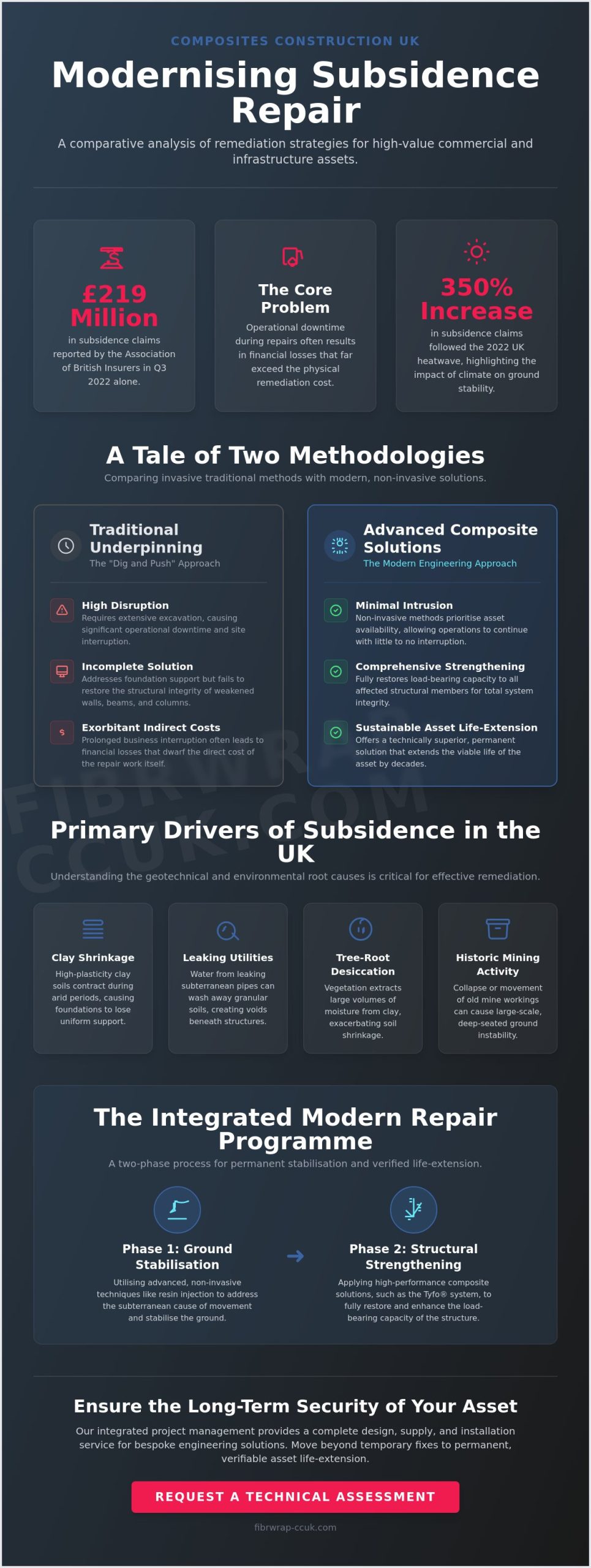
The bearing capacity of foundations is intrinsically linked to the moisture content of the supporting strata. In the UK, particularly across the South East and Midlands, high-plasticity clay soils are susceptible to significant volumetric contraction during periods of prolonged aridity. The 2022 UK heatwave, where temperatures exceeded 40°C, led to a 350% increase in subsidence-related insurance claims compared to the previous year according to the Association of British Insurers. Tree-root desiccation exacerbates this issue; vegetation extracts moisture from deep within the clay, causing the soil to shrink and the foundation to lose its uniform support. Engineers must distinguish between non-structural hairline cracks, often under 1mm, and significant structural fractures exceeding 5mm that indicate a breach in the building’s load-bearing capacity.
Economic and Safety Implications of Delayed Repair
Neglecting structural movement in reinforced concrete or masonry assets invites the risk of progressive collapse. When the equilibrium of a load-bearing wall is disrupted, the stress is redistributed to adjacent members, often exceeding their original design limits. This leads to a rapid decline in asset valuation and complicates insurance renewals. The Association of British Insurers reported that subsidence claims reached £219 million in the third quarter of 2022 alone. For commercial portfolios, unresolved ground movement can result in the withdrawal of insurance cover or the imposition of substantial excesses. Implementing a comprehensive programme of subsidence repair ensures structural strengthening and facilitates essential asset life-extension. For those requiring a technical assessment of their asset, our team can be reached via our contact page to discuss bespoke engineering solutions. Subsidence is a geo-structural failure requiring immediate engineering intervention.
Structural Diagnosis: The Engineering Rigour Behind Subsidence Repair
Effective subsidence repair necessitates a transition from subjective visual observation to rigorous quantitative analysis. Whilst surface-level cracking provides an initial indicator of distress, structural engineers must employ a systematic diagnostic framework to isolate the precise mechanism of movement. This empirical approach ensures that any subsequent intervention addresses the root cause of instability rather than merely masking the architectural symptoms. Identifying whether movement is caused by clay shrinkage, granular soil washout, or historical mining activity is fundamental to the integrity of the remediation strategy.
The role of the structural engineer involves synthesizing various data streams to form a cohesive geological and structural profile. Understanding these subterranean drivers is critical, as highlighted by the USGS on Land Subsidence, which details how groundwater fluctuations and soil compaction influence the stability of the built environment. In a UK context, engineers must also account for the impact of vegetation and leaking drainage systems on the plasticity of local soils. All remedial designs are benchmarked against the Building Regulations 2010 and the Construction (Design and Management) Regulations 2015 to ensure that the structural strengthening measures provide long-term security and compliance.
Comprehensive Asset Inspection and Testing
The diagnostic phase relies on geotechnical borehole investigations, where soil samples are extracted from depths often exceeding 3 metres to evaluate moisture content and plasticity indices. For reinforced concrete assets, carbonation testing and pull-off tests are conducted to assess the chemical stability and tensile strength of the substrate. Engineers install crack monitoring gauges to record movement over a period of 6 to 12 months. This longitudinal data is essential to determine if the movement is active or historic, allowing for a more targeted application of subsidence repair techniques.
Feasibility Studies for Complex Remediation
The selection of a repair methodology is dictated by a comprehensive feasibility study that reconciles soil characteristics with the specific load requirements of the asset. Engineers evaluate the viability of various strengthening methods, prioritising technical specifications that facilitate asset life-extension. This process incorporates bespoke engineering calculations and design to ensure the proposed solution integrates seamlessly with the existing structure. By focusing on high-performance materials and precise load-path analysis, the risk of secondary settlement is effectively mitigated.
If you require a technical assessment of structural movement or asset instability, you can contact our engineering team to discuss a bespoke diagnostic survey.
Comparative Analysis of Modern Subsidence Remediation Techniques
The selection of an appropriate strategy for subsidence repair necessitates a rigorous evaluation of geotechnical data and structural load requirements. Engineers must balance the immediate necessity of structural stabilisation with the long-term requirements of asset life-extension. The traditional reliance on invasive “dig and push” methods is often rooted in a conservative engineering bias, yet empirical data suggests that non-invasive technologies provide equivalent or superior results in specific soil profiles. Asset managers frequently perceive heavy excavation as the only route to permanent stability, but this overlooks the precision offered by modern material science.
Traditional Underpinning and Piling
Mass concrete underpinning remains a fundamental technique for load redistribution in shallow foundations. This process involves the sequential excavation of sections beneath the existing footing, which are then backfilled with concrete to transfer the structural load to deeper, more competent strata. Whilst effective, the logistical burden in restricted urban environments is significant. In cities like London or Manchester, the challenges of spoil removal and limited site access can increase project timelines by more than 30%. Piling and beam methods are typically reserved for deep-seated soil instability or structures with high vertical loads. These systems provide a robust mechanical connection to stable ground, though the vibration levels during installation must be monitored to prevent collateral damage to adjacent heritage assets. Asset managers seeking a detailed breakdown of expenditure variables should consult our analysis of underpinning cost from a structural engineering perspective, which examines how soil morphology and material selection influence total project expenditure.
Resin Injection and Ground Stabilisation
Utilising geopolymer resins represents a sophisticated shift towards non-disruptive structural remediation. This technique involves the controlled injection of expansive polymers into the sub-base to fill voids and compact loose soil structures. One of the primary advantages is the rapid curing time; resins often reach 90% of their compressive strength within 15 to 30 minutes. This allows operational assets, such as distribution centres or highways, to remain functional during the intervention. However, limitations exist within certain UK clay compositions. High-plasticity clays, which are prone to significant shrink-swell behaviour, require a bespoke design approach. Resins alone may not address the underlying hydrologic issues inherent in these soil types, necessitating a more comprehensive geotechnical strategy.
The optimal engineering outcome is frequently achieved through a hybrid approach. By combining the mechanical certainty of traditional piling with the soil-enhancement properties of geopolymer resins, a more resilient foundation system is established. The trade-off between initial capital expenditure and speed of delivery is a critical metric for B2B stakeholders. While non-invasive methods can reduce site preliminaries by 20%, the long-term durability must be validated against the specific environmental stressors of the site. It’s essential to view structural strengthening as a holistic process where the integration of advanced materials and traditional mechanics ensures the continued integrity of essential infrastructure.
- Speed of Delivery: Resin injection can reduce project durations by up to 50% compared to traditional mass concrete methods.
- Site Disruption: Non-invasive techniques eliminate the need for heavy plant machinery and large-scale spoil disposal.
- Structural Integrity: Hybrid solutions provide a multi-layered defence against future soil movement and moisture fluctuations.
The Structural Strengthening Phase: Beyond Foundation Stabilisation
Whilst ground stabilisation addresses the underlying cause of movement, it doesn’t automatically rectify the physical damage sustained by the superstructure. A comprehensive subsidence repair programme necessitates a secondary phase focused on structural strengthening to ensure the building’s integrity is fully restored. When foundations shift, the resulting stress concentrations often lead to shear failure in masonry and tensile cracking in reinforced concrete. These defects compromise the load-path efficiency, meaning the structure might no longer meet its original design specifications even after the soil is secured.
Restoring the structural integrity of walls, beams, and columns requires a methodical approach that prioritises the redistribution of loads. Engineers must assess the extent of the fracturing to determine whether traditional stitching or advanced composite wrapping is required. This phase is critical for asset life-extension, as it prevents the re-emergence of cracks and ensures the building can withstand future environmental pressures.
CFRP and Tyfo® Fibrwrap® Systems
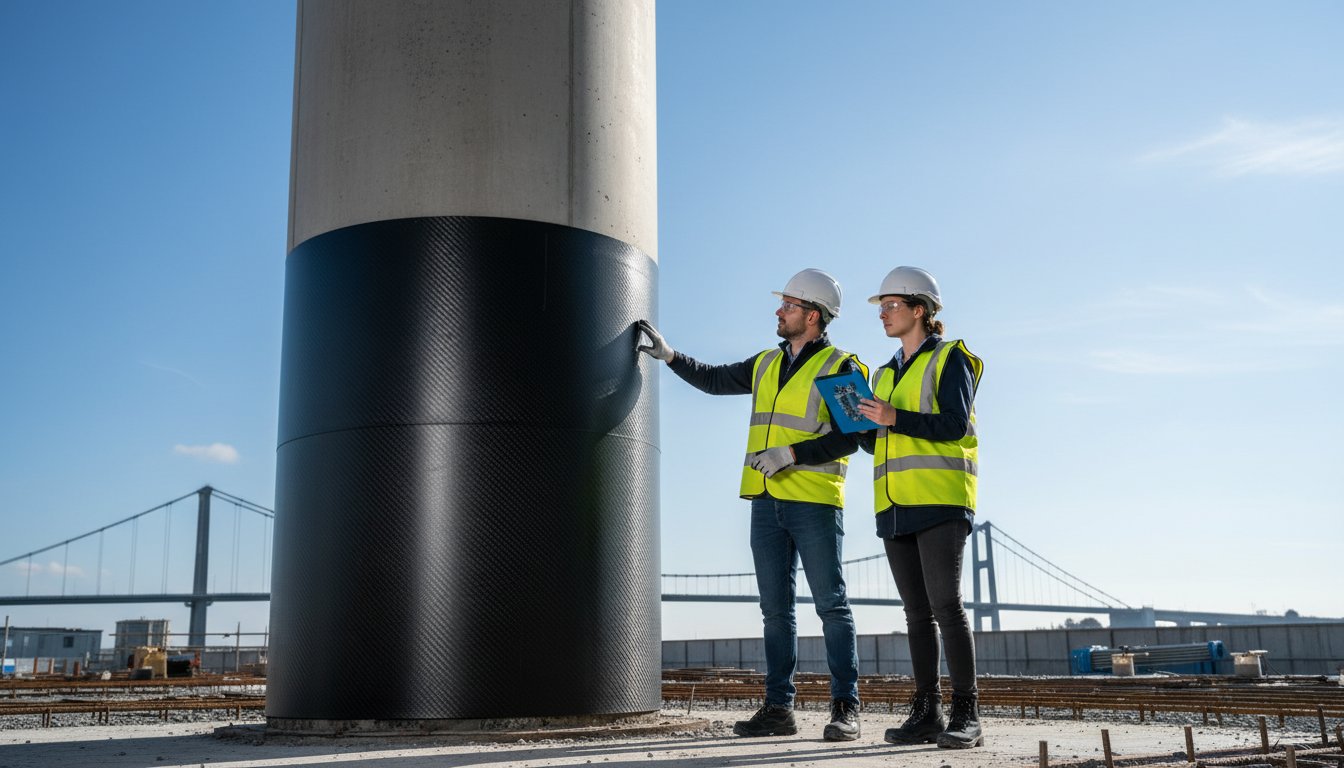
Carbon Fibre Reinforced Polymers (CFRP) represent a significant advancement in structural remediation, offering high-tensile strengthening with negligible added weight. This is particularly advantageous in historic or high-rise assets where adding heavy steel sections would create unwanted dead loads. Applying Tyfo® Fibrwrap® to rehabilitate fractured concrete elements allows for the confinement of the material, effectively restoring its original load-bearing capacity. The system’s low profile ensures that the building’s original dimensions are maintained, which is vital for preserving architectural aesthetics. For a deeper understanding of the application process, consult this technical guide to Tyfo® Fibrwrap® installation.
Masonry Reinforcement and Stabilisation
Fractured masonry is typically addressed through a combination of bed joint reinforcement and the installation of lateral restraint straps. These interventions tie the building envelope back to the internal floor diaphragms, creating a unified structural unit that resists further movement. Low-viscosity resin injection is also employed to seal leaks and consolidate fractured masonry, ensuring the monolithic behaviour of the wall. Composite materials restore shear and flexural capacity to compromised structures. This technical approach ensures that the subsidence repair is not merely a cosmetic fix but a robust engineering solution.
The repair workflow is organised to ensure the superstructure can once again handle design loads before any decorative work commences. This sequence is essential for long-term security, as it allows the structure to settle into its reinforced state. By following a disciplined, problem-to-solution trajectory, asset managers can be confident that the remediation provides a permanent safeguard against future instability.
Learn how our bespoke design features
Managing Large-Scale Subsidence Projects: Design, Supply, and Installation
The execution of a large-scale subsidence repair programme requires more than just reactive measures; it demands a holistic approach where design, supply, and installation are integrated through a single-point-of-contact. This delivery model minimises the risk of communication failures between design consultants and site teams, ensuring that the structural intent is preserved throughout the project lifecycle. During the remediation phase, the coordination of temporary works is paramount. This includes the precise deployment of propping and shoring systems to maintain the equilibrium of the structure whilst permanent reinforcements are applied. Without this level of oversight, the redistribution of loads during the repair process can lead to secondary cracking or further instability.
Quality control is maintained through a regime of rigorous material testing and constant site supervision. Every stage of the structural strengthening process is documented, with pull-off tests and resin cure monitoring providing empirical evidence that the installation meets the specified engineering tolerances. Selecting a specialist engineering contractor with national UK coverage allows for the deployment of standardised, high-specification solutions across diverse geographical regions. This ensures that whether a project is located in the London Basin or the Scottish Highlands, the technical performance of the remediation remains consistent and compliant with BS EN 1504 standards.
The Role of the Specialist Engineering Contractor
Specialist engineering contractors bridge the gap between theoretical consultancy design and practical, site-level installation. They manage the intricate logistics of composite material supply, ensuring that advanced polymers are transported and stored according to strict environmental requirements. The value of proprietary systems like Tyfo® lies in their guaranteed performance characteristics. These systems aren’t merely off-the-shelf products; they’re engineered solutions that provide predictable structural outcomes. By managing the supply chain and the application process, the contractor ensures that the final composite bond achieves the exact tensile strength required by the original design.
Asset Life-Extension and Sustainability
Repairing and strengthening an existing structure is fundamentally more sustainable than the traditional cycle of demolition and rebuild. The embodied carbon associated with new concrete and steel production is substantial; choosing remediation can reduce the carbon footprint of a project by as much as 80% compared to a total rebuild. Calculating the long-term ROI of advanced structural remediation involves looking beyond the initial cost. By extending the service life of an asset by 30 to 50 years, owners preserve their initial capital investment whilst avoiding the logistical disruption of a major construction site. If you require a professional evaluation of an at-risk structure, contact CCUK for a structural survey
Securing Long-Term Asset Integrity Through Engineered Remediation
The mitigation of structural movement requires a transition from reactive patching to a disciplined, engineering-led methodology. Effective subsidence repair is predicated on precise diagnostic data and the integration of foundation stabilisation with advanced superstructure reinforcement. By prioritising asset life-extension over temporary fixes, asset managers ensure the continued safety of critical infrastructure whilst adhering to the requirements of UK building regulations.
Fibrwrap Construction UK operates as the exclusive UK licensee for the Tyfo® Fibrwrap® system, providing a comprehensive design, supply, and installation service that addresses the most complex remediation challenges. Our technical expertise encompasses both traditional concrete repair techniques adhering to BS EN 1504 standards and the application of advanced carbon fibre reinforced polymers. It’s a dual-faceted approach. This ensures every project receives a bespoke solution tailored to its specific load-bearing requirements. Discuss your structural repair requirements with our specialist engineering team to ensure your infrastructure remains resilient for decades to come.
Frequently Asked Questions
How much does subsidence repair cost for a commercial property?
Commercial subsidence repair costs vary significantly based on the structural footprint and soil conditions, though industry data from the Association of British Insurers (ABI) indicates average UK claims reached £9,600 in 2022. For complex commercial remediation involving piling or resin injection, costs often exceed £50,000. Each project requires a bespoke assessment to determine the precise engineering requirements and material volumes needed to ensure the long-term stability of the asset.
What are the first signs of subsidence in a reinforced concrete building?
Early indicators of subsidence in reinforced concrete structures typically manifest as diagonal shear cracks that exceed 3mm in width. These fractures often appear around door frames or window apertures where the structural integrity’s compromised by differential movement. One might also observe the separation of floor slabs from load-bearing walls or the jamming of fire-rated doors due to frame distortion. These symptoms suggest that the foundation’s no longer providing uniform support to the superstructure.
Is underpinning the only way to fix subsidence in the UK?
Underpinning isn’t the only methodology for addressing ground movement in contemporary engineering. Whilst traditional mass-pour concrete underpinning remains a valid solution for certain scenarios, modern alternatives such as geopolymer resin injection or the application of the Tyfo® system provide non-disruptive options. These advanced techniques focus on structural strengthening and soil stabilisation, often negating the need for extensive excavation. This approach minimises operational downtime for commercial facilities whilst ensuring the integrity of the foundation.
Can composite materials like CFRP be used for subsidence repair?
Carbon Fibre Reinforced Polymers (CFRP) are frequently utilised to restore the structural integrity of buildings affected by ground movement. By applying the Tyfo® system to weakened masonry or concrete elements, engineers can achieve significant structural strengthening without adding substantial mass to the foundation. This method’s particularly effective for remediating tensile stresses caused by differential settlement in commercial assets. It represents a sophisticated alternative to traditional steel reinforcement, offering superior corrosion resistance and durability.
How long does it take to complete a structural subsidence remediation project?
The duration of a structural subsidence remediation project is dependent on the selected methodology, with minor resin injections often completed within 2 to 5 working days. Conversely, a comprehensive underpinning project for a large commercial facility can span 8 to 12 weeks depending on site access and soil complexity. Detailed site investigations and monitoring periods often precede the physical repair phase to ensure that the chosen solution provides a permanent fix for the asset. For a comprehensive overview of the financial variables involved in foundation remediation, our guide on underpinning cost and geotechnical complexity provides a detailed engineering perspective.
Will my commercial insurance cover the cost of structural strengthening?
Most standard commercial policies cover the cost of subsidence repair, provided the movement isn’t caused by coastal erosion or thermal expansion. It’s important to recognise that insurance typically covers the stabilisation of the structure rather than preventative structural strengthening. Asset managers should consult the specific terms of their policy, as excesses for subsidence claims in the UK frequently start at £1,000. Many policies also exclude damage to external paths or fences unless the main building’s affected.
What is the difference between subsidence, landslip, and heave?
Subsidence is defined as the downward movement of the ground beneath a building’s foundations, which differs from the upward movement seen in heave. Heave occurs when the ground rises because of increased moisture levels, frequently seen after the removal of mature trees. Landslip involves the lateral movement of soil on a slope, usually triggered by heavy rainfall or erosion. Each condition requires a distinct engineering approach to ensure the continued safety and performance of the structure.
Do I need a structural survey before starting subsidence repairs?
A comprehensive structural survey is an essential prerequisite before any subsidence repair works commence. Professional engineers must conduct a thorough assessment to identify the root cause of the movement and determine the appropriate remediation strategy. This technical evaluation ensures that the chosen solution provides long-term asset life-extension and complies with UK Building Regulations. Without this data, there’s a significant risk that any repairs won’t address the underlying geological instability, leading to future failures.


