


If a structural repair requires a second intervention within twenty-four months, it isn’t a solution; it’s a deferred liability that compromises the long-term integrity of the asset. For engineers managing ageing infrastructure within the M25, the persistent failure of traditional cementitious patching often results in a cycle of escalating maintenance costs and avoidable operational downtime. Selecting the right concrete repair contractors London requires a transition from viewing remediation as a temporary fix to treating it as a rigorous engineering discipline. It’s a challenge that demands strict adherence to BS EN 1504 standards and an empirical understanding of advanced material performance.
You’re likely aware that the disruption caused by heavy-duty demolition often outweighs the immediate benefits of the repair itself. This guide provides a technical framework to evaluate specialist contractors and advanced structural remediation systems, including Carbon Fibre Reinforced Polymers (CFRP). We’ll examine how the application of proprietary technologies, such as the Tyfo® system, ensures asset life-extension whilst maintaining the structural strengthening required for modern safety mandates. By the end of this analysis, you’ll possess the criteria needed to justify high-performance remediation over costly total replacement to your stakeholders.
Key Takeaways
- Understand the distinction between general builders and specialist concrete repair contractors London to ensure the technical integrity of complex structural remediation projects.
- Learn why compliance with BS EN 1504 remains a non-negotiable standard for asset managers seeking to meet UK regulatory requirements for concrete protection.
- Compare the limitations of traditional cementitious mortars against high-performance Carbon Fibre Reinforced Polymer (CFRP) for advanced structural strengthening and load-bearing enhancement.
- Recognise the necessity of a data-driven project lifecycle, beginning with comprehensive structural surveys and diagnostic testing to inform precise engineering interventions.
- Evaluate the environmental and fiscal advantages of structural remediation as a sustainable strategy for asset life-extension whilst avoiding the costs of demolition.
Key Qualifications to Demand from Concrete Repair Contractors in London
The selection of concrete repair contractors London necessitates a rigorous assessment of technical credentials that extend far beyond the capabilities of general building firms. While domestic contractors may manage superficial repairs, structural remediation demands an engineering-led approach to address the underlying causes of concrete degradation, such as carbonation-induced corrosion or chloride ingress. Asset managers and structural engineers must prioritise contractors who hold formal membership in the Concrete Repair Association (CRA). This membership serves as a primary indicator that the firm adheres to the BS EN 1504 series, which governs the products and systems used for the protection and repair of concrete structures. Professional indemnity insurance is equally critical; it provides the necessary financial security for the liability associated with engineered solutions and complex structural design.
Evaluating past performance requires more than a cursory review of testimonials. Technical case studies involving similar asset classes, such as multi-storey car parks or Victorian-era infrastructure, should be analysed for their empirical success. A specialist contractor is expected to provide detailed data on bond strengths, compressive capacities, and the longevity of the applied systems. This methodical vetting process ensures that the chosen partner possesses the requisite expertise to maintain structural integrity throughout the asset’s extended lifecycle.
Vetting for Technical Competence
Technical competence is verified through a contractor’s internal capacity to provide bespoke structural design services. This ensures that the proposed solution is tailored to the specific load-bearing requirements and environmental stresses of the London site. Proficiency in the application of resin-based mortars and carbon fibre reinforced polymers (CFRP) is essential for high-consequence infrastructure. For example, the strengthening of industrial silos or highway bridges requires a documented history of precision engineering. Specialist training in the Tyfo® system or similar composite technologies should be evidenced to ensure the highest standards of application and performance.
Safety and Regulatory Compliance
Adherence to the Construction (Design and Management) Regulations 2015 (CDM 2015) is a fundamental requirement for all site-based engineering works. Specialist concrete repair contractors London must demonstrate robust health and safety protocols, particularly for high-risk activities involving confined spaces or work at height on tall structures. The use of CE-marked or UKCA-marked materials is a mandatory requirement to ensure the structural integrity of the remediation. Every material used, from advanced polymer modified mortars to specialised sacrificial anodes, must meet these stringent regulatory benchmarks to guarantee long-term asset life-extension and public safety.
Technical Compliance: The Role of BS EN 1504 in Structural Remediation
BS EN 1504 is the harmonised European and UK standard governing the products and systems used for the protection and repair of concrete structures. For asset managers overseeing high-value infrastructure in the capital, selecting concrete repair contractors London who operate strictly within this regulatory framework is essential for risk mitigation. The standard is divided into 10 distinct parts, ranging from Part 1 (Definitions) to Part 10 (Site application of products and quality control), each providing a structured methodology for remediation. Compliance ensures that every material, from surface protection systems to structural bonding agents, meets rigorous performance criteria established by the British Standards Institution (BSI).
The BS EN 1504 standards provide the technical bedrock for engineering decisions, ensuring that the remediation strategy isn’t merely a cosmetic fix but a scientifically validated intervention. Part 9 of the standard is particularly critical, as it outlines the general principles for the use of products and systems, guiding the contractor through the selection process based on the identified cause of deterioration. This methodology allows for a disciplined approach to asset life-extension, prioritising safety and structural integrity over temporary repairs.
Principles of Concrete Protection and Repair
BS EN 1504 stands as the definitive standard for ensuring the long-term integrity and safety of concrete repair interventions. Within this framework, Principle 4 (Structural Strengthening) is frequently utilised in modern remediation to restore or increase the load-bearing capacity of a structure. Before any remediation begins, diagnostic testing for carbonation depth and chloride ion concentration is conducted to inform a strategy that aligns with the standard’s requirements. These empirical results dictate whether the chosen methodology should focus on moisture control, physical resistance, or the restoration of passivity through electrochemical means, such as cathodic protection systems that halt reinforcement corrosion at its electrochemical source.
Material Compatibility and Performance
The successful extension of an asset’s lifecycle depends upon the precise matching of thermal expansion coefficients and the elastic modulus between repair materials and the parent concrete. If generic, non-compliant mortars are applied, the resulting differential movement often causes premature delamination, leading to repair failure within 24 to 48 months. Contractors must provide a technical data sheet (TDS) for every material to confirm compliance. By utilising advanced systems like the Tyfo® range, engineers ensure that structural strengthening measures provide the necessary ductility whilst maintaining compatibility with the existing substrate. For projects requiring bespoke solutions, a comprehensive design review is recommended to validate material specifications and ensure long-term performance.
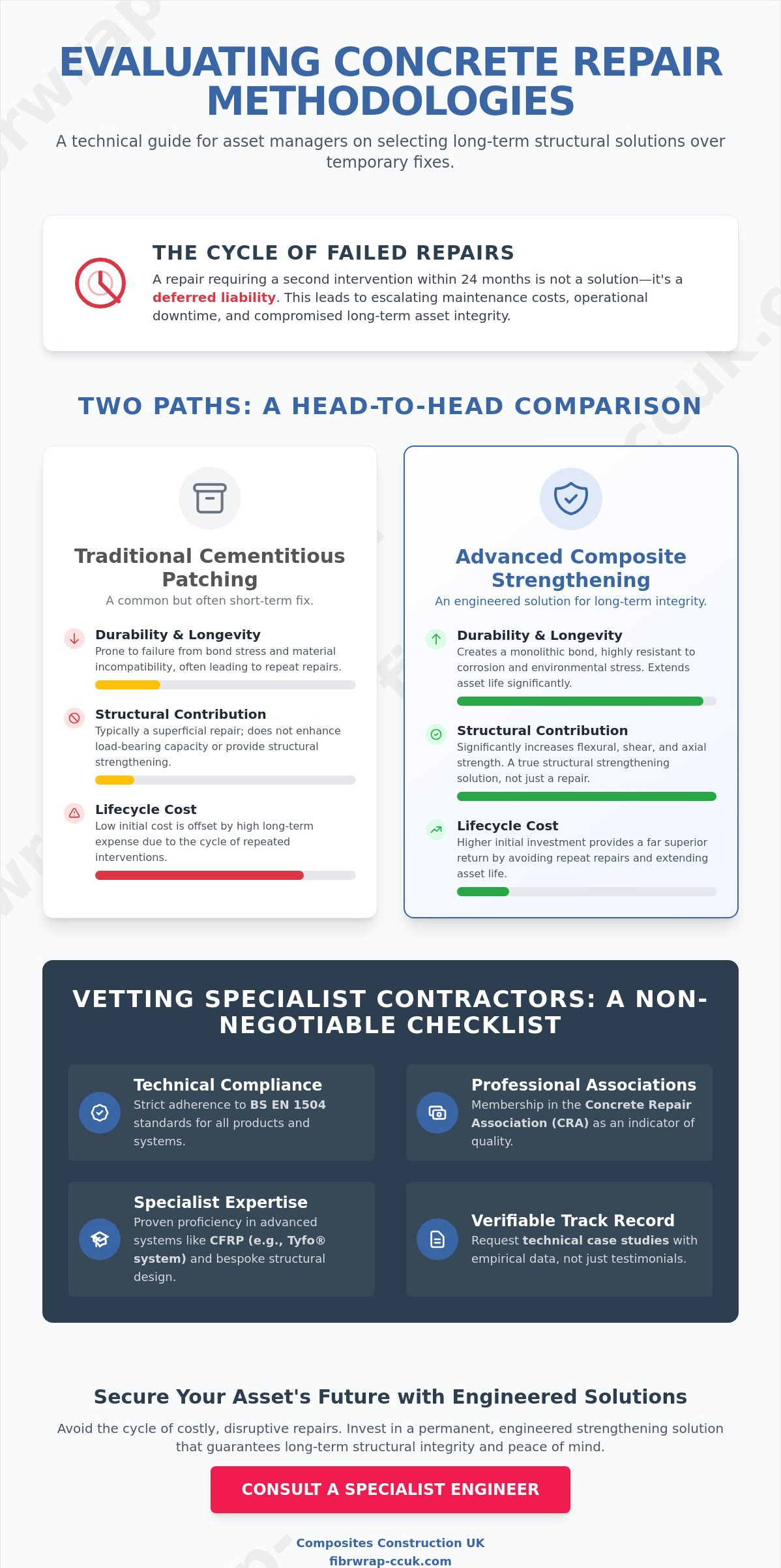
Evaluating Repair Methodologies: Traditional Patching vs Composite Strengthening
Traditional repair techniques often rely on hand-applied cementitious mortars to address surface-level spalling. Whilst these methods are suitable for minor cosmetic remediation, they frequently fail to address deep-seated structural deficiencies or re-establish the original load-bearing capacity of a member. Specialist Concrete Repair Association (CRA) members recognise that for major defects, relying solely on patching is often a temporary measure that requires repeated intervention within 5 to 10 years. Carbon Fibre Reinforced Polymer (CFRP) systems offer a more robust alternative, providing a permanent solution that restores tensile strength without the significant weight penalties associated with traditional steel plate bonding. For a detailed technical comparison of these methodologies and their alignment with current UK standards, the comprehensive guide to concrete repairs and structural remediation for UK infrastructure provides an in-depth framework for engineering-led decision making.
When concrete repair contractors London evaluate structural upgrades, the weight-to-strength ratio of the materials is a critical engineering consideration. Traditional steel plate bonding adds substantial dead load to the structure and requires intensive mechanical fixing. In contrast, CFRP systems possess a tensile strength up to 10 times that of steel while weighing roughly 80% less. This high-performance profile reduces the need for additional foundation strengthening. Analysis of life-cycle costs shows that whilst the initial outlay for composite systems may be higher than basic patching, the extension of asset life by 30 years or more provides a superior return on investment for asset managers.
The Tyfo® Fibrwrap® Advantage
The application of the Tyfo® Fibrwrap® installation guide ensures that structural strengthening meets rigorous seismic and axial load requirements. This system provides 360-degree confinement for failing columns, which is essential for preventing catastrophic failure in high-load environments. Because the material is thin and applied via wet-layup, it’s non-intrusive. Occupants often remain in the building during the works, which avoids the £10,000+ daily costs associated with full site closures in central London commercial districts.
When to Use Resin Injection and Leak Sealing
Structural remediation often begins with restoring monolithic integrity through high-pressure epoxy resin injection. This process fills cracks as narrow as 0.1mm, effectively “welding” the concrete back together. If active water ingress is detected, polyurethane injection is used because it reacts with water to form a flexible, expanding seal. Professional concrete repair contractors London frequently combine these injection techniques with CFRP wrapping. This dual-layered strategy ensures that the internal reinforcement is protected from corrosion whilst the exterior is strengthened against future mechanical stresses.
The Project Lifecycle: From Structural Survey to Professional Execution
Successful structural remediation isn’t a reactive process; it’s a data-driven sequence that begins long before the first chisel touches the substrate. When engaging concrete repair contractors London asset managers must prioritise the initial diagnostic phase. This ensures that the underlying causes of deterioration, such as carbonation or chloride ingress, are fully understood before any physical intervention occurs. A successful project relies on a tripartite alliance between the client, the consultant, and the specialist contractor. This collaboration facilitates a transparent flow of technical data, ensuring that the proposed methodology aligns with the structural requirements and the long-term asset life-extension goals of the building or infrastructure.
Operating in central London requires meticulous planning. Site logistics must account for restricted access, limited storage, and the proximity of neighbouring assets. Managing these variables without disrupting the local infrastructure is a hallmark of professional execution. Quality control measures are integrated into every stage, with pull-off tests and bond strength verification serving as empirical benchmarks for success. These tests ensure the repair material has achieved the required adhesion to the parent concrete, typically targeting a minimum tensile strength of 1.5 MPa for structural applications.
The Importance of Diagnostic Testing
Precision in repair begins with half-cell potential mapping, which is utilised to identify areas of hidden reinforcement corrosion by measuring the electrical potential of the steel. This is complemented by cover meter surveys, which are essential before any diamond drilling or cutting to prevent accidental damage to the reinforcement bars. Accurate data at this stage is the most effective tool for preventing scope creep. Where electrochemical corrosion activity is identified, engineers may specify cathodic protection as a long-term intervention to arrest reinforcement corrosion within UK infrastructure. Industry analysis indicates that thorough pre-repair testing can reduce unforeseen costs by up to 25% during the construction phase, as it allows for a fixed-price approach based on known quantities rather than estimates.
Execution and Temporary Works Design
Complex repairs often require specialist engineering consultancy to design temporary propping and shoring systems. This ensures structural stability whilst sections of compromised concrete are removed. During the removal process, noise, dust, and vibration are managed through high-pressure water jetting or vacuum-shrouded mechanical tools, adhering to strict Section 61 agreements under the Control of Pollution Act 1974. The final handover process includes a comprehensive health and safety file, detailing long-term warranties and maintenance schedules to ensure the continued integrity of the structural strengthening measures.
Secure the future of your infrastructure with data-backed engineering. Contact our technical team for a comprehensive structural survey.
Securing Long-Term Asset Integrity with CCUK’s Specialist Engineering
Asset life-extension is the primary goal of modern structural engineering, particularly within the dense urban environment of the capital. For asset managers evaluating concrete repair contractors London, the decision to rehabilitate rather than demolish reflects a commitment to both financial prudence and environmental stewardship. The carbon footprint reduction achieved by rehabilitating existing concrete structures is substantial; the construction industry is responsible for approximately 39% of global energy-related carbon emissions, and a significant portion of this is attributed to the production of new cement and steel. By utilising advanced structural strengthening techniques, the embodied carbon within the original frame is preserved. Carbon Fibre Reinforced Polymer (CFRP) strengthening allows buildings to be upgraded to meet new load requirements or revised building codes without the need for invasive structural alterations. This bespoke approach to structural strengthening effectively reduces the total cost of ownership by avoiding the capital-intensive cycle of demolition and reconstruction.
Sustainable Structural Solutions
The application of the Tyfo® system, for which CCUK is the exclusive UK licensee, provides a high-performance solution for ageing infrastructure. These composite materials offer a high strength-to-weight ratio and exceptional corrosion resistance, ensuring that the integrity of the asset is maintained for decades. When concrete repair contractors London are engaged to deploy these technologies, the result is a structure that often exceeds its original design specifications. This methodology aligns with the UK government’s Net Zero targets, as the environmental impact of a retrofit is typically 50% to 70% lower than that of a comparable new-build project. It’s a strategy that prioritises the longevity of existing materials through scientific intervention.
Partnering with CCUK for London Infrastructure
Managing complex concrete remediation requires a seamless integration of engineering design and site execution. CCUK provides a comprehensive design-and-install contract, which eliminates the friction often found between separate consultants and contractors. This single point of responsibility ensures that structural integrity is maintained from the initial assessment through to the final application of the composite system. Asset managers gain significant peace of mind knowing that the technical risks are managed by a global leader with a deep understanding of local regulatory standards. For those overseeing critical infrastructure or high-value commercial assets, the long-term security provided by expert engineering is an essential investment. We encourage asset managers to contact our engineering team for a feasibility study to determine the most effective strategy for their portfolio.
Securing the Future of London’s Structural Infrastructure
Selecting the most qualified concrete repair contractors London offers requires a methodical evaluation of technical compliance and engineering depth. Adherence to the BS EN 1504 standard remains the baseline for any structural remediation project; this ensures that materials and methods meet rigorous safety benchmarks. It’s vital to partner with specialists who maintain in-house structural design teams, as this eliminates the fragmentation often found between initial structural surveys and the final execution of repairs.
Fibrwrap Construction UK provides a distinct advantage as the exclusive UK licensee for Tyfo® Fibrwrap® systems, offering high-performance carbon fibre reinforced polymers for complex structural strengthening. Our track record includes the successful delivery of remediation works on critical UK infrastructure and sensitive heritage assets, where the focus remains on asset life-extension rather than costly replacement. By prioritising engineering rigour and advanced material science, asset managers can protect the long-term integrity of their portfolios.
Request a Technical Feasibility Study for Your Asset to begin your project with engineering certainty. We’re ready to assist in safeguarding your structural investments.
Frequently Asked Questions
How much do concrete repair contractors in London typically charge?
Professional rates for specialist concrete repair contractors in London are determined by project complexity and the specific technical requirements of the site. According to the BCIS 2023 data, day rates for skilled operatives in the capital typically range between £250 and £450 per person. Total project expenditure depends on the volume of structural remediation required and the chosen materials, such as high-performance mortars or advanced composite systems.
What is the difference between concrete spalling and structural cracking?
Concrete spalling is a surface-level degradation where the outer layer flakes away, usually triggered by the expansion of corroding reinforcement steel within the substrate. Structural cracking involves deep fissures that penetrate the core of the element, which often indicates that the load-bearing capacity of the asset’s compromised. Both conditions necessitate a professional assessment to determine the most effective structural strengthening strategy to prevent further moisture or chloride ingress.
Is carbon fibre strengthening better than traditional steel plate bonding?
Carbon fibre reinforced polymers (CFRP) offer superior performance over steel plate bonding due to their exceptional strength-to-weight ratio and inherent resistance to corrosion. Whilst steel plates are effective, they’re heavy and require mechanical fixings that can further damage the concrete. Systems like the Tyfo® system provide a lightweight, non-corrosive solution that’s often installed 30% faster than traditional methods, making it ideal for constrained London environments.
How long does a typical CFRP concrete repair last?
A professionally installed CFRP repair is engineered to match or exceed the remaining service life of the original structure, typically offering a design life of 50 years or more. Research published in the Concrete Society Technical Report 55 confirms that these composite materials maintain their mechanical properties under diverse environmental conditions. This longevity is a core component of asset life-extension strategies, as it significantly reduces the need for future maintenance cycles.
Can concrete repairs be carried out whilst the building is still in use?
Specialist concrete repair contractors in London often execute structural remediation projects whilst buildings remain fully operational to minimise commercial downtime. By utilising low-noise equipment and advanced materials like CFRP, which require minimal heavy machinery, disruption to occupants is kept to a minimum. Phased delivery schedules are typically implemented to ensure that essential services and access routes remain safe and accessible throughout the strengthening works.
What are the most common causes of concrete failure in UK infrastructure?
The primary causes of concrete failure in the UK are carbonation and chloride-induced reinforcement corrosion, particularly in structures built between 1950 and 1980. Data from the Standing Committee on Structural Safety suggests that inadequate cover to reinforcement and exposure to de-icing salts are the most frequent contributors to premature degradation. These chemical processes lead to the internal expansion of steel rebar, which forces the surrounding concrete to crack and spall, a process whose full technical implications for structural integrity are critical for asset managers to understand.
Do I need a structural engineer before hiring a concrete repair contractor?
It’s vital to engage a qualified structural engineer to conduct a comprehensive condition survey and provide a technical specification before appointing a contractor. An engineer’s report ensures that the root cause of the failure is identified rather than just the visible symptoms. This detailed foundation allows contractors to provide accurate tenders for bespoke structural strengthening solutions aligned with engineering-led concrete repairs that comply with current UK Building Regulations and Eurocodes.


