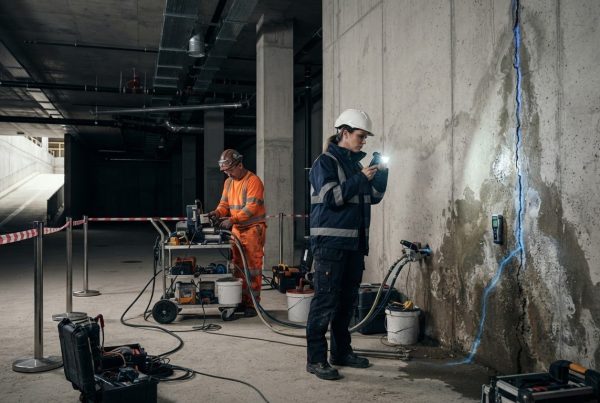


Can a primary structural element sustain a 25% reduction in its critical shear zone for new utility ducts without the requirement for invasive, heavy-duty steel plate bonding? Most structural engineers understand that the introduction of service penetrations into existing reinforced concrete members risks compromising the original design intent, especially when spatial limitations prevent traditional reinforcement methods from being implemented effectively. This technical guide outlines the rigorous methodology for strengthening concrete beams for new openings through the application of carbon fibre reinforced polymers (CFRP), ensuring that structural integrity is maintained in accordance with Eurocode 2 and UK building regulations. By adopting advanced composite solutions such as the Tyfo® system, the necessity for site disruption is significantly reduced while long-term asset life-extension is secured. We’ll explore the specific material properties, bond strength requirements, and design considerations necessary to accommodate new service penetrations without jeopardising the safety of the infrastructure or the capacity of the original section.
Key Takeaways
- Understand how geometric discontinuities from new penetrations alter nonlinear stress distributions and necessitate the management of secondary bending moments within the beam chords.
- Evaluate the performance advantages of Carbon Fibre Reinforced Polymers (CFRP) over traditional steel, specifically regarding superior strength-to-weight ratios and the mitigation of site logistical complexities.
- Identify the critical stages of the engineering workflow, from utilizing non-destructive testing for reinforcement mapping to executing bespoke calculations for strengthening concrete beams for new openings.
- Discover how the application of the Tyfo® system facilitates structural remediation in complex commercial retrofits, prioritising long-term asset life-extension through advanced materials science.
The Structural Implications of Creating New Openings in Reinforced Concrete Beams
The requirement for retrospective modifications to structural elements is frequently driven by the modernization of building services. HVAC upgrades, utility rerouting, and the large-scale repurposing of commercial assets—such as when project teams explore Rational iCombi Pro solutions for high-spec catering facilities—necessitate these penetrations to ensure continued operational relevance. While these changes are vital for asset life-extension, the creation of a void in a reinforced concrete beam introduces a severe geometric discontinuity. This disruption alters the internal stress paths, causing a highly nonlinear stress distribution across the remaining beam depth. It’s a complex engineering challenge that demands precision. Simple “hole-cutting” without a pre-emptive strategy for strengthening concrete beams for new openings leads to an immediate loss of stiffness and potential localized failure. In the UK, these structural modifications are strictly governed by the Building Regulations 2010. Engineers must ensure compliance with BS EN 1992-1-1 to maintain the safety and long-term security of the built environment.
Identifying Critical Zones for Beam Penetrations
Positioning is the most decisive factor in preserving a beam’s residual capacity. Openings in the tension zone primarily compromise the tensile reinforcement, while those in the compression zone reduce the concrete’s ability to resist axial crushing. Shear-critical regions, usually located within a distance of twice the beam depth from the supports, represent the highest risk for new penetrations. These voids interfere with the diagonal compression struts required for shear transfer. To avoid the coalescence of stress concentrations, multiple service penetrations should maintain a minimum clear spacing of 300mm or three times the opening diameter. Detailed technical analysis is often required through our bespoke design features to ensure every modification remains within safe performance limits.
Common Failure Modes Associated with Unreinforced Openings
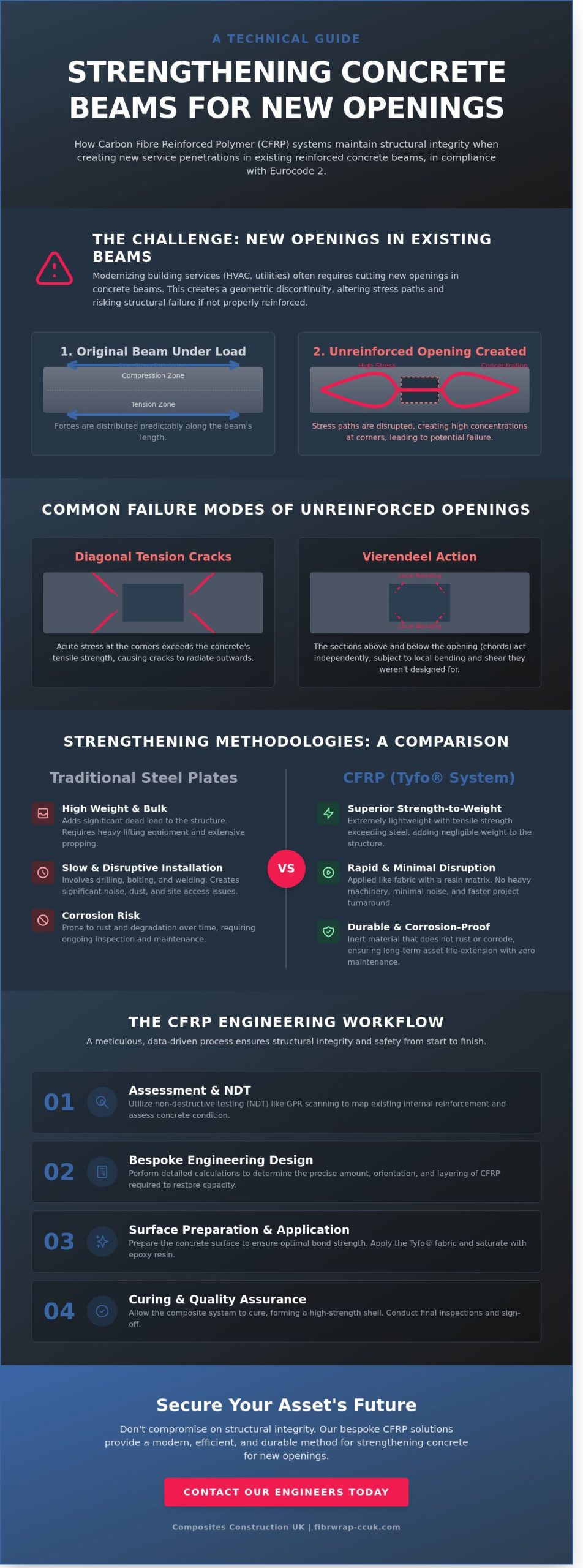
Unreinforced openings often trigger diagonal tension cracks that originate from the corners of the penetration. These cracks are a direct result of acute stress concentrations that exceed the tensile strength of the concrete. If an opening is large enough to remove a significant portion of the compression flange, the flexural capacity of the member is drastically reduced. In cases involving large rectangular openings, the beam often transitions into “Vierendeel” action. This occurs when the segments above and below the opening must resist local bending and shear independently. Such mechanisms cause premature failure if the remaining chords aren’t specifically reinforced to manage these secondary moments. Effective strengthening concrete beams for new openings is the only way to restore the load-bearing integrity of the original design and prevent catastrophic structural remediation requirements later in the asset’s life cycle.
Technical Mechanisms: Stress Redistribution and Reinforcement Theory
The introduction of a void into a monolithic reinforced concrete beam fundamentally alters the internal stress field. Forces that previously followed linear trajectories are forced to deviate around the opening, creating high stress concentrations at the corners. This phenomenon, often referred to as the Vierendeel effect, induces secondary bending moments and shear forces within the chords located above and below the aperture. The remaining cross-sectional area is reduced, which typically causes a shift in the neutral axis and a corresponding decrease in the section modulus. Research into strengthening beams with openings has demonstrated that without intervention, these localized stresses can exceed the design capacity of the original reinforcement, leading to brittle failure modes.
It’s critical to recognize that traditional steel reinforcement can’t be integrated internally once the concrete matrix has cured. Drilling and grouting additional rebar into a live structural member is often impractical and fails to provide the necessary continuity for global load paths. Consequently, strengthening concrete beams for new openings requires external systems that can be bonded to the exterior surface to assume the tensile and shear demands that the internal steel can no longer support alone.
Shear Strengthening Requirements for Web Openings
The removal of vertical stirrups during the coring process necessitates a calculated replacement of shear capacity. Engineers must determine the precise area of external Carbon Fibre Reinforced Polymer (CFRP) required to bridge the gap in the original shear reinforcement layout. The implementation of “U-wrap” configurations is standard practice for restoring shear transfer, as these wraps provide the necessary confinement to the beam’s web. Within the Tyfo® Fibrwrap® system framework, shear transfer is defined as the mechanical mechanism by which transverse loads are effectively redistributed across the discontinuity through the high tensile modulus of the composite laminate.
Flexural Compensation and Crack Control
Restoring the flexural capacity of a compromised beam involves the application of longitudinal CFRP strips to the beam soffit. These strips act as external tension reinforcement, compensating for any longitudinal bars that were severed or for the increased demand caused by the reduced effective depth. Stress concentrations at the 90-degree corners of the opening are managed using diagonal composite reinforcement, which arrests the development of shear cracks that typically initiate at these high-stress points. Managing deflection limits is essential in occupied structures to prevent serviceability failures, such as cracking in non-structural partitions. By utilizing the bespoke design features of composite materials, engineers ensure that the post-strengthened member meets or exceeds its original performance criteria.
Comparing Strengthening Methodologies: CFRP vs. Traditional Steel
The selection of a reinforcement strategy for structural remediation is governed by material performance, site accessibility, and long-term durability. When evaluating carbon fibre reinforced polymers (CFRP) against structural steel, the strength-to-weight ratio remains the most compelling metric. Carbon fibre provides a tensile strength that often exceeds 3,000 MPa, whereas standard S355 structural steel offers a yield strength of 355 MPa. This disparity allows engineers to achieve the necessary load-bearing capacity with a fraction of the material mass. In modern engineering contexts, CFRP vs. traditional strengthening techniques have been studied extensively to determine their efficacy in high-stress environments, often proving that composites offer superior fatigue resistance and lower lifecycle costs.
Installation logistics further differentiate these methodologies. Steel requires heavy lifting equipment, specialized welding or bolting, and often, significant temporary propping to manage the weight of the plates during installation. Conversely, CFRP systems are lightweight and applied manually, which is advantageous in confined service voids where ceiling heights are restricted. The low-profile nature of a 1.2mm carbon laminate ensures that architectural clearances and service runs aren’t obstructed. For projects requiring strengthening concrete beams for new openings, these spatial considerations are often the deciding factor in material selection, as they prevent the need for costly modifications to existing ductwork or plumbing.
Traditional Steel Plate Bonding and Bolting
The use of steel plates involves mechanical anchoring, which presents inherent risks to the existing structure. Precision drilling is required to avoid damaging internal reinforcement bars; however, the density of rebar in older concrete beams makes this a complex task. The addition of heavy steel sections also increases the dead load on the foundation and supporting columns, potentially necessitating further remedial work elsewhere. Steel is prone to corrosion, so it requires ongoing maintenance and protective coatings, especially in industrial or coastal environments where moisture ingress is a constant threat. Fireproofing requirements also demand the application of thick intumescent paint, which increases the physical footprint of the installation.
Advanced Composite Strengthening with Tyfo® Fibrwrap®
The Tyfo® Fibrwrap® system offers a bespoke approach to structural integrity, where the composite layout is tailored to the specific stress concentrations created by a new opening. The material’s flexibility before curing allows it to be wrapped around complex beam geometries with a precision that rigid steel cannot match. This adaptability results in a 70% reduction in site downtime compared to traditional steelwork, as it eliminates the need for heavy plant and extensive site preparation. Detailed specifications on system application and material properties are available in the Tyfo® Fibrwrap® Installation: A Technical Guide. Asset managers use these composite solutions to ensure the long-term sustainability of the structure through a corrosion-resistant, maintenance-free finish that preserves the beam’s capacity for strengthening concrete beams for new openings without compromising the building’s aesthetic or functional space.
The Engineering Workflow: Designing and Installing Reinforcement
Structural integrity during modification depends on a rigorous, data-driven sequence. The process initiates with a comprehensive structural survey and non-destructive testing (NDT), typically employing Ground Penetrating Radar (GPR) to map internal reinforcement with 98% accuracy. These findings inform the bespoke engineering calculations required for strengthening concrete beams for new openings, ensuring that the redistribution of loads remains within the safety limits defined by Eurocode 2 or ACI 440 standards. It’s critical that the design accounts for both the loss of cross-sectional area and the concentration of shear forces at the corners of the new void.
Phase 1: Feasibility and Design Features
Engineers utilize bespoke design features to simulate stress concentrations around the proposed void before any concrete is removed. This advanced modelling determines whether High Modulus (HM) CFRP is necessary for deflection control or if High Strength (HS) fibres are sufficient for flexural enhancement. For projects requiring high-precision visualization of complex ductwork or bespoke structural components, collaborating with 3D design specialists like Protomolecule can further refine the coordination between structural and M&E teams. Coordination with M&E contractors ensures the opening dimensions, often specified to within 5mm tolerances, align with the structural capacity of the modified beam. This phase eliminates the risk of utility conflicts that might otherwise necessitate mid-project design revisions.
Success in these projects relies heavily on the concrete substrate’s integrity. Surfaces are prepared to an ICRI CSP 3 profile through mechanical grinding to remove laitance and contaminants. Quality control involves pull-off tests, where a minimum tensile strength of 1.5 MPa is verified before application. Resin cure monitoring ensures the polymer matrix achieves full chemical cross-linking, typically within 24 to 72 hours depending on ambient temperatures and humidity levels.
Phase 2: Professional Installation and Validation
Installation follows a methodical, step-by-step protocol to ensure the Tyfo® system performs as intended. A primer is applied to the prepared substrate, followed by a tack coat of epoxy saturant. Carbon fibre sheets are then impregnated and hand-laid. Specific attention is given to the 150mm overlap requirements and anchoring details that prevent debonding under peak loads. It’s this precision in the application of strengthening concrete beams for new openings that guarantees the long-term performance of the composite repair.
Once the installation is validated, a final inspection confirms the work meets the original design intent. Detailed handover documentation is provided for the building’s structural health record, ensuring long-term asset traceability and compliance with UK building regulations. This methodical approach ensures that the service life of the asset is extended without compromising safety.
For technical guidance on project-specific requirements, contact the engineering team at Fibrwrap Construction UK for a specialist structural consultation.
Bespoke Composite Solutions for Complex Structural Modifications
The application of Carbon Fibre Reinforced Polymer (CFRP) in complex commercial retrofits demands a level of precision that generic strengthening methods cannot provide. When strengthening concrete beams for new openings, a one-size-fits-all methodology fails because it ignores the localized stress concentrations created by the removal of structural mass. Each beam possesses a unique history of loading and degradation; therefore, the reinforcement strategy must be tailored to the specific residual capacity of the member. In high-rise environments where space is at a premium, the thin profile of composite materials allows for significant capacity increases without the geometric constraints of traditional steel sections.
Modern engineering standards in the UK, including BS EN 1992-1-1, necessitate a rigorous approach to fire safety when using composites. Integrating fire protection systems with CFRP is a critical requirement to ensure the structural integrity of the building during a thermal event. By applying specialized intumescent coatings or cementitious fire-resistant mortars, these composite systems can achieve fire ratings of up to 240 minutes, meeting the stringent demands of commercial insurers and building control officers.
Asset Life-Extension through Structural Remediation
Structural remediation is a cornerstone of the UK’s commitment to reducing construction-related carbon emissions. By avoiding the demolition of existing elements, asset managers can bypass the heavy carbon debt associated with new concrete and steel production. Research indicates that structural strengthening can reduce the total material costs of a project by approximately 35% to 50% compared to total beam replacement. This economic efficiency is particularly relevant in the current UK market, where material price volatility remains a concern for developers. Tyfo® systems provide a scientifically validated means of enhancing structural performance, ensuring that essential infrastructure remains functional and sustainable for decades beyond its original design life.
In a 2023 retrofit of a 15-storey commercial asset in London, the requirement for new high-speed data cabling necessitated 250mm diameter penetrations through primary concrete beams. Traditional steel bracing was rejected due to the risk of clashing with existing HVAC ducting. The implementation of bespoke CFRP laminates provided the necessary shear and flexural reinforcement, allowing the project to proceed without any reduction in the floor-to-ceiling heights required by the premium tenants.
Partnering with a Specialist Engineering Contractor
The transition from a theoretical design to a successful site installation requires a specialist contractor who understands the nuances of advanced material science. CCUK provides an end-to-end service, managing everything from initial design consultancy to the final application of protective finishes. This holistic approach ensures that the design intent is strictly maintained throughout the construction phase, reducing the risk of coordination errors between disparate parties.
Managing structural works within a live office or retail environment requires meticulous logistical planning. CCUK utilizes low-noise and low-vibration techniques to ensure that the building remains operational during the strengthening process. Often, works are scheduled during night shifts or phased across different floors to minimize the impact on daily commercial activities. This level of operational discipline is essential for maintaining the safety and comfort of building occupants while delivering critical structural upgrades. Contact our engineering team for a technical consultation on your next project.
Securing Future Asset Performance Through Engineered Composite Solutions
The successful modification of reinforced concrete elements depends on a rigorous understanding of stress redistribution and the application of high-performance materials. It’s demonstrated that the Tyfo® Fibrwrap® system provides a lightweight, non-corrosive alternative to traditional steel section replacement. This methodology ensures that strengthening concrete beams for new openings is achieved without the significant weight penalties or installation complexities associated with 20th-century reinforcement techniques. With over 30 years of global performance data supporting the Tyfo® system, these bespoke composite solutions are developed through our comprehensive in-house structural design and engineering expertise. Fibrwrap Construction UK operates as the exclusive UK licensee for these advanced materials, maintaining a proven track record across the UK infrastructure and commercial sectors. We’re committed to the principles of asset life-extension, providing a sustainable and scientifically validated path for complex structural modifications. Our team is ready to assist in navigating the technical requirements of your next project to ensure long-term structural security.
Request a Technical Assessment for Your Beam Strengthening Project
Frequently Asked Questions
Is it always possible to strengthen a concrete beam for a new opening?
Feasibility isn’t guaranteed and depends on the remaining cross-sectional area when strengthening concrete beams for new openings. If the proposed opening exceeds 30% of the total beam depth, the structural integrity may be compromised beyond the limits of composite remediation. A detailed finite element analysis is required to determine if the load path can be redistributed safely without risking sudden failure.
How much does CFRP strengthening cost compared to traditional steel?
While material costs for carbon fibre are higher than steel, the total project cost for CFRP is often 20% to 30% lower when accounting for labor and specialized equipment. Steel requires heavy lifting machinery and mechanical fixings, whereas the Tyfo® system utilizes lightweight materials that reduce site overheads. It’s a more efficient solution for constrained environments where access is limited.
What is the maximum size an opening can be in a reinforced concrete beam?
Openings are generally limited to 25% of the beam’s total depth to ensure the compression zone remains functional. When strengthening concrete beams for new openings, the hole must also be positioned within the middle third of the span to avoid critical shear zones near the supports. Exceeding these parameters typically requires secondary support structures or extensive structural remediation to maintain the load path.
How long does the CFRP installation process take for a single beam?
A standard application of the Tyfo® system for a single beam is typically completed within 48 to 72 hours. This timeframe includes surface preparation through abrasive blasting, the application of primer, and the hand-layup saturation of the fibre. Full structural cure is achieved in 7 days, though the system gains 90% of its design strength within the first 24 hours of curing.
Does the building need to be vacated during the strengthening work?
Building occupants don’t usually need to vacate because the installation process is non-disruptive and vibration-free. Unlike traditional steel plate bonding, which requires drilling for heavy mechanical anchors, CFRP application is quiet and requires minimal clearance. This allows 100% of the facility to remain operational during the structural strengthening process, which is a critical advantage for commercial assets and infrastructure.
Can CFRP be used for both circular and rectangular beam openings?
The Tyfo® system is effectively utilized for both circular and rectangular geometries without compromising performance. Rectangular openings require a 50mm radius corner grinding to prevent stress concentrations in the carbon fibre wrap. Circular openings are often preferred in engineering designs as they provide a more uniform stress distribution and simplify the application of composite materials during the reinforcement process.
What are the fire rating requirements for CFRP strengthened beams in the UK?
Structural elements must comply with BS 476 or EN 13381-10 standards, typically requiring a 60 to 120-minute fire resistance rating. Because CFRP loses structural capacity at the glass transition temperature of approximately 65°C to 80°C, a cementitious or intumescent fire protection layer must be applied over the composite. It’s essential to meet UK Building Regulations to ensure long-term safety and compliance.
How do I know if my concrete beam requires shear or flexural strengthening?
The requirement is determined by the location of the new opening relative to the beam’s internal forces. If an opening is placed within the first 25% of the span from the supports, shear strengthening via vertical U-wraps is mandatory. If the opening is located mid-span, flexural strengthening using longitudinal CFRP laminates is required to compensate for the loss of tension reinforcement.