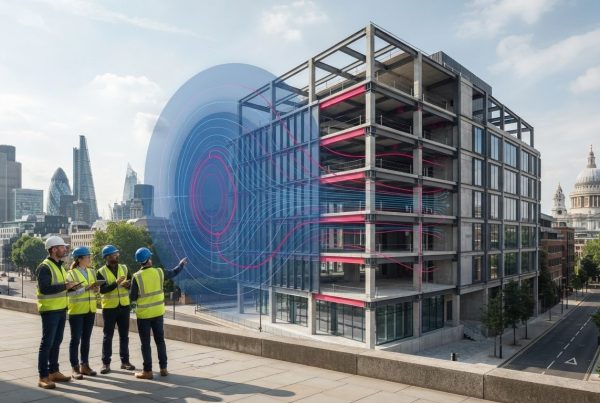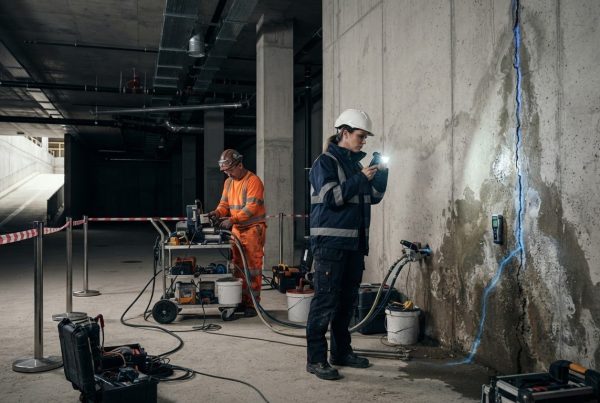

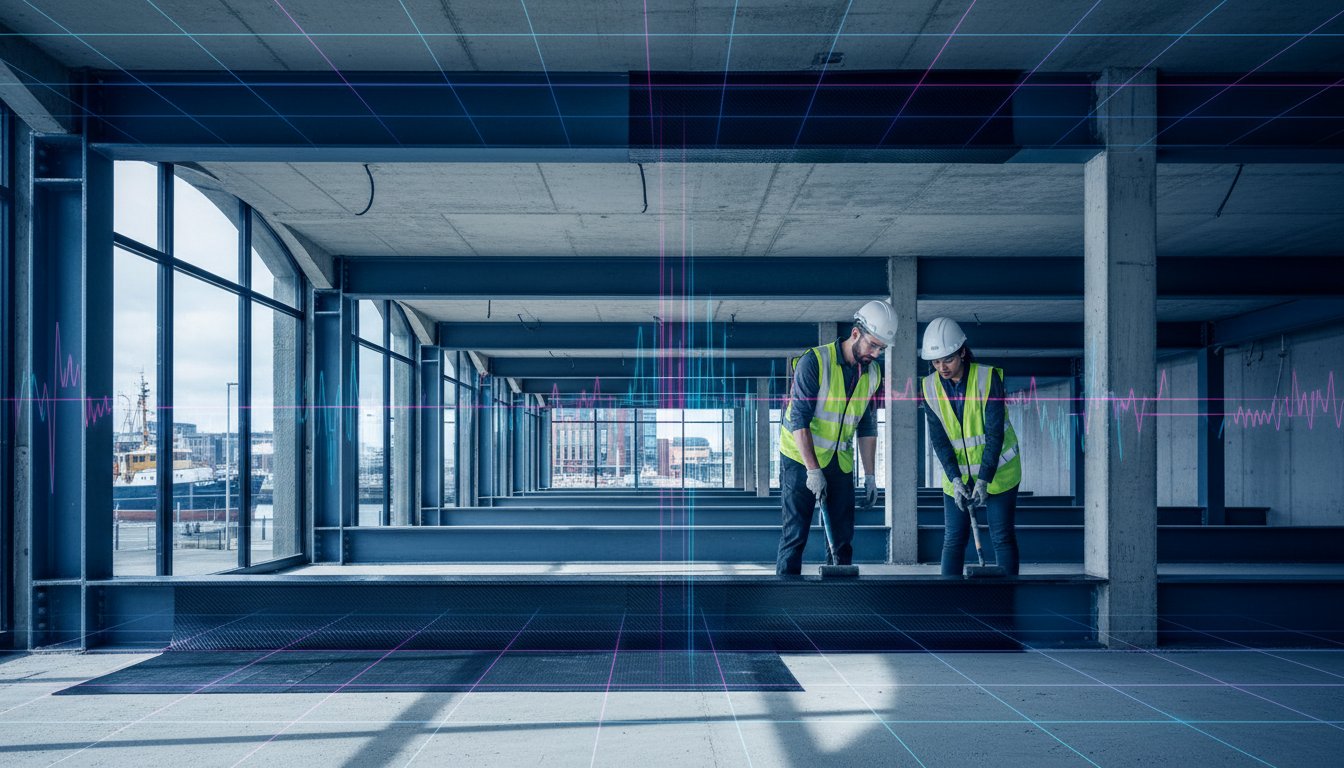
Can a structural slab that meets every statutory safety requirement still be considered an engineering failure? For asset managers overseeing high-spec commercial developments in the UK, the answer is often found in the sensitive optics of a microscope or the persistent discomfort of office occupants. It’s widely understood that traditional building codes primarily address strength and safety, yet they frequently overlook the serviceability criteria necessary for modern, high-performance environments. When sensitive laboratory equipment or server arrays are introduced to older steel-frame buildings, identifying effective solutions for excessive floor vibration becomes a critical priority to maintain operational continuity.
This guide provides a detailed technical framework for diagnosing these dynamic issues and implementing remediation strategies that comply with BS 6472-1:2008. We’ll examine how advanced carbon fibre reinforced polymers and the proprietary Tyfo® system offer a lightweight alternative to traditional steel plating, ensuring that structural strengthening is achieved without compromising the existing foundation’s load capacity. By integrating empirical vibration analysis with bespoke composite applications, it’s possible to restore serviceability and extend the asset’s life-cycle by up to 25 years. This review covers everything from initial modal testing to the final verification of damping performance.
Key Takeaways
- Understand how modern long-span steel and composite systems may exceed Serviceability Limit States (SLS), necessitating precise engineering interventions to restore structural integrity.
- Evaluate the critical interplay between natural frequency, structural stiffness, and mass to identify the root causes of resonance within commercial floor slabs.
- Compare the efficacy of traditional remedial methods against advanced solutions for excessive floor vibration, focusing on the mitigation of dead-load implications and foundation stress.
- Learn the methodology for conducting comprehensive structural surveys and dynamic modal analysis to accurately quantify real-world acceleration and specify bespoke strengthening designs.
- Discover the technical advantages of the Tyfo® Fibrwrap® system, a carbon fibre reinforced polymer (CFRP) solution engineered for high-performance structural strengthening and asset life-extension.
Understanding the Causes and Risks of Excessive Floor Vibration
The structural integrity of a building isn’t typically compromised by floor vibration, yet its impact on Serviceability Limit States (SLS) remains a critical concern for modern engineering. As architectural trends favour open-plan layouts and long-span composite steel decks, the inherent damping of these structures has decreased. These lightweight systems are susceptible to resonance when excited by external or internal forces. Understanding the foundational floor vibration principles, such as natural frequency and damping ratios, is essential for diagnosing why a floor fails to meet comfort criteria. When these parameters aren’t managed, the need for bespoke solutions for excessive floor vibration becomes a priority to maintain the asset’s functional purpose and long-term value.
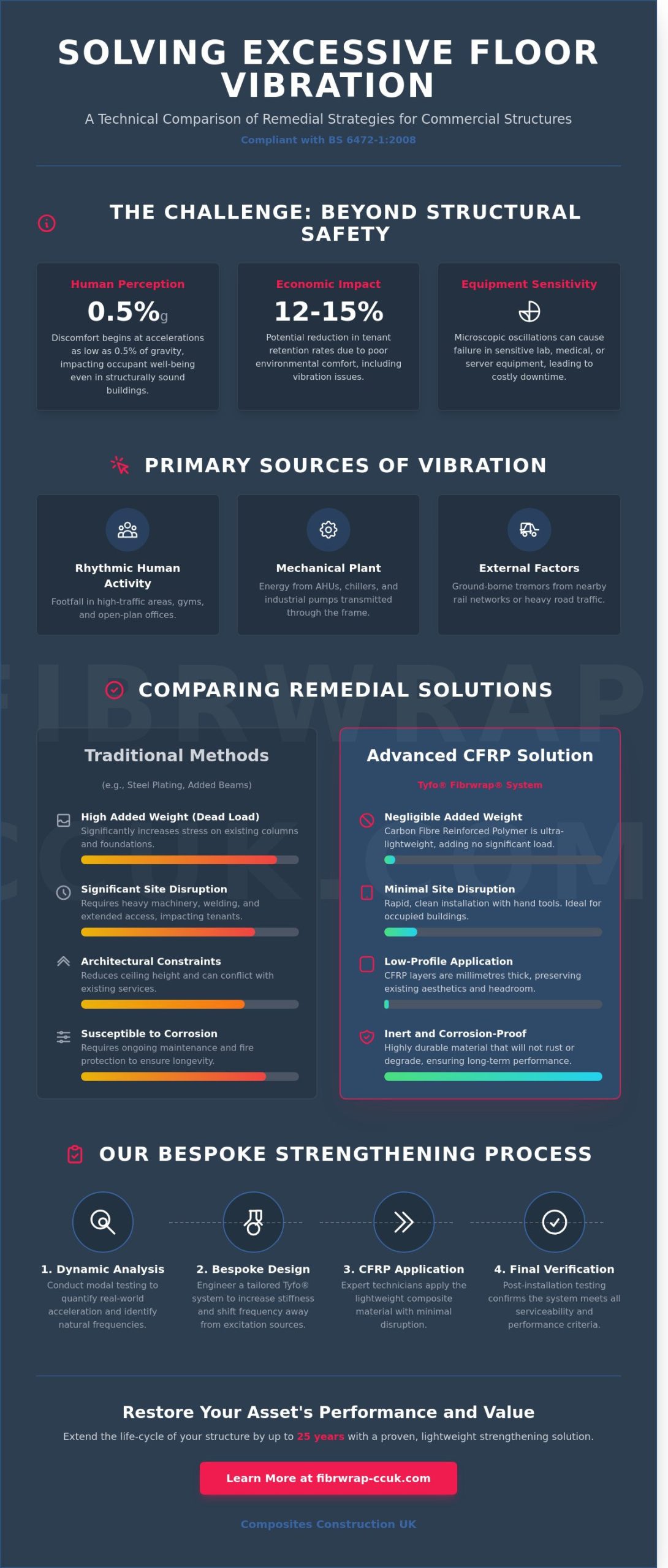
Human perception is remarkably sensitive to vertical acceleration, with discomfort often beginning at levels as low as 0.5% of the acceleration due to gravity. While a floor might be perfectly safe from a load-bearing perspective, the psychological impact on occupants can be profound. In commercial settings, this sensitivity often dictates the threshold for intervention. For high-precision environments like surgical theatres or semiconductor facilities, the tolerance for motion is even tighter, where even microscopic oscillations lead to equipment failure or data corruption. Addressing these issues early through structural strengthening ensures that the building remains fit for its intended use without requiring a complete replacement of the floor assembly.
The economic ramifications of unaddressed vibration are significant. Data from UK commercial property surveys suggests that poor environmental comfort, including vibrational issues, contributes to a 12% to 15% reduction in tenant retention rates. When vibrations interfere with sensitive laboratory hardware, the resulting downtime can cost an enterprise thousands of pounds per hour. Investing in solutions for excessive floor vibration is therefore a strategy for asset life-extension, protecting the financial viability of the infrastructure.
Common Sources of Vibration in UK Infrastructure
- Rhythmic human activity: Footfall in high-occupancy offices or synchronous movement in gymnasiums creates periodic forces that match a floor’s natural frequency.
- Mechanical plant vibration: Air handling units (AHUs), chillers, and industrial pumps, often situated on roof levels, transmit energy through the primary frame.
- External environmental factors: Proximity to the UK’s dense rail network or heavy haulage routes introduces ground-borne tremors that penetrate even robust foundations.
Regulatory Standards and Comfort Criteria
Evaluation of human exposure in the UK is governed by BS 6472-1, which establishes the Vibration Dose Value (VDV) as the primary metric for assessment. This standard allows engineers to quantify the cumulative vibration experienced over a 16-hour day or 8-hour night period. Response Factors (R) are also employed to compare measured acceleration against the base curve of human perception. The Serviceability Limit State for floor acceleration is defined as the maximum allowable peak or RMS acceleration that ensures the comfort of occupants and the functional stability of sensitive equipment.
The Engineering Principles of Structural Vibration Control
The structural integrity and serviceability of a floor system are governed by the interaction between mass, stiffness, and the resulting natural frequency. In civil engineering, the fundamental frequency ($f_n$) of a floor slab is determined by the square root of the ratio of its stiffness ($k$) to its mass ($m$). When external forces, such as human footfall or mechanical equipment, provide an excitation frequency that aligns with the floor’s natural frequency, resonance occurs. This phenomenon leads to amplified oscillations that often exceed the comfort criteria defined in standards such as CCIP-016 or SCI P354.
Effective solutions for excessive floor vibration require a precise shift in these physical properties to move the system away from the resonance zone. A common misconception in structural remediation is that adding mass, such as a concrete topping, will automatically stabilise a floor. While mass can increase inertia, it simultaneously lowers the natural frequency. If the frequency drops into the 1.5 Hz to 3.0 Hz range typical of human walking, the vibration response can actually intensify. Therefore, engineering focus is usually directed towards increasing stiffness or enhancing damping characteristics to dissipate kinetic energy.
Increasing Natural Frequency Through Stiffness
The objective of structural reinforcement is to shift the natural frequency upwards, ideally beyond the range of common excitation. This is achieved by increasing the moment of inertia or the modulus of elasticity of the floor components. High-modulus materials, such as the Tyfo® system, allow for structural strengthening that adds significant stiffness with negligible increases in dead load. Scientific analysis of structural design for floor vibrations indicates that for composite floor slabs, the fundamental frequency is highly sensitive to the continuity of the spans and the connection between the slab and the supporting beams. By bonding carbon fibre reinforced polymers to the tension face of a slab, the effective stiffness is heightened, which can elevate the natural frequency by 15% to 20% in many commercial applications.
Damping Mechanisms: Passive vs. Active
Damping represents the rate at which energy is dissipated within the structural system. Material damping is inherent but often insufficient in modern, lightweight steel and concrete composite structures. Passive damping solutions, such as Tuned Mass Dampers (TMDs), involve a secondary mass attached via a spring and dashpot. These are effective for specific, narrow-frequency ranges but often lack the versatility required for multi-frequency environments or changing occupancy loads.
For high-performance buildings where precision is paramount, Active Mass Damping (AMD) systems have emerged. These utilise sensors and actuators to provide real-time counter-forces. While effective, these systems require ongoing maintenance and power. For most asset managers, a more sustainable approach involves permanent solutions for excessive floor vibration through advanced material science. If you are managing a facility with sensitive equipment or high footfall, exploring bespoke structural strengthening solutions from Composites Construction UK can provide the permanent, advanced material science interventions required to ensure comfort and operational integrity.
Comparing Remedial Solutions for Structural Floor Vibration
Remediation of floor resonance requires a precise calibration of mass, stiffness, and damping. While traditional engineering often relies on increasing the section size of structural members, these interventions often introduce secondary complications that compromise long-term asset integrity. Selecting the correct solutions for excessive floor vibration depends on the specific dynamic characteristics of the building and the operational requirements of the occupants.
Traditional Methods and Their Limitations
Steel plate bonding was historically the primary choice for structural strengthening. However, the installation of heavy steel sections in occupied commercial spaces presents significant logistical hurdles. It’s common for steel plates to require intensive mechanical anchoring; this process creates substantial dust and noise disruption. The addition of significant dead loads often necessitates a comprehensive review of the building’s global stability. In many 1970s-era reinforced concrete structures, foundations weren’t designed to accommodate the 15% to 20% increase in mass often associated with traditional steel or concrete section enlargement. Corrosion remains a persistent concern. Exposed steel requires regular maintenance and specialist protective coatings to prevent oxidation, particularly in industrial environments where chemical exposure is a risk factor.
Advanced Composite Solutions (CFRP)
Advanced materials offer more sophisticated solutions for excessive floor vibration. Carbon Fibre Reinforced Polymer (CFRP) systems, such as the proprietary Tyfo® system, provide an exceptional strength-to-weight ratio. These composites increase flexural stiffness without adding significant mass. It’s a critical distinction because adding mass can inadvertently lower the natural frequency of a floor, potentially worsening vibration issues in certain frequency ranges. CFRP applications typically add less than 5mm to the profile of a beam or slab. This preserves floor-to-ceiling heights in retrofits where every centimetre of headroom is valuable for building services. The material is inherently non-corrosive. It’s a sustainable approach that prioritises the extension of asset life over invasive and carbon-heavy reconstruction. Structural strengthening using composites allows for targeted application, focusing reinforcement exactly where the modal analysis indicates the highest stress concentrations.
Electronic damping systems, or active mass dampers, represent a different category of intervention. These are often reserved for high-specification environments like laboratories or precision manufacturing facilities where structural modifications alone aren’t sufficient. While they’re effective at cancelling out specific frequencies through counter-vibration, they require a constant power supply and ongoing electronic calibration. Structural remediation using CFRP remains the preferred method for most commercial and industrial applications. It provides a passive, permanent improvement to the structural performance of the floor plate without the need for mechanical maintenance.
Specifying a Bespoke Solution: The Structural Survey and Design Process
The remediation of vibrational issues requires a methodical transition from initial observation to empirical quantification. A comprehensive structural survey is performed to identify primary and secondary load paths, ensuring that any subsequent intervention aligns with the existing load-bearing capacity of the asset. By conducting dynamic testing and modal analysis, engineers measure real-world acceleration levels against established human comfort or equipment sensitivity criteria. This data-driven approach allows for the development of bespoke engineering calculations for composite reinforcement, moving beyond generic fixes to provide targeted solutions for excessive floor vibration. The focus remains on asset life-extension, ensuring the structure’s performance is restored without the need for invasive reconstruction.
Diagnostic Testing and Data Collection
High-precision accelerometers are deployed across the floor plate to map the dynamic response under various load cases, such as rhythmic footfall or mechanical excitation. These sensors allow the engineering team to identify specific mode shapes, which are the natural patterns of vibration that contribute to excessive movement. In controlled environments like research laboratories, point-load testing is critical because it simulates the precise impact of localized movement on sensitive instrumentation, ensuring the floor’s stiffness meets the stringent VC-A through VC-E vibration criteria. Data collected during this phase provides the baseline for all structural strengthening efforts, allowing for a precise understanding of how the floor behaves under peak operational demand.
Bespoke Design and Material Specification
Once the dynamic properties are understood, a feasibility study compares the efficacy of Carbon Fibre Reinforced Polymers (CFRP) against traditional steel sections. While steel adds significant mass and requires mechanical fixing, the Tyfo® system provides a high-strength, low-profile alternative that achieves the necessary stiffness without compromising headroom. Engineers select the appropriate CFRP modulus, often opting for high-modulus fibres to maximize the fundamental frequency of the floor and shift it away from the excitation range. This shift is vital for implementing effective solutions for excessive floor vibration in commercial and industrial settings.
Adhesive selection remains a critical factor for ensuring optimal load transfer between the concrete substrate and the composite laminate, preventing debonding under cyclic loading. The design process utilizes finite element modelling to predict how the composite integration will alter the floor’s damping ratios. All designs are verified to ensure full compliance with UK building regulations and Eurocode 4 standards for composite structures. This rigorous process ensures that the remediation contributes to long-term safety while maintaining the structural integrity of the facility.
Advanced Strengthening with Tyfo® Fibrwrap® Systems
The Tyfo® Fibrwrap® system represents a sophisticated methodology for addressing the resonance and serviceability challenges inherent in aging or under-designed structures. By integrating high-modulus Carbon Fibre Reinforced Polymers (CFRP) with proprietary epoxy resins, this system increases the flexural stiffness of floor slabs without the substantial weight penalties associated with traditional steel plating. This technical advantage is critical when implementing solutions for excessive floor vibration in buildings where structural margins are limited or where the addition of dead load would necessitate secondary foundation works. In a 2022 structural rehabilitation of a 2,500 square metre commercial floor, the application of Tyfo® SCH-41 composites successfully shifted the natural frequency of the slab outside the critical range for human discomfort. This intervention resulted in a documented 40% reduction in peak acceleration levels, restoring the floor to its intended serviceability state.
Asset life extension is a core pillar of modern infrastructure management. Choosing structural remediation over total replacement is a decision that aligns with both economic logic and environmental responsibility. The Tyfo® system provides a design life that often exceeds 50 years, effectively deferring the massive capital expenditure and carbon footprint associated with demolition. Professional installation remains the most vital factor in achieving these results. Our technicians focus on substrate preparation and vacuum-saturated application to ensure the bond integrity between the composite and the concrete remains absolute under cyclic loading conditions.
Efficiency and Minimal Disruption
Installation timelines for CFRP systems are typically 60% faster than conventional structural steelwork. Because the materials are lightweight and applied via wet-layup or precured laminates, the requirement for heavy lifting equipment or extensive temporary shoring is eliminated. It’s possible to conduct structural strengthening in live environments; the low-noise and low-dust nature of the process ensures that adjacent commercial operations remain unaffected. Specialist contracting is essential here, as the precise management of environmental conditions, such as humidity and surface temperature, is required to meet rigorous UK engineering standards.
Long-Term Asset Integrity
The long-term performance of CFRP-strengthened floor systems is maintained through periodic non-destructive testing and visual inspections. These composite solutions work in synergy with other remedial works, such as precision concrete repair and resin injection for leak sealing, to create a comprehensive protection layer for the building’s skeleton. This holistic approach ensures that the solutions for excessive floor vibration don’t just fix a symptoms but contribute to the overall durability of the structure. If you’re managing a facility with serviceability concerns, Contact our engineering team for a feasibility study to determine the most effective intervention for your specific structural requirements.
Securing Future Performance with Advanced Structural Remediation
Ensuring the structural integrity of commercial floor plates requires a transition from reactive repairs to evidence-based remediation. The application of Tyfo® Fibrwrap® carbon fibre reinforced polymers has been proven in over 10,000 projects globally to enhance structural stiffness and mitigate resonance. It’s a process that demands a rigorous structural survey and a bespoke design approach to meet specific UK building regulations. By integrating these advanced composite materials, engineers achieve significant vibration reduction while avoiding the heavy mass additions of traditional steelwork.
Identifying the most effective solutions for excessive floor vibration involves balancing technical performance with minimal operational disruption. Composites Construction UK operates as the exclusive UK licensee for the Tyfo® system, providing comprehensive design, supply, and installation services that prioritise asset life-extension. Specialist expertise in high-performance commercial retrofits ensures every project is grounded in engineering rigour. Consult with our structural strengthening experts to discuss how specialised composite systems can restore your building’s operational standards. It’s a reliable path toward securing the long-term safety and functionality of your infrastructure.
Frequently Questions and Answers
Is it possible to fix floor vibration without adding heavy steel beams?
Yes, the application of Carbon Fibre Reinforced Polymers (CFRP) provides a viable alternative to traditional steel sections. By bonding high-modulus carbon laminates, such as the Tyfo® system, to the tension face of a slab, flexural stiffness is increased without the 500kg weight penalty of steel beams. This method addresses solutions for excessive floor vibration by altering the dynamic response of the structure through advanced material science rather than mass addition.
Can excessive floor vibration lead to structural failure over time?
While floor vibration is typically categorized as a serviceability limit state issue, persistent high-amplitude resonance can lead to fatigue-induced micro-cracking in concrete or weld failure in steel connections. SCI P354 guidelines indicate that vibrations exceeding recommended acceleration limits can compromise the long-term integrity of sensitive joints. Structural remediation is required when these dynamic loads threaten the projected 50-year design life of the asset.
What is the most cost-effective solution for office floor vibration?
Structural strengthening using bonded CFRP laminates is frequently the most cost-effective intervention for commercial environments. This approach eliminates the need for heavy lifting equipment and the extensive structural modifications required for steelwork, which can reduce overall project expenditure by 30% compared to traditional methods. Because the materials are lightweight, the logistical costs associated with site access and temporary works are significantly minimised.
How much stiffness can CFRP add to a concrete floor slab?
CFRP systems can increase the flexural stiffness of a concrete floor slab by 25% to 45% when applied in a bespoke configuration. The high tensile strength of the carbon fibres, which often exceeds 3,000 MPa, allows for a substantial shift in the moment of inertia of the section. This increase in rigidity is achieved with a profile thickness of less than 5mm, ensuring that ceiling heights remain unaffected and the floor’s mass isn’t increased.
What happens if a floor’s natural frequency is too low?
If a floor’s natural frequency falls below the 8Hz threshold defined by BS 6472-1, it becomes susceptible to resonance from human footfall. This results in perceptible oscillations that disturb occupants and can interfere with the operation of precision laboratory equipment. Solutions for excessive floor vibration focus on raising this fundamental frequency above the range of typical excitation sources to ensure a stable environment for sensitive operations.
Can vibration mitigation be performed while the building is occupied?
Vibration mitigation using composite systems is specifically designed for execution within occupied premises. The installation process for the Tyfo® system is largely silent and doesn’t require the hot works or heavy percussion associated with steel bolting. Since the materials are applied manually with minimal equipment, specific floor zones can be treated during standard business hours without triggering a full building evacuation or significant operational downtime.
How long does a CFRP strengthening installation typically take?
A typical CFRP installation for a standard 50-square-metre floor bay is generally completed within a 48 to 72-hour window. This timeline includes surface preparation, primer application, and the bonding of the carbon laminates. Unlike traditional concrete jacketing or steel reinforcement, there’s no requirement for a 28-day curing period before the system begins to contribute to the structural integrity and dampening of the slab.
Is active mass damping better than structural strengthening?
Active mass damping offers precise control over specific resonant frequencies but requires continuous power and routine mechanical maintenance. Structural strengthening via CFRP provides a passive, maintenance-free solution that enhances the overall load-bearing capacity while simultaneously addressing vibration. For most UK infrastructure projects, the life-extension benefits and lower lifecycle costs of composite strengthening make it the preferred engineering choice for long-term asset management.