

What if the most effective method for hardening critical infrastructure against explosive threats isn’t adding mass, but rather increasing ductility through advanced material science? You’re likely aware that the UK’s ageing concrete and masonry assets are increasingly vulnerable to modern threats, yet the disruption and weight of traditional steel reinforcement often make conventional upgrades unfeasible. This article provides a technical exploration of how blast mitigation systems UK can be transformed using advanced Carbon Fibre Reinforced Polymer (CFRP) to enhance energy dissipation without the structural burden of heavy materials.
We’ll examine the mechanics of structural ductility and how these non-invasive interventions ensure compliance with NPSA standards whilst extending the functional lifespan of essential infrastructure. By focusing on the transformation of rigid, brittle structures into resilient systems, you’ll gain insight into maintaining the “golden thread” of building safety required by the Building Safety Act 2022. We’ll outline the specific advantages of Tyfo® Fibrwrap® systems in achieving these rigorous performance-based specifications through empirical evidence and engineering rigour.
Key Takeaways
- Identify the critical distinctions between blast resistance and blast relief to ensure the selected strategy aligns with the specific vulnerabilities of your asset.
- Learn how high-performance blast mitigation systems UK employ Carbon Fibre Reinforced Polymer (CFRP) to enhance structural ductility and prevent catastrophic brittle failure.
- Explore the non-invasive application of Tyfo® Fibrwrap® systems for hardening transport infrastructure and government buildings whilst preserving architectural integrity.
- It’s essential to recognise the role of bespoke engineering in delivering certified protection that adheres to UK regulatory frameworks and NPSA guidelines.
- Discover how multi-functional composite repairs provide both explosive threat protection and structural life-extension for ageing concrete and masonry infrastructure.
Understanding Blast Mitigation Systems in the UK Context
Blast mitigation is defined as the strategic application of engineering principles to reduce structural damage and minimise casualties during an explosive event. Within the United Kingdom, the implementation of blast mitigation systems UK engineers specify is primarily guided by the National Protective Security Authority (NPSA), which provides the rigorous framework for Threat, Vulnerability, and Risk Assessment (TVRA). The current threat landscape remains focused on the risk posed by vehicle-borne improvised explosive devices (VBIEDs), necessitating a sophisticated understanding of how structures respond to rapid pressure changes. Whilst various explosion protection techniques exist, the UK context requires a clear distinction between blast resistance, where the envelope is designed to withstand the full magnitude of the pressure wave, and blast relief, which involves the use of sacrificial elements to vent overpressure safely.
The Mechanics of an Explosive Event
An explosion generates a high-velocity shock wave characterised by two distinct phases: incident pressure and reflected pressure. When the shock wave encounters a flat surface, the reflected pressure can be several times greater than the initial incident wave, depending on the angle of impact and the structural geometry. This makes the building envelope’s orientation and surface area critical factors in the load-calculation phase. Security assessments prioritising “stand-off distance” are fundamental because increasing the distance between the potential blast source and the asset exponentially reduces the peak pressure and impulse delivered to the structure. This distance allows the energy to dissipate naturally before impacting the asset’s primary defences.
Primary vs Secondary Structural Protection
Effective mitigation requires a tiered approach that considers the entire structural system. Secondary protection often addresses the most immediate cause of injury, such as flying debris and glass fragments from facades or glazing. However, relying solely on secondary measures is insufficient for critical infrastructure. Primary structural protection focuses on the reinforcement of load-bearing elements including columns, beams, and slabs. Without this hardening, a building remains susceptible to progressive collapse, where the failure of a single member leads to a disproportionate and catastrophic loss of the entire structure. A holistic, system-based approach ensures that both the envelope and the primary frame possess the necessary ductility to dissipate energy, particularly in ageing masonry or concrete assets that lack modern reinforcement. By transforming these brittle components into ductile systems, the risk of total structural failure is significantly mitigated.
The Science of Energy Dissipation: Why Composites Excel
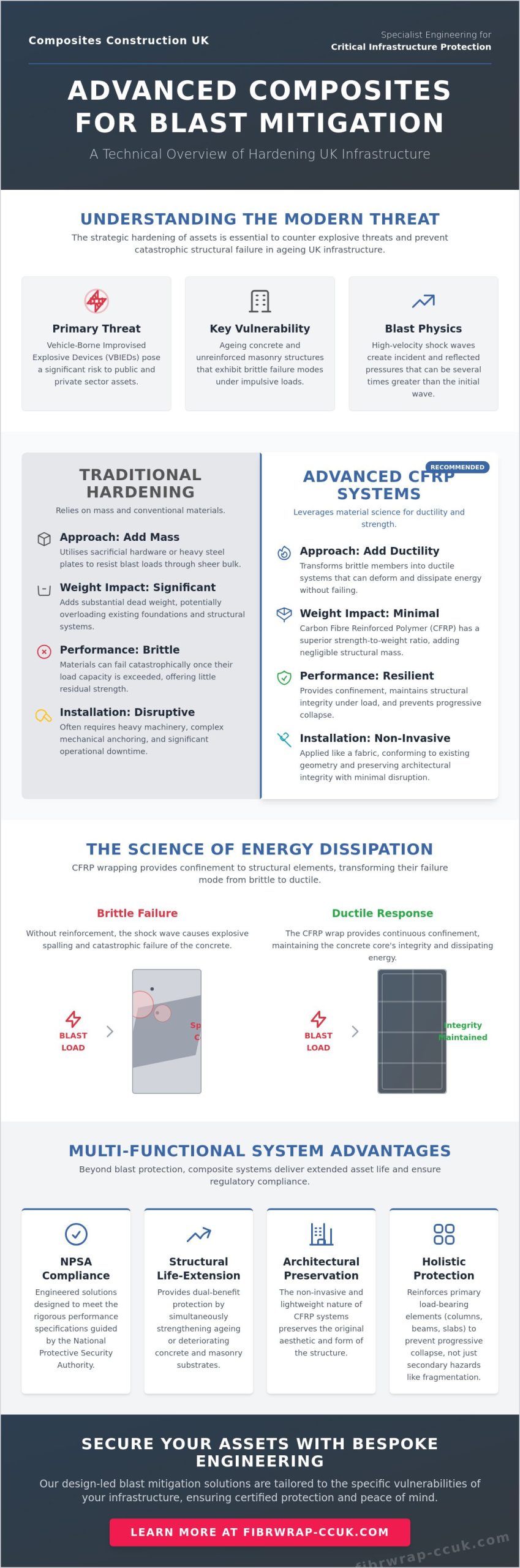
Traditional hardening methods often rely on sacrificial hardware or heavy steel plates, yet modern blast mitigation systems UK professionals implement increasingly favour advanced composite materials for their superior energy dissipation. Brittle materials like unreinforced masonry or ageing concrete fail catastrophically when subjected to the impulsive loading of an explosion. Carbon Fibre Reinforced Polymer (CFRP) transforms these substrates by introducing exceptional tensile strength and ductility. Unlike traditional steel jacketing, which adds significant dead weight and necessitates complex mechanical anchoring, Tyfo® Fibrwrap® systems provide a high strength-to-weight ratio. This allows for the reinforcement of primary load-bearing members without significantly altering the structural mass, ensuring the asset remains resilient without the risk of overloading the existing foundations.
CFRP and Structural Ductility
In blast engineering, ductility isn’t just a material property; it’s the ability of a system to deform plastically without experiencing total failure. CFRP wrapping provides essential confinement to concrete columns, which is the primary defence against explosive spalling. When the initial shock wave strikes, the radial confinement pressure exerted by the composite wrap maintains the integrity of the concrete core. Even as the concrete undergoes micro-cracking, the wrap prevents the expulsion of material. The specialised resin matrices used in these systems are critical, as they ensure a high-performance bond that facilitates immediate load transfer between the reinforcement and the substrate during the millisecond-long duration of a blast event.
Material Properties Under High-Strain Rates
Structural responses during an explosion are governed by high-strain rates, where material behaviour differs significantly from static loading scenarios. Engineers utilise Dynamic Increase Factors (DIF) to adjust material strengths in their design calculations, accounting for the increased resistance materials often show under rapid deformation. CFRP demonstrates superior performance in these shock conditions compared to traditional reinforced concrete. Whilst concrete tends to shatter under high-velocity impact, the polymer matrix absorbs and dissipates kinetic energy through controlled, predictable deformation. For masonry assets, a correctly applied layer of CFRP reinforcement prevents fragmentation by binding individual masonry units together, ensuring the wall functions as a unified, ductile diaphragm rather than a source of secondary projectiles. You can examine the technical parameters of these applications in greater detail through our structural design features.
Blast Resistance vs Blast Relief: Selecting the Strategy
Choosing the appropriate response to an explosive threat requires a detailed evaluation of the asset’s function and its surrounding environment. In dense UK urban centres, the implementation of blast mitigation systems UK asset owners require often leans heavily towards structural hardening. This is because venting pressure, which is the core principle of blast relief, is frequently unfeasible in locations where secondary debris or the blast wave itself could impact adjacent buildings or public thoroughfares. Conversely, for isolated industrial modules or plant rooms, relief systems provide a controlled method for releasing overpressure before it reaches critical thresholds that would compromise the primary frame. The decision-making process must also account for the location of the threat; internal events generate gas pressure that persists significantly longer than external open-air detonations.
Hardening existing assets is a fundamentally more sustainable approach than the alternative of demolition and reconstruction. By reinforcing the current structure, engineers reduce the embodied carbon associated with new concrete and steel. This strategy aligns technical safety requirements with environmental goals, prolonging the functional lifespan of the structure whilst ensuring it meets modern NPSA standards. It’s a method that respects the architectural heritage of UK cities whilst providing the absolute reliability required for critical national infrastructure.
Hardening Strategies for Existing Infrastructure
Retrofitting brittle masonry walls with composite laminates is a proven method for preventing “lethal debris” scatter. By applying CFRP to the interior or exterior face, the wall is transformed into a ductile diaphragm capable of absorbing significant energy. This is particularly effective when integrated with specialised masonry reinforcement to ensure heritage stabilisation whilst meeting modern safety requirements. Floor slabs also require specific attention; reinforcing them with Tyfo® Fibrwrap® allows them to resist the sudden upward pressure generated by basement-level explosions, preventing the progressive collapse of the levels above.
Venting and Relief Considerations
Blast relief systems are most appropriate for specialised enclosures where the risk of gas accumulation or internal explosions is high, such as plant rooms or chemical storage areas. These systems are designed with a precise “opening pressure” calculated to ensure that venting occurs well before structural compromise. However, relief cannot be viewed in isolation. The risk of secondary fires following an explosion is significant, meaning these systems must often incorporate fire-rated materials. Engineers must ensure that once the pressure is relieved, the remaining structure maintains its fire-resistance rating to protect the building’s occupants and critical systems during the subsequent emergency response.
Implementation Across Critical UK Asset Classes
The deployment of blast mitigation systems UK engineers specify has expanded beyond high-security military installations to encompass the broader spectrum of critical national infrastructure and public spaces. A primary driver for this shift is the recognition that reinforcing existing assets is more sustainable and cost-effective than total replacement. By utilising advanced composites, the functional lifespan of essential structures is prolonged whilst their resistance to explosive threats is significantly enhanced. This approach ensures that transport networks, utility grids, and government buildings remain operational under extreme conditions, fulfilling the rigorous safety requirements of the Building Safety Act 2022 and other regional mandates.
Bridges and Transport Hubs
Transport infrastructure presents unique challenges due to the high volume of traffic and the physical vulnerability of key structural elements. Bridge piers and support columns are particularly susceptible to vehicle-borne threats, where a detonation could lead to immediate loss of load-bearing capacity. Tyfo® Fibrwrap® systems are frequently utilised in these environments because they allow for rapid, low-disruption installation on active networks. This non-invasive method provides the necessary confinement and ductility to prevent catastrophic failure without the need for extensive closures. Similar principles are applied to the protection of utility networks, where pipeline rehabilitation techniques are adapted to harden essential conduits against sabotage or accidental overpressure events.
Public Realm and Commercial Assets
The introduction of Martyn’s Law, also known as the Protect Duty, has significant implications for UK venue operators and commercial property owners. There is now a clear requirement to implement proportionate measures to protect the public from terror attacks at high-occupancy sites. Composite blast mitigation systems UK providers deliver are ideal for these settings because they can be concealed behind traditional finishes or architectural cladding, preserving the aesthetic integrity of the building. This is especially vital for diplomatic buildings or heritage sites where visual alterations are strictly controlled. Furthermore, the lightweight nature of CFRP reinforcement ensures that no significant dead load is added to the structure, which prevents the need for costly and disruptive foundation underpinning. This technical efficiency allows for the seamless integration of high-level security within the existing urban fabric.
If you require a detailed technical assessment for a specific infrastructure project, please contact our specialist engineering team to discuss bespoke mitigation strategies.
The CCUK Approach: Design-Led Blast Mitigation
CCUK’s approach to blast mitigation systems UK asset owners require is rooted in a design-led methodology that prioritises site-specific engineering over generic product application. Every project necessitates bespoke engineering calculations because the response of a building to an explosive load is dependent on its unique structural configuration, material properties, and the specific threat profile it faces. This transition from standard structural repairs to advanced protective hardening is facilitated by the exclusive UK licensing of the Tyfo® Fibrwrap® system. This proprietary technology provides an assured level of quality and performance that has been empirically validated through extensive blast testing. By opting for composite retrofitting, asset controllers can establish a robust economic case for life-extension, avoiding the significant capital expenditure and environmental impact associated with demolition and new construction.
Engineering Consultancy and Feasibility
The process begins with comprehensive structural surveys to identify inherent weak points within the building envelope and primary frame. These findings inform the development of detailed design features, which include bespoke CFRP layouts tailored to the specific load paths of the asset. We collaborate closely with security consultants to ensure that the proposed reinforcement meets specific “TNT equivalent” threat levels whilst adhering to NPSA guidelines. This integrated approach ensures that the mitigation strategy is both proportionate to the risk and technically sound, providing a reliable foundation for the subsequent installation phase.
Specialist Installation and Quality Assurance
Executing these complex designs requires the expertise of a specialist engineering contractor capable of operating within high-stakes, operational environments. Our installation teams adhere to rigorous testing protocols to verify that the blast mitigation systems UK projects demand perform exactly as designed. This includes pull-off tests to ensure adequate bond strength to the substrate and material verification of the resin matrices and carbon fibres. Following the successful application of the system, we provide final project delivery documentation and long-term asset management strategies to ensure the continued integrity of the protection. To discuss your specific requirements and explore how advanced composites can protect your infrastructure, please contact our engineering team.
Strengthening the Resilience of National Infrastructure
The technical imperative for robust blast mitigation systems UK has never been more critical as regulatory frameworks like Martyn’s Law and the Building Safety Act 2022 redefine structural accountability. By prioritising the transformation of brittle masonry and concrete into ductile, energy-dissipating systems, a level of security is achieved that traditional steel reinforcement cannot match without excessive weight or disruption. These advanced composite interventions don’t just protect against explosive threats; they serve as a sustainable strategy for extending the functional lifespan of essential infrastructure through scientific remediation and engineering rigour.
CCUK remains the exclusive UK licensee for Tyfo® Fibrwrap® systems, providing a comprehensive design-to-installation service delivered by a specialist engineering team with full national coverage. This end-to-end capability ensures that every bespoke CFRP layout is grounded in empirical evidence and executed with precision to meet the most stringent NPSA safety standards. Securing the future of your assets requires a partner committed to professional sobriety and long-term reliability. Consult with our Specialist Engineers on Blast Mitigation today to ensure your infrastructure remains resilient against evolving threats whilst maintaining its structural integrity for decades to come.
Frequently Asked Questions
What are the main types of blast mitigation systems used in the UK?
The primary blast mitigation systems UK engineers deploy include structural hardening, pressure relief venting, and catchment systems. Structural hardening involves reinforcing primary load-bearing members, such as columns and slabs, with advanced composites like CFRP to prevent progressive collapse. Conversely, pressure relief systems utilise sacrificial panels to vent overpressure in industrial enclosures. Catchment systems are typically employed for secondary protection, focusing on mitigating the risk of flying debris from non-structural facades and glazing.
How does CFRP improve a building’s resistance to explosive threats?
Carbon Fibre Reinforced Polymer (CFRP) improves resistance by transforming brittle structural elements into ductile systems capable of controlled energy dissipation. When applied to concrete columns, the material provides radial confinement that prevents explosive spalling and maintains the integrity of the core under high-impulse loading. This confinement ensures the member continues to carry axial loads even after significant deformation, thereby mitigating the risk of a disproportionate collapse following a detonation.
Is it possible to retrofit blast protection to heritage or listed buildings?
Retrofitting blast protection to heritage or listed buildings is achievable using ultra-thin composite laminates that preserve the asset’s architectural integrity. Because CFRP reinforcement adds negligible thickness and weight, it can be concealed behind existing finishes or within masonry joints without altering the building’s external appearance. This non-invasive approach is often preferred by heritage consultants as it provides the necessary protective hardening whilst adhering to strict conservation guidelines and avoiding the need for heavy, disruptive steelwork.
What is the difference between blast-resistant glazing and structural blast hardening?
The fundamental difference lies in the classification of protection; glazing is a secondary measure, whilst structural hardening is a primary defence. Blast-resistant glazing is designed to remain within its frame or shatter into non-lethal fragments to protect occupants from flying debris. Structural hardening, however, focuses on the building’s skeleton, reinforcing columns, beams, and slabs to ensure the entire facility remains standing and avoids progressive collapse during a major explosive event.
How does Martyn’s Law (Protect Duty) affect blast mitigation requirements for UK venues?
Martyn’s Law introduces a legal requirement for certain UK venues to implement proportionate security measures based on a Threat, Vulnerability, and Risk Assessment (TVRA). For high-occupancy locations, this necessitates a documented strategy for mitigating the impact of potential attacks, which may include the installation of blast mitigation systems UK standards approve. Venue operators must demonstrate that they’ve considered structural resilience as part of their broader public safety obligations, ensuring that the building can protect occupants during an incident.
Can blast mitigation systems be integrated with fire protection measures?
Integration with fire protection is a standard requirement, as explosive events are frequently followed by secondary fires. Advanced composite systems can be specified with intumescent coatings or specialised fire-resistant resin matrices to ensure dual compliance with both blast and fire safety standards. It’s essential that the structural reinforcement maintains its load-bearing capacity at elevated temperatures, providing the necessary window for safe evacuation and emergency service intervention following an initial blast.
What is the typical lifespan of a composite blast reinforcement system?
A correctly installed composite reinforcement system typically has a design life exceeding 50 years, often matching or surpassing the remaining functional lifespan of the original structure. Unlike steel, CFRP is inherently resistant to corrosion and environmental degradation, which significantly reduces long-term maintenance requirements. Regular structural surveys and testing ensure the system remains effective, providing a durable and sustainable solution for protecting critical national infrastructure against long-term threats.
How is the effectiveness of a blast mitigation system verified?
Effectiveness is verified through a combination of empirical blast testing data, sophisticated finite element analysis, and on-site quality assurance protocols. Engineers use pull-off tests to confirm the bond strength between the composite and the substrate, ensuring the specified load transfer is achieved. Adherence to NPSA-approved design methodologies and material verification provides the necessary evidence that the system will perform as predicted under the extreme strain rates of an explosion.