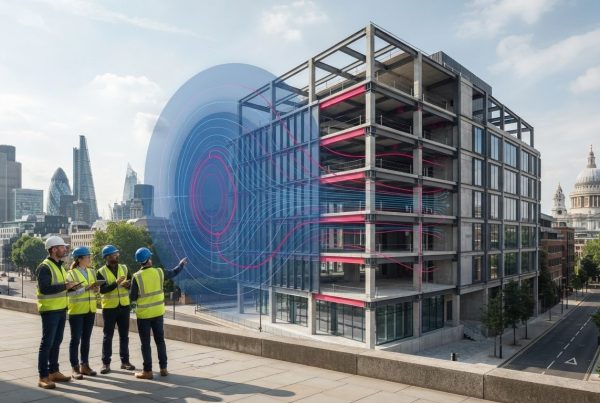

The traditional lifecycle of UK infrastructure is being fundamentally rewritten by a shift towards sophisticated, engineering-led remediation. As asset owners face the reality of aging structures reaching their design limits, the financial and operational costs of total replacement have become increasingly difficult to justify. You’re likely aware that the pressure to maintain safety standards whilst minimising downtime requires more than just a superficial fix. It demands a partner who understands the material science required to fortify a structure for the next half-century.
Identifying specialist structural repair contractors UK who can bridge the gap between complex engineering design and on-site installation is often the most significant hurdle in asset management. This guide explores how advanced composite technologies, such as Carbon Fibre Reinforced Polymer (CFRP) and Tyfo® Fibrwrap® systems, are redefining the possibilities of structural life-extension. We’ll outline how these design-led interventions can extend the functional lifespan of your assets by decades and ensure compliance with the latest 2026 regulatory frameworks without the disruption of a total rebuild.
Key Takeaways
- Distinguish between routine building maintenance and the engineering-led remediation required to address the complex structural deficits of aging national infrastructure.
- Understand the technical advantages of Carbon Fibre Reinforced Polymer (CFRP) and proprietary Tyfo® Fibrwrap® systems in significantly enhancing the load-bearing capacity of existing assets.
- Evaluate the essential criteria for selecting specialist structural repair contractors UK, focusing on the necessity for bespoke engineering design and proven technical accreditation.
- Follow the methodical phased approach to structural remediation, from comprehensive diagnostic testing to the precise installation of advanced material systems.
- Analyse the economic and environmental case for structural life-extension, positioning remediation as a sustainable alternative to the high cost and carbon impact of demolition.
The Role of Specialist Structural Repair Contractors in the UK Infrastructure Sector
The discipline of engineered remediation exists at the critical intersection of material science and structural mechanics. Unlike general building firms that focus on aesthetic or non-load-bearing elements, specialist structural repair contractors UK are tasked with restoring or enhancing the fundamental integrity of an asset. This work is strictly governed by Structural engineering principles, ensuring that every intervention is mathematically validated to meet modern safety codes. By providing bespoke solutions for complex load-transfer requirements, these specialists act as the guardians of the built environment, extending the utility of structures that would otherwise face decommissioning.
The UK’s critical infrastructure is currently navigating a period of intense transition. With total construction output forecasted to rise by 3.7% in 2026, the repair, maintenance, and improvement (RM&I) sector has emerged as a primary driver of this growth. Life-extension is now a national priority, as the economic case for remediation far outweighs the carbon cost and capital expenditure of demolition. There’s been a decisive shift from traditional steel propping towards advanced composite reinforcement. These materials allow for significant strengthening with minimal impact on the structure’s original geometry, providing a more efficient route to compliance.
The Complexity of Modern Structural Challenges
Aging assets frequently suffer from concrete carbonation and chloride ingress, particularly in marine or highway environments where de-icing salts are prevalent. These processes lead to the corrosion of internal reinforcement, which compromises structural integrity long before visible signs appear. Managing fatigue in industrial pipelines or high-rise structures requires a nuanced understanding of dynamic loading. In dense urban centres, the requirement for non-disruptive repair is paramount. Asset controllers cannot afford the operational downtime associated with traditional demolition and reconstruction; they require methods that allow for continuous functionality during the remediation process.
When to Appoint a Specialist Engineering Contractor
Identifying the threshold between routine maintenance and specialist intervention is critical for risk management. Whilst aesthetic repairs might address surface-level degradation, structural stabilisation requires a deep understanding of load paths and material behaviour. Specialist structural repair contractors UK are typically appointed when technical surveys reveal latent defects, such as internal delamination or reinforcement section loss. The legal landscape has also become more stringent; the Building Safety Regulator (BSR) now implements rigorous oversight for higher-risk buildings. Consequently, asset controllers increasingly require a single point of responsibility. Engaging a contractor with comprehensive design and installation capabilities ensures that the remediation strategy is technically sound and fully compliant with modern safety standards.
Advanced Composite Technologies: Tyfo® Fibrwrap® and CFRP Strengthening
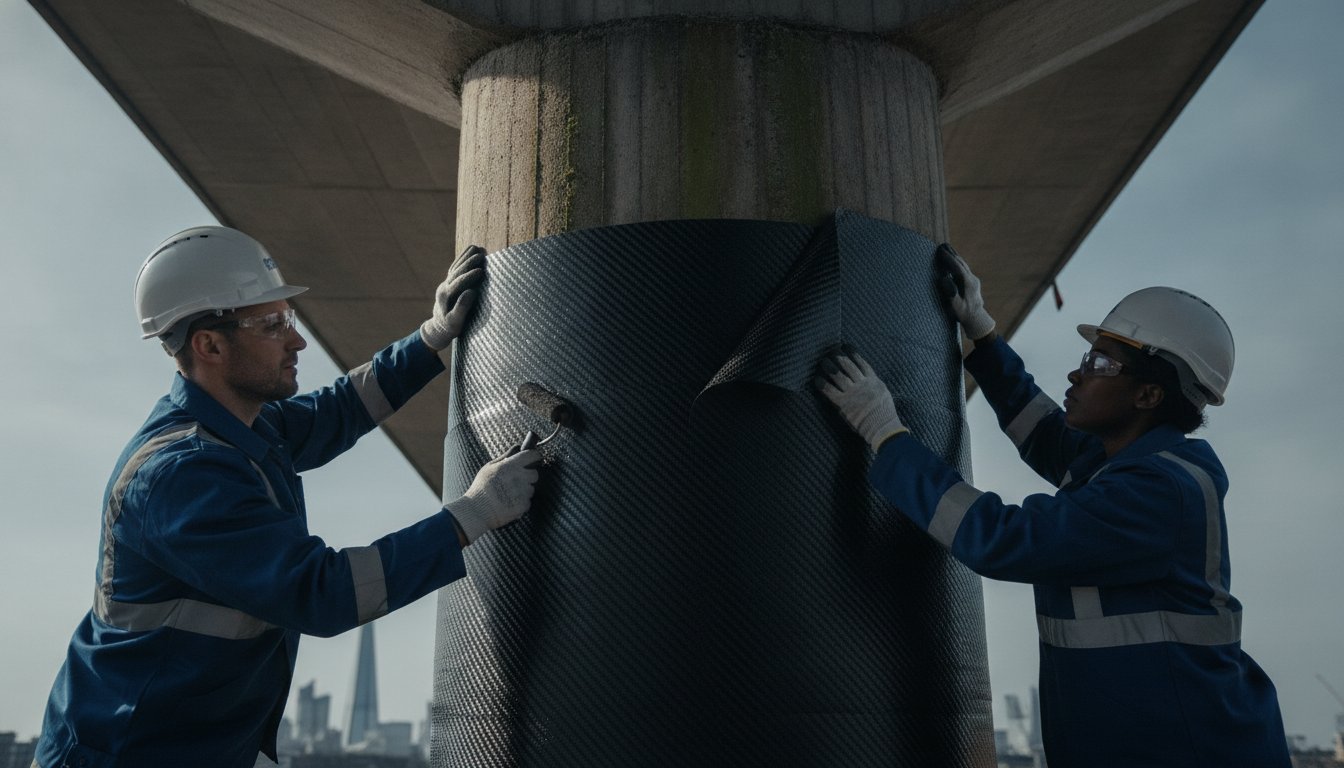
The implementation of Carbon Fibre Reinforced Polymer (CFRP) represents a paradigm shift in the methodology of structural strengthening. This advanced material, characterised by exceptional tensile strength and a superior modulus of elasticity, allows for the precise reinforcement of concrete, masonry, and steel elements. Unlike traditional methods that rely on heavy mechanical fixings, CFRP is chemically bonded to the substrate, creating a monolithic repair that enhances load-bearing capacity without altering the structure’s original geometry. Specialist structural repair contractors UK increasingly deploy these systems to meet the rigorous demands of modern infrastructure, where traditional materials often fail to provide a viable long-term solution.
Tyfo® Fibrwrap®: The Industry Standard for Life-Extension
The Tyfo® Fibrwrap® system is a proprietary hand-layup composite that has set the benchmark for structural life-extension globally. It consists of high-strength fibres saturated with specialised resins, which are then applied to the prepared surface of the asset. This system is particularly effective for pipeline rehabilitation and blast mitigation, where the ability to conform to complex shapes and provide 360-degree confinement is essential. Because it’s lightweight and requires no heavy lifting equipment, it’s the preferred choice for repairs in confined spaces or sensitive urban environments. The durability of these systems is a significant factor in their selection; they provide exceptional resistance to aggressive chemical environments and corrosion, which are the primary causes of degradation in UK infrastructure.
CFRP vs Traditional Steel Reinforcement
When evaluating strengthening options, the comparison between CFRP and traditional steel plating highlights clear technical advantages. Steel is inherently heavy, which increases the dead load on existing foundations and often necessitates further structural adjustments. In contrast, the high strength-to-weight ratio of CFRP ensures that strengthening is achieved with minimal additional mass. This is a critical consideration for projects supported by the government fund to fix England’s bridges, where speed of installation and the reduction of operational downtime are vital.
Installation speed is another area where composites excel. Specialist structural repair contractors UK can often complete CFRP applications in a fraction of the time required for steel welding or bolting. This efficiency directly translates to reduced road closures and rail possessions, providing a more cost-effective solution over the asset’s total lifecycle. If you’re managing a project with complex loading requirements, you might consider consulting with a technical expert to determine the optimal composite specification for your specific asset.
Criteria for Selecting Specialist Structural Repair Contractors
The selection of specialist structural repair contractors UK requires a rigorous evaluation of technical capability that extends far beyond surface-level remedial experience. In the current regulatory environment, specifically following the 2026 updates to building safety frameworks and the enhanced powers of the Building Safety Regulator, the distinction between a general builder and an engineering-led contractor is defined by the ability to provide validated structural calculations. Every remediation project must be underpinned by a bespoke design that accounts for the specific material properties and load paths of the existing asset. This ensures that the intervention doesn’t just mask symptoms but addresses the fundamental structural deficit.
Proprietary system licensing is a critical marker of exclusivity and quality. For instance, the status of an exclusive licensee for Tyfo® Fibrwrap® systems ensures that the contractor possesses direct access to the manufacturer’s empirical technical data and specialised installation training. This relationship is vital for ensuring that the performance characteristics of advanced composites, such as tensile strength and bond durability, are fully realised on-site. Without these proprietary links, the risk of material incompatibility or incorrect application increases significantly, potentially compromising the safety of the asset.
The Importance of a Design-Led Approach
Generic, “off-the-shelf” solutions frequently fail to address the underlying causes of structural distress in complex assets. A design-led approach ensures that feasibility studies are integrated with final installation, allowing the design to account for future load requirements and environmental stressors such as chloride ingress or seismic activity. This methodology prioritises long-term asset security over temporary patching. It’s a disciplined process where the engineering consultancy works in tandem with the installation team to ensure that the technical specification is achievable within the operational constraints of the site.
Technical Support and Professional Indemnity
Technical competence should be verified through professional affiliations, such as membership in the Structural Concrete Alliance, which sets the industry standard for corrosion prevention and concrete repair. It’s essential to verify that the contractor carries comprehensive Professional Indemnity (PI) insurance that specifically covers structural design. This provides the necessary financial security for the asset owner. National service providers often offer the most robust support for multi-asset portfolios, as they possess the scale to collaborate seamlessly with client-side engineers. This partnership ensures that the rigorous technical standards required for critical infrastructure are maintained throughout the project lifecycle.
The Structural Remediation Process: From Survey to Asset Life-Extension
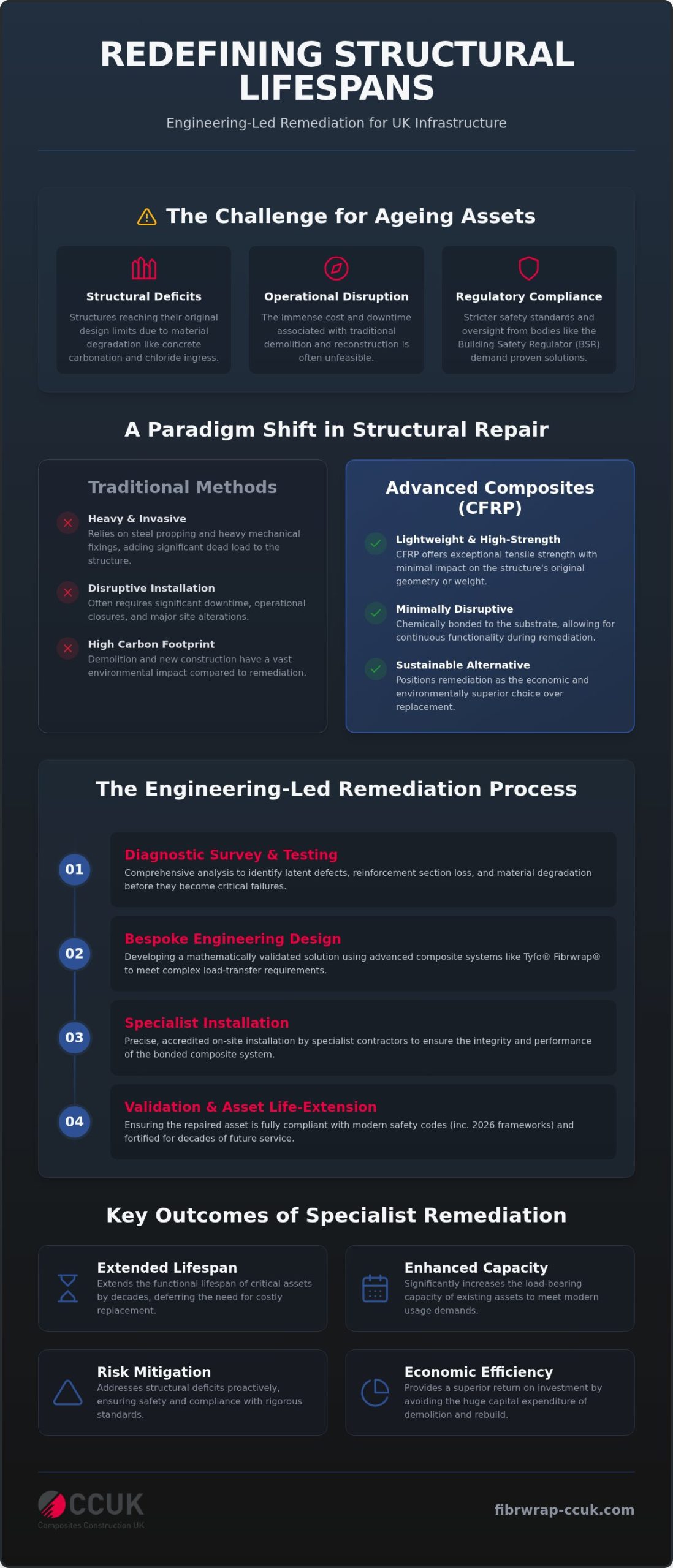
The execution of structural remediation follows a disciplined, five-phase trajectory that ensures every intervention is grounded in empirical data. For specialist structural repair contractors UK, the process begins long before any material is applied to the substrate. It’s a methodical progression from diagnostic forensic analysis to the final verification of structural performance. This structured approach is essential for maintaining the safety of critical infrastructure, where the margin for error is non-existent. By adhering to a rigorous sequence of engineering milestones, asset controllers can be certain that the life-extension of their structure is both technically sound and legally compliant.
The transition from survey to installation requires a seamless integration of disciplines. Once the initial data is gathered, bespoke engineering designs are developed to address the specific deficits identified. This leads into meticulous site preparation, where the substrate is remediated to ensure optimal bond strength. The professional installation of strengthening systems, such as Carbon Fibre Reinforced Polymer (CFRP), is followed by a final phase of quality assurance. This ensures that the installed system meets the exact technical specifications defined during the design phase, providing a validated increase in load-bearing capacity.
Diagnostic Testing: Carbonation and Pull-Off Tests
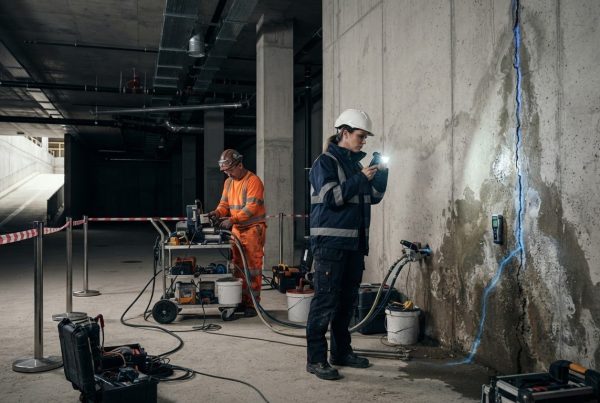
Forensic investigation is the cornerstone of any successful remediation project. Determining the depth of carbonation is vital for assessing the long-term health of reinforced concrete, as it identifies the point at which the alkaline protection of the steel reinforcement is lost. Specialist structural repair contractors UK utilise pull-off tests to measure the tensile strength of the substrate, ensuring it can support the high-modulus bond required for composite adhesion. Non-destructive testing (NDT), including ground-penetrating radar, is frequently employed to map internal reinforcement and identify areas of delamination or voiding that aren’t visible to the naked eye.
Execution and Quality Control
The success of advanced composite applications depends heavily on strict environmental controls. Resin-based systems require precise temperature and humidity ranges to cure correctly and achieve their design strength. Adhering to these strict curing times is a non-negotiable aspect of the installation process. Post-installation testing, which may include digital bond verification or acoustic sounding, is conducted to verify that the strengthening design has been executed perfectly. This level of rigour ensures that the asset’s functional lifespan is extended by decades rather than years. If you require a comprehensive diagnostic assessment of your asset, you should contact our technical team to arrange a specialist survey.
Sustainable Infrastructure: The Economic Case for Repair over Replacement
The environmental cost of the demolish and rebuild cycle is increasingly untenable within the UK construction sector, which is under intense pressure to meet Net Zero 2050 targets. Demolition generates substantial waste and necessitates the production of new concrete and steel, both of which are high-carbon materials. In contrast, remediation focuses on the preservation of existing structural mass. By appointing specialist structural repair contractors UK, asset owners can significantly reduce the carbon footprint of their portfolios whilst ensuring long-term structural security. This strategic shift prioritises the retention of embodied carbon, aligning technical engineering requirements with broader environmental responsibilities.
Life-cycle costing provides a compelling economic justification for strengthening. Traditional replacement projects often involve prohibitive capital expenditure and extensive operational downtime. Remediation, particularly when utilising advanced material science, offers a superior return on investment by extending the functional utility of an asset for a fraction of the cost of new-build construction. This approach future-proofs assets. It enhances their resilience against the challenges of climate change, such as increased thermal stresses or more frequent extreme weather events. The economic argument is clear: preserving an existing asset is more efficient than creating a new one.
Successful delivery of these efficiency-focused projects often depends on the logistical support provided to the specialised crews involved. Project managers looking to streamline these operations can explore Team Accommodation to find reliable housing solutions that keep their contractors close to the site throughout the remediation process.
Prolonging Functional Lifespan with CFRP
The application of Carbon Fibre Reinforced Polymer (CFRP) can extend the utility of bridges, industrial structures, and high-rise assets by 30 years or more. This prevents the need for carbon-intensive new-build projects. It also avoids the massive community disruption associated with major demolition works. The social value of this approach shouldn’t be underestimated. Maintaining the continuity of essential transport or utility services is a key metric for modern asset controllers. Strengthening existing structures allows for the preservation of local infrastructure without the logistical nightmare of a total replacement. This commitment to structural longevity is shared by specialist firms globally, such as Rainier Roofing LLC, who contribute to the preservation of local history and built environments through dedicated maintenance services.
Similarly, PRO Construction provides expert services within the residential sector, focusing on structural renovations and custom builds that ensure the permanence of family homes.
Strategic Asset Management for 2026 and Beyond
Aligning structural repair with corporate ESG and sustainability targets is no longer optional. As regulatory frameworks evolve, the ability to demonstrate a reduction in carbon intensity becomes a competitive advantage. The future of composite technology in UK civil engineering lies in its ability to provide high-performance solutions that are both technically advanced and environmentally responsible. Specialist structural repair contractors UK are the essential partners in this transition, providing the expertise required to navigate complex remediation challenges. To explore the viability of life-extension for your critical assets, you can contact our engineering team for a feasibility assessment.
Securing the Future of UK Infrastructure Through Engineering Rigour
The successful life-extension of critical assets depends on a transition from reactive maintenance to a proactive, science-led strategy. By prioritising advanced composite technologies and validated engineering designs, asset controllers can navigate the complexities of aging infrastructure whilst ensuring compliance with evolving 2026 safety standards. This methodical approach doesn’t just address immediate structural deficits; it establishes a framework for long-term operational security and environmental responsibility through the preservation of embodied carbon.
Selecting specialist structural repair contractors UK who possess a comprehensive design-supply-install capability is the most decisive factor in achieving these outcomes. As an ISO certified specialist contractor and the exclusive UK Tyfo® Fibrwrap® licensee, we provide the technical authority required to fortify your structural portfolio for the next half-century. It’s possible to extend the utility of your essential assets without the disruption of total replacement. Consult with our specialist engineering team for a bespoke structural design to begin your feasibility assessment. We look forward to helping you safeguard the integrity of your infrastructure.
Frequently Asked Questions
What is considered a specialist structural repair?
Specialist structural repair refers to engineered interventions designed to restore or enhance the load-bearing capacity and fundamental integrity of a structure. Unlike general building maintenance, which may focus on aesthetic or non-structural elements, these works address critical deficits such as reinforcement corrosion, seismic vulnerability, or load-path failures. Specialist structural repair contractors UK utilise advanced materials and bespoke engineering calculations to ensure that the remediated asset meets modern safety standards and regulatory requirements.
How much does structural repair cost for commercial assets in the UK?
The total expenditure for structural repair is determined by the complexity of the engineering design, the specific material requirements, and the operational constraints of the site. Because each project requires a bespoke technical specification based on forensic diagnostic testing, costs are calculated on a project-by-project basis. Asset controllers should evaluate these costs through the lens of life-cycle value; the investment in extending an asset’s utility by decades is significantly lower than the capital expenditure required for total demolition and replacement.
Is carbon fibre strengthening (CFRP) better than steel plate bonding?
Carbon Fibre Reinforced Polymer (CFRP) is often superior to steel plate bonding due to its exceptional strength-to-weight ratio and inherent resistance to corrosion. CFRP is significantly lighter, which avoids adding substantial dead load to existing foundations, and its chemical stability eliminates the risk of future oxidation. The installation process for composites is typically faster and requires less heavy machinery, providing a more efficient solution for strengthening bridges, rail infrastructure, and industrial assets.
How long do CFRP structural repairs typically last?
CFRP structural repairs are engineered for long-term durability, with the capability to extend the functional lifespan of an asset by 30 to 50 years or more. The actual longevity is dependent on the precision of the initial design and the quality of the substrate preparation. Because advanced composites don’t suffer from the same degradation mechanisms as steel or concrete, they provide a stable, low-maintenance solution that resists environmental stressors and aggressive chemical exposure throughout their service life.
Can specialist structural repairs be carried out whilst a building is occupied?
Yes, many specialist structural repairs can be executed whilst a building remains fully operational. Advanced composite systems, such as Tyfo® Fibrwrap®, are non-disruptive and require minimal heavy equipment, which significantly reduces noise and vibration compared to traditional demolition and reconstruction. This allows asset controllers to maintain business continuity and minimise operational downtime, which is a critical requirement for high-occupancy commercial structures and essential public infrastructure.
What qualifications should a specialist structural repair contractor have?
A reputable contractor should possess ISO certifications for quality, environmental management, and health and safety, alongside comprehensive Professional Indemnity insurance that specifically covers structural design. It’s also vital to verify proprietary system licensing, such as being an exclusive UK licensee for Tyfo® Fibrwrap®. Membership in industry bodies like the Structural Concrete Alliance indicates a commitment to professional standards and a deep understanding of modern material science and engineering principles.
What is the difference between structural repair and general maintenance?
General maintenance typically involves preventative or aesthetic tasks, such as painting or minor surface patching, designed to preserve the appearance and secondary functions of an asset. Structural repair is a remedial discipline triggered by diagnostic findings that indicate a compromise in the asset’s load-bearing capacity. It’s an engineered intervention that addresses the root cause of structural distress, ensuring the safety and long-term utility of the built environment through scientifically validated solutions.
How does the Tyfo® Fibrwrap® system improve seismic or blast resistance?
The Tyfo® Fibrwrap® system enhances seismic and blast resistance by providing exceptional confinement and ductility to structural elements. During a blast or seismic event, the composite wrap prevents the brittle failure of concrete columns and masonry walls, allowing the structure to absorb and dissipate energy without catastrophic collapse. This containment is essential for protecting occupants and ensuring that critical infrastructure can withstand extreme dynamic loading scenarios whilst remaining structurally sound.