

Blast damage prevention isn’t a matter of protecting one part of a building and assuming the rest will perform. Blast pressure and reflected waves can affect façades, glazing, structural connections and load-bearing elements. Debris and local failures may also have wider consequences. Which components are most vulnerable depends on the building, its condition and the hazard being considered.
Choosing suitable measures can be challenging because the response needs to account for both the threat scenario and the existing asset. There is no single solution for every project. Blast mitigation is a project-specific engineering task, with measures designed around defined hazards rather than every possible event.
This guide explains how blast effects can damage buildings, compares prevention approaches and shows why structural assessment is central to selecting a proportionate response. It also outlines the information that helps specialists develop a tailored plan, from the asset’s construction and condition to its operating requirements. Where a building needs strengthening or repair, blast mitigation can form part of a wider structural engineering response.
Key Takeaways
- Understand how blast pressure can affect a building’s façade, floors, connections and load-bearing frame.
- Distinguish explosive blast loading from operational blasting effects, such as ground vibration and air overpressure.
- Compare risk assessment, monitoring, component protection and structural strengthening by their purpose and scope. Monitoring alone isn’t mitigation.
- Use a project-specific blast damage prevention process that accounts for the hazard, asset requirements, structural condition and operational constraints.
- See how feasibility work, bespoke design, blast mitigation systems and structural strengthening can contribute to a tailored engineering response.
Blast damage prevention: what it means for buildings and infrastructure
Blast damage prevention means reducing an asset’s vulnerability to defined blast hazards through assessment, design and appropriate mitigation, without assuming that any measure can eliminate all risk. It describes an engineering approach, not a single material or product. The aim is to understand how a structure may respond, identify relevant vulnerabilities and select measures suited to the asset and its operating requirements.
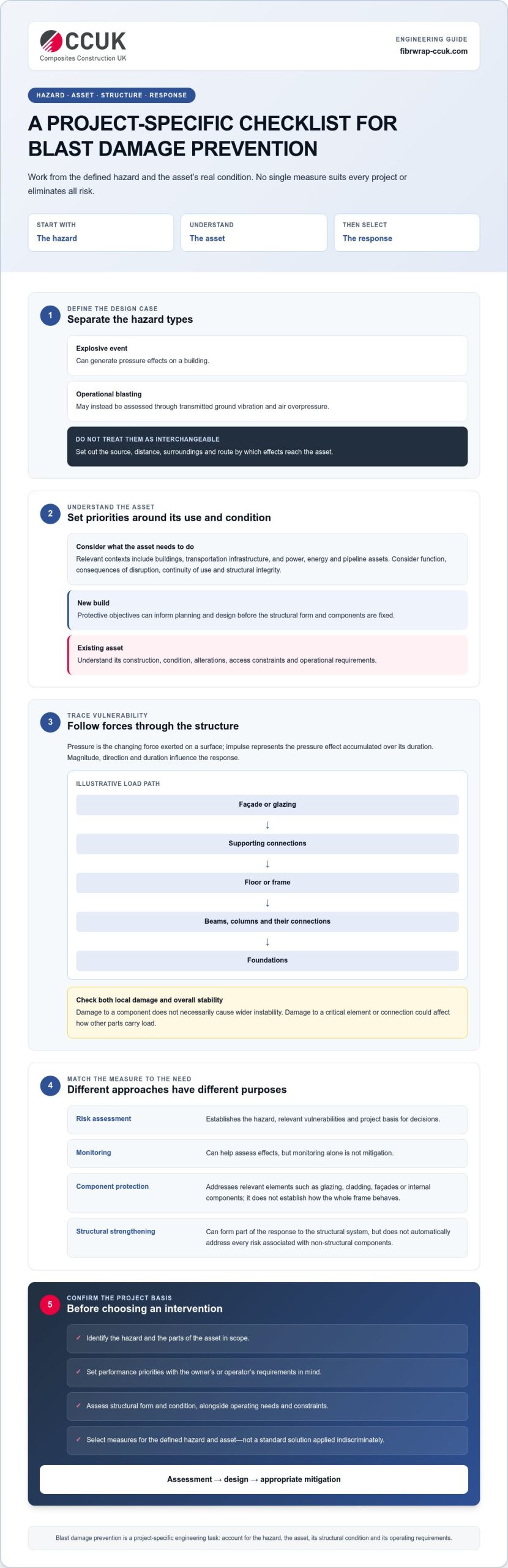
First, describe the hazard accurately. An explosive event can generate pressure effects on a building. Operational blasting, such as work at a quarry or construction site, may instead be assessed in terms of transmitted ground vibration and air overpressure. These are related to blasting activity, but they are not interchangeable design cases. The source, distance, surroundings and route by which effects reach the asset all influence what needs assessment. A broad overview of explosion protection methods includes preventing explosions and mitigating their effects on structures, but a project’s engineering basis must reflect its specific hazard and asset.
Which assets and project contexts require consideration?
Relevant contexts include buildings, transportation infrastructure, and power, energy and pipeline assets. For each, consider the asset’s function, the consequences of disruption and the required continuity of use, as well as structural integrity. A facility that supports essential operations may have different performance priorities from a building with less demanding operational requirements. Set those priorities for the project rather than assuming them from the asset category.
For a new build, protective objectives can inform planning and design before the structural form and components are fixed. For an existing asset, start by understanding its construction, condition, alterations and access or operational constraints. This evidence helps inform decisions about strengthening and other mitigation. In both cases, match the engineering response to the hazard, asset use and structural form rather than applying a standard solution indiscriminately.
What does blast damage prevention aim to reduce?
The objective is to reduce the likelihood or consequences of damage to the structure and relevant non-structural components. Façade performance and the potential for debris to become a hazard need consideration, but they are separate from the response of the primary structural system. A façade measure alone does not establish how the frame or its connections would behave. Similarly, structural strengthening does not automatically address every risk associated with glazing, cladding or internal components.
Make the design basis clear: identify the hazard, the parts of the asset in scope and the performance priorities that matter to its owner or operator. Assessment of the structure and its condition provides essential context. Project specialists should establish the basis for design and intervention, taking operational needs into account alongside structural characteristics.
How blast effects interact with a structure and its load paths
Blast pressure describes the changing force exerted on a surface, whilst impulse represents the pressure effect accumulated over its duration. Their magnitude, direction and duration influence how a building responds. The response also depends on the structure’s geometry, materials, condition and restraint. Blast effects act on building components and generate forces that pass through connected structural elements, so blast damage prevention requires an understanding of both local response and continuity of the load path.
For example, a pressure wave acting on a façade creates actions that are transferred through its supporting connections into the floor or frame. Forces may then pass through beams, columns and their connections to the foundations. The route depends on the structural arrangement. A weakness or change at one point can affect how forces are carried elsewhere, so assessing one component in isolation may not reveal how the whole system behaves.
Local damage and overall stability are related, but they are different engineering questions. A component may be damaged without causing wider instability. Damage to a critical element or connection, however, could change the capacity of other parts to carry load. An assessment should therefore consider both individual component performance and the integrity of the structural system as a whole.
How façades, glazing and connections influence the response
Façades and glazing need to be considered alongside the structure that supports them. The performance of a panel or window does not, by itself, establish how its frame, anchorage or supporting structure will behave under the same loading. Component protection and structural-system assessment address different parts of the problem. The design needs to account for how they interact.
Connections transfer forces between components. Their configuration, condition and relationship to the surrounding structure inform how those forces can be carried. No generic detail suits every building. Assess the relevant connections and load paths within the project’s design basis.
Why existing condition and structural form matter
Material, geometry, condition and later alterations all affect what needs to be examined. Reinforced concrete, steel and masonry are distinct structural systems, with different arrangements and behaviours. Findings from one should not be applied automatically to another. For an existing asset, structural records and condition evidence help specialists understand what is present and identify where further investigation may be needed.
A general rule based on one feature, such as material type or apparent age, cannot reliably predict how a particular structure will respond. Assessment should account for the actual configuration, including how components connect and whether modifications have changed the original load path. This project-specific understanding helps distinguish a local component concern from a wider stability question. Composites Construction UK provides blast mitigation systems and structural engineering services that can form part of a tailored response to the asset’s requirements.
Comparing blast damage prevention and mitigation approaches
Different measures address different engineering questions. Assessment helps define the hazard and understand the asset. Monitoring records effects or behaviour. Component protection addresses selected elements, while structural strengthening changes the capacity or response of identified parts of the structure. These approaches can inform one another, but they are not interchangeable. Monitoring provides evidence, not physical protection.
| Approach | Primary purpose | Scope and limitation |
|---|---|---|
| Risk assessment | Establish the relevant hazard, asset requirements and performance objectives. | Guides decisions about further assessment or intervention; does not itself alter the structure. |
| Monitoring | Measure selected effects or changes in asset behaviour where relevant to the project. | Provides evidence for review; does not prevent damage or replace mitigation. |
| Component protection | Address the response of selected components, such as glazing or façade elements. | Applies to defined components; the supporting frame and wider structural system still require consideration. |
| Structural strengthening | Modify the capacity or response of identified structural elements. | Requires project-specific assessment and design; strengthening one element does not establish whole-building performance. |
The right combination depends on the defined hazard, the asset’s condition and the performance objectives. An existing facility with condition concerns may need surveys to establish its baseline before an intervention is selected. A project focused on façade components may require a different scope from one reviewing the structural system. There is no universally superior measure: compare options by suitability and scope, not by ranking them in isolation.
Monitoring and surveys compared with physical mitigation
Monitoring can record effects when measurement is relevant to the project. Structural surveys and testing can document condition or inform an assessment. These are evidence-gathering activities. They can help specialists understand an asset or review its behaviour, but they do not, by themselves, change its response to a hazard. Physical mitigation involves an intervention intended to address identified vulnerabilities. Keeping these roles distinct prevents monitoring results from being mistaken for protection.
Where composite strengthening may fit
Carbon-fibre strengthening may be considered as a structural intervention when assessment and engineering design support its use for the identified requirement. Suitability depends on the element, existing construction, condition and intended structural response. It is not a stand-alone or universal blast-protection solution. The wider load path and other relevant components still need consideration. A technical guide to Tyfo Fibrwrap installation provides background on composite strengthening.
For a project considering physical measures, discussing the asset’s blast mitigation requirements can help define a tailored engineering response.
A practical engineering pathway for blast damage prevention
A proportionate response starts with a clear project basis, not a preselected product. Bring together the hazard, asset requirements and available structural evidence before developing interventions. Assessment findings inform mitigation design by identifying the vulnerabilities, constraints and performance objectives that proposed measures need to address.
Define the project basis before selecting an intervention
Start by establishing what the project is intended to protect and how the asset needs to function. Define the relevant blast scenario and required functional outcomes for the specific project. For an operating facility, requirements may include maintaining access, managing disruption during works or preserving essential operations. These constraints can affect which interventions are practicable.
Gather information about the structure as it exists, not only as it was originally designed. Useful inputs include available drawings, inspection findings, alteration records, observed condition and information about previous repairs. Identify gaps in the record so they can be considered for further investigation. Verify applicable technical criteria and guidance for the project’s hazard and asset context rather than assuming a general reference applies.
Develop, install and review a project-specific solution
Once the project basis is established, organise the work into linked stages:
- Characterise the hazard and asset requirements. Record the scenario being considered, the asset’s function and the performance objectives that will guide decisions.
- Review structural information and condition. Examine drawings, alterations and inspection evidence, then identify where further assessment is needed to understand the existing structure.
- Evaluate feasible interventions. Compare suitable measures against the identified vulnerabilities, operational constraints and intended outcomes. Feasibility work can help establish whether an approach is practicable before detailed design proceeds.
- Develop the design and installation plan. Tailor the design to the assessed structure and agreed objectives. Coordinate installation with access, sequencing and the asset’s operating requirements.
- Review the completed response. Check that the installed work corresponds with the design intent and consider any inspection or maintenance requirements identified for the asset.
Where condition issues also need repair, remediation may form part of a broader asset strategy. The guide to structural repairs discusses how repair can support the continued use of existing infrastructure. Feasibility studies, bespoke design and professional installation can each contribute to a project-specific engineering response. The assessment should shape the scope rather than lead to a standard package.
Composites Construction UK provides blast mitigation systems alongside structural strengthening and repair, supporting an integrated response to asset requirements. To discuss a project’s blast mitigation requirements and structural context, contact the engineering team.
How CCUK approaches blast damage prevention projects
Blast damage prevention calls for an engineering response shaped around the asset, its condition and the project’s objectives. Composites Construction UK (CCUK) provides Blast Mitigation Systems, alongside structural strengthening and repair. Its wider engineering services include feasibility studies, bespoke design solutions and professional installation. These services support a project response based on the requirements established through assessment.
CCUK brings over 25 years of expertise in structural strengthening, concrete repair and carbon-fibre strengthening. This describes the company’s experience, not a guarantee of a particular blast outcome. The performance sought from any measure depends on the defined project basis, the existing structure and how the proposed intervention is designed and installed.
Integrating blast mitigation with structural engineering
A project scope can consider blast mitigation alongside structural condition and repair needs, so component measures and the supporting structure are assessed within the same engineering context. Feasibility work helps inform the options for the asset, while bespoke design responds to its identified requirements. Carbon-fibre strengthening may be considered where engineering design supports its use. CCUK’s free, no-obligation design service applies specifically to carbon-fibre strengthening projects, not blast design generally.
Where the existing structure needs strengthening or repair, plan the intervention around the asset’s broader function and condition. The aim is a considered response to identified project needs that supports the continued use of existing infrastructure where appropriate. Plan installation in coordination with the agreed design and the asset’s operational constraints.
What to prepare for an initial project discussion
A concise project summary helps establish the context for an initial conversation. Useful information includes the asset type and intended function, available structural drawings, and known condition or inspection findings. Describe the project objective, any identified repair or strengthening needs, and practical constraints such as access or maintaining operations during works.
These details help frame feasibility and design discussions without assuming a solution in advance. Avoid placing sensitive security information in a public enquiry. Share only information appropriate to the channel and project stage, and address further technical detail through suitable project discussions.
For a project-specific conversation about blast mitigation, structural condition or strengthening requirements, make a project enquiry with CCUK. This is a starting point for discussing the asset and the engineering considerations that will inform a tailored response.
Set the next step for your asset
Turn the protection objective into a clear, reviewable project brief. Record the decisions that matter to the asset owner, including which functions must be maintained, what constraints will shape intervention and how assumptions will be reviewed as design information develops. This gives technical specialists a stronger basis for evaluating options and helps keep engineering decisions aligned with operational priorities.
Blast damage prevention is most useful as part of ongoing asset planning, not as a one-off choice made without reference to the structure or its future use. A considered project discussion can establish the right scope for feasibility work and identify how a tailored engineering response could progress. Discuss your blast mitigation project with Composites Construction UK to take a clear, informed next step towards protecting your asset.
Frequently Asked Questions
Can blast damage to an existing building be prevented?
Risk to an existing building can be reduced, but no intervention can guarantee that it will remain undamaged in every event. Blast damage prevention begins by assessing the defined hazard against the building’s actual form and condition, including changes made since construction. For example, an extension or altered opening may affect the assessment. Specialists use these findings to develop suitable measures, distinguishing risk reduction from absolute protection.
Is blast monitoring enough to prevent structural damage?
No. Monitoring records selected effects, such as vibration or structural movement, where these measurements suit the project. It doesn’t physically strengthen members, improve connections or prevent an explosive event. Its value lies in the evidence it supplies for interpretation and decisions, perhaps alongside a condition survey. Whether monitoring is useful depends on the hazard and asset. It isn’t automatically required and cannot replace designed physical mitigation.
Can carbon-fibre strengthening be used for blast mitigation?
Yes, carbon-fibre composite strengthening may be considered where engineering assessment shows it is appropriate to the structural requirement. Its role is specific to the elements and behaviour addressed by the design. It should not be treated as complete blast protection for a building. CCUK offers a free, no-obligation design service for carbon-fibre strengthening projects. This service is specific to carbon-fibre work, rather than a general blast-design offer.
Do blast-resistant windows protect the whole building?
No. Blast-resistant windows address glazing and potentially related façade components, but they do not establish how the supporting frame, anchorage, floors or primary structure will respond. Specifying glazing alone leaves the transfer of forces into surrounding construction as a separate engineering question. Define the scope against project requirements and verify relevant technical guidance for that application. Whole-building performance cannot be inferred from a window specification alone.
Can blast damage prevention be designed into a new building?
Yes. Protection objectives can be incorporated during early design, when the building’s function, hazard basis and structural requirements are being established. This allows those objectives to inform coordination between the layout, façade and structural design. For an existing asset, the approach must also account for its condition, previous alterations and operational constraints. Verify applicable criteria for the particular project rather than assuming a generic standard applies.
What information is useful for a blast mitigation assessment?
Useful starting information includes the asset type and intended function, available structural drawings, known alterations, inspection or condition information, and a concise statement of the project objective. For example, note whether the work concerns a new-build design or an existing structure requiring assessment. The engineering team can use relevant information to shape a tailored approach; there is no fixed document set for every project. Keep sensitive security details out of public enquiries.