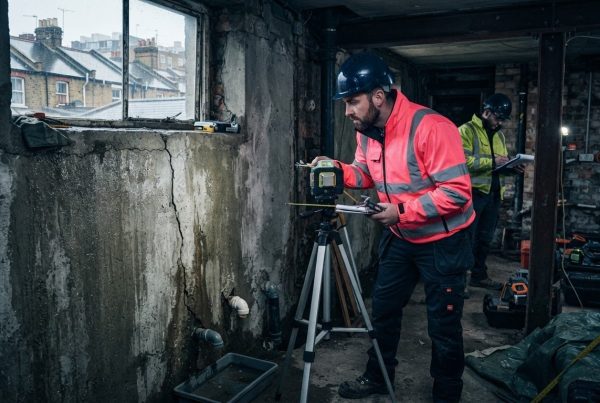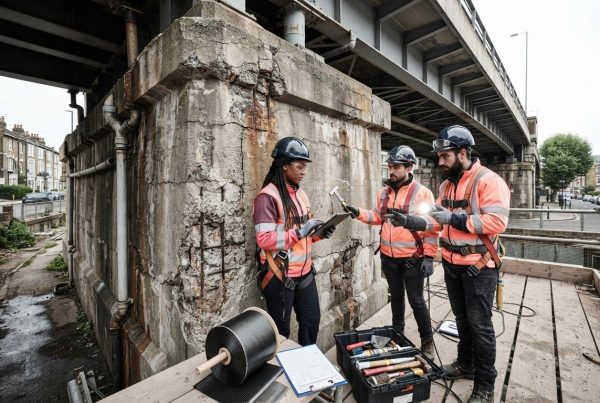

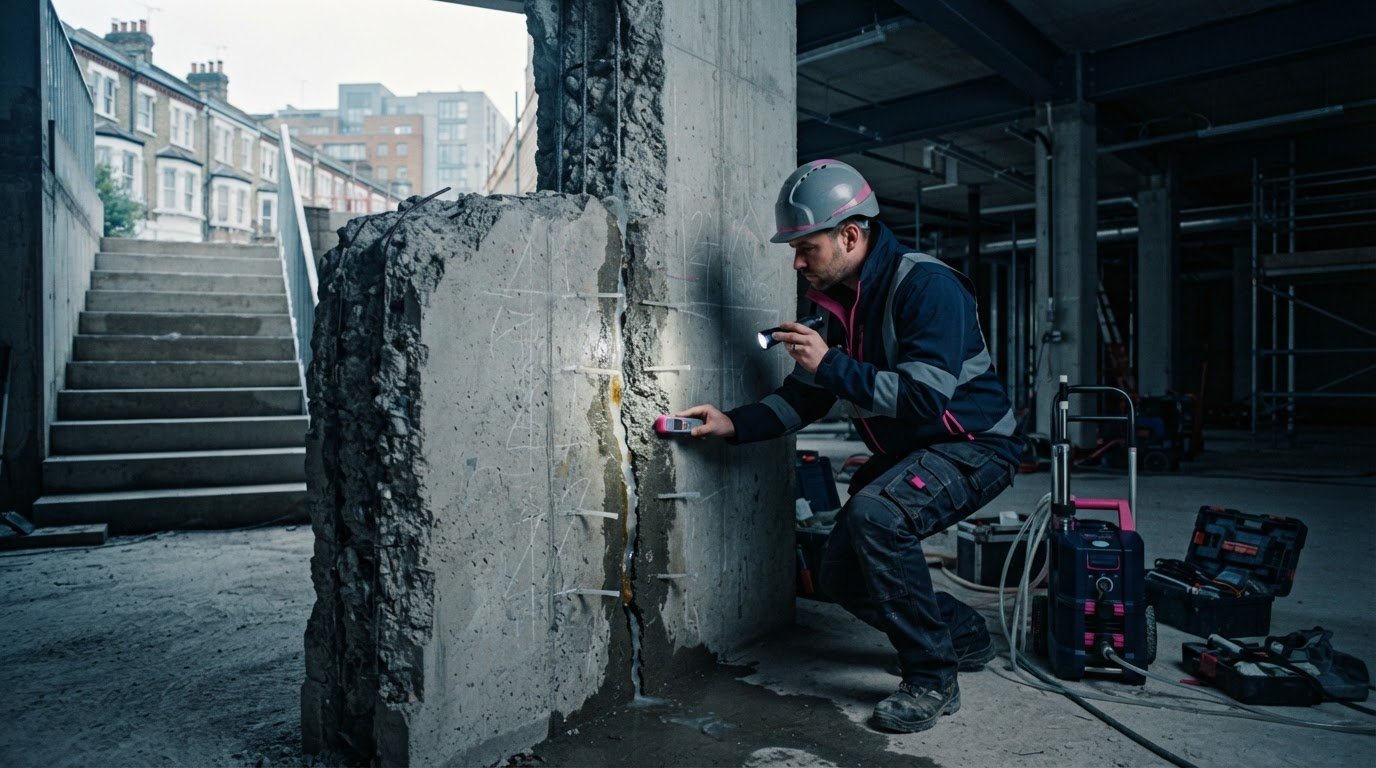
Could the crack admitting water be a symptom rather than the whole problem? Basement resin injection can seal a route for water or contribute to a structural repair, but the visible crack alone does not reveal what is happening within the wall, whether it is changing, or why water is entering. If the underlying cause remains unaddressed, ingress may return.
When water appears in a basement, a direct fix can seem like the obvious answer. Yet the resin and injection method need to suit the defect: an actively leaking crack, a dry crack and evidence of structural movement call for different repair considerations. Injection has a defined role, but it does not replace diagnosis of wider movement or water-management issues.
This guide explains how specialists assess basement cracks, how site conditions shape the choice of resin and injection approach, and what the method can and cannot address. It also shows how feasibility assessment, bespoke repair design and professional installation fit together, so you can understand the decisions behind a diagnosis-led intervention.
Key Takeaways
- Basement resin injection is selected for a specific repair purpose. First establish whether the issue is leakage, cracking or structural movement.
- Injection ports provide controlled access for placing resin into a defect, but the method depends on site conditions and the intended outcome.
- Assess the defect’s cause, the substrate condition and water conditions to determine whether injection is suitable.
- Crack mapping and substrate inspection help shape the project sequence, from assessment and design through preparation, injection and review.
- Specialist assessment, bespoke design and professional installation help align resin injection with the structure’s wider repair needs.
Basement resin injection: what it addresses and why diagnosis comes first
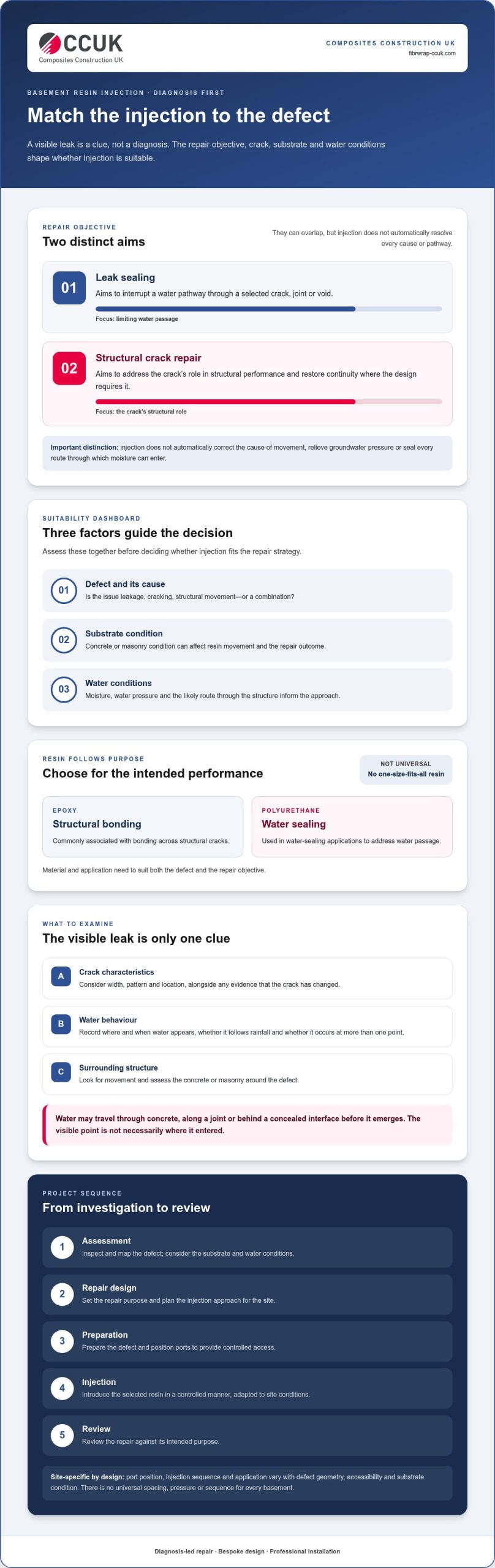
Basement resin injection introduces resin into selected cracks, joints or voids to address a defined defect. Its purpose depends on the condition being treated: limiting water passage is different from repairing a crack that affects structural performance. The visible point of leakage may show where water emerges, but not the full route it has travelled or the forces acting on the basement structure.
Leak sealing aims to interrupt a water pathway; structural crack repair aims to address the crack’s role in the structure. These objectives may overlap, but injection does not automatically correct the cause of movement, relieve groundwater pressure or seal every route through which moisture can enter.
What basement defects may lead to an injection assessment?
Seepage at a wall or floor, persistent damp patches, or water emerging through a crack or construction joint may prompt an investigation. Consider these observations alongside the crack’s width, pattern and location, and any evidence that it has changed or that the surrounding structure has moved. A narrow, localised route and a crack associated with displacement are different conditions and should not be treated as equivalent.
Record where and when water appears, and whether it follows rainfall or occurs at more than one point. This can help distinguish a localised pathway from a wider condition involving groundwater pressure or drainage. Treating one visible defect may not address the broader condition directing water towards the basement.
Why visible water does not identify the cause
Water may emerge at a crack after travelling through concrete, along a joint or behind a concealed interface. The point where it appears is not necessarily where it entered. A surface inspection alone may not show whether the route is continuous, whether other pathways are present or how well the substrate is performing around the defect.
Assessment considers the concrete or masonry condition, moisture, water pressure and the defect’s relationship to the wider structure. These factors help determine whether injection is suitable and what repair objective is realistic. Basement waterproofing can involve different approaches; this overview of basement waterproofing methods, including foundation crack injections provides useful context, but it does not determine the right intervention for a particular structure.
Where cracking, water ingress and possible movement occur together, assess them as related but distinct observations. A repair focused only on stopping visible leakage may leave a structural issue or another moisture pathway unresolved. Equally, dampness alone does not establish that the structure has moved. The wider principles of investigation and repair are explored in this guide to concrete repair and structural remediation.
Basement resin injection can target a selected defect, but its suitability depends on the defect, substrate and water conditions. Establishing this context is the basis for deciding whether injection belongs in the repair strategy.
How basement resin injection works: pathways, materials and repair purpose
Once the repair objective is established, injection is planned around the defect and the route the resin is intended to follow. Ports are positioned along or near a crack, joint or void to provide controlled access for placing material into the identified pathway. Their location and the injection sequence depend on the defect’s geometry and the condition of the surrounding substrate.
Resin is introduced in a controlled manner, with the application adapted to the selected system and site conditions. There is no universal port spacing, pressure or sequence for every basement. A narrow crack, an irregular construction joint and a concealed void present different flow paths. Resin may also travel differently through sound concrete than through a deteriorated or discontinuous substrate.
How resin reaches a basement leak pathway
Injection points are arranged to access the route being treated, rather than simply placed wherever water is visible. The planned position and sequence reflect the defect’s direction, accessibility and likely continuity through the structure. If the pathway is concealed, the method must account for uncertainty about its extent. Substrate condition can affect both resin movement and the likelihood of achieving the intended repair.
How injection purpose influences resin selection
Resin selection follows the repair objective and assessment. Materials used for leak sealing are chosen to address water passage, whereas structural crack repair seeks to bond across the crack and restore continuity where the design requires it. These are distinct aims, even when a defect presents both leakage and structural concerns.
Epoxy and polyurethane are resin families used for different injection purposes. Epoxy is commonly associated with structural crack bonding, while polyurethane is used in water-sealing applications. Neither is a universal answer for every crack, joint or water condition. The American Concrete Institute’s guidance on crack repair by epoxy injection sets out procedures for that specific repair approach, not a general method for all basement leakage.
Resin choice should follow the repair objective and site assessment, because the material and application must suit both the defect and the intended performance. Basement resin injection is designed around the structure, not selected from the visible symptom alone.
After injection, review the work against its defined objective, such as whether the treated pathway remains sealed or whether the structural repair has been completed as specified. Interpret the review in context: treating one defect does not prove that unrelated moisture routes or wider causes have also been addressed.
Where project conditions call for a tailored intervention, bespoke engineering design solutions can connect the repair objective with the selected method and its installation requirements.
Basement resin injection: suitability and diagnosis
Injection suitability depends on more than whether water is visible. An assessment needs to establish the likely cause of the defect, the substrate condition, the water conditions and the intended repair outcome. A focused leak-sealing intervention may suit a defined pathway, but it is not a substitute for diagnosing structural damage or wider water-management conditions.
| Observed condition | What it may indicate | Assessment focus |
|---|---|---|
| Water at an identifiable crack or joint | A localised route through or along the basement structure | Trace the pathway and inspect the surrounding substrate to determine whether a targeted injection is appropriate. |
| Cracking with displacement or a changing pattern | Possible structural movement, rather than leakage alone | Consider crack behaviour, location and the structural role of the affected element before defining a repair. |
| Multiple ingress points or recurring water | Connected defects, wider groundwater pressure or drainage-related conditions may be involved | Examine the basement and its water-management context, as treating one visible point may not address the wider cause. |
Signs that a focused injection assessment may be relevant
A defined crack, construction joint or localised concrete defect from which water emerges can provide a starting point for assessing a targeted intervention. Map the visible route, note where dampness or seepage occurs, and inspect the adjacent material to help establish whether the defect can be treated in isolation. These observations identify a potential pathway, not a repair specification. Visible leakage alone does not establish the cause or confirm that injection is suitable.
Conditions that call for a wider structural assessment
Recurring movement, a changing crack pattern, displacement or several separate ingress points call for investigation beyond the immediate leak. These signs may indicate a structural issue, connected pathways or water pressure acting across a broader area. Concrete deterioration can also affect the substrate and the repair options, so the intervention needs to account for the surrounding structure.
Hydrostatic pressure or drainage-related conditions may continue to direct water towards a basement after a particular route has been sealed. Persistent ingress therefore calls for consideration of connected defects and broader water management, not simply repeated treatment where water appears. The repair objective should distinguish between controlling a local leak, addressing structural cracking and managing conditions affecting the basement as a whole.
Basement resin injection may form one part of a wider repair strategy. Diagnosis establishes whether the defect is localised, whether the structure is moving and whether the proposed intervention matches the observed conditions. If findings indicate a broader issue, the assessment should reflect that complexity rather than assume injection alone will resolve it.
What happens during a basement resin injection repair project?
A basement resin injection project is organised around the identified defect and the intended performance of the repair. The process connects site observations with a designed intervention, then reviews the completed work against its purpose. Preparation, injection arrangement and review are project-specific; no fixed duration or single installation sequence applies to every basement.
Assessment and project-specific repair design
The assessment records crack and joint locations, visible water pathways and relevant structural observations. Inspect the substrate so its condition can inform the proposed method, alongside the defect’s location and extent. These findings help define whether the objective is leak sealing, structural crack repair or a combination that requires a broader intervention.
Engineers use the site information to develop an injection approach suited to the defect and structure, including the intended resin path and placement of access points. The concrete repair design feature describes how bespoke engineering solutions can be shaped around project requirements.
Installation, review and next steps
Before injection, the work area and defect are prepared in line with the project method. Injection points are positioned in relation to the mapped crack or joint, and resin is applied in a controlled manner. The sequence and installation details depend on the selected system, the substrate and the pathway being treated; they should not be assumed to be identical across projects.
After the work, review the treated area against the defined repair objective. If inspection identifies additional defects or pathways, those findings inform whether further investigation or a revised repair scope is needed. This keeps the next decision tied to observed conditions instead of assuming the initial intervention addressed every issue.
A typical project sequence is:
- Assess and map defects, water pathways and relevant structural conditions.
- Define the repair objective and develop a project-specific design.
- Prepare the work area and position injection points in accordance with the method.
- Apply resin under controlled conditions using the planned sequence.
- Review the completed work against the objective and determine any further action from the findings.
This structured approach makes basement resin injection part of an engineered repair process, rather than an isolated application. Composites Construction UK provides resin injection and leak sealing, with assessment, bespoke design and professional installation shaped around the project.
Basement resin injection with an engineering-led repair partner
Resin injection and leak sealing are part of Composites Construction UK’s specialist structural repair work. That context matters because basement water ingress can coincide with cracking, deterioration or movement, and the appropriate intervention depends on how these conditions relate to the structure. Shape the repair around the defect and its purpose, rather than starting with a material choice.
Connecting assessment, bespoke design and professional installation gives the project a coherent engineering basis. Site observations inform the repair objective; feasibility and design considerations help define the scope and method. Installation follows that project-specific approach, with the intervention considered in relation to the wider structural condition rather than as an isolated application.
How an engineering-led approach supports repair decisions
An engineering-led approach considers what the defect indicates and what the repair needs to achieve. A localised water pathway may call for leak sealing, while cracking associated with structural concerns can require a different objective and wider consideration. If findings point beyond a single defect, the repair scope can account for connected conditions instead of assuming injection alone will resolve them.
Feasibility assessment and bespoke design translate inspection findings into a practical intervention for the structure. The method is tailored to the observed defect, the substrate and the project requirements. Professional installation then delivers that designed approach on site. This joined-up process supports informed repair decisions and, where appropriate, the continued use of the asset through targeted repair rather than premature replacement. It does not guarantee that all future water ingress or defects will be eliminated.
Discussing a basement repair requirement
Useful information can help frame an initial project discussion. Share what is known about the defect and its behaviour, including:
- Where water ingress or dampness has been observed, and whether it appears at a crack, joint or another location.
- Whether the visible defect has changed, or whether there are signs of movement or deterioration.
- Whether water appears at other points or returns after previous repair work.
- Available inspection records, photographs, drawings or previous repair details that provide context.
These details do not replace site assessment, but they help identify the questions to resolve and the information needed to develop a suitable repair strategy. As the investigation progresses, findings can refine the scope, design and installation plan, keeping the intervention aligned with the basement’s observed condition.
Plan the next step around the structure
A basement repair decision can shape how an asset is managed for years to come. Treating an immediate symptom without understanding its context may leave questions about future maintenance, connected defects or the structure’s required performance. A considered repair brief accounts for these issues, helping ensure basement resin injection is assessed as part of the asset’s wider needs rather than as an isolated task.
Composites Construction UK is a specialist engineering contractor providing resin injection and leak sealing. Where required, assessment, bespoke design and professional installation can be brought together to develop a repair approach tailored to the defect and structure. The aim is a proportionate intervention that supports continued asset use where appropriate, without assuming that a single repair can prevent every future source of water ingress.
Share the defect location, what you have observed and any relevant inspection records to begin a focused project discussion. Discuss a basement resin injection project and take the next step towards a clearly defined repair strategy.
Frequently Asked Questions
Can basement resin injection stop a leak permanently?
Basement resin injection may seal a defined water pathway, but no repair should be presented as a guarantee against future ingress. The result depends on the cause of water entry, the substrate and whether connected routes or continuing external conditions remain. After the work, record any recurrence, including where it appears and when. This information can help distinguish a new pathway from a change at the treated defect.
Is basement resin injection suitable for every crack?
No, injection is not suitable for every crack. A stable crack associated with a defined leak presents a different repair question from one showing displacement or a changing pattern. Dated photographs can help show whether the visible line has altered, although they cannot establish structural significance on their own. The assessment needs to relate the crack’s behaviour and location to the element it affects.
What is the difference between epoxy and polyurethane resin injection?
Epoxy and polyurethane are different resin families, and their suitability depends on the repair purpose and project conditions. Broadly, epoxy may be considered for structural crack bonding, while polyurethane may be used for leak-sealing applications. These descriptions are not universal rules: a resin family alone does not establish suitability. The specific defect, substrate, water conditions and technical requirements inform the material and application selected for the project.
Can resin injection be carried out from inside a basement?
Injection from the accessible side of a defect may be possible, depending on the construction, defect location and repair objective. However, internal access does not prove that the pathway is understood or that injection is appropriate. Internal finishes can also obscure the substrate or the precise route of water. An assessment determines whether the accessible face provides a suitable basis for the planned intervention.
How long does a basement resin injection repair take?
There is no standard duration for every basement resin injection project. Time on site depends on the number and accessibility of defects, the investigation and preparation required, and the installation method designed for the project. A single defined defect is not comparable with several connected pathways that require further assessment. A realistic programme can be set once the scope and site conditions have been evaluated.
Does basement resin injection fix damp as well as active leaks?
Not necessarily. Injection may be relevant if assessment identifies a crack, joint or other route allowing water into the basement, but damp can arise from other sources, including condensation or plumbing leakage. For example, moisture on a cold surface may not indicate water passing through a structural defect. Identifying the moisture source is essential before deciding whether resin injection addresses the condition.
What information is useful when assessing basement water ingress?
A brief record of where and when water appears can make an initial assessment more informative. Note whether it follows rainfall, whether the affected area changes and whether water has been observed at other points. Dated photographs, previous repair details, inspection records and available drawings can provide useful context. These documents support the investigation, but do not replace examination of the basement and its construction.