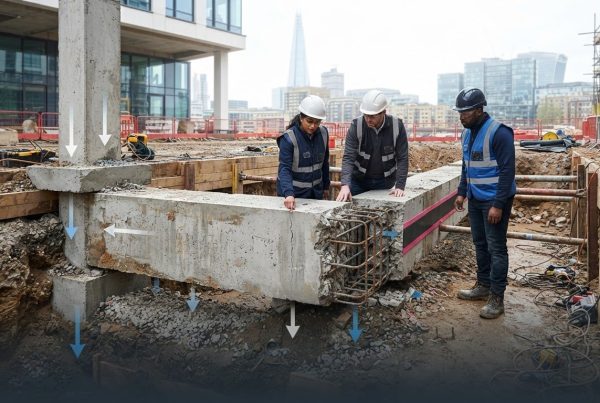

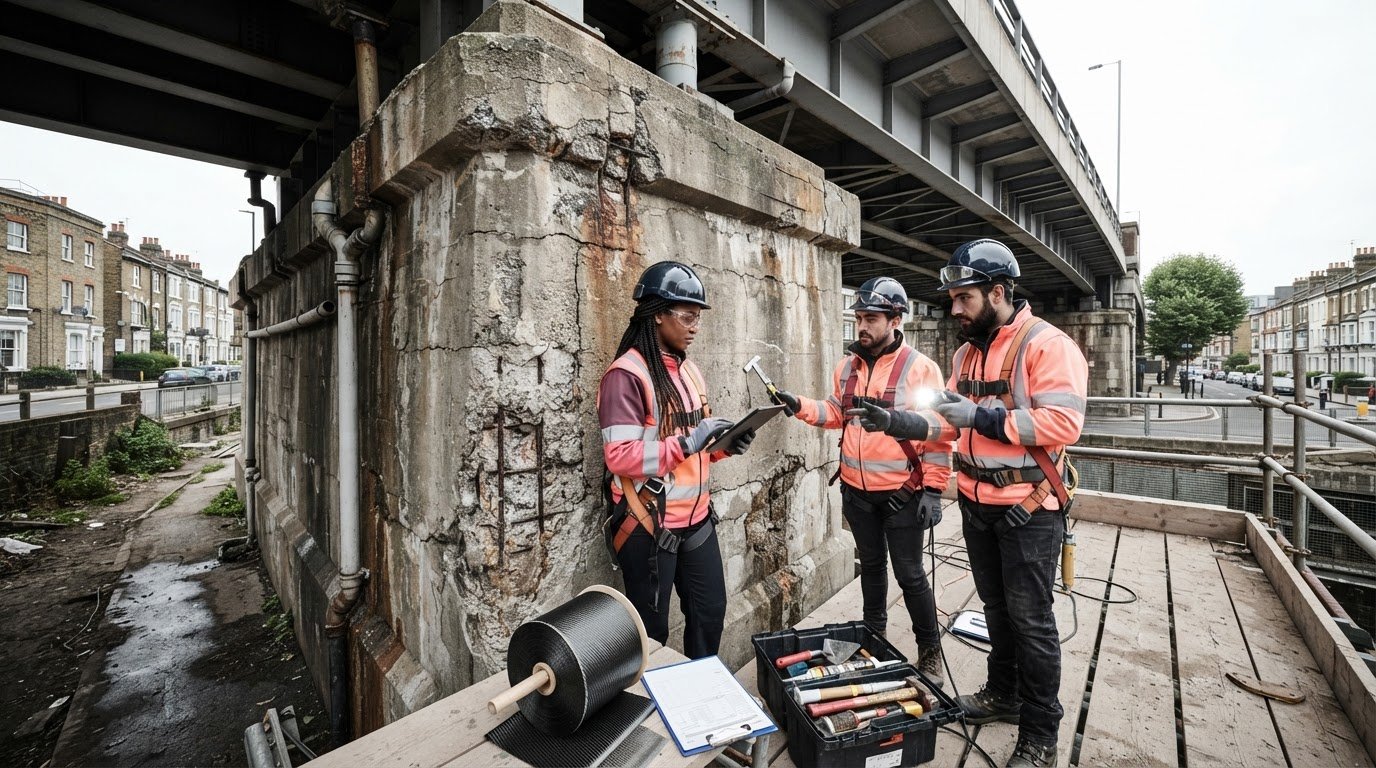
Could a crack in a bridge abutment be a surface defect, or evidence of movement affecting the structure’s support? The visible damage alone rarely provides the answer. Effective bridge abutment repair starts by distinguishing symptoms such as cracking, spalling or water staining from their underlying causes, which may include water ingress, drainage problems or changing ground conditions.
Repairing damaged concrete without addressing the mechanism behind its deterioration can leave the original problem unresolved. The right intervention depends on the defect’s extent, the abutment’s structural function and whether the issue concerns durability, load capacity or movement.
This guide explains how abutment defects are assessed, what information supports repair design, and how concrete repair and structural strengthening may be selected to suit the condition. It also sets out why surveys, testing and project-specific engineering matter when planning an intervention to extend an asset’s service life.
Key Takeaways
- Understand how an abutment’s role in retaining approach fill and transferring bridge reactions affects the significance of visible defects.
- Learn why similar cracks can have different causes, and how to distinguish concrete deterioration from movement or drainage-related problems.
- See how bridge abutment repair methods can be matched to the diagnosed need, from local concrete reinstatement to work addressing corrosion or water pathways.
- Use a structured sequence of records review, inspection, testing, diagnosis, design, works and verification to plan an informed intervention.
- Explore how feasibility studies, bespoke design and installation can be coordinated, with CFRP strengthening considered where assessment identifies a structural need.
Bridge abutment repair: what the structure does and why defects matter
An abutment is more than the concrete support visible at a bridge end. It forms part of the bridge’s load-carrying system and retains the earth that connects the span to the approach. Its condition can therefore affect both the bridge and the ground behind it. Understanding this combined function is essential before deciding whether a defect calls for concrete repair, structural intervention or further investigation.
What does a bridge abutment do?
The abutment supports the end of the bridge and retains the approach embankment, helping manage the transition between the structure and adjoining earthworks. Its components may include a backwall behind the bridge end, a bearing area supporting the deck or beam ends, and wingwalls retaining fill beside the approach. Nearby retaining elements may also interact with the abutment, although their structural relationship varies by design. A general overview of bridge abutment forms and functions provides useful context.
Load paths depend on the bridge configuration, geometry and detailing. Reactions may pass through bearings into the abutment and then to its foundation, while earth pressure acts on retaining faces. Some arrangements allow movement at the bridge end; others have different structural connections. The relationship between the abutment, deck, bearings, foundation, approach fill and drainage must be understood as a system, rather than inferred from appearance alone.
Which visible defects warrant investigation?
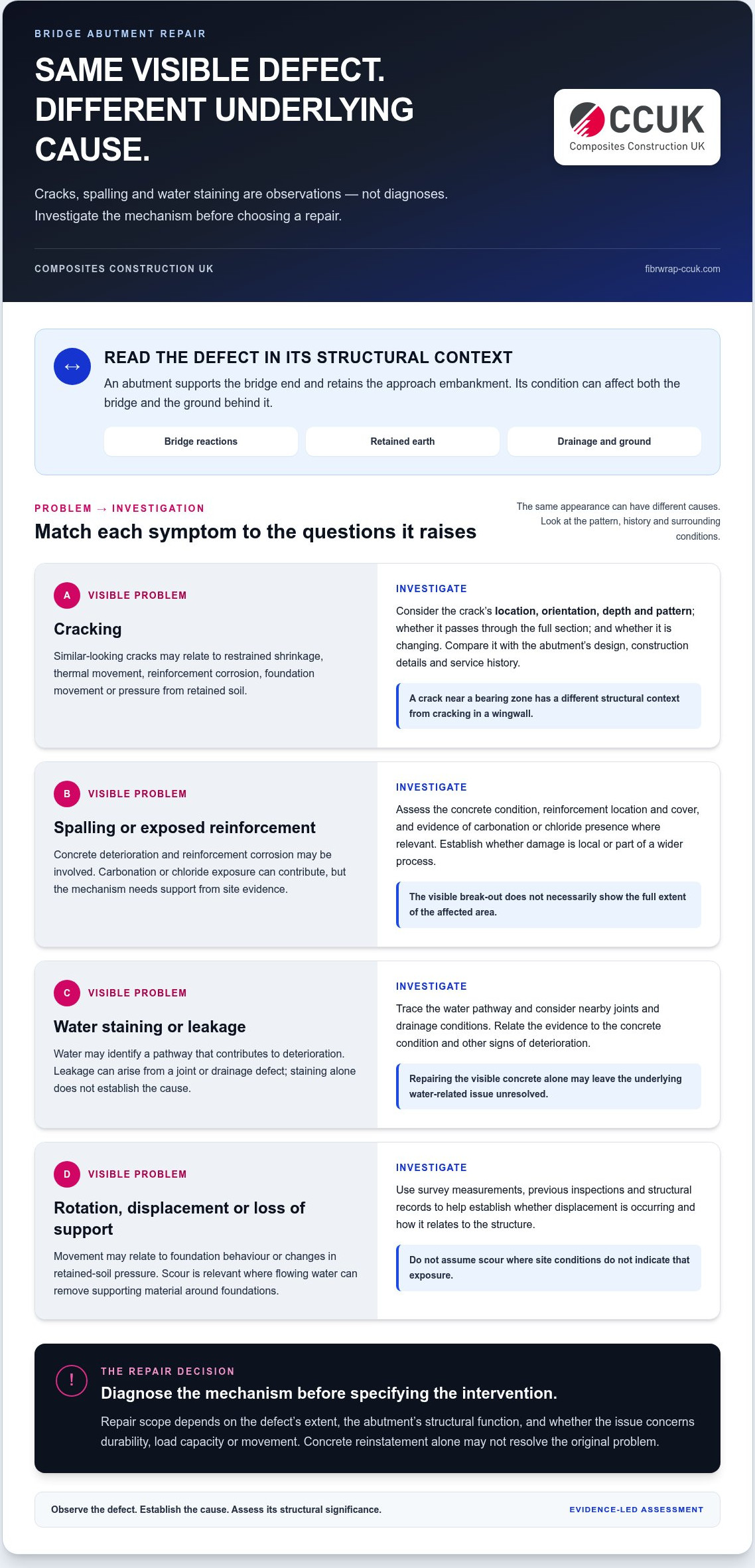
Cracking, spalling, exposed reinforcement, leakage and displaced joints are observations, not diagnoses. A crack’s position, orientation, width and pattern can help guide an investigation, but no single visual feature establishes its cause. A crack near a bearing zone, for example, has a different structural context from cracking in a wingwall. Both need to be interpreted against the design and surrounding conditions.
Change over time matters. A stable crack may indicate a different mechanism from one that is widening, extending or accompanied by displacement. Spalling and exposed reinforcement can point to concrete deterioration and corrosion, while water staining or leakage may identify a pathway contributing to deterioration. Rotation, differential movement or loss of support may instead involve the foundation, retained fill or drainage conditions. These mechanisms can coexist, so treating the visible concrete alone may leave the underlying issue unresolved.
For bridge abutment repair, the objective is to address the diagnosed problem while maintaining safety and serviceability, improving durability and retaining the existing asset where practicable. The work may require local reinstatement, measures directed at corrosion or water ingress, structural strengthening, or investigation of movement and support. The appropriate scope depends on the abutment’s function and condition. It cannot be selected reliably from a photograph or defect label alone.
Where damage appears to be changing, affects a bearing or joint, or is associated with displacement or loss of support, competent inspection and project-specific engineering judgement are important to urgent risk decisions. The immediate priority is to establish the defect’s significance and whether the structure’s function may be impaired before specifying repairs.
How abutment deterioration develops: connect symptoms to causes
A crack records a response within the structure, but does not identify the mechanism that produced it. Similar-looking cracks may arise from restrained shrinkage, thermal movement, reinforcement corrosion, foundation movement or pressure from retained soil. Their significance depends on factors such as location, orientation, depth, whether they pass through the full section and whether they are changing. Diagnosis requires considering the defect alongside the abutment’s form, construction details and service history.
Concrete and reinforcement deterioration
Carbonation or chloride exposure may contribute to loss of the protective conditions around reinforcement, but either mechanism needs to be supported by site evidence. If reinforcement corrodes, the resulting expansion can create tensile stresses in the surrounding concrete, leading to cracking, delamination and, in more advanced cases, loss of cover. The visible break-out does not necessarily show the full extent of the affected area.
Condition testing can help establish the extent and character of deterioration before repair design. Depending on the suspected mechanism, investigations may examine concrete condition, reinforcement location and cover, or evidence of carbonation and chloride presence. The findings help distinguish local damage from a wider process and inform whether repairs need to address the concrete, reinforcement corrosion or both.
Movement, water and ground interaction
Movement calls for a different line of enquiry. Settlement or rotation may relate to foundation behaviour, while changes in retained-soil pressure can place additional demand on the abutment. Scour is relevant where flowing water can remove supporting material around foundations; it should not be assumed where site conditions do not indicate that exposure. Survey measurements, comparison with previous inspections and review of structural records can help establish whether displacement is occurring and how it relates to the structure.
Water can contribute to deterioration, but it is not a diagnosis in itself. Leakage may arise from a joint or drainage defect, and water reaching retained fill can affect its condition or contribute to pressure behind the wall. Blocked drainage, staining, wet areas and deposits can help identify a pathway for investigation, but do not establish its source or the extent of any effect. Inspecting drainage outlets, joints and water routes alongside ground and structural evidence helps distinguish a water-management problem from concrete deterioration or movement.
Research from Iowa State University’s Institute for Transportation discusses improved abutment and approach slab details alongside water-management practices, highlighting the importance of considering bridge-end details and water pathways together.
Photographs can document surface condition, but cannot reliably establish crack depth, movement, reinforcement condition or foundation behaviour. A project-specific investigation may combine visual inspection, measurements, records review and targeted testing to assess possible causes. Durable bridge abutment repair depends on identifying the deterioration mechanism and addressing it as part of the intervention, rather than simply reinstating visible damage.
Choosing bridge abutment repair methods against the diagnosed need
Repair selection should follow the diagnosed mechanism and the abutment’s structural function. Restoring a patch of concrete may not address reinforcement corrosion, a continuing water pathway or a structural capacity shortfall. The comparison below outlines common intervention categories and their purposes. The final scope depends on investigation findings and project-specific design.
| Diagnosed need | Intervention category | Intended function | Design considerations |
|---|---|---|---|
| Local defective or delaminated concrete | Concrete removal and reinstatement | Restore the affected section and its protective cover | Extent and depth of removal, reinforcement condition, substrate and reinstatement requirements |
| Corrosion affecting reinforcement | Concrete repair with specified reinforcement treatment or protective measures | Address damaged concrete and the identified corrosion mechanism | Evidence of corrosion, affected area and how the repair specification manages the cause |
| Identified water ingress pathway | Targeted water-pathway or joint intervention | Reduce the source or route of water reaching vulnerable areas | Pathway location, drainage details and interaction with retained fill and concrete |
| Insufficient structural capacity | Engineered structural strengthening, potentially using CFRP | Address a calculated structural demand | Load path, geometry, substrate condition, design assumptions and installation requirements |
| Movement or loss of support | Further investigation and a response designed for the established cause | Address the mechanism affecting support or stability | Movement evidence, foundation and ground conditions, retained fill and water effects |
Concrete remediation and durability measures
Removing and reinstating defective concrete is a designed, condition-dependent intervention, not simply a matter of filling visible damage. The repair scope should account for the soundness of surrounding concrete, the extent of deterioration and the condition of the reinforcement. Where assessment and specification require it, reinforcement treatment or protective measures may form part of the work. This guide to concrete repair methods provides further context on matching remediation to the defect and asset requirements.
Concrete reinstatement and water management serve different purposes. If water continues to reach the repaired area, the pathway may need to be addressed alongside the concrete work. Likewise, where corrosion is established, reinstatement alone may not manage the identified mechanism. The design should define the purpose and limits of each measure.
When structural strengthening may be appropriate
Strengthening is considered when engineering analysis identifies a structural capacity requirement, not simply because cracking or spalling is present. Carbon Fibre Reinforced Polymer (CFRP) is one possible engineered approach where the abutment’s geometry, substrate and design conditions permit. It does not replace concrete remediation where defective material needs repair. Tyfo® Fibrwrap® system installation provides further system-specific context.
For bridge abutment repair, no material or method should be selected from a surface defect alone. A coordinated design can distinguish concrete repair from strengthening and bring both into the same project where assessment shows they are needed.
Planning an abutment repair: investigation, design and delivery
A durable intervention depends on a clear chain from available evidence to verified work. Surveys and tests inform that process, but their results must be interpreted alongside the structure’s design, condition and operating constraints. No single observation or test automatically proves a cause. For bridge abutment repair, develop the investigation, design and delivery scope for the asset rather than relying on a fixed specification or assumed programme.
A practical sequence is:
- 1. Review records: Gather available drawings, previous inspection findings, repair records and information about changes to loading or use.
- 2. Inspect: Record defect locations and characteristics, examine adjoining elements and note access, drainage and water conditions.
- 3. Test: Select material or structural investigations to answer specific questions raised by the inspection.
- 4. Diagnose: Compare records, observations and test results to assess plausible deterioration or movement mechanisms.
- 5. Design: Define the intervention, its limits, required preparation and how it relates to the abutment’s structural function.
- 6. Deliver the works: Coordinate access, traffic management, asset operation and site conditions with the specified repair or strengthening sequence.
- 7. Verify: Check completed work against the approved project specification and record relevant quality information.
What information informs the repair design?
Drawings can clarify geometry, reinforcement details and intended load paths. Earlier inspections and repair records may show whether defects have changed or returned. Inspection observations, material tests and structural calculations each answer different questions: tests characterise selected materials or conditions, while calculations assess structural behaviour against defined assumptions. Consider the findings together, with the design requirements and structural design considerations informing intervention selection.
How are works coordinated and checked?
Before work starts, the project plan should address safe access, traffic management, water conditions and how the bridge will remain in operation or be managed during the intervention. The specified sequence may include preparation, concrete repair or strengthening installation, curing requirements and inspection hold points. These are project-dependent steps; the approved specification should define which apply and when work can proceed.
Quality records and verification should match the designed intervention. This may include documenting preparation, inspecting work at specified hold points and checking completed work against approved requirements. Any monitoring should relate to the diagnosed mechanism and the asset’s risk, rather than being applied as a generic measure. Scope and sequencing depend on the condition found and the constraints at the bridge.
Composites Construction UK coordinates feasibility studies, bespoke engineering design, surveys and testing, concrete repair and installation as project-specific interventions. These services can be brought together to suit the asset’s condition and engineering requirements.
Delivering a bridge abutment repair with integrated engineering support
Assessment, design and delivery work best as connected parts of one engineering process. Inspection and testing help establish the structure’s condition; feasibility work and design translate that evidence into a defined scope, with installation planned around the asset’s geometry and operating constraints. This approach supports repair decisions based on the diagnosed need rather than a standard treatment applied to every abutment.
A project-specific repair and strengthening strategy
The scope should reflect three things: the defect mechanism, any identified structural requirement and the practical constraints of the site. For example, local concrete deterioration may call for concrete repair, while a separate analysis may identify a need for structural strengthening. If both are specified, their design and installation can be coordinated so the concrete intervention and strengthening measures serve their distinct purposes within the overall scheme.
Carbon Fibre Reinforced Polymer (CFRP) strengthening, including Tyfo® Fibrwrap® systems, is a project-dependent option where engineering assessment identifies a relevant structural demand and the design conditions are suitable. It is not a default response to cracking or spalling, nor a substitute for addressing the cause of concrete deterioration. The selected system, preparation requirements and installation details should follow the project-specific design and the condition of the substrate.
Site constraints also influence how a repair is delivered. Access to the abutment, traffic management, water conditions and the need to maintain bridge operation can affect work sequencing and installation planning. Incorporate these factors into feasibility and design discussions early enough to establish a practicable scope without changing the intervention’s engineering purpose.
From assessment to a defined project scope
Bringing inspection evidence, testing, design and installation planning together helps maintain a clear link between observed condition and specified work. Survey findings inform the diagnosis; bespoke engineering design defines the required repair or strengthening; and installation planning turns that specification into coordinated site activities. Verification can then be matched to the approved scope. The intervention is intended to address the established need and support continued asset service, but no single method guarantees a particular outcome or suits every bridge.
Composites Construction UK provides specialist engineering services across the United Kingdom, including structural surveys and testing, feasibility studies, bespoke design, concrete repair, structural strengthening and professional installation. Its assessment-led approach brings these elements together for project-specific bridge abutment repair, with CFRP and Tyfo® Fibrwrap® considered where the engineering requirements support their use.
Set the next repair decision on sound engineering evidence
Bring available inspection records, drawings and observations into a clear project brief. This gives the engineering team a basis for considering the abutment’s condition, operational constraints and any further information needed to define an appropriate scope. A well-founded decision can direct work towards the identified need and support continued use of the existing asset where practicable.
Composites Construction UK delivers specialist structural strengthening and concrete repair across the United Kingdom, with project work that can include feasibility studies, bespoke engineering design and professional installation. CFRP strengthening and Tyfo® Fibrwrap® systems are project-specific options where engineering assessment identifies a relevant requirement, rather than default remedies.
If you are planning work on a bridge abutment, contact Composites Construction UK’s engineering team to discuss the asset’s condition and requirements. You can also visit Composites Construction UK to learn more about its structural strengthening and repair services.
Frequently Asked Questions
What causes cracks in a bridge abutment?
Cracks can result from structural, material or ground-related mechanisms, including movement, reinforcement corrosion and restraint effects. Their appearance alone cannot identify the cause. Engineers consider the crack’s position, pattern and width, whether it changes over time, and nearby conditions such as joints, drainage and the approach ground. Inspection, with targeted testing where appropriate, helps distinguish possible causes and define a repair scope suited to the evidence.
Can a cracked bridge abutment be repaired without replacement?
Repair may be feasible if investigation shows that the damage can be addressed and the remaining structure can meet its required function. Depending on the findings, work might include concrete remediation, protective measures or designed strengthening. Repair is not suitable in every case: the decision between rehabilitation and replacement depends on the abutment’s condition, performance requirements and practical constraints, including access and how the bridge must operate during the work.
How is bridge abutment damage assessed?
Assessment typically combines records review, close visual inspection and targeted investigation or testing where needed. Engineers consider where defects occur, whether they are progressing, the condition of materials and the abutment’s structural role, as well as water and ground interactions. Changes in bridge use or loading may also be relevant. For bridge abutment repair, these sources of evidence are interpreted together; photographs or a single test cannot establish the full diagnosis.
Does water ingress mean a bridge abutment needs structural strengthening?
No. Water ingress can contribute to material deterioration, but it does not by itself show that the abutment lacks structural capacity. Assessment needs to establish where water enters, what damage is associated with the pathway and whether structural performance is affected. The appropriate response may focus on concrete condition or water management. Strengthening is considered only if engineering analysis identifies a structural requirement, not simply because dampness or leakage is visible.
When is CFRP used for bridge abutment repair?
CFRP may be considered where engineering analysis identifies a need to strengthen the abutment and the substrate, geometry, access and design conditions are suitable. It serves a different purpose from concrete reinstatement: replacing defective concrete restores material, but does not automatically increase structural capacity. The chosen system, detailing and installation method must be set by project-specific design and specification, taking account of the surface condition where the strengthening will be applied.
What information is needed to plan a bridge abutment repair?
Useful starting information includes available drawings, inspection records, repair history, observed defect changes, access constraints and details of the bridge’s current use. Depending on the suspected mechanism and intended repair, engineers may also need targeted testing or structural calculations. The relevant information varies between assets, so this list is a starting point rather than a complete specification. Competent engineering judgement is needed to identify gaps and define the investigation required.
Can bridge abutment repair be carried out whilst the bridge remains in use?
Sometimes, but continued bridge use cannot be assumed before the work is planned. The decision depends on the defect, work location, safe access, construction sequence and temporary conditions, as well as any restrictions identified through assessment. The delivery plan must address safety and operational controls, including whether traffic management or temporary works are needed. These requirements should be determined for the specific asset and intervention, rather than promised in advance.