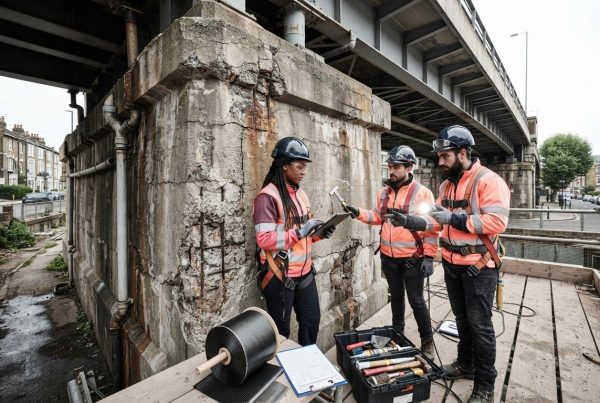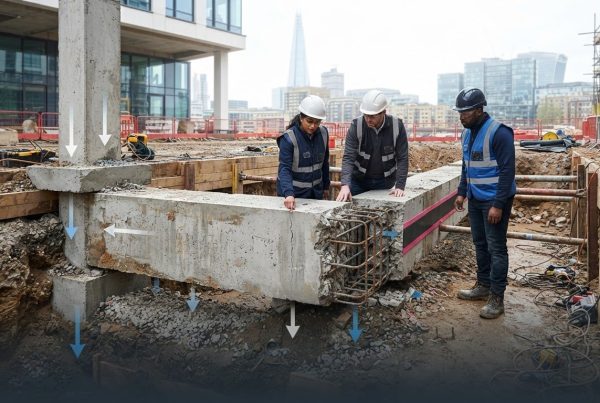


The most effective bridge beam strengthening solution may not use the most familiar material or involve the most substantial intervention. It must address the beam’s diagnosed deficiency: a system that improves flexural capacity, for example, will not necessarily resolve shear weakness, corrosion or another cause of reduced performance.
Uncertainty about damage, construction access and keeping an asset in service can make options difficult to compare. A structured engineering process helps resolve these questions, beginning with investigation and assessment rather than choosing a preferred repair method in advance.
This article explains how engineers assess beam condition and capacity, identify the cause of a deficiency, and compare interventions against structural requirements and project constraints. It also examines where external post-tensioning, section enlargement and composite reinforcement, including CFRP, may be appropriate. The aim is to show how evidence informs a bespoke design and installation plan, so the intervention is proportionate to the need and supports continued service where assessment demonstrates this is suitable.
Key Takeaways
- Start bridge beam strengthening with evidence-led assessment so the intervention addresses the actual cause of reduced capacity.
- Distinguish flexural, shear, fatigue and local detailing deficiencies, as each can lead to different design requirements.
- Compare CFRP, steel plate strengthening, prestressing and section enlargement against the structural need, substrate condition and access constraints.
- Plan design and delivery around feasibility, calculations, preparation, installation sequencing and verification, accounting for traffic and operational requirements.
- Composite systems such as CFRP and Tyfo® Fibrwrap® may form part of a project-specific strengthening solution when assessment and design indicate they are suitable.
Why bridge beam strengthening starts with a structural assessment
Bridge beam strengthening is an engineered intervention to address an identified shortfall in a beam’s capacity, condition or performance. The evidence and the structure’s requirements determine the method. No single material or technique suits every bridge. Choosing a solution before understanding the deficiency risks treating the wrong problem.
Strengthening and repair are related but address different needs. Strengthening changes or supplements structural resistance to meet defined performance objectives. Repair addresses deterioration or damage in the material, such as concrete delamination or cracking. A project may need both: deterioration can affect capacity and must be understood before a strengthening system is designed. Inspection findings, design actions and the asset’s required service all inform whether an intervention is justified.
What conditions can prompt a bridge beam strengthening assessment?
An assessment may be prompted by increased loading demands, observed deterioration or a known structural deficiency. A change in use or loading assumptions can lead asset teams to review whether the existing beams remain adequate. Inspections may also identify cracking, spalling, deformation or other damage that warrants investigation.
Visible signs are evidence to investigate, not a diagnosis in themselves. A crack’s location, pattern and development may help engineers understand structural behaviour, but appearance alone does not establish a verified capacity shortfall. The review should consider the beam as part of the complete structure, including how loads pass through the deck, supports and connections.
Original design drawings, calculations and inspection records can help establish the intended structural arrangement and assumptions. Later alterations, repairs or changes in use may also affect the assessment. Where records are incomplete, appropriate inspection and investigation can help address uncertainty without relying on assumptions.
What evidence informs the assessment?
The evidence required depends on the project. It may include document review, visual inspection, measurements and targeted testing. Together, these sources help establish the beam’s geometry, material condition, reinforcement details and likely load paths, informing the engineering model and its assumptions. Structural form provides useful context: a reinforced concrete bridge, for example, relies on the interaction of concrete and reinforcement, so their arrangement and condition matter to the assessment.
- Document review: Drawings, calculations, previous inspection findings and records of alterations help reconstruct the design and maintenance history.
- Inspection and measurement: Observations and dimensional checks can identify areas requiring closer examination and confirm relevant geometry.
- Targeted testing: Selected investigations can provide more information about materials or concealed details where existing evidence is insufficient.
Concrete deterioration should be considered alongside structural performance, since damage or corrosion may affect the reliability of the section being assessed. The appropriate response depends on the cause and extent of deterioration. The guide to concrete repairs explains how repair and structural remediation relate. Once the evidence is assembled, engineers can identify the governing deficiency and determine whether strengthening, repair or a coordinated intervention is warranted.
How engineers diagnose a bridge beam’s strengthening requirement
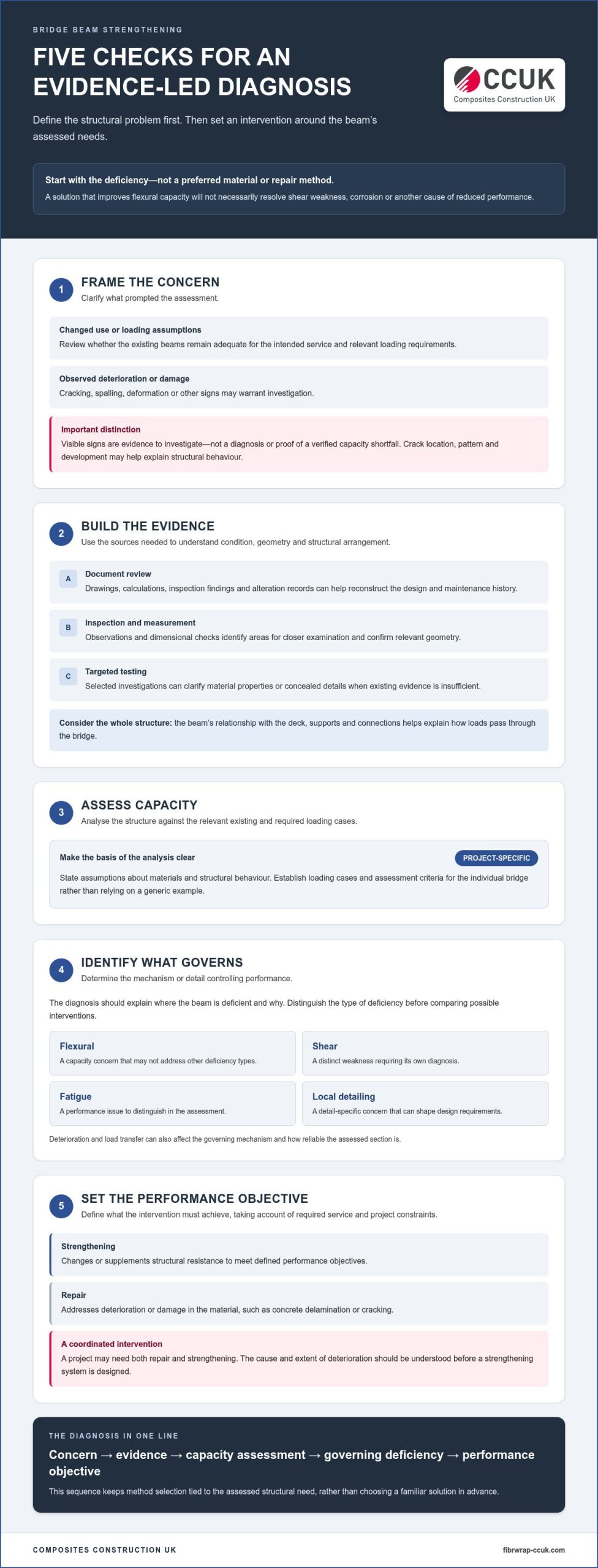
A useful diagnosis turns inspection findings and loading requirements into a defined engineering problem. It identifies not only where a beam is deficient, but also the mechanism governing its performance and the outcome an intervention must achieve. This keeps method selection tied to structural need rather than familiarity with a particular material.
- Define the concern. Establish what prompted the review, such as a change in intended service, a capacity concern or evidence of a developing structural problem.
- Gather relevant evidence. Bring together available records, inspection observations, measured geometry and any targeted investigation needed to describe the beam’s current condition and configuration.
- Assess capacity. Analyse the structure against relevant existing and required loading cases, making assumptions about materials and structural behaviour explicit.
- Identify the governing mechanism. Determine which limit state or detail controls performance, and whether deterioration or load transfer affects it.
- Set performance objectives. Define what the intervention is intended to achieve, taking account of the asset’s required service and project constraints.
How do loading and structural analysis shape the design brief?
The design brief should establish the loading cases relevant to the bridge’s present and intended service. These may include existing traffic demands and specified future requirements. The applicable cases and assessment criteria must be established for the individual project, not assumed from a generic example.
Beam analysis also depends on how forces pass through the structure. Load paths, support conditions, continuity between spans and the interaction of deck and beams affect the calculated response. If these conditions are represented incorrectly, the analysis may not reflect actual structural behaviour. The Federal Highway Administration’s Techniques for Bridge Strengthening provides a reference on intervention approaches, but it does not replace project-specific assessment or applicable UK guidance.
How does the diagnosed failure mode guide the intervention?
Flexural concerns relate to resistance to bending, while shear concerns involve forces acting across a beam section. Fatigue relates to performance under repeated loading, while local detailing issues may involve anchorage, connections or force transfer. These mechanisms are not interchangeable: a solution developed for one may leave another unresolved.
Assessment must also consider what happens beyond the strengthened beam. Changes in stiffness or capacity can affect adjacent members, connections and the wider load path, so the intervention’s effects need to be checked across the structural system. A strengthening design must address the governing deficiency identified by assessment and remain compatible with the surrounding structure.
For composite solutions, design assumptions must be coordinated with substrate condition, detailing and installation requirements. The technical Tyfo® Fibrwrap® guide discusses system installation in a structural strengthening context. Where a composite intervention is being considered, a bespoke strengthening design can connect the diagnosed requirement to a project-specific solution.
Which bridge beam strengthening methods suit different constraints?
Method selection follows the diagnosed deficiency and the bridge’s constraints, not a generic ranking of materials. Engineers consider beam geometry, substrate condition, reinforcement arrangement, available access and the intervention’s effects on the wider structure. The comparison below is an initial guide. Suitability must be established through project-specific analysis and design.
| Method | Potential structural need | Access and substrate considerations | Design considerations |
|---|---|---|---|
| CFRP strengthening | Additional reinforcement for an assessed capacity need where a bonded or anchored composite layout is suitable. | Requires access to the application surface and a substrate prepared to meet the system requirements. | Layout, bond, anchorage, terminations and interaction with existing reinforcement must be designed. |
| Steel plate strengthening | Supplementary reinforcement where plates can be detailed to address the identified demand. | Handling and fixing plates can require working space; the concrete surface and attachment details need assessment. | Connection behaviour, force transfer, plate geometry and detailing at ends require consideration. |
| Prestressing | External prestressing may be considered where a designed force can address the beam’s structural requirement. | Access is needed for tendons, anchorages and installation operations. | Force introduction, anchorage zones, tendon profile and effects on the structure must be assessed. |
| Section enlargement | Added concrete or other material may be considered where a larger or modified section is appropriate. | Formwork and placement need access; the existing surface and interface require preparation. | Added mass, changed geometry, interface behaviour and construction sequence affect the design. |
Where can CFRP strengthening fit into a bridge beam scheme?
Carbon Fibre Reinforced Polymer (CFRP) can provide lightweight reinforcement for suitable substrates and structural needs. It may be relevant where access, geometry or the need to limit added material makes a composite scheme worth evaluating. These characteristics do not establish suitability on their own; the deficiency and the member’s condition remain decisive.
The design must specify the reinforcement layout and how forces are transferred into the beam. Bond, anchorage, termination details and interaction with existing reinforcement all need to be addressed. Surface condition and preparation are also central to the design and installation plan. CFRP should not be treated as a substitute for diagnosing or resolving deterioration in the substrate.
When might other strengthening approaches be considered?
Steel plates, prestressing and section enlargement offer different ways to introduce or develop additional resistance, but each brings distinct detailing and construction requirements. Plates need secure force transfer; prestressing depends on designed anchorages and force paths; enlargement changes the section and may add mass. Access limitations and the sequence of work can therefore affect which options remain practicable.
Where deterioration is present, repair and capacity intervention may require coordinated but distinct design decisions. An option that addresses the required structural performance must also be compatible with the existing beam and surrounding members. The appropriate bridge beam strengthening method is one that meets the assessed need and can be designed and delivered within the project’s structural and operational constraints.
What should a bridge beam strengthening design and delivery plan cover?
A practical design and delivery plan connects the assessed structural need to a buildable intervention, with responsibilities, assumptions and verification defined before installation begins. It should bring together feasibility, bespoke engineering design and delivery planning so the selected system can be installed as intended and the asset owner can understand how the work was completed.
For bridge beam strengthening, the plan should set out:
- Design brief and feasibility: The deficiency, required performance, available evidence and constraints that influence the proposed intervention.
- Detailed design: Calculations, member-specific detailing, material requirements and interfaces with the existing structure.
- Delivery and verification: Surface preparation, installation sequence, project-specified quality checks, records and post-installation review.
Check current asset-owner requirements and applicable UK technical guidance for each project. Design assumptions, material selection and acceptance criteria need to suit the structure and its intended service, rather than being carried over uncritically from another scheme.
How should design account for access and live-asset constraints?
Working space, safe access and the need to maintain traffic or other operations can shape both design and installation sequencing. A beam accessible only from below, for example, presents different handling and preparation considerations from one with clear access around its soffit and sides.
Planning should identify any required possessions, traffic management or temporary arrangements, subject to the asset, approvals and project-specific method statements. The sequence also matters structurally: temporary conditions during installation may differ from the completed state and should be considered in the design and programme. A particular closure or duration cannot be assumed without project-specific planning.
How are substrate preparation and installation quality controlled?
For composite reinforcement, the receiving surface is a critical interface. Inspect its condition, and carry out preparation in line with the engineered system requirements so the specified bond and detailing can be achieved. Any deterioration requiring repair needs to be addressed through a coordinated plan before reinforcement is installed over the affected area.
Quality control should be set out in project documentation, including the checks and records needed at relevant stages. These may cover surface preparation, materials used, installation conditions and completed work, as specified for the project. The design should establish the acceptance criteria rather than relying on generic thresholds.
Why do records and future inspection matter?
Traceability carries the design intent through to the installed work. Organise drawings, calculations, preparation and installation records, and verification information so the asset owner can relate what was built to the approved design. These records support future inspections by showing where reinforcement is located and which details or interfaces may warrant attention.
Durability planning should also consider environmental exposure, interface detailing and whether the strengthened area remains accessible for inspection. These are design considerations, not grounds for assuming that a material removes the need for future maintenance. The composite strengthening service brings together project-specific feasibility, design and installation.
How can a specialist strengthen bridge beams for longer asset life?
Extending a bridge’s useful life depends on matching the intervention to its verified structural need and delivering it in a way that respects the asset’s condition and operating context. Where engineering assessment supports strengthening rather than replacement, a coordinated project can help preserve the existing structure and its utility. The outcome depends on the evidence, design and quality of execution.
What does an integrated bridge strengthening project involve?
A joined-up project moves from feasibility findings to a defined design brief, then through detailed engineering, system selection, installation planning and verification. Each stage informs the next. For example, feasibility work can establish whether the identified deficiency is addressable through strengthening and clarify the constraints the design must accommodate. Calculations and detailing then translate those requirements into a scheme for the specific member.
Coordination between assessment and delivery is important. Installation planning should reflect the design intent, substrate and available site access, while verification records should show how the completed work relates to the specified scheme. This connection helps reduce the risk of design assumptions being lost between engineering and site delivery.
Composites Construction UK provides feasibility studies, bespoke engineering design and professional installation. CFRP strengthening and Tyfo® Fibrwrap® Systems can be considered as engineered options where the beam, substrate and diagnosed need are suitable. As the exclusive UK licensee for the Tyfo® Fibrwrap® system, the company connects system selection with project-specific design and installation. No composite system is suitable for every beam; suitability depends on the structural assessment and scheme requirements.
How can composite strengthening support asset life-extension?
Retaining and strengthening an existing asset may offer a proportionate alternative to premature replacement when engineering evidence shows the required performance can be achieved. This can preserve the function of infrastructure already in service while focusing intervention on the identified need. The case for life-extension must be established for the particular bridge, rather than presumed from the material selected.
Durability depends on more than reinforcement type. Substrate condition, design detailing, environmental exposure, installation execution and subsequent asset management all influence how an intervention performs over time. Future inspection and maintenance remain part of responsible asset stewardship, and the strengthening design should consider how relevant areas can be reviewed after installation.
A clear project brief connects the concern to the next engineering step. Useful starting information may include inspection findings, drawings or records of alterations, the beam location and known access or operational constraints. These details support a focused feasibility review and help identify the evidence needed to develop a project-specific scheme.
For a defined bridge beam concern, share the available project information with Composites Construction UK to discuss assessment, design and installation.
Turn the structural concern into a defined project brief
Give the concern a clear route into engineering review. Record what prompted it, what is known about the beam and its service, and which operational constraints could shape investigation or delivery. Gaps in the available information can be identified as questions for feasibility work rather than filled with assumptions. This creates a practical starting point for deciding whether bridge beam strengthening is appropriate and what evidence is needed to develop a proportionate scheme.
Where assessment supports retaining the existing structure, a project-specific intervention may help extend its use instead of moving prematurely towards replacement. That decision should remain grounded in structural evidence, with the design and delivery approach aligned to the asset’s needs.
Discuss your bridge beam strengthening project with Composites Construction UK to take the next step towards an engineered assessment of your asset’s requirements.
Frequently Asked Questions
Can bridge beams be strengthened without replacing the whole bridge?
Yes. Bridge beam strengthening can address a deficiency in an existing member without requiring whole-bridge replacement, if assessment shows the structure can meet its required performance after intervention. The scope might focus on one beam or a defined part of the structure, but engineers must consider how loads transfer through connected members and supports. Where deterioration is extensive or affects other elements, the appropriate response may involve a broader repair or renewal strategy.
Can bridge beam strengthening be carried out while a bridge remains in service?
It may be possible, but this depends on the work area, access arrangements, installation sequence and the bridge’s operating requirements. Some tasks may be planned around continued use, while others could require restrictions or temporary arrangements to manage safety and construction risks. These decisions are made for the specific asset and are subject to relevant approvals and method statements. Continued service should not be assumed before temporary works and the work sequence have been assessed.
Does CFRP strengthening add significant weight to a bridge beam?
CFRP is a lightweight reinforcement option compared with interventions that add substantial concrete or steel, so its added mass may be limited in a suitable design. The actual effect depends on the specified system, its layout and the area being strengthened. Weight alone does not establish suitability: the design must also consider how the reinforcement transfers forces into the beam, the receiving surface’s condition and the structural deficiency being addressed.
Can a bridge beam be strengthened if its concrete is deteriorated?
Potentially, but the deterioration must be investigated and addressed as part of the engineering solution. Applying composite reinforcement over unsound concrete or unresolved corrosion may fail to address the cause of reduced performance or provide a suitable substrate. Assessment can determine whether concrete repair, treatment of the underlying deterioration and strengthening should be coordinated. The proposed system and installation details must then reflect the verified condition of the beam.
How long does bridge beam strengthening take?
There is no reliable single duration for every project. Timescales depend on the extent of investigation and design, access, the size and condition of the work area, preparation requirements, installation sequencing and any traffic or operational arrangements. Verification and approvals can also affect the programme. A feasibility review can help define these dependencies before a delivery plan is established, but a project-specific scope is needed to develop a meaningful programme rather than relying on a generic estimate.
What information is useful before a bridge beam strengthening feasibility study?
Useful starting material includes available drawings or calculations, inspection reports, records of previous repairs or alterations, and a clear description of the concern that prompted the study. Note the beam’s location, known access limitations, current or intended use, and any operational constraints. If documents are missing, state that rather than guessing. This information helps focus the feasibility review and identify what further inspection, measurement or testing may be required.