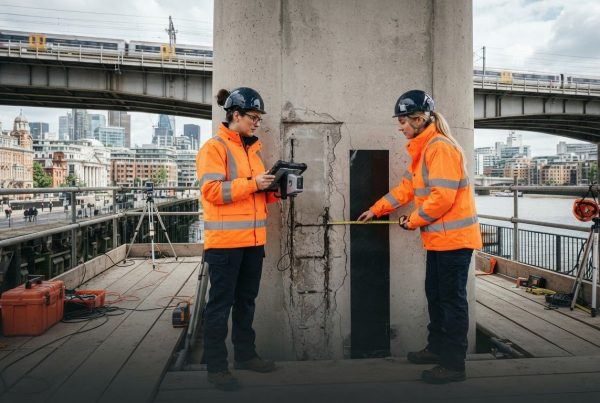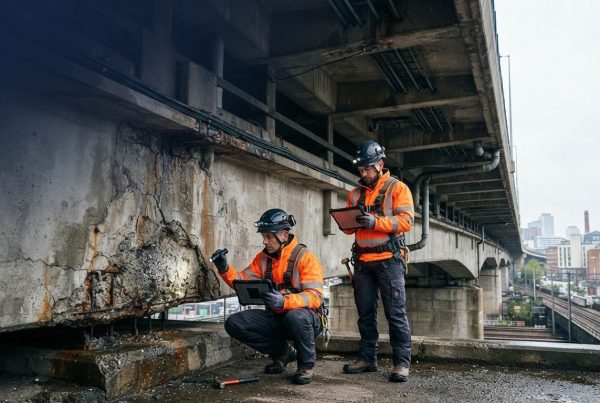

Could strengthening a ground beam make the problem worse if its role in the foundation system is misunderstood? Cracking, movement or excessive deflection can raise legitimate concerns, but visible damage alone cannot show whether a beam has lost capacity or identify the cause.
Ground beam strengthening should start with the load path: how forces pass through the beam, its supports and the connected structure. Soil movement, changes in loading, construction defects or deterioration may contribute to distress. Assessing the cause and structural demand before choosing an intervention helps avoid treating symptoms whilst leaving the underlying problem unresolved.
This article explains how engineers assess ground beams, distinguish structural concerns from other forms of damage and compare strengthening methods against site constraints. It also considers when a project-specific CFRP intervention may be appropriate, alongside the design and installation details needed to integrate it with the existing structure. The aim is to support a proportionate repair strategy that preserves the wider foundation system and extends the asset’s service life where assessment shows retention is appropriate.
Key Takeaways
- Trace how the beam transfers loads through its supports and foundation elements before interpreting signs of damage.
- Review drawings, reinforcement details and loading history alongside survey findings to build a reliable assessment.
- Compare concrete enlargement, steel and CFRP against the structural action required, available access and construction constraints.
- Effective ground beam strengthening depends on detailing that transfers forces into sound existing material.
- Link assessment, bespoke design and installation to develop a proportionate intervention that supports the asset’s continued service.
Ground beam strengthening: what it addresses and why it matters
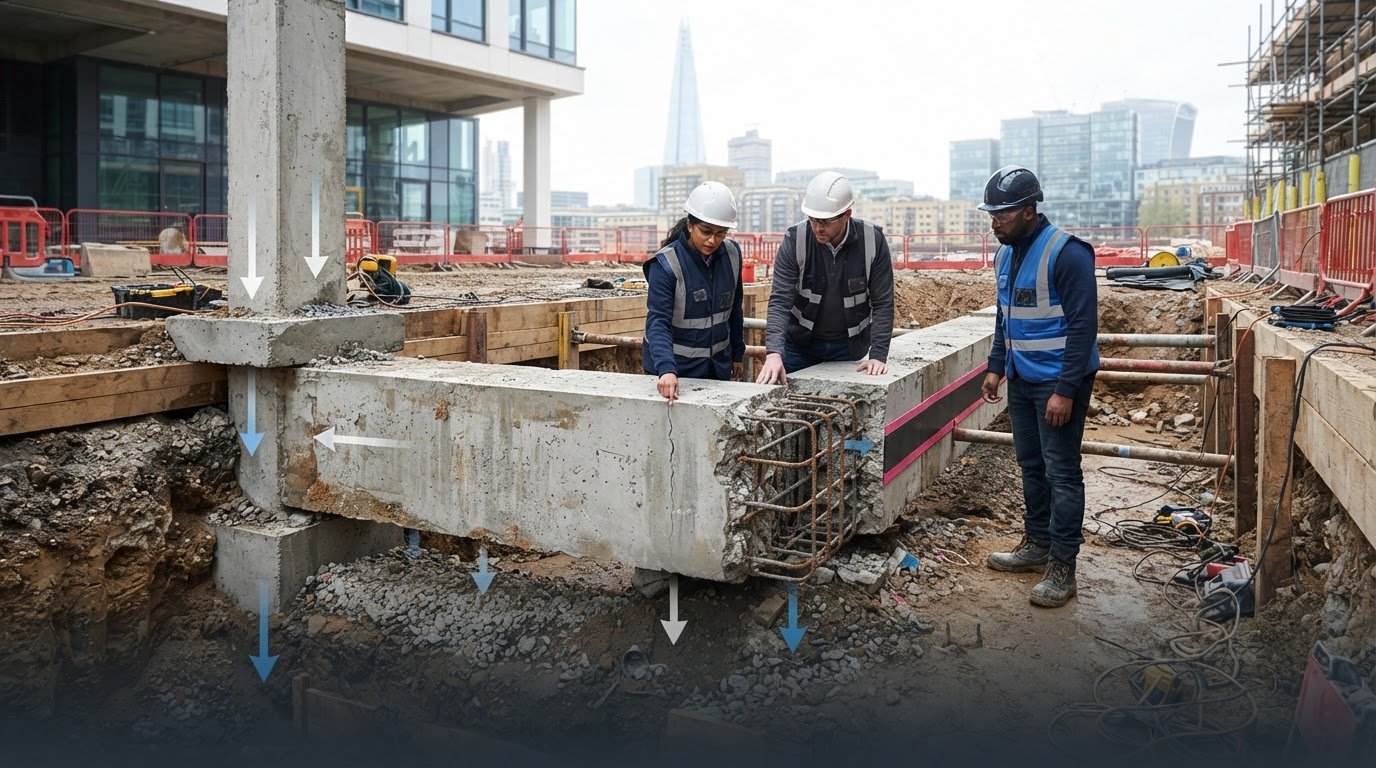
A ground beam is a structural member at or near ground level that transfers loads between supports or foundation elements. Depending on its design, it may connect pile caps, piles, columns or other supports, carrying loads from the structure above through the foundation system. Like other beams, it may be subject to bending, shear, axial force or a combination of actions. The general behaviour of a beam is outlined in Beam (structure), but a ground beam’s actual function must be established from the project design.
Terminology and structural role vary between projects. A beam may span between supports, tie foundation elements together or do both; its load path cannot be inferred reliably from its name or appearance alone. This distinction matters because ground beam strengthening addresses a shortfall in structural capacity or performance. Concrete repair restores damaged material, whilst defect remediation addresses an identified cause, such as water ingress or reinforcement corrosion. Underpinning, by contrast, changes or extends the foundation support. These interventions may be considered together, but they are not interchangeable.
How a ground beam works within the foundation load path
Understanding how the beam connects to its supports is central to identifying the forces it must resist. A beam spanning between piles, for example, may develop bending and shear as it transfers loads between them. Restraint from connected elements may also introduce axial forces. Behaviour depends on support conditions, continuity, reinforcement, geometry and the stiffness of adjacent components. Engineers should therefore compare design drawings with the observed construction before assessing the beam’s role.
When ground beam strengthening may be considered
Assessment may be prompted by altered building use or additional loads, impact damage, material deterioration, or a suspected deficiency in the original design or construction. Cracking, visible deflection and concrete distress are signs to investigate, not diagnoses. Similar symptoms can have different causes, and a crack does not by itself demonstrate inadequate capacity.
The source of distress may lie beyond the beam. Movement can be associated with its supports, changing ground conditions or connected structural elements, so treating only the visible damage risks leaving the cause unresolved. Investigation should establish whether the concern relates to local deterioration, a change in the load path, loss of support or a combination of factors.
The appropriate intervention depends on verified structural behaviour and site conditions, including access and the condition of the material that would receive the strengthening detail. Repair may be suitable where capacity remains adequate; strengthening may be considered where analysis identifies a capacity or performance shortfall. This distinction helps ensure the design addresses the underlying need and supports continued use of the existing asset.
Assessing a ground beam before choosing a strengthening method
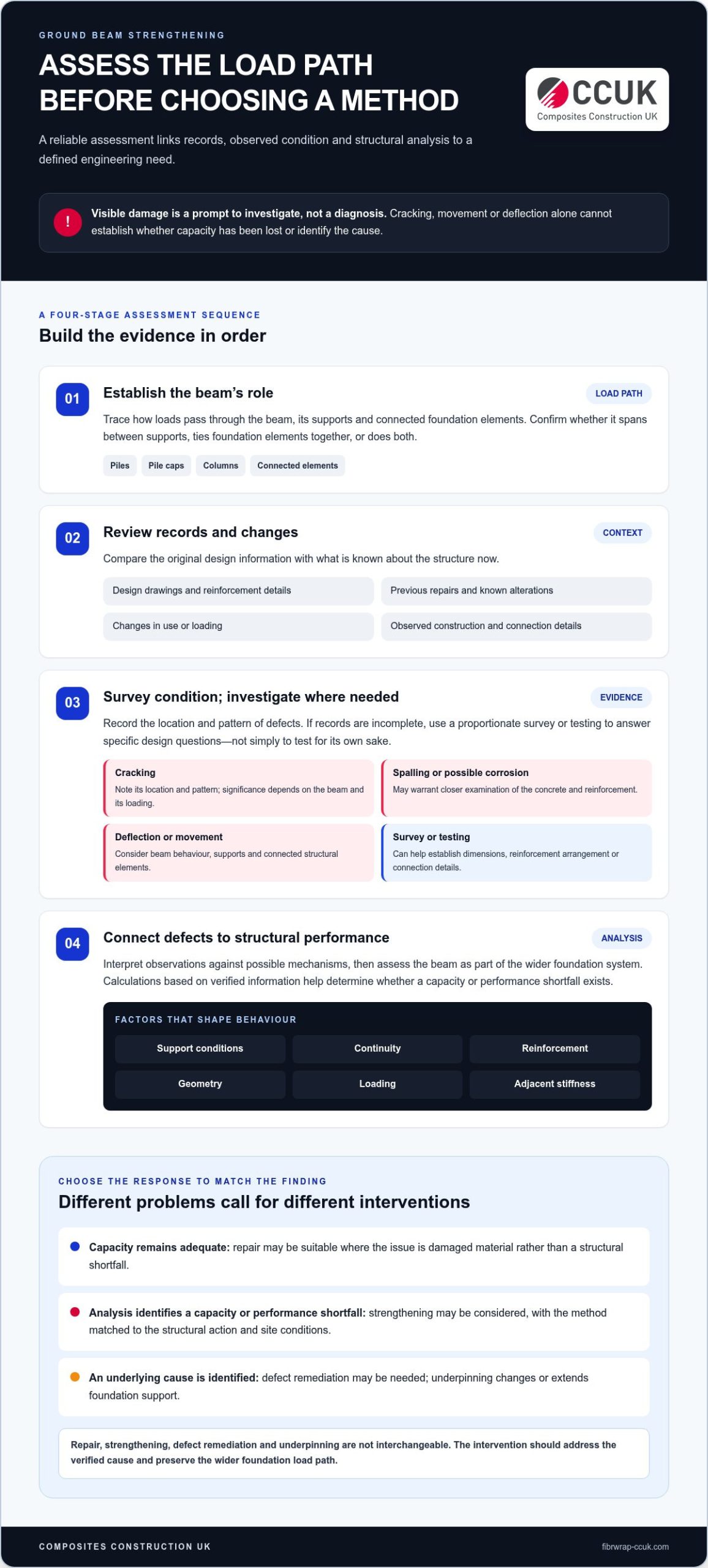
A reliable assessment moves from available evidence to targeted investigation and then structural analysis. The aim is not simply to catalogue visible defects, but to establish how the beam behaves, what loads it must carry and whether its condition and capacity meet the project requirements. This sequence helps ensure that ground beam strengthening addresses a defined engineering need, rather than an assumption based on appearance.
What information informs a ground beam assessment?
Start with available design drawings and records, including reinforcement details, previous repairs, known alterations and changes in use or loading. Where records are incomplete, a proportionate survey or testing may be needed to establish the beam’s dimensions, reinforcement arrangement or connection details. The investigation should be guided by the questions the design needs to answer, rather than testing for its own sake.
A visual survey records the location and pattern of cracking, concrete spalling, possible corrosion indicators, deflection and evidence of movement. These observations provide information about condition, but do not independently establish load capacity. A crack’s position and orientation, for example, may suggest a possible structural mechanism; its significance still depends on the beam’s geometry, reinforcement, support conditions and loading.
How engineers connect defects to structural performance
Engineers interpret observed distress against potential failure mechanisms. Cracking may prompt investigation of bending, shear, restraint or reinforcement anchorage. Spalling and signs of corrosion may raise durability concerns and lead to closer examination of the concrete and reinforcement. Deflection or movement may reflect beam behaviour, but can also relate to changes in supports or connected elements.
The beam must therefore be considered as part of the wider foundation system, including piles, pile caps, columns and adjoining structural components. Structural surveys and testing can provide information about material condition and configuration, whilst analysis evaluates how the system responds to current and required loads. Calculations based on verified information, not visual evidence alone, help determine whether a capacity or performance shortfall exists and what intervention may be appropriate.
- Records establish context: drawings and loading history help define the intended arrangement and current demand.
- Survey findings direct investigation: recorded symptoms help identify where further examination may be useful.
- Analysis tests the structural question: calculations relate verified details and loads to beam and support behaviour.
Composites Construction UK provides structural surveys and testing to inform remedial design, alongside feasibility studies and bespoke engineering. Where composite strengthening is under consideration, the CFRP design approach can form part of this evidence-led process. Assessment findings help establish whether CFRP is suitable for the project, rather than making it a default response to cracking or deterioration.
Comparing ground beam strengthening methods and their design trade-offs
Choose a method to meet the structural requirement, not simply because a particular material is preferred. The design must establish which action needs to be addressed, how forces will transfer between the existing beam and the strengthening, and whether the work can be installed safely within the available access and construction constraints. Substrate condition is critical: a bond or connection to unsound concrete may not achieve its intended function.
| Method | Potential role and design considerations |
|---|---|
| Concrete enlargement | Can increase the beam’s section, provided the reinforcement and force transfer are designed for the required action. It adds concrete mass and dimensions, and may require formwork, access around the beam and careful detailing of the interface with existing material. |
| Steel strengthening | Plates or other steel details may address defined structural demands, but connections, anchorage and load transfer into the existing beam must be designed. Working space, access for fixing and exposure conditions also influence detailing and protection requirements. |
| Externally bonded or wrapped CFRP | Can provide a project-designed strengthening detail without substantial section enlargement. Suitability depends on the structural action required, concrete substrate, bond and anchorage design, surface preparation and controlled installation. |
This is not a ranking. Beam geometry, reinforcement arrangement, condition, exposure to moisture or other environmental factors, and construction sequence can all affect which option is practicable. The design must account for how the intervention terminates and transfers forces, not just the strengthened span.
When CFRP may be considered for a ground beam
Engineered CFRP reinforcement may be considered where analysis identifies a specific strengthening requirement and the existing substrate can provide the necessary interface. Surface preparation, bond behaviour, anchorage and installation quality are part of the design solution, not separate finishing details. CFRP is not a substitute for diagnosing movement, deterioration or a support problem.
Composites Construction UK uses Tyfo® Fibrwrap® Systems for project-designed strengthening. A bespoke CFRP strengthening design can relate the proposed detail to verified beam behaviour and site conditions.
How composite strengthening differs from conventional interventions
Concrete enlargement changes the section and may affect clearance or loading. Steel strengthening requires designed connections and consideration of exposure. Externally bonded or wrapped CFRP may suit different access and geometry constraints, but depends on a sound substrate and effective force transfer. The comparison is project-specific: select ground beam strengthening only after assessment shows that the proposed detail addresses the structural demand and can be installed properly.
Designing and delivering ground beam strengthening safely
A strengthening detail is effective only if it accounts for the structure during installation as well as in its completed state. The project sequence should connect assessment findings to a defined design basis, construction methodology, temporary works, substrate preparation, installation and verification. At every stage, consider the beam and its supports as part of the same load path.
Design checks, interfaces and construction constraints
The design establishes the actions to be resisted, the beam’s boundary conditions and how the strengthening will transfer forces into sound existing material. Connections, anchorage and interfaces with adjoining elements need to reflect the structural behaviour identified by assessment. Applicable design standards and project specifications should be verified for the particular scheme, rather than assumed from the strengthening material alone.
Construction sequencing matters. Surrounding foundations, services or connected structures may restrict access, whilst installation activities or temporary removal of finishes may affect the beam’s condition or support. The design and method statement should identify any temporary works, loading restrictions or staged installation requirements needed to manage these effects. Plan inspection points around the work sequence, including checks before concealed details are covered.
Preparation, installation and verification
For a bonded strengthening system, assess and prepare the existing concrete in accordance with the project design and system requirements. Unsound material, surface contamination or an unsuitable substrate can compromise the intended interface, so preparation and verification are part of the engineered scope. Install the strengthening to the designed configuration, paying attention to bond, anchorage, terminations and connections that enable forces to pass between the existing beam and the intervention.
Specify installation controls and inspection requirements for the project, and retain records as work proceeds. Verification confirms that the installed detail corresponds with the design and provides useful information for future inspection and asset management. Assess any departure from the specified condition for its effect on structural performance, rather than treating it as a purely cosmetic matter.
For further technical context, read the guide to Tyfo® Fibrwrap® installation and structural strengthening. Composites Construction UK brings feasibility studies, bespoke engineering design and installation together for project-specific strengthening schemes.
A project-specific route to ground beam strengthening
A sound strengthening scope follows a clear sequence: establish the beam’s function, investigate its condition, analyse the structural demand and design an intervention that can be installed within site constraints. Each stage informs the next. This avoids selecting a repair detail solely from visible symptoms before establishing the load path and required performance.
What a project-specific strengthening scope should resolve
The scope should state the deficiency or performance requirement the intervention is intended to address, such as a verified capacity shortfall under current loading. It should bring together investigation findings, design assumptions, relevant interfaces and construction constraints, including access and sequencing requirements. If assessment identifies both deterioration and a structural deficiency, concrete repair and strengthening may form complementary parts of the work, with each addressing a distinct need.
This distinction supports proportionate decisions about the existing asset. Where the beam and its supports can be retained, a designed repair or strengthening intervention may help extend its service life. If the underlying cause remains unresolved, strengthening alone may not address the problem. Link the intended outcome to evidence and analysis rather than assuming it in advance.
Connecting assessment, design and specialist installation
Survey and testing findings provide a basis for bespoke engineering, informing the strengthening detail and its connection to sound existing material. The proposed solution must account for the beam’s structural behaviour, interfaces with adjoining elements and the practical conditions in which the work will be delivered. Assessment, design and installation are connected stages, not separate decisions.
Where engineering establishes that a composite intervention is appropriate, CFRP, including Tyfo® Fibrwrap® Systems, may be specified as part of the project-designed solution. It is not a universal response to damage or a substitute for investigating its cause. Composites Construction UK combines structural surveys and testing with feasibility studies, bespoke design and installation, supporting a coherent scope from investigation through delivery.
For background on how engineered repairs can support asset retention, read this guide to structural repairs and asset life-extension. A project scope should bring together the structural need, assessment information and design requirements so that the intervention can be matched to the asset and the objective of extending its useful life where appropriate.
Make the next step an informed one
Effective ground beam strengthening begins with understanding the beam’s role in the foundation load path, not simply responding to visible cracking or concrete distress. Assessment and structural analysis establish whether a capacity or performance issue exists, whilst the beam’s condition, supports and site constraints help determine the appropriate intervention.
Concrete repair, steel strengthening, section enlargement and CFRP each involve different design and construction considerations. No single method suits every beam. Where assessment supports a composite solution, its detailing must transfer forces into sound existing material and be coordinated with installation requirements.
Composites Construction UK brings structural surveys and testing together with bespoke engineering design and installation. Its CFRP strengthening capability includes Tyfo® Fibrwrap® systems, specified for project requirements rather than used as a substitute for diagnosis. This connected approach can support the retention and continued service of an existing asset where engineering assessment justifies it.
Discuss your ground beam strengthening project with Composites Construction UK to plan an evidence-led route from assessment to intervention.
Frequently Asked Questions
What is a ground beam, and what does it support?
A ground beam is a structural member at or near ground level that transfers loads between supports or foundation elements. It may connect piles, pile caps, columns or other supports, carrying loads from the structure above through the foundation system. Depending on its design and connections, it can resist bending, shear, axial force or combined actions. Its precise function varies between projects, so consider the drawings alongside the actual structural arrangement.
When does a ground beam need strengthening?
Ground beam strengthening may be considered if assessment identifies a capacity or performance shortfall, such as following a change of use, additional loading, impact damage, deterioration or a design deficiency. Cracking, deflection and concrete distress warrant investigation, but do not prove on their own that strengthening is necessary. Similar symptoms can result from beam damage, support movement, ground conditions or connected elements, so establish the cause and structural demand before selecting an intervention.
How is a ground beam assessed before strengthening?
Assessment typically starts with available drawings and records, including reinforcement details, previous repairs, alterations and loading history. A visual survey records cracking, spalling, corrosion indicators, deflection and movement. Where the engineering question requires it, targeted testing can help establish concrete condition, reinforcement location or connection details. Engineers then relate this evidence to support conditions and structural analysis. Visible symptoms guide investigation, but calculations using verified information are needed to evaluate capacity and performance.
Can CFRP strengthen a ground beam?
Yes, CFRP can strengthen a ground beam when project-specific assessment and design establish its suitability. The design must identify the structural action being addressed and show how forces transfer through the CFRP detail into sound existing material. Substrate condition, surface preparation, bond, anchorage and installation quality all matter. Composites Construction UK uses CFRP systems, including Tyfo® Fibrwrap®, for designed strengthening solutions. CFRP is not a universal response to damage or a replacement for diagnosis.
What is the difference between ground beam repair and strengthening?
Repair addresses damage or deterioration in the beam, such as defective concrete, whilst strengthening is intended to improve structural capacity or performance where a shortfall has been established. They may be required together, but one does not automatically resolve the need for the other. For example, repairing spalled concrete may restore affected material without increasing the beam’s capacity. The appropriate scope depends on the cause of distress, the beam’s condition and the results of structural assessment.
Does ground beam strengthening require temporary works?
Not in every case. The need for temporary works depends on the beam’s behaviour, support arrangement, condition, access and proposed construction sequence. Temporary support or other measures may be required if installation activities, staged work or changes to loading could affect stability or load transfer. Consider these requirements as part of project design and method planning. Loading restrictions and sequencing are also project-specific, particularly where the beam connects to adjoining structural elements.
How does an engineer choose a ground beam strengthening method?
An engineer chooses a method by matching the verified structural demand to the beam’s condition, geometry, supports and site constraints. The design considers how forces will transfer into the existing structure, alongside access, construction sequencing, added section or mass, and exposure conditions. Concrete enlargement, steel strengthening and externally bonded or wrapped CFRP each involve different detailing requirements. No option is universally suitable; the selected intervention should address the identified deficiency and be practicable to install and inspect.