


The fastest route to an unnecessary bridge replacement may be choosing a strengthening material before understanding the deck’s load path. Effective bridge deck strengthening starts by establishing whether the governing concern is inadequate capacity, deterioration, fatigue or a combination of mechanisms. Each may call for a different intervention.
For asset owners and design teams, the challenge is not simply to identify a repair method. It is to compare options against the structure’s condition, access requirements, traffic disruption and design constraints, while making sure the proposed work addresses the cause of the problem rather than its visible symptoms.
This article explains how engineers assess the need and scope for strengthening, then compares composite reinforcement with approaches such as section enlargement, external post-tensioning and protective overlays. It also sets out the route from investigation and bespoke design through installation and ongoing asset management, including where CFRP systems may be appropriate. The aim is to provide a project-specific basis for deciding whether assessment supports retaining and extending a bridge deck’s service life.
Key Takeaways
- Distinguish structural strengthening from concrete repair, routine maintenance and deck replacement before defining the intervention.
- Base bridge deck strengthening on the governing structural demand, including relevant flexural, shear, serviceability and fatigue considerations.
- Assess CFRP alongside other measures, taking account of the deck’s condition, geometry, access requirements and operational constraints.
- Use a clear project sequence, from records and investigation through bespoke design, surface preparation, installation and verification.
- Base decisions about retaining and extending an asset’s life on verified condition and structural evidence.
Why does a bridge deck need strengthening? Start with the structural problem
A bridge deck carries traffic and transfers its effects to the supporting structure. It may be a slab, a grid or a deck supported by beams, but assessment must establish how the specific bridge deck behaves as part of the whole bridge. Strengthening is considered when verified structural performance is insufficient for assessed demands, or when changes in use, damage or deterioration justify reviewing capacity.
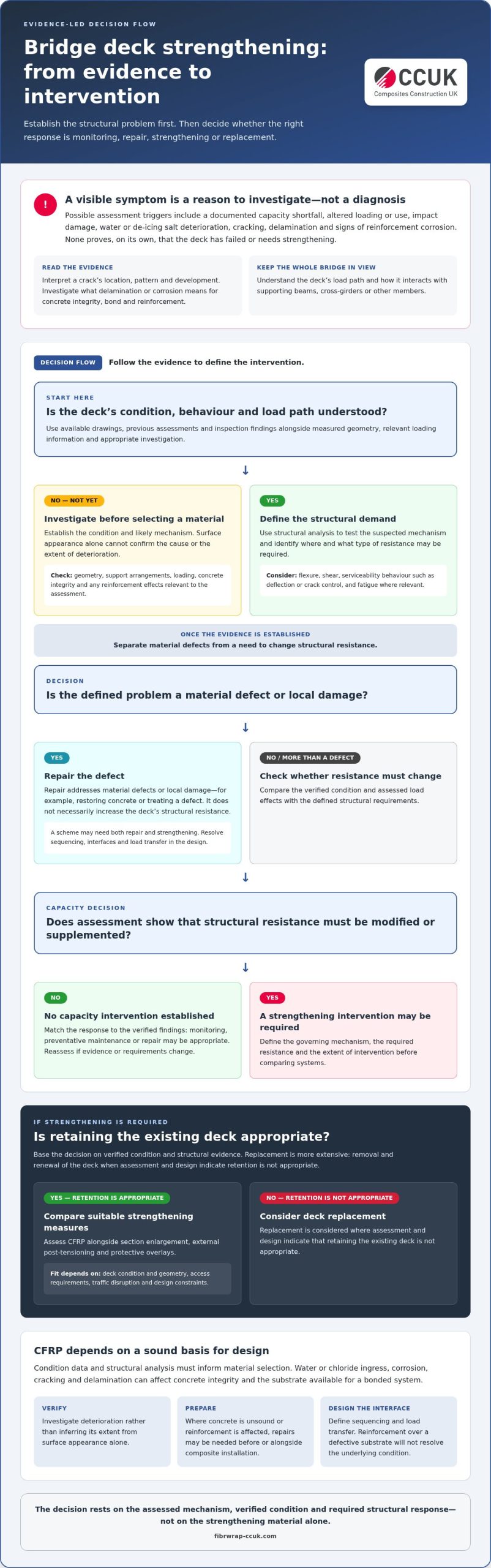
Bridge deck strengthening is a designed intervention that modifies or supplements structural resistance to meet defined requirements, based on verified condition and assessed load effects. It is not a material choice made in isolation. The governing mechanism, the extent of intervention and its relationship to supporting members need to be understood first.
Which bridge deck conditions can prompt an assessment?
Possible triggers include a documented capacity shortfall, altered loading or use, impact damage, and deterioration associated with water or de-icing salts. Cracking, delamination and signs of reinforcement corrosion may also warrant investigation. None of these signs, by itself, proves that a deck has failed or needs strengthening.
Visible symptoms are evidence to interpret, not a diagnosis. A crack’s location, pattern and development may relate to structural action, restraint, material behaviour or another cause. Delamination can indicate a loss of bond or concrete integrity, while corrosion can reduce reinforcement section and affect surrounding concrete. Investigation and structural assessment help distinguish these mechanisms and determine whether the appropriate response is monitoring, maintenance, repair or a capacity intervention.
What is the difference between repair and strengthening?
Repair addresses material defects or local damage, restoring concrete or treating a defect without necessarily increasing the deck’s structural resistance. Preventative maintenance aims to limit deterioration before more substantial intervention is needed. Strengthening changes or supplements structural resistance to meet defined demands. Replacement is more extensive, involving removal and renewal of the deck when assessment and design indicate that retention is not appropriate.
A scheme may require both concrete repair and strengthening. Damaged or unsound substrate may need attention before a strengthening system can perform as designed. The design must also resolve sequencing, interfaces and load transfer. Selecting CFRP before establishing these requirements risks treating a visible symptom without addressing the underlying structural mechanism. Where deterioration is central to the assessment, see the concrete repair and remediation guide.
For bridge deck strengthening, the practical starting point is a defined problem: what demand cannot be met, what condition is limiting performance, and what evidence supports retaining the existing structure? Those answers shape the scope and help determine whether composite reinforcement or another intervention is suitable.
How bridge deck loads and deterioration shape the strengthening design
Strengthening design depends on how forces pass through the deck and into its supporting members. Engineers examine geometry, continuity, bearing and support arrangements, then assess the structural actions created by relevant loading. A local deck response may not be the only concern: interaction with beams, cross-girders or other supporting elements can affect where additional resistance is needed.
Condition data and structural analysis must inform material selection. A strengthening system can only be designed effectively for the verified substrate, governing load effects and required structural response. Assessment establishes the problem before possible interventions are compared.
How do engineers establish the deck’s structural demands?
Available drawings, previous assessments and inspection findings are reviewed alongside measured geometry and relevant loading information. Structural analysis then tests the suspected mechanism and identifies the location and type of resistance required.
Depending on the asset, this may involve flexural or shear demand, as well as serviceability behaviour such as deflection or crack control. Fatigue may also be relevant where repeated traffic loading affects structural response. Load cases, material properties and design criteria must be established for the individual bridge; generic capacity assumptions cannot replace an asset-specific assessment.
How can deterioration affect a strengthening scheme?
Water and chloride ingress can contribute to reinforcement corrosion, cracking and delamination. These conditions may affect concrete integrity and the substrate available for a bonded system, influencing preparation requirements and the design of the strengthening interface. The extent and significance of deterioration need to be established through appropriate inspection and investigation, rather than inferred from surface appearance alone.
Where concrete is unsound or reinforcement is affected, repairs may be needed before or alongside composite installation. The design must define the sequencing and interfaces. Applying reinforcement over a defective substrate would not resolve the underlying condition or provide a sound basis for load transfer. Bridge deck strengthening must therefore respond to both structural demand and the actual condition of the material receiving the intervention.
Installation planning follows from these design decisions. Surface preparation, repair and composite application need to be coordinated so the specified system can be installed on a suitable substrate and checked against design requirements. For further detail on sequencing, see the technical guide to Tyfo® Fibrwrap® installation.
Where a project needs a coordinated assessment and intervention, bespoke structural design connects the verified condition, analysis and installation requirements into a project-specific scheme.
CFRP for bridge deck strengthening: where it fits and what it cannot replace
Externally bonded Carbon Fibre Reinforced Polymer (CFRP) may be considered where analysis identifies a need for additional tensile reinforcement and the deck’s geometry, substrate and design actions allow a suitable detail to be developed. The material alone does not determine suitability: bond behaviour, anchorage, termination details and interaction with existing reinforcement all need project-specific consideration.
CFRP is a design option, not a universal solution. It cannot correct unresolved deterioration or provide a sound bond to defective concrete. Where the substrate is damaged, repair may be needed before or alongside composite installation, with the sequence and interfaces established by the design. Composites Construction UK uses Tyfo® Fibrwrap® systems for structural strengthening.
What should CFRP be compared with?
Compare possible interventions against the identified structural problem and practical constraints, rather than ranking materials in isolation. Access, worksite geometry, traffic management, disruption, durability requirements and the intended asset-life strategy can all affect the feasible scope. The table summarises questions raised by each broad approach; it does not imply a universal performance order.
| Approach | Application and design considerations | Constraints to assess |
|---|---|---|
| Externally bonded CFRP | May add designed tensile reinforcement where the required load transfer and detailing can be achieved. | Substrate condition, surface preparation, bond, anchorage, geometry and access for installation. |
| Other engineered strengthening | Alternative details, such as section enlargement or external post-tensioning, may address different structural actions or configurations. | Effects on geometry, interfaces, access, construction sequence and the supporting structure. |
| Concrete repair | Addresses material defects and deterioration; it may form part of a strengthening scheme. | Repair alone may not provide the additional structural resistance required by the assessment. |
| Deck replacement | Considered where the assessed condition and design requirements do not support retaining the existing deck. | Scope, disruption, interfaces with the wider bridge and asset-life objectives. |
For bridge deck strengthening, the decision should connect verified condition and structural demand to a constructible intervention. Feasibility assessment and bespoke design help establish whether a composite detail is suitable, another measure is more appropriate, or replacement should be considered. If CFRP is selected, the design and installation need to address the actual substrate and load path, not simply the location where a defect is visible.
Explore structural strengthening design to see how project-specific requirements can inform an intervention.
From bridge deck survey to installation: a practical project sequence
A controlled project sequence links site evidence to the strengthening detail ultimately installed. For bridge deck strengthening, the scope should move through defined assessment, design, construction and verification stages, with access, traffic management and work staging coordinated around the asset and its operating constraints.
- Review records and inspect. Assemble available drawings, previous assessments and maintenance history. Compare them with the observed deck condition, geometry and stated performance requirement.
- Investigate where evidence is incomplete. Targeted testing or further inspection can clarify suspected defects, material condition or reinforcement-related concerns. Select methods to answer specific assessment questions, rather than applying a fixed checklist.
- Assess feasibility and design. Use the findings to define the structural requirement and develop a bespoke strengthening design. Establish the intervention scope, design assumptions, materials, detailing and installation specification.
- Prepare the work area and substrate. Plan access, traffic arrangements, staging and substrate preparation in accordance with the approved project specification. Coordinate any concrete repair or other prerequisite work with the strengthening sequence.
- Install, inspect and verify. Carry out installation under the project’s defined controls, recording relevant checks and any required inspection or testing. Complete the work with verification and handover information for future asset management.
What happens during assessment and design?
Feasibility findings translate site evidence into a design brief: the condition to address, the performance required and the practical constraints governing construction. The engineer develops a strengthening detail and installation requirements for that asset rather than relying on a generic arrangement. The project engineer should identify and verify the applicable project standards and asset-owner requirements for the scheme.
How are preparation, installation and verification coordinated?
Substrate preparation and application controls are set out in the approved specification. Access limitations, exposure to weather and the sequence of repair and strengthening works are managed through project-specific method planning. Define inspection points and acceptance criteria in the design and quality documentation so checks can be traced to the intended installation requirements.
Records remain important after the work is complete. A clear handover can capture the installed scope, verification evidence and relevant maintenance information, supporting informed decisions during later inspections. Explore the structural design and engineering approach to see how feasibility, bespoke design and installation requirements can be brought together.
Plan a bridge deck strengthening scheme around asset life and evidence
A sound intervention brief brings together verified deck condition, structural demand and the performance required of the asset. The aim is not to select a material in advance, but to establish whether retention is justified and what work would be needed to support continued use. Where assessment and design support strengthening, a carefully scoped scheme may extend the useful life of the existing bridge. Where they do not, the brief should reflect that evidence.
What information helps define a strengthening brief?
Bring available information together at the outset. Identify gaps and address them through a project-specific feasibility and investigation scope rather than filling them with assumptions.
- Available drawings, previous assessments and inspection or maintenance records.
- Known defects, their locations and any investigation or testing findings.
- The required structural performance and the demands the deck must accommodate.
- Operational constraints, access conditions and anticipated traffic management needs.
- Relevant asset-owner requirements and applicable project standards, to be verified by the project engineer.
This evidence helps define intervention limits, design assumptions and any information still needed to progress the scheme. A clear brief also supports a meaningful comparison of options against access, disruption, interfaces and longer-term asset management objectives.
How can a specialist delivery team support the scheme?
Coordinating feasibility, engineering design and installation planning helps maintain a clear link between the diagnosed structural mechanism and the work delivered on site. Design decisions can account for the deck’s condition, load effects, substrate preparation, detailing and practical construction sequence. This integrated approach does not predetermine the outcome. It provides a structured basis for determining whether CFRP, another intervention or a different asset decision is justified.
Composites Construction UK delivers CFRP strengthening and projects using Tyfo® Fibrwrap® systems, alongside bespoke engineering design and professional installation. The company is the exclusive UK licensee for the Tyfo® Fibrwrap® system. The selected approach remains specific to each bridge’s evidence and requirements, with installation and verification planned against the design.
To begin defining a bridge deck strengthening brief, gather the available asset records and outline the structural concern, operating constraints and performance requirement. Share the project’s technical requirements through the project enquiry form to discuss a suitable route from assessment to delivery.
Make the next strengthening decision evidence-led
Effective bridge deck strengthening begins with a clear understanding of the asset’s condition and structural demands. That evidence helps engineers distinguish between material repair and a change to structural resistance, then assess whether CFRP or another intervention is appropriate. Where assessment and design justify retaining the deck, a coordinated scheme may support continued use and extend the asset’s service life.
Composites Construction UK provides feasibility studies, bespoke engineering design and professional installation as part of its UK-wide structural strengthening and concrete repair capability. Its work includes CFRP strengthening and Tyfo® Fibrwrap® systems, with the intervention tailored to the structure and project requirements.
Share your available asset information and technical challenge through the project enquiry form to discuss your bridge deck strengthening requirements and take the next step towards an evidence-led intervention.
Frequently Asked Questions
What is bridge deck strengthening?
Bridge deck strengthening is a designed intervention that modifies or supplements a deck’s structural resistance to meet assessed demands. Its scope is based on verified condition, load effects and design requirements, rather than a material chosen in advance. Depending on the identified mechanism, the design may address flexural or shear resistance, for example, while also considering serviceability and the deck’s interaction with supporting members. It is distinct from repair, routine maintenance and replacement.
Can CFRP be used to strengthen a bridge deck?
Yes. CFRP can be used where assessment shows that a suitable strengthening detail can provide the required structural resistance. Externally bonded CFRP may add designed tensile reinforcement, but its suitability depends on the structural action, deck geometry, substrate condition, bond, anchorage and installation access. It does not resolve underlying deterioration or replace necessary concrete repair. Tyfo® Fibrwrap® systems are among the composite systems Composites Construction UK uses for structural strengthening.
How do engineers decide whether a bridge deck needs strengthening?
Engineers review available records, inspection findings, deck geometry, relevant loading and required structural performance, then investigate uncertainties that could affect the assessment. Structural analysis tests the suspected mechanism and identifies whether a capacity shortfall exists, considering relevant actions such as flexure or shear and, where applicable, serviceability and fatigue. Cracking or delamination may prompt investigation, but visible signs alone do not establish that strengthening is necessary.
What is the difference between bridge deck repair and strengthening?
Repair addresses defects or deterioration in the material, such as damaged or unsound concrete. Strengthening changes or supplements the structure’s resistance to meet assessed demands. A project may need both: concrete defects could require repair before or alongside strengthening, with sequencing and interfaces determined through design. Repair alone does not necessarily increase structural capacity, just as adding reinforcement will not resolve a defective substrate or an untreated deterioration mechanism.
Does a bridge deck always need to be replaced if its capacity is inadequate?
No. An assessed capacity shortfall does not automatically mean replacement is the only option. Engineers can examine whether designed strengthening, potentially combined with concrete repair, can meet the required performance while retaining the existing deck. The decision depends on verified condition, structural demands, the feasibility of a suitable intervention and asset requirements. Replacement may be considered where assessment and design do not justify retention, but it should not be presumed before that evaluation.
What affects the design of a bridge deck strengthening scheme?
Design is affected by the governing structural mechanism, load effects, deck geometry, supporting structure, material properties and verified deterioration. For composite reinforcement, substrate quality, bond, anchorage and detailing are also important. Access, traffic management, construction sequencing and asset-owner requirements influence how the scheme can be delivered. These factors are assessed for the individual bridge, so a detail suitable for one deck should not be assumed to suit another.
How is a bridge deck strengthening project carried out?
A project typically progresses from records review and inspection to targeted investigation, feasibility assessment and bespoke design. The approved specification then informs substrate preparation, any required repairs, installation planning and application controls. Access, traffic arrangements and sequencing are coordinated for the asset and site conditions. Inspection and acceptance criteria should be set out in the design and quality documentation, with verification and handover records retained to support future asset management.