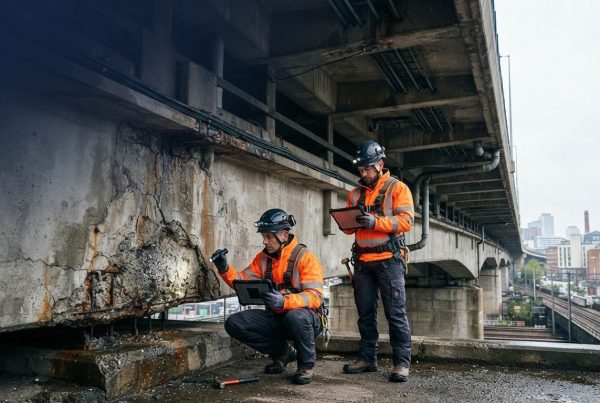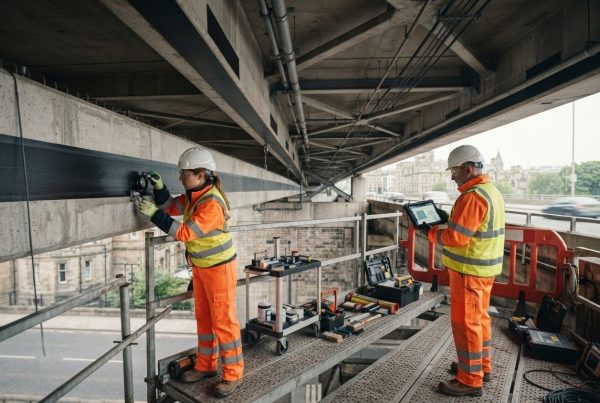

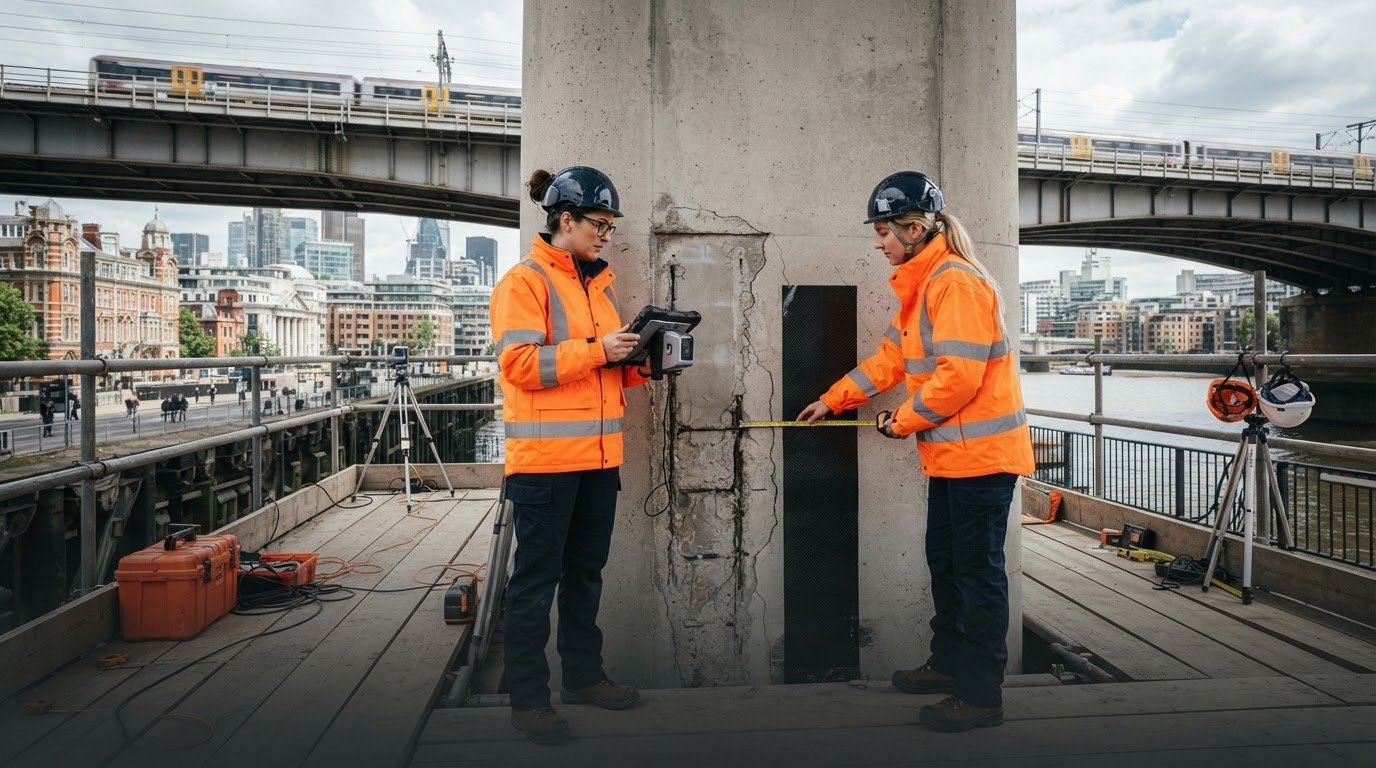
A visible defect is not always the governing problem. Cracking or concrete spalling may point to a durability issue, a loss of structural capacity, or both. That distinction matters when planning bridge pier strengthening: the intervention needs to address the cause of deterioration as well as the pier’s structural demands, or the underlying problem may remain unresolved.
Choosing how to strengthen a pier safely starts with investigation, not a default choice of material. Condition, load path, substrate quality and required performance all inform the design. Access and the need to keep the bridge operating can also shape how the work is planned.
This article explains how engineers assess bridge piers and develop project-specific remedial strategies. It compares composite wrapping, concrete enlargement and other approaches, including where CFRP may contribute when designed for the assessed demand and substrate condition. You’ll also see how coordinated surveys, engineering design and installation can support a repair strategy focused on extending the asset’s useful life.
Key Takeaways
- Distinguish a loss of structural capacity from deterioration, local defects and issues involving foundations or bearings before defining remedial work.
- Base the assessment on the pier’s geometry, materials, structural actions and observed condition to establish a project-specific design basis.
- Compare concrete enlargement, steel jacketing and CFRP by their function, access needs, substrate requirements and design implications.
- Plan access, substrate preparation, installation and inspection in sequence, accounting for project-specific traffic and possession constraints.
- Link diagnosis and design with installation and verification to target repairs towards longer asset life.
Why bridge piers need strengthening: identify the structural problem first
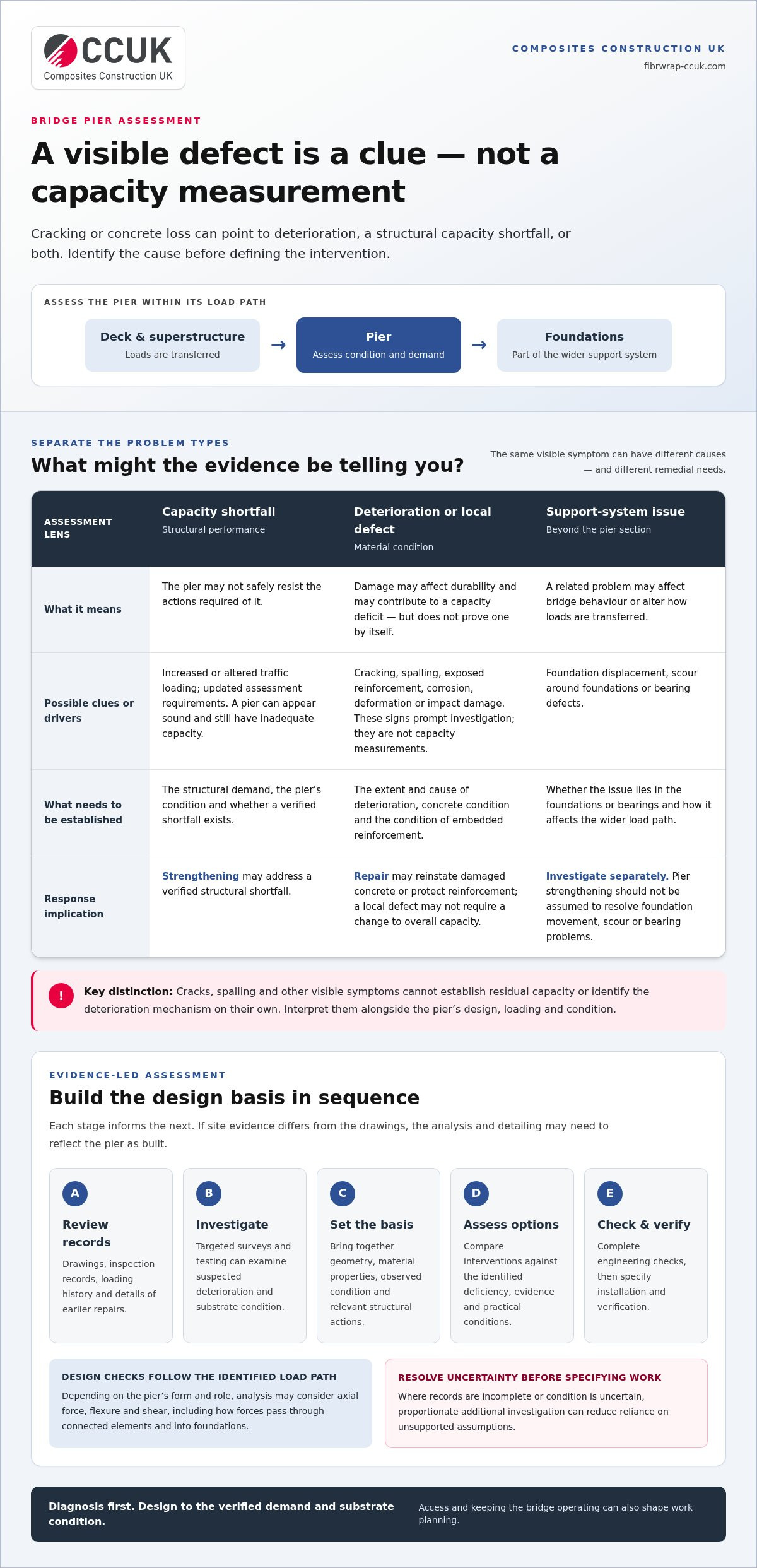
A bridge pier transfers loads from the deck and superstructure to the foundations, although its form and structural behaviour vary with the bridge design. In practical terms, bridge pier strengthening is an engineered intervention selected to improve or restore a pier’s structural performance, based on its verified condition and design demand. The bridge pier should therefore be assessed as part of the wider load path, rather than treated as an isolated concrete element.
The distinction between structural capacity and durability is fundamental. A capacity deficit means the pier may not safely resist the actions required of it. Deterioration, such as reinforcement corrosion or concrete damage, may contribute to that deficit, but does not prove it on its own. Local defects may need concrete repair without requiring a change to the pier’s overall capacity. Conversely, a pier can appear sound while its capacity is inadequate for changed loading or revised assessment assumptions.
Potential drivers include increased or altered traffic loading, progressive deterioration, impact damage and updated assessment requirements. The right response depends on the cause. Strengthening may address a verified structural shortfall, while repair may be needed to reinstate damaged concrete or protect the reinforcement. Neither intervention should be assumed to resolve foundation movement, scour or bearing problems. These can affect bridge behaviour but require their own investigation.
Which signs may prompt a bridge pier investigation?
Cracking, spalling, exposed reinforcement, deformation and evidence of vehicle or vessel impact can all prompt investigation. These are indicators, not capacity measurements. Engineers need to interpret a crack’s position and pattern, the extent of concrete loss and the condition of embedded reinforcement alongside the pier’s design and loading. Visible symptoms alone cannot establish residual capacity or the mechanism causing deterioration.
Observations at the pier should also be distinguished from movement or damage elsewhere in the support system. Foundation displacement, scour around the foundations and bearing defects may produce related signs or alter load transfer, but should not be misdiagnosed as a deficiency in the pier section.
What must a structural assessment establish?
Assessment begins with available drawings, inspection records, loading history and details of earlier repairs. These records help identify original design assumptions and focus the site investigation. Their completeness and consistency also need to be considered.
Targeted structural surveys and testing can then examine suspected deterioration and substrate condition. Depending on the findings, this may include concrete condition surveys and pull-off testing to assess substrate suitability. The assessment should establish structural demand, material condition and any uncertainties that need resolving before an intervention is specified. This evidence-led process helps ensure bridge pier strengthening addresses the actual deficiency rather than simply covering visible symptoms.
How engineers assess and design bridge pier strengthening
A defensible design follows a clear sequence: review records, investigate the structure, establish the design basis, assess intervention options, complete engineering checks, then specify installation and verification. Each stage informs the next. If site evidence differs from the drawings, for example, the analysis and detailing may need to reflect the pier as built rather than rely on assumed dimensions or reinforcement positions.
The design basis brings together pier geometry, material properties, observed condition and the structural actions relevant to the asset being assessed. Depending on its form and role, analysis may consider axial force, flexure and shear, including how forces pass through the pier and into connected elements and foundations. These checks should be selected for the identified load path and deficiency, not applied as an indiscriminate standard list. Applicable design criteria must also be verified against the project, asset-owner requirements and current UK practice. International guidance, such as this FHWA overview of new methods of strengthening bridges, can inform understanding of techniques but does not replace project-specific criteria.
How do investigation findings shape the design basis?
Survey observations and test results inform assumptions about material properties, the extent of deterioration and any concrete repair needed before or alongside strengthening. Where records are incomplete or condition is uncertain, proportionate additional investigation can reduce the risk of designing around unsupported assumptions. Any remaining uncertainty should be recognised in the design, with suitably conservative assumptions where appropriate.
Detailing also depends on practical interface conditions. Reinforcement layout can affect fixing locations, concrete condition influences preparation and bond performance, and access constraints may shape installation sequencing. Structural surveys and testing, including concrete condition investigations and pull-off testing, provide evidence for a specification that can be followed on site.
How is strengthening performance verified?
Calculations and detailing checks must suit the selected intervention, assessed demand and existing substrate. Composite strengthening, for instance, is not simply a product choice: the design needs to account for the intended load transfer and the condition of the surface receiving the system.
The design must address both the required load path and the substrate condition. Construction-stage inspections and records then provide evidence that preparation, materials and installation conform to the specified design. Connecting investigation, bespoke engineering and specialist installation helps maintain continuity from assessment through execution. For further context on how engineered composite interventions are developed, see the CFRP design approach.
Bridge pier strengthening methods compared: concrete, steel and CFRP
There is no universal best method. Bridge pier strengthening should address the assessed deficiency and account for pier geometry, durability requirements, substrate condition and construction constraints. Concrete enlargement, steel jacketing and externally bonded or wrapped carbon fibre reinforced polymer (CFRP) contribute to the load path in different ways, and each requires project-specific design.
| Method | Potential application | Space, access and substrate | Design considerations |
|---|---|---|---|
| Reinforced concrete enlargement | Builds up the pier section where increased section capacity or a new reinforced jacket is required. | Needs formwork, reinforcement placement and concrete installation space; adds mass and changes the pier’s dimensions. | Check interfaces, load transfer, foundation implications and how new concrete connects with the existing pier. |
| Steel jacketing | May provide confinement or contribute to strengthening, depending on the jacket configuration and design. | Requires access for fitting and connections; detailing must suit the pier shape and existing surface. | Assess connection and load-transfer requirements, durability and protection of steel in the bridge environment. |
| Externally bonded or wrapped CFRP | Can be designed for defined functions, such as confinement or flexural strengthening. | Requires suitable substrate preparation, sound bond surfaces and access to install and inspect the system. | Design the composite reinforcement, bond, terminations and detailing for the assessed demand and substrate condition. |
When might concrete enlargement or steel jacketing be considered?
Concrete enlargement creates a larger composite section, but the added mass, changed geometry and interface with existing concrete must be accounted for. The connection between the new section and the existing pier is critical to its intended structural contribution. Steel jacketing may suit a different need, including confinement, but its effectiveness depends on the jacket design, connections and durability provisions. Neither approach is inherently preferable: calculations and site constraints determine suitability.
Where can CFRP strengthening contribute to a pier intervention?
CFRP can provide a designed strengthening layer without the same section build-up as concrete enlargement, which may be useful where space or access is constrained. Systems such as Tyfo® Fibrwrap® may be specified for a defined structural function, but performance depends on more than the composite material. Surface preparation, bond, detailing and controlled installation are all part of the engineered intervention.
CFRP is not a substitute for sound diagnosis or concrete repair. Active deterioration must be addressed, and composite wrapping cannot independently remedy deficient foundations or every possible structural shortfall. Where concrete is damaged or unsuitable as a bond surface, repair and preparation may be needed before strengthening. The appropriate solution meets the assessed demand and suits the pier’s actual condition, rather than simply appearing less intrusive.
Planning bridge pier strengthening: access, sequencing and quality control
Bridge pier strengthening is delivered effectively when the approved design, access strategy and inspection plan are coordinated before site work begins. A practical sequence is to confirm the design and work boundaries, plan access and any required traffic management or possessions, prepare the substrate, install the strengthening system, then inspect and record the completed work. The sequence and controls must suit the asset and project specification rather than rely on a standard programme.
How do access and sequencing affect the intervention?
Pier height, surrounding ground or water conditions, available working space and proximity to live bridge operations all influence how work can be carried out. Restricted access may affect equipment positioning and how materials are moved or applied. Traffic management or possession requirements depend on the bridge and planned activities. These constraints should be considered alongside temporary works, so access arrangements support installation without conflicting with the permanent strengthening design.
Staging may also be needed to coordinate substrate repairs, preparation and strengthening, particularly where different faces of a pier have different conditions or access. The sequence should identify interfaces between these activities and the inspection points at which work needs review before proceeding. This helps site delivery follow the design intent while accommodating actual working conditions.
What should quality assurance cover?
For composite installation, substrate condition is central to bond and system performance. Preparation should follow the project specification, with the surface inspected before application. Environmental conditions and material handling should also be monitored in accordance with the specified system and installation requirements. If the substrate is unsound or conditions fall outside the requirements for the planned work, the issue needs to be addressed before installation proceeds.
Quality assurance should capture the checks and records required by the design, which may include:
- Substrate preparation and inspection findings, including any required test results.
- Material identification, handling and installation records.
- Designated hold points, inspection stages and any specified verification tests.
- Recorded departures, remedial actions and completion evidence.
There is no universal acceptance threshold to apply independently of the project specification. Inspection and testing requirements should be defined for the particular intervention, and the resulting records retained as part of the asset information. This documentation supports future inspection and maintenance by showing what was installed, where it was applied and how conformity was assessed. For further detail on engineered composite interventions, explore CFRP design considerations.
A project-specific route to bridge pier strengthening and longer asset life
A durable intervention follows a clear decision sequence: diagnose the pier’s condition, define the structural demand, compare suitable methods and specify how the completed work will be verified. This keeps the scope tied to the actual deficiency rather than selecting a system before the evidence and design requirements are understood. Where targeted repair and strengthening are both needed, consider their sequence and interfaces together.
Integrated surveys, feasibility assessment, bespoke engineering design and specialist installation connect investigation to site delivery. CFRP, including Tyfo® Fibrwrap® systems, may form part of the solution when it is designed for the assessed demand and the substrate is suitable. It is not a default remedy: the intervention must reflect the pier’s geometry, condition, access constraints and required performance. This considered approach can help extend an asset’s useful life by addressing verified needs rather than relying on a one-size-fits-all repair.
How does integrated engineering support a tailored intervention?
Structural investigation establishes the condition evidence used to assess feasibility and develop the design and installation approach. If the survey identifies unsound or deteriorated concrete, repair may be required before strengthening so the substrate and interfaces are addressed within the overall scope. Inspection and testing can also inform preparation requirements where a composite system is considered. For technical information on CFRP design considerations, explore the design feature page.
What information helps define the next engineering step?
Useful starting information includes:
- Available drawings and previous repair details.
- Inspection records, survey findings and relevant test results.
- Known changes in loading or the bridge’s use.
- Access constraints, working restrictions and any interfaces with bridge operation.
These inputs help shape the investigation, while the intervention scope and specification are developed around the asset’s assessed requirements. Missing or inconsistent records can be considered alongside site evidence, with further investigation used where needed to resolve material uncertainties. The outcome should be a coherent route from verified condition and design demand through to installation and specified verification.
For a project-specific discussion of bridge pier strengthening, make a project enquiry with the available asset information. Composites Construction UK connects survey, engineering design and installation to develop targeted strengthening and repair strategies.
Extend bridge service life through an engineered approach
Effective bridge pier strengthening begins with a reliable diagnosis. The assessment must distinguish a capacity shortfall from durability damage or a problem elsewhere in the support system, then define the structural demand the intervention needs to address. Concrete enlargement, steel jacketing and CFRP each have different design, substrate and access implications, so method selection should follow the evidence rather than a default preference.
Continuity between investigation, bespoke design and installation helps ensure the specified intervention reflects the pier’s condition and can be delivered with appropriate inspection and verification. Composites Construction UK provides integrated feasibility studies, bespoke engineering design and specialist installation for strengthening and repair projects. As the exclusive UK licensee for the Tyfo® Fibrwrap® system, the company engineers composite solutions to assessed project requirements, supporting targeted rehabilitation intended to extend asset service life.
To discuss a bridge strengthening project, make a project enquiry. A project-specific engineering route can turn condition evidence into a durable intervention and a sound basis for the pier’s continued service.
Frequently Asked Questions
What causes a bridge pier to need strengthening?
A bridge pier may need strengthening when its verified capacity is insufficient for required structural actions, or when deterioration or damage has affected its performance. Increased loading, impact damage, corrosion-related concrete deterioration and changed assessment requirements can prompt investigation. However, cracks, spalling or exposed reinforcement are evidence to assess, not proof of inadequate capacity. Engineers must establish the cause, extent and effect before specifying strengthening.
How is bridge pier strengthening designed?
Bridge pier strengthening is designed by reviewing available drawings, inspection records and loading history, then investigating the pier’s condition and assessing its structural demand. The evidence defines the design basis and informs the assessment of suitable interventions and the detailing of the selected solution, including interfaces and substrate requirements where relevant. Calculations, design criteria and verification requirements depend on the asset, its condition, project specification and owner requirements. Construction-stage inspection and records help confirm the work follows the design.
Can CFRP strengthen a concrete bridge pier?
Yes. CFRP can be designed to strengthen a concrete bridge pier for a defined structural function, such as confinement or flexural reinforcement, where assessment supports its use. The design must account for structural demand, pier geometry, substrate condition, bond, detailing and installation requirements. Damaged concrete may need repair first, and CFRP won’t correct deficient foundations or every possible failure mode. It is a project-specific strengthening option, not a universal repair.
What is the difference between concrete jacketing and CFRP wrapping?
Concrete jacketing enlarges the pier section, potentially increasing its capacity through additional concrete and reinforcement. It adds material, mass and physical dimensions, and requires a designed interface with the existing structure. CFRP wrapping adds composite reinforcement around or onto a prepared substrate, generally with less section build-up, but relies on suitable surface condition, bond and correct detailing. Their roles and constraints differ, so selection should follow engineering assessment rather than a blanket preference.
Does bridge pier strengthening require concrete repair first?
Not always. Whether concrete repair is needed before bridge pier strengthening depends on the type and extent of deterioration and the strengthening system’s substrate requirements. Unsound or damaged concrete may need removal and repair so the intervention can be installed on a suitable surface and perform its intended role. Investigation establishes the repair scope, while design and project specification determine sequencing, preparation and any inspection or testing needed before strengthening proceeds.
How long does bridge pier strengthening take?
There is no single reliable duration for bridge pier strengthening. The programme depends on the investigation and design required, pier access, working restrictions, traffic management or possessions, substrate preparation, repair scope, installation method and inspection requirements. Work may need to be staged around bridge operation or site conditions. A project-specific sequence can be developed once the scope, constraints and verification activities are understood, so generic time estimates may be misleading.
How can engineers verify bridge pier strengthening works?
Engineers verify the work against the project design and specification through planned inspections, installation records and any specified testing. For composite systems, records may document substrate preparation, material handling, installation conditions and completion checks; other methods have their own inspection needs. Hold points allow designated stages to be reviewed before work continues. Acceptance criteria and verification requirements are project-specific, rather than universal values, and the completed records support future asset inspection and maintenance.