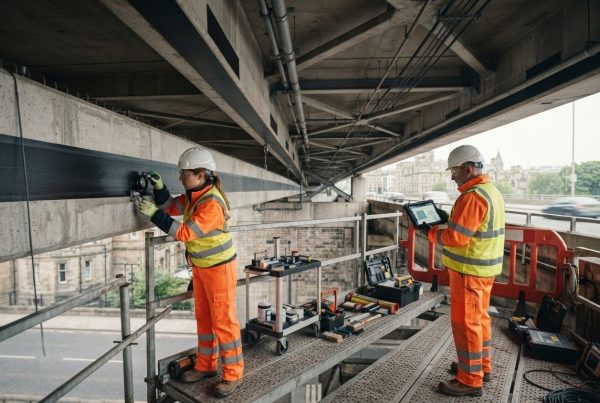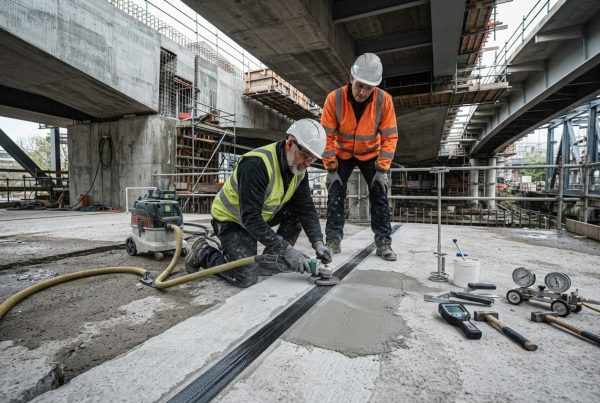

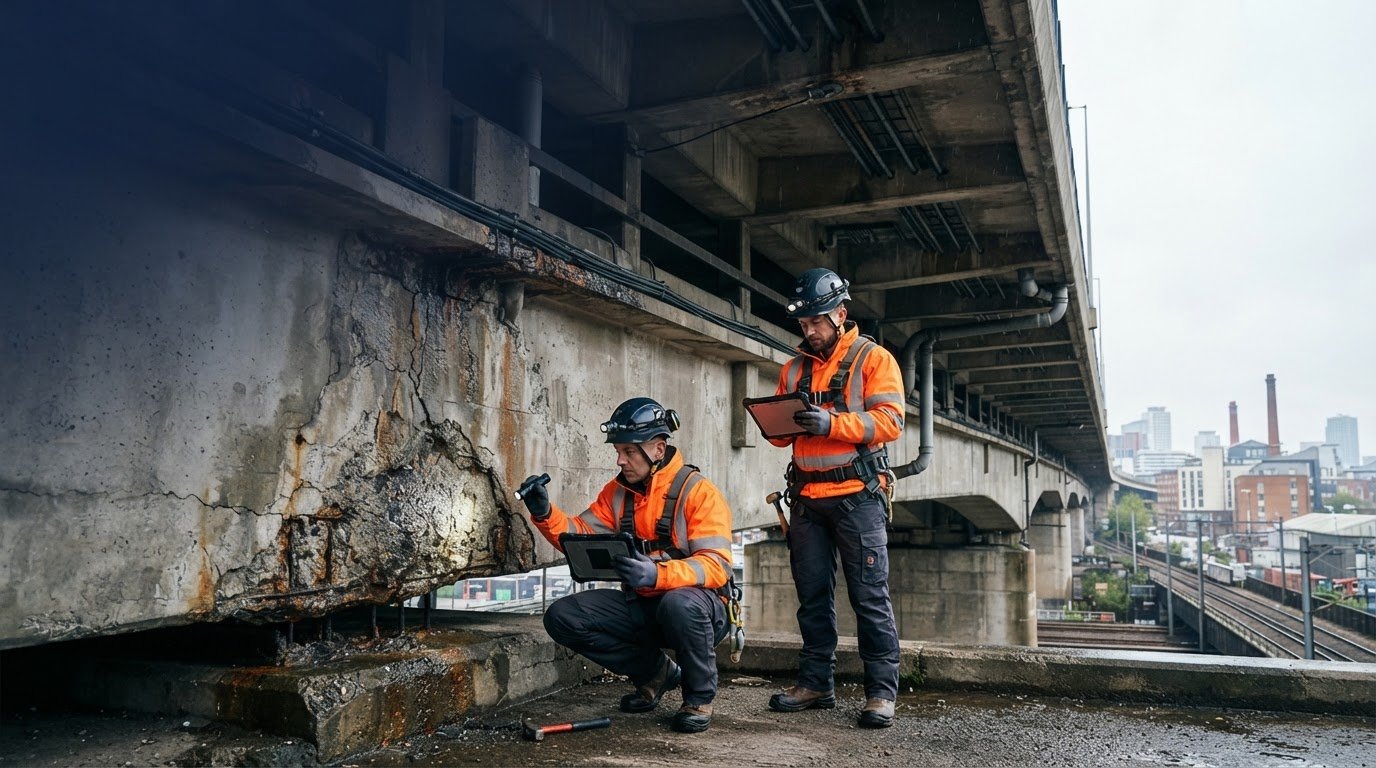
Could a neat patch be the wrong repair? In concrete bridge repair, visible cracking, spalling or rust staining is a reason to investigate, not a repair specification. The deterioration may point to reinforcement corrosion, water ingress, material degradation or a structural demand that a surface repair cannot address.
It is understandable to focus first on the defect and on keeping traffic moving, particularly where access windows and temporary restrictions shape what can be done. But choosing a repair material before establishing the cause, the condition of the surrounding concrete and the element’s structural function can lead to work that does not last or meet the asset’s needs.
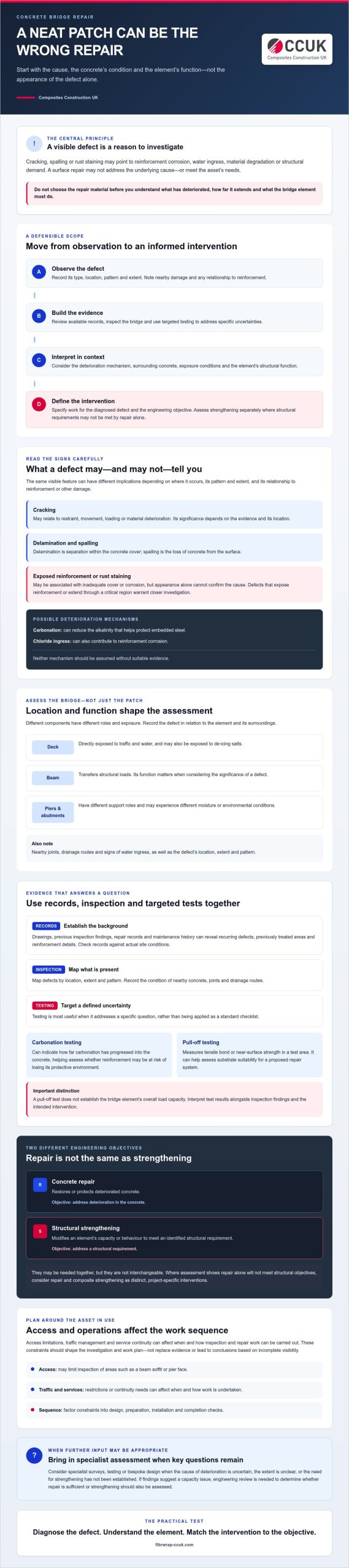
This guide explains how to develop a defensible repair scope, from reviewing records and inspecting the bridge to using targeted tests to assess substrate condition. It compares repair approaches by defect and function, explains how access and operational constraints shape planning, and identifies when specialist design, testing or strengthening input may be appropriate. Where assessment shows that repair alone will not meet structural objectives, concrete repair and composite strengthening should be considered as distinct, project-specific interventions.
Key Takeaways
- Use asset records, inspection and targeted testing to build an evidence-based picture of deterioration before defining the repair scope.
- Specify concrete bridge repair according to the diagnosed defect, exposure conditions and structural function, rather than selecting a method by appearance alone.
- Distinguish local concrete repair and surface protection from structural strengthening. Each addresses a different engineering objective.
- Factor access, traffic or service constraints into the sequence of design, preparation, installation and completion checks.
- Consider specialist surveys, testing or bespoke design when the cause of deterioration or the need for strengthening remains uncertain.
Concrete bridge repair starts with identifying the defect and its cause
Concrete bridge repair should be specified using evidence about the element’s condition, function and deterioration mechanism, not a surface symptom alone. A crack, patch of spalling or rust stain is an observation; its cause and engineering significance still need to be established. The same visible defect can have different implications depending on its location, pattern, extent and relationship to reinforcement or other damage.
Definition: Concrete repair restores or protects deteriorated concrete, whereas structural strengthening modifies an element’s capacity or behaviour to meet an identified structural requirement. They may be needed together, but they are not interchangeable interventions.
What bridge defects can indicate
Cracking may relate to restraint, movement, loading or material deterioration. Delamination is separation within the concrete cover, while spalling is the loss of concrete from the surface. Exposed reinforcement may be associated with inadequate cover or corrosion, but appearance alone cannot confirm the cause. A local surface blemish may have no structural consequence; defects that expose reinforcement or extend through a critical region warrant closer investigation.
Carbonation can reduce the alkalinity that helps protect embedded steel, while chloride ingress can also contribute to reinforcement corrosion. Neither mechanism should be assumed without suitable evidence. The Deterioration and maintenance of concrete bridges overview explains these processes. For a specific asset, inspection and targeted testing, such as carbonation testing, can help determine whether they are relevant and how far deterioration extends.
Why bridge location and function matter
Interpret each observation in context. A deck is directly exposed to traffic and water, and may also be exposed to de-icing salts. A beam transfers structural loads, while piers and abutments have different support roles and may experience different moisture or environmental conditions. Other bridge components have their own functions, which affect how defects should be assessed. Record the element, the defect’s location and extent, and any nearby joints, drainage paths or signs of water ingress.
Investigation planning must reflect the conditions under which evidence can be gathered. Access limitations may restrict inspection of a beam soffit or pier face; traffic management or service continuity may affect when and how work can be undertaken. These constraints should inform the investigation scope, not lead to conclusions based on incomplete visibility. Where findings suggest a capacity issue, engineering review is needed to establish whether repair is sufficient or strengthening should also be assessed.
How engineers assess concrete bridge deterioration before repair
A defensible assessment moves from existing information to site observations, targeted testing and engineering interpretation. At each stage, the aim is to answer questions that affect the scope: where deterioration is present, what may be driving it, how far it extends and whether the affected element’s function could be compromised.
Inspection, records and targeted testing
Available drawings, previous inspection findings, repair records and maintenance history provide context for the site visit. They can help identify recurring defects, areas treated previously and details such as reinforcement layout, but records should be checked against actual site conditions. During inspection, map defects by location, extent and pattern, and note the condition of nearby concrete, joints and drainage routes.
Testing is most useful when it addresses a defined uncertainty, rather than being applied as a standard checklist. Carbonation testing can indicate how far carbonation has progressed into the concrete, helping assess whether reinforcement may be at risk of losing its protective environment. Pull-off testing measures the tensile bond or near-surface strength of a test area. It can help assess whether the substrate is suitable for a proposed repair system, but it does not establish the bridge element’s overall load capacity. Interpret results alongside inspection findings and the intended intervention.
Repair specifications should reflect verified site conditions, not assumptions drawn from a defect’s appearance.
From survey findings to repair specification
Once evidence has been assembled, engineers consider whether it indicates an isolated defect, more extensive deterioration or a possible structural concern. A localised area of unsound cover may call for a different scope from damage that recurs across an element or is associated with reinforcement corrosion. If the evidence is incomplete, further investigation may be needed before the repair boundary or method can be set confidently.
The specification should account for exposure, substrate condition and structural function. For example, requirements for a deck exposed to water and de-icing salts may differ from those for a less exposed internal face. The right choice still depends on site assessment and design. The scope should clarify preparation requirements, the extent of concrete removal and how completed work will be checked. Naming a material without defining the conditions it must perform in is not enough.
If a defect may affect load-bearing performance, or findings do not explain its cause or extent, seek engineering review before work proceeds. Structural surveys and testing can help inform that decision. To discuss the investigation scope for a bridge asset, contact the structural engineering team with the records and inspection findings available.
Concrete bridge repair methods: match the intervention to the problem
Compare repair methods by the condition they address and the function they need to perform. A surface patch may reinstate local concrete, but it will not necessarily address deterioration continuing beyond the visible defect or resolve a structural capacity concern. The scope should follow the investigation findings, including the condition of the surrounding substrate, the exposure and the role of the affected element.
| Intervention | Condition addressed | Investigation needed | Intended function | Key limitation |
|---|---|---|---|---|
| Local concrete repair | Localised defective or unsound concrete | Establish defect extent, cause, substrate condition and reinforcement condition | Reinstate the specified concrete area | A patch alone may not address wider or ongoing deterioration |
| Surface protection | Exposure-related risks identified in the assessment | Assess exposure, surface condition and the intended protective objective | Help protect the concrete surface as part of a defined repair strategy | Doesn’t restore lost section or increase structural capacity |
| Structural strengthening | An assessed shortfall or change in structural requirements | Engineering assessment of the element and required structural performance | Modify or increase structural capacity as designed | Doesn’t replace concrete repair where deteriorated material also needs attention |
When concrete repair and protection may be considered
Where investigation confirms localised unsound concrete, removal and reinstatement may be specified to suit the defect, substrate and exposure. The repair boundary and preparation requirements matter: material placed over unsound or unsuitable concrete may not achieve its intended function. Surface protection may also be considered where the assessment identifies an exposure-related objective, but it should not be treated as a substitute for repairing defective concrete. Suitability and expected performance depend on project-specific conditions and the defined specification.
For more on repair planning and remediation, see this concrete repairs and structural remediation guide.
When bridge strengthening may also need assessment
Repair restores or protects concrete; strengthening addresses structural capacity or behaviour. If engineering assessment identifies a strengthening requirement, carbon fibre reinforced polymer (CFRP) strengthening may be considered as a separate or complementary intervention, subject to bespoke design and the condition of the substrate. Tyfo® Fibrwrap® is a CFRP system used for structural strengthening. Read the Tyfo® Fibrwrap® structural strengthening guide for related technical detail.
Planning concrete bridge repairs around access, safety and asset operation
A sound repair design still needs a workable delivery plan. Sequence concrete bridge repair from an agreed scope through design, preparation, installation and completion checks, considering access arrangements and operational interfaces for the specific asset. Traffic management, service continuity or restricted access may affect the programme. These constraints vary between bridges and should be confirmed with the asset owner and relevant project parties.
A repair specification should connect inspection evidence to work sequencing and verification, so the completed intervention can be checked against its intended purpose.
Preparing the bridge and repair work area
Before work begins, confirm which areas need access, how the work zone will be controlled and whether the repair could affect traffic, services or other operations. The method statement should translate the design into a practical sequence, including substrate preparation, installation requirements and controls for relevant environmental conditions. These details depend on the system and project, so preparation should not be assumed to follow one universal procedure.
Coordination matters. The asset owner, designer and repair team should share relevant inspection findings, agree interfaces and clarify who will review work at defined stages. Resolve access or operating restrictions early enough to inform the scope and installation plan, rather than treating them as site issues to address after mobilisation.
Quality checks, records and ongoing monitoring
Define completion checks in the project specification, taking account of the repair’s intended function. They may include inspection of prepared areas, confirmation that installation followed the agreed method, and any specified testing or verification. The required checks depend on the system and design, so set acceptance criteria before work starts rather than improvising them at completion.
Keep records of repaired locations, materials used, relevant installation conditions, inspections and agreed verification activities. These records provide a useful reference for future asset reviews and help distinguish new observations from previously repaired areas. Post-repair inspection can be considered within the asset owner’s wider management approach, informed by the bridge’s condition, exposure and performance. No single monitoring interval is suitable for every structure.
For support with survey, design and repair planning, contact the structural engineering team to discuss the project requirements and available condition information.
Selecting a specialist for concrete bridge repair and defining next steps
Choosing a specialist is not simply a matter of comparing repair methods. Asset owners need to understand how the proposed scope connects survey findings to engineering design, installation and verification. For concrete bridge repair, look for a clear explanation of the deterioration mechanism, the affected element’s function and the evidence supporting the recommended intervention.
Questions to ask a bridge repair contractor
Before agreeing a scope, clarify who is responsible for each technical and delivery stage. Ask how the proposed work responds to the identified defect and what remains uncertain. Establish whether the contractor’s contribution includes survey and testing, bespoke engineering design, professional installation and documented completion checks, or only selected parts of that sequence.
- What evidence supports the proposed repair or strengthening approach, and how does it relate to the element’s structural function?
- What investigation and design work are included, and who is responsible for resolving assumptions or gaps in the available information?
- How will access constraints, interfaces with other work and project-specific acceptance criteria be addressed and recorded?
Ask for relevant installation experience and examples of the documentation provided at completion. The aim is not to seek a generic promise of performance, but to confirm that responsibilities, assumptions and verification requirements are defined for the project.
Moving from condition concern to an engineered scope
Initial discussions are more productive when supported by information already held by the asset owner. Gather inspection records, drawings, photographs and known repair history. Note where access is limited and whether traffic or service constraints may affect investigation or delivery. These records help frame the questions, but they do not replace verification of site conditions.
A feasibility study or targeted structural testing may help establish whether the next step is local repair, further investigation or assessment of a strengthening requirement. The appropriate route depends on engineering review, verified evidence and applicable project requirements. Composites Construction UK provides structural surveys and testing, bespoke design, concrete repair and structural strengthening, including CFRP systems such as Tyfo® Fibrwrap® where project assessment identifies a relevant need.
To discuss a bridge condition or define a potential project scope, share the information available through specialist engineering project enquiries. This provides a starting point for clarifying what further assessment or design input may be appropriate.
Turn bridge condition findings into a durable repair plan
Effective concrete bridge repair begins with understanding what a defect indicates, not simply treating what is visible. Inspection records and targeted testing help establish the deterioration mechanism and substrate condition. The repair or strengthening scope can then be matched to the element’s function and exposure.
Method selection is only part of the work. Access, operational constraints, preparation, installation controls and completion checks all need to be considered in a project-specific plan. Where evidence indicates a structural capacity requirement, assess strengthening separately from concrete reinstatement. CFRP systems, including Tyfo® Fibrwrap®, may be relevant where engineering assessment supports their use.
Composites Construction UK provides concrete repair, structural surveys and testing, design and installation, with structural strengthening capability for projects where it is appropriate. To discuss your bridge condition or potential scope, discuss a concrete bridge repair project with our engineering team. Start with the condition information available and speak with the team about the next assessment or design step for your project.
Frequently Asked Questions
What are the most common causes of concrete bridge deterioration?
Common causes include reinforcement corrosion, water ingress, carbonation, chloride exposure, repeated loading and movement. These mechanisms may interact: for example, water can carry chlorides into concrete, contributing to corrosion where reinforcement is affected. Poor drainage or vulnerable details can increase exposure in particular areas. Cracking, rust staining or spalling can indicate deterioration, but inspection and, where appropriate, targeted testing are needed to establish the cause and extent.
How is a concrete bridge assessed before repair work begins?
Assessment usually starts with available drawings, inspection records and repair history, followed by a site inspection to map defects and observe surrounding concrete. Testing should address specific uncertainties. Carbonation testing, for example, can help establish carbonation depth, while pull-off testing provides information about near-surface tensile bond or strength. Engineers interpret these findings alongside the element’s exposure and structural function before defining a repair scope or identifying the need for further investigation.
Can cracked or spalled concrete on a bridge be repaired without strengthening?
Yes, where assessment confirms that concrete repair can address the defect and there is no identified need to alter structural capacity. Localised unsound concrete may be removed and reinstated if the specification supports that approach. However, a surface patch will not necessarily address deterioration beyond the visible area, and appearance alone cannot establish structural significance. Engineering review is appropriate if damage may affect load-bearing performance or the cause and extent remain uncertain.
What repair methods are used for concrete bridge decks?
Methods depend on the defect, substrate condition, exposure and deck function. A specified intervention may involve removing and reinstating defective concrete. Suitable crack treatment may also be considered where investigation supports it. If assessment identifies reinforcement corrosion or continuing water ingress, the repair scope may need to address those risks rather than simply cover the surface. The deck’s traffic exposure, drainage and operational constraints should inform design, preparation and completion checks.
When is CFRP strengthening considered during concrete bridge repair?
CFRP strengthening may be considered when engineering assessment identifies a need to increase or modify an element’s structural capacity or behaviour. It serves a different purpose from concrete repair, which restores or protects deteriorated material, although both interventions may be required on the same asset. Suitability depends on the bridge condition, structural requirements and substrate. Systems such as Tyfo® Fibrwrap® should only be specified following project-specific assessment and design.
How can chloride exposure affect reinforced concrete bridges?
Chlorides can penetrate concrete and, where they reach embedded reinforcement at relevant levels, contribute to loss of the steel’s protective condition and corrosion. Corrosion products may occupy more space than the original steel, potentially contributing to cracking, delamination or spalling. Exposure can arise in areas affected by de-icing salts or chloride-bearing water, but its presence and significance should be verified. Inspection and suitable testing help establish whether chloride-related deterioration is part of the defect mechanism.
What should an asset owner look for when appointing a bridge repair contractor?
Look for relevant survey and testing capability, clear engineering design responsibilities, installation experience and project documentation. Ask how the proposed scope relates to the diagnosed deterioration mechanism and structural function, what assumptions or access constraints apply, and how work will be checked against project-specific criteria. Confirm which stages are included, from investigation and design to installation and verification. A well-defined scope helps asset owners compare proposals on their technical basis, not by method name alone.