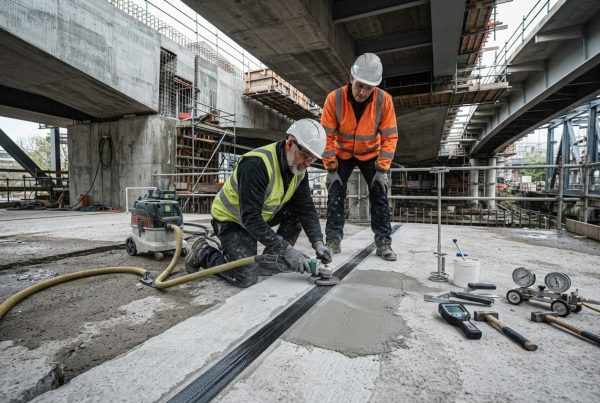


What if a bridge capacity shortfall can be addressed without replacing the structure? CFRP bridge strengthening may be appropriate when a defined structural requirement can be met by strengthening specific elements, but it isn’t a default remedy for every defect. Suitability depends on the bridge’s condition, the cause of the shortfall and the behaviour of the member being strengthened.
It’s right to ask whether a proposed intervention addresses the underlying problem and whether its performance can be verified. A robust decision requires more than selecting a composite system: the existing structure and substrate must be assessed, design assumptions made explicit, and installation quality controlled.
This article explains where CFRP can play a role in bridge strengthening, what information supports a defensible feasibility and design decision, and where its limitations matter. It follows the project process from investigation and specification through surface preparation, installation, inspection and verification, including the responsibilities to agree between the asset owner, engineer and specialist contractor.
Key Takeaways
- Use CFRP bridge strengthening only where the assessed structural demand, load path and governing limit state align with the strengthening design.
- Check that the existing substrate and bridge condition can support effective force transfer before specifying a composite system.
- Compare CFRP with repair, load-management or other strengthening options against the project’s objectives and constraints, rather than assuming one approach is universally preferable.
- Set out the project sequence from investigation and design basis through surface preparation, installation, inspection and documentation, with responsibilities clearly defined.
- At handover, retain the design basis, as-built records, inspection findings and specified maintenance requirements in the bridge’s asset-management records.
Why CFRP bridge strengthening is considered for capacity and asset-life challenges
CFRP bridge strengthening is an engineered intervention in which fibre-reinforced polymer materials are applied or attached to selected bridge elements to improve a defined aspect of structural performance. Unlike routine maintenance, it is specified to address a structural demand or capacity issue identified through assessment. This overview of Carbon Fiber Reinforced Polymer (CFRP) outlines the material and its civil engineering applications.
A feasibility assessment may be prompted by a proposed change in loading, a capacity concern identified through structural evaluation, or investigation findings related to deterioration. These are reasons to assess whether strengthening is needed, not proof that CFRP is automatically the right answer. Observed cracking, spalling or other damage must be distinguished from its cause and structural significance. Further inspection or testing may be needed before defining an intervention.
What bridge conditions prompt a CFRP feasibility assessment?
The assessment scope depends on the bridge’s form, construction materials, loading history and condition, as well as access to the relevant elements. These factors determine what can be inspected and what information is needed to understand structural behaviour. For example, deterioration may indicate a material defect requiring repair, a reduced capacity requiring strengthening, or an underlying cause that must first be addressed.
What can CFRP contribute to a bridge intervention?
Where supported by the design, externally bonded CFRP laminates or fabric systems can be attached to a prepared concrete surface. Force is transferred between the existing member and the composite through the bond, making substrate condition and strengthening details central to the intervention. Depending on the member, assessed behaviour and design, CFRP may be configured to improve a specific response, such as flexural or shear performance. It doesn’t provide a universal capacity increase, so suitability must be established for the bridge in question.
Concrete repair and structural strengthening serve related but distinct purposes. Repair addresses defects in the material; strengthening targets a defined structural demand or capacity shortfall. A project may require one or both, but strengthening should not mask unresolved deterioration or its cause. For more context on how these scopes differ, see the guide to concrete repairs and structural remediation.
The decision should be evidence-led, not based on material preference. Establish what is wrong, how it affects structural performance, and whether a designed CFRP intervention can meet the requirement within the bridge’s constraints.
How CFRP interacts with bridge load paths, substrates and structural behaviour
CFRP strengthening must be designed against the bridge’s assessed demand, load path and governing structural limit state. The engineer needs to establish how forces move through the structure and which response the intervention is intended to change. A strengthening detail that doesn’t address the controlling behaviour may add material without resolving the capacity concern.
Load-transfer principle: bonded CFRP reinforcement receives force from the concrete through stresses at the adhesive interface. The composite, bond and supporting substrate must work together to achieve the designed load path. The Federal Highway Administration (FHWA) guidance provides technical context on FRP applications in bridge engineering. UK projects still require design against applicable project and asset-owner requirements.
How does externally bonded CFRP transfer force to a bridge?
In an externally bonded system, high-strength fibres provide the principal tensile reinforcement, while the resin matrix holds the fibres in position and helps transfer stress between them. The adhesive and interface transfer force between the composite and concrete. Design must therefore account for more than the CFRP’s tensile properties: bond failure, debonding or failure of the concrete near the interface may govern the response.
Fibre orientation and reinforcement layout are selected to suit the intended structural action. For example, the arrangement for flexural strengthening differs from one designed to address shear behaviour. The design should check relevant failure modes and detailing, rather than rely on a generic capacity increase.
Why do concrete condition and bridge details matter?
Concrete integrity is fundamental to force transfer. Cracking, contamination, weak surface material and previous repairs need to be investigated because they can affect the bonding surface or indicate a broader structural issue. Surface preparation and acceptance criteria should be specified for the actual system and substrate, not assumed from a typical detail.
Geometry, joints, drainage paths and exposure also influence reinforcement placement and detailing. Moisture or other environmental exposure may affect material selection and design assumptions, while restricted access can constrain preparation, installation and inspection. Resolve these matters during design and planning, before installation begins.
For a project-specific discussion of CFRP design considerations, consult the company’s CFRP design information. Coordinating the assessment of demand, substrate and detailing is central to making CFRP bridge strengthening technically appropriate and verifiable.
When is CFRP suitable for bridge strengthening, and what are its limits?
Suitability is a bridge-specific engineering decision, not something that can be inferred from cracking or a capacity concern alone. The assessment must establish what structural response needs to change, whether the substrate and detailing can support the proposed system, and whether the design can meet the project’s requirements. CFRP should not be treated as a remedy for unresolved deterioration, unsuitable concrete or every structural deficiency.
Which project conditions support considering CFRP?
Consider CFRP when investigation has established a defined strengthening objective and the available information adequately characterises the relevant bridge element and substrate. The proposed reinforcement must suit the intended structural action, installation environment and bridge operations. Access, geometry, exposure and detailing all affect feasibility. The design team must also verify that the selected system and its application meet current project specifications and are supported by appropriate technical evidence.
The comparison below is a starting point for setting the scope, not a substitute for design assessment:
| Intervention | Purpose | Enabling conditions and constraints | Verification focus |
|---|---|---|---|
| CFRP strengthening | Address a defined structural demand or capacity shortfall. | Requires a characterised substrate, suitable detailing and feasible installation conditions; it won’t resolve an underlying cause of damage by itself. | Confirm design assumptions, system requirements, substrate acceptance and installed work against project criteria. |
| Concrete repair | Rectify defective or deteriorated concrete. | Requires the defect and its cause to be understood; repair alone may not address a capacity shortfall. | Check repair scope and substrate condition before any subsequent strengthening. |
| Load management | Manage demand placed on the bridge. | May be considered where operational changes are practicable and acceptable to the asset owner. | Verify the agreed loading assumptions and their implementation. |
| Other strengthening | Meet the structural objective through a different engineered intervention. | Compare feasibility against bridge form, access, operational constraints and design requirements. | Assess the selected method against its own design basis and acceptance criteria. |
When should engineers investigate alternatives or additional work?
Pause the CFRP decision if damage mechanisms remain uncertain, the concrete is unsuitable for the proposed bond, or structural behaviour cannot yet be reliably assessed. Further investigation or concrete repair may be needed before strengthening, or as part of a coordinated scope. If the required response cannot be achieved through the proposed CFRP arrangement, assess whether another strengthening approach or load-management measure may be appropriate.
Engineering, specification and delivery need to remain coordinated, with responsibilities and acceptance criteria clearly defined. For more context, see the article on specialist engineering contractor responsibilities.
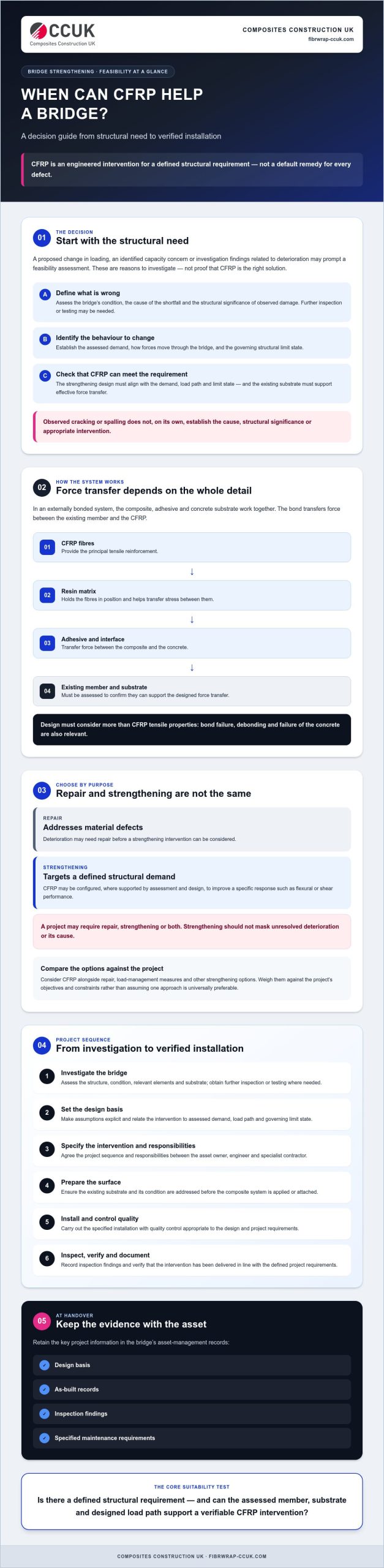
How a CFRP bridge strengthening project moves from survey to verified installation
A reliable CFRP bridge strengthening project connects investigation findings to a clear design basis, then carries that basis through specification, site work and documented verification. The sequence below provides a practical framework. Set its scope and acceptance requirements for the individual bridge and system.
- 1. Investigate. Record the bridge’s condition, relevant loading and operational constraints. Targeted surveys or testing may be needed to clarify substrate condition, damage or structural behaviour. Each investigation should answer a defined feasibility question.
- 2. Define the design basis. State the strengthening objective, assessed demand, relevant structural limit states and assumptions. Identify access, sequencing and operational constraints that may affect the proposed intervention.
- 3. Specify. Translate the design into project-specific calculations, drawings and requirements for the selected system, substrate preparation, installation conditions, inspection and records.
- 4. Prepare. Check the work area and substrate against the approved procedure. Record preparation and any condition that may require review before installation proceeds.
- 5. Install. Apply the system in accordance with the approved specification and system requirements. Manage relevant environmental conditions and record workmanship as the work progresses.
- 6. Inspect. Carry out inspections and any specified testing at the stages and against the criteria defined for the project. Refer departures or defects for assessment rather than assuming they are acceptable.
- 7. Document. Compile design and as-built information, material traceability where specified, inspection findings, test records where required, and any agreed handover or maintenance requirements.
What should bridge assessment and design establish before installation?
Before work starts, the assessment should establish the relevant condition, structural behaviour, strengthening objective and operational constraints. Calculations and drawings must reflect those findings, while the specification should define the chosen system and how conformity will be assessed. Agree and document acceptance criteria before installation begins, against the applicable project specification, asset-owner requirements and system requirements. Further context is available in the structural design feature.
What installation and quality records support verification?
Records should make it possible to trace the work from the approved procedure to the completed installation. Depending on the specification, they may include substrate-preparation records, environmental observations, material identification and traceability, inspection findings, and records of any specified testing. Project documents must identify who reviews these records and how non-conformances are resolved. Don’t assume that a single test or acceptance threshold applies to every bridge or system.
Project records should capture the requirements and evidence needed to verify that the completed work follows the approved specification.
How to manage a CFRP-strengthened bridge after project completion
Completion of the installation doesn’t mark the end of the engineering record. The strengthened element remains part of the bridge, so its design intent and condition should be understood within the asset owner’s inspection and management arrangements. CFRP doesn’t remove the need to monitor the structure or investigate future deterioration. It changes the bridge and should be considered in subsequent inspections.
What should asset owners include in bridge handover records?
Handover information should help future inspectors and engineers understand what was strengthened, why the intervention was selected and how the completed work relates to the original design. Retain relevant project documentation, including:
- the assessment findings and design basis, including objectives, assumptions and relevant limitations;
- approved calculations, drawings and system specifications;
- as-built records showing the location and configuration of the installed reinforcement;
- installation records, including inspection findings and any testing or material traceability information required by the project;
- specified maintenance requirements and any agreed actions arising from handover.
These records help distinguish the strengthened detail from the original construction and give future inspections a reliable reference point. Changes in visible condition or other relevant observations can then be considered against the as-built information and design intent. Inspection frequency should follow the asset owner’s requirements and project documentation, rather than an assumed universal interval.
How can a specialist contractor support a bridge project?
Coordinated feasibility, bespoke engineering design, supply and professional installation can help maintain continuity between the assessment, specified solution and site execution, provided responsibilities and acceptance requirements are clearly defined. Composites Construction UK provides CFRP strengthening, including systems such as Tyfo® Fibrwrap®, for project-specific consideration. Their relevance must be established through assessment and design, not assumed for every bridge or defect.
Before selecting an intervention, asset owners should confirm the problem to be addressed, the available evidence, the substrate and operational constraints, and how the completed work will be verified and recorded. This provides a sound basis for deciding whether CFRP is appropriate, whether additional repair or investigation is needed, and what information to retain for future asset management.
Project contact details are available through the structural strengthening team’s contact page.
Make the next strengthening decision evidence-led
CFRP bridge strengthening is most defensible when it responds to a clearly assessed structural need, suits the bridge’s substrate and load path, and is supported by project-specific design and installation controls. CFRP isn’t a universal remedy: deterioration and its causes must be understood, and repair or another intervention may be needed. Clear acceptance criteria, inspection findings and as-built records also help asset owners manage the strengthened structure over time.
Composites Construction UK provides feasibility studies, bespoke engineering design and professional installation, and is the exclusive UK licensee for the Tyfo® Fibrwrap® system. These capabilities can support a project-specific assessment, but the appropriate solution depends on the bridge and its requirements.
If you’re evaluating a capacity concern or strengthening option, discuss your bridge strengthening requirement with Composites Construction UK. A considered feasibility and design process can help establish the right next step and support the continued use of existing infrastructure.
Frequently Asked Questions
Is CFRP suitable for every type of bridge?
No. Suitability depends on the bridge’s form, materials, condition, structural behaviour and specific capacity requirement. CFRP may be considered for selected elements where the design can provide an effective load path and the substrate and installation conditions meet system requirements. The assessment must also account for access, exposure and operational constraints. A different repair or strengthening approach may be more appropriate if these conditions cannot be met.
How does CFRP strengthen a concrete bridge?
CFRP strengthens a concrete bridge by adding designed composite reinforcement to a selected element so it can contribute to a defined structural response. In an externally bonded arrangement, fibres provide tensile reinforcement, while the resin matrix holds them in position and the bond transfers force between the composite and concrete. The layout follows the intended structural action, such as flexure or shear, and must be checked against relevant failure modes.
Can CFRP be applied to a bridge with cracked or deteriorated concrete?
Possibly, but visible cracking or deterioration must first be investigated. It doesn’t, by itself, establish whether CFRP is suitable. The cause, extent and structural significance of the defect need to be understood, and the concrete must provide a suitable substrate for the proposed system. Repair or further investigation may be required before strengthening, or as part of the same project. The design should specify how substrate condition is assessed and accepted.
What information is needed to assess CFRP bridge strengthening?
Assessing CFRP bridge strengthening requires information about the bridge’s form, materials, condition, structural behaviour and loading history, alongside the capacity concern or other design objective. Existing drawings, inspection findings and details of previous repairs can help establish the assessment basis. Targeted surveys or testing may be needed to resolve uncertainties. Access, environmental exposure and operational constraints also inform feasibility, design detailing and the practical installation scope.
How is a CFRP strengthening installation inspected and verified?
Inspection and verification should follow project-specific requirements set before installation. The specification should identify the relevant installation procedures, substrate acceptance criteria, environmental controls, inspection stages and any required testing. Records may include preparation observations, material traceability where specified, inspection findings and as-built details. If work departs from the approved requirements, assess and resolve it through the project’s agreed process rather than assuming it is acceptable.
Does CFRP bridge strengthening eliminate future maintenance?
No. Strengthening doesn’t remove the need to manage the bridge or investigate future deterioration. Include the intervention in inspection and asset-management records, retaining design information, as-built details, findings and specified maintenance requirements for future reference. Inspection arrangements should follow the asset owner’s requirements and project documentation; don’t assume a universal interval. Ongoing observations help engineers interpret the strengthened element in the context of the whole structure.
What is the difference between CFRP strengthening and concrete repair?
Concrete repair addresses defects in the concrete, such as local deterioration, whereas CFRP strengthening is designed to improve a defined structural response or address a capacity shortfall. Both interventions may be required, but neither should be selected without understanding the defect and its cause. Where concrete is deteriorated, assess its condition and suitability as a substrate before specifying a bonded strengthening system.