

FRP column wrapping is a designed confinement intervention, not a generic covering for damaged concrete. Its purpose is to influence how a column behaves under load. That distinction matters when the structure’s condition, capacity and required performance need to be assessed.
As concrete is compressed, it tends to expand sideways. A composite wrap can restrain that movement, providing confinement that may improve the column’s structural behaviour. It does not automatically resolve every defect or suit every column. The outcome depends on the existing structure, the loads it must carry and a project-specific design.
This article explains how confinement works, when FRP column wrapping may be suitable, and what engineers assess before specifying a system. It also covers what to expect from a designed and installed intervention, including assessment of the concrete, column geometry, surface preparation and site conditions. Composites Construction UK undertakes feasibility studies, bespoke design and installation using composite systems, including Tyfo® Fibrwrap®, with suitability determined for each project.
Key Takeaways
- FRP column wrapping is a confinement intervention intended to influence concrete column behaviour, not simply cover a damaged surface.
- Column shape, condition and the required structural response inform the wrap arrangement an engineer may specify.
- Compare the proposed strengthening objective with the diagnosed condition, and identify what information the structural engineer needs to assess suitability.
- Assessment, project-specific design, surface preparation, installation and verification are distinct stages to consider.
- Feasibility studies, bespoke design and specialist installation can be coordinated, including consideration of Tyfo® Fibrwrap® where appropriate.
What is FRP column wrapping, and what structural problem does it address?
FRP column wrapping applies an externally bonded fibre-reinforced polymer system around a concrete column to provide designed lateral confinement. FRP is a broad category of composite materials made from fibres within a polymer matrix. Carbon-fibre reinforced polymer (CFRP) is one type, not a synonym for every FRP system. The Fibre-reinforced plastic overview provides background on the material category. A structural system still needs to be selected and designed for the specific column and project.
The intervention is intended to influence how a column responds to loading, not simply conceal surface defects. Its suitability depends on the structural assessment, the outcome required and the characteristics of the existing member. Wrapping should not be specified on the assumption that every column needs the same treatment or that a composite layer will resolve every form of weakness.
What does confinement mean for a reinforced concrete column?
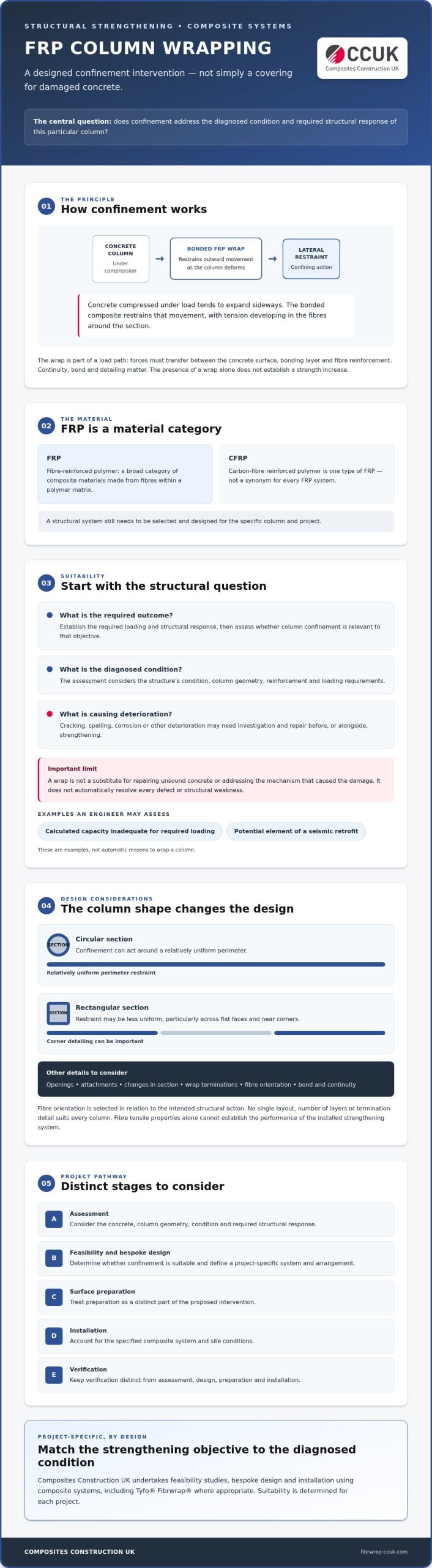
Concrete under compression tends to expand laterally. A bonded composite wrap can restrain this movement as the column deforms, developing a confining action around the section. That restraint changes the conditions under which the concrete carries load, which is why a wrap may be considered when the design objective involves column confinement. The extent and structural significance of the effect must be assessed for the specific column. Capacity or ductility improvements should not be assumed without project-specific design evidence.
Which column conditions may lead engineers to consider wrapping?
An engineer may assess wrapping as part of a strengthening proposal where a column’s calculated capacity is inadequate for the required loading, or as a potential element of a seismic retrofit. These are examples, not automatic reasons to wrap a column. The governing deficiency must first be established from the structure’s condition, geometry, reinforcement and loading requirements.
Diagnosis matters. Cracking, spalling, corrosion or other deterioration may require repair and investigation of the underlying cause before, or alongside, strengthening. A wrap is not a substitute for repairing unsound concrete or addressing the mechanism that caused the damage. An upgrade prompted by changed demands is also different from remediation of deteriorated material. The engineer must determine whether confinement is relevant, whether other measures are needed, and whether the proposed system can fulfil its intended structural role. Composites Construction UK undertakes feasibility studies, bespoke design and installation using composite systems, including Tyfo® Fibrwrap®, with selection dependent on the project.
How FRP wrapping confines a concrete column
Confinement works through a linked load path. As an axially compressed concrete column shortens, it also tends to expand laterally. A bonded composite layer restrains that outward movement. Tension develops in the fibres around the section, applying lateral restraint to the concrete. This interaction is the intended confinement mechanism, not an independent increase in strength that can be assumed simply because a wrap is present.
How the composite wrap interacts with the column
For the restraint to act as designed, forces must transfer between the concrete surface, bonding layer and fibre reinforcement. The wrap’s continuity, bond and detailing therefore matter alongside the material properties. FRP column wrapping may be designed to address a defined confinement objective, but it does not automatically resolve every axial, shear or flexural deficiency. Those actions require separate assessment, and the selected arrangement must reflect the governing structural demand.
Why geometry and fibre orientation matter
Column shape influences how restraint develops. A circular section allows confinement to act around a relatively uniform perimeter. On a rectangular column, restraint can be less uniform, particularly across flat faces and near corners. Corner detailing can therefore be important to the design. Openings, attachments, changes in section and wrap terminations can also affect continuity and need to be considered.
Fibre orientation is selected in relation to the intended structural action. For a confinement design, fibres arranged to resist circumferential expansion may be relevant, but no single layout, number of layers or termination detail suits every column. The choices depend on the design assumptions, existing substrate and specified system. Fibre tensile properties alone cannot establish the performance of the installed strengthening system. Bond, resin, surface condition, workmanship and exposure conditions also form part of the engineering assessment.
Diagram brief: Show a concrete column cross-section surrounded by a continuous composite wrap. Use arrows pointing outwards from the concrete to indicate lateral expansion under compression, and arrows acting inwards at the wrap to illustrate confinement. Label fibre direction as project-specific rather than presenting a universal arrangement.
In practice, the intended response must be translated into design details that can be installed on the actual structure. A general description of the material is not enough to specify a column intervention. Composites Construction UK works with composite systems including Tyfo® Fibrwrap®, with suitability and detailing dependent on project-specific engineering. For context on how design decisions inform composite strengthening, see the composite strengthening design approach.
When is FRP column wrapping suitable, and what are its limits?
Consider FRP column wrapping only after identifying the structural need. The proposed purpose might be to address a defined confinement requirement within a strengthening or seismic retrofit design. That does not make wrapping a general remedy for a column that is damaged, deteriorated or inadequately supported. The intervention must respond to the diagnosed condition, and its suitability must be checked against the column’s role and the demands placed on it.
What should be established before specifying a wrap?
The engineer needs an adequate understanding of the column’s geometry, materials, reinforcement, loading and connection to the surrounding structure. The column’s condition and structural role also matter: a local defect may have different implications from a deficiency affecting the wider frame. Inspection and testing can help establish these facts, but the appropriate methods should be selected for the project rather than treated as a fixed package.
Most importantly, establish the cause and extent of any damage or shortfall. Cracking or concrete loss, for example, may require investigation and repair before a strengthening system is considered. Applying a wrap over unsound concrete does not, by itself, restore the substrate or address the cause of deterioration.
| Potential objective | Information to establish | Question for the structural engineer |
|---|---|---|
| Improve a defined confinement response | Section shape, concrete condition, reinforcement and design actions | Is confinement the governing requirement, and can the proposed arrangement address it? |
| Strengthen for changed or increased demands | Current and required loading, column role and load paths | Which capacity deficiency has been identified, and are other actions also critical? |
| Support a seismic retrofit objective | Structural system, connections, condition and retrofit scope | How does column wrapping contribute to the wider retrofit design? |
| Address visible deterioration | Damage extent, substrate quality and likely cause | Is repair or further investigation needed before strengthening? |
What can limit or complicate a wrapping solution?
Bond depends on a suitable substrate, so weak, contaminated or deteriorated concrete may complicate installation or require repair. Column shape, restricted access, nearby services, interfaces with beams or slabs, and wrap terminations can also affect design and construction. Fire performance, durability, environmental exposure and any required protective measures need project-specific review. They should not be assumed from the fibre material alone.
FRP column wrapping may be unsuitable as a stand-alone response, or another strengthening approach may better match the diagnosed deficiency. Concrete repair may also be required before or alongside strengthening. A feasibility study and bespoke design can help compare the identified need with practical options before selecting an intervention.
How engineers assess, design, and install FRP column wrapping
A reliable intervention follows a project-specific sequence: establish the column’s condition and structural requirements, develop a design for the identified need, then install and check the specified system. Assessment and design determine what the site team must achieve. Installation controls help ensure the work follows those decisions. Neither stage can be replaced by selecting a material on its own.
From condition assessment to a project-specific design
Survey findings are considered alongside available information about the column’s geometry, materials, reinforcement, loading and structural role. Where information is incomplete, the engineer determines whether further inspection or testing is needed to evaluate feasibility and confirm the design basis.
The design sets out the proposed system arrangement and relevant detailing, as well as project controls for installation and verification. These decisions may address the extent and orientation of the wrap, interfaces with adjoining elements, and substrate preparation requirements. The appropriate approach depends on the structure and the specified composite system. For more on the structural design and engineering approach, see the design feature.
What happens during preparation, application, and quality checks?
Before application, the concrete surface is prepared to meet the project requirements. The substrate condition matters because the system relies on an effective bond. Defects that could affect installation need to be assessed and addressed as directed by the design and project documents. Preparation should not be treated as a generic step with one method for every column.
The composite system is then applied in accordance with its specified method. This may involve placing fibre reinforcement with the designated resin, followed by curing under the conditions required for that system. Consult the applicable installation documentation, including the Tyfo® Fibrwrap® installation guide where relevant, for system-specific instructions. Do not assume universal curing times or acceptance criteria.
Checks during and after application should follow the project’s defined quality requirements. These may include confirming that specified preparation and application stages have been completed, documenting relevant site conditions, and inspecting the installed work against the design. The project documents must establish the required checks and any acceptance criteria. Installer competence and adherence to the approved method are essential to achieving the design intent.
Composites Construction UK provides feasibility studies, bespoke design and installation using composite systems, including Tyfo® Fibrwrap®. Discuss a column wrapping project where assessment, design and installation need to be considered together.
Planning an FRP column wrapping project with a specialist engineer
Plan around the asset’s needs, not a predetermined strengthening method. Before progressing with FRP column wrapping, clarify the concern to be addressed, the evidence available and the operational conditions the work must accommodate. These decisions help determine whether a feasibility study is appropriate, what further investigation may be required and how design and installation can be coordinated.
What information should an asset owner prepare?
Gather the information already held, even if it is incomplete. Useful starting points include:
- Available structural drawings and records of previous alterations or repairs.
- Inspection reports, monitoring information and photographs of observed defects.
- Known or anticipated loading requirements, alongside the column’s role in the structure.
- Operational constraints, such as access limitations or the need to keep adjacent areas in use.
Describe the performance concern in practical terms. Is it a suspected structural deficiency, visible deterioration, or a proposed change in use or loading? A clear brief helps an engineer focus the initial review. Missing drawings or uncertain material information need not prevent a conversation. Record these as information gaps and address them through investigation selected for the project.
When should a specialist engineering contractor be involved?
Specialist input is valuable when structural assessment, bespoke design and composite installation need to align. The design must translate the identified requirement into a system arrangement and practical installation details, while site work must follow the specified method. Coordinating these stages helps ensure the proposed intervention responds to the actual structure rather than a generic assumption about wrapping.
Composites Construction UK is a specialist engineering contractor providing feasibility studies, bespoke design and installation using composite systems, including Tyfo® Fibrwrap®. The company is the exclusive UK licensee for the Tyfo® Fibrwrap® system, although its suitability must still be established for the particular column and project. Clarify the intended outcome, information still required, design responsibilities, installation constraints and how the completed work will be checked.
Where engineering assessment supports strengthening or repair, an intervention may help extend an asset’s useful life and defer more extensive work. That outcome cannot be assumed in advance. The condition, cause of any deterioration, design requirements and viable alternatives all need consideration. Establishing these points early gives asset owners a sounder basis for deciding whether to proceed and what further information is needed.
To discuss the assessment, design and installation considerations for a specific project, discuss a structural strengthening project.
Make the next step an informed engineering decision
FRP column wrapping is a designed confinement intervention, not a generic covering or a substitute for diagnosing concrete deterioration. Its suitability depends on the column’s condition, structural role and required performance. Geometry, detailing and installation also influence the design outcome.
For asset owners, a practical starting point is to bring together available drawings, inspection records, loading information and operational constraints. A specialist engineer can identify information gaps, assess feasibility and determine whether wrapping, repair or another intervention merits consideration. Where strengthening is appropriate, project-specific design and controlled installation connect the intended structural response with the work on site.
Composites Construction UK provides feasibility studies, bespoke design and professional installation, and is the exclusive UK licensee for the Tyfo® Fibrwrap® system. Suitability must still be assessed for each project. To discuss the structural concern and possible next steps, contact Composites Construction UK about a structural strengthening project. A considered assessment is a sound basis for planning work that supports the continued use of an asset.
Frequently Asked Questions
What is FRP column wrapping?
FRP column wrapping applies fibre-reinforced polymer composite around a concrete column to provide a designed strengthening function, commonly confinement. The composite combines reinforcing fibres with a polymer matrix and is bonded to the prepared column surface. Carbon fibre is one possible reinforcement type within the broader FRP category. Select the system, arrangement and intended structural role through project-specific engineering, rather than treating the wrap as a generic covering.
How does FRP wrapping strengthen a concrete column?
FRP wrapping can strengthen a column by restraining its tendency to expand laterally as the concrete is compressed. Tension develops in the wrap as it resists that expansion, providing confinement to the concrete. The effect depends on the column, design and installed system, so a particular increase in capacity or ductility must not be assumed without engineering assessment. Wrapping also does not automatically correct separate axial, shear or flexural deficiencies.
Can FRP wrapping be used on rectangular columns?
Yes, FRP wrapping can be considered for rectangular columns, but the section shape affects how confinement develops. Flat faces and corners create different design considerations from those of a circular column. Corner treatment, fibre arrangement, interfaces and terminations may influence the proposed details. The engineer should assess the actual geometry and structural objective before specifying a system. There is no universal layout for every rectangular column.
Is FRP column wrapping suitable for damaged concrete?
FRP column wrapping may form part of a strengthening scheme for a damaged column, but it should not be applied to conceal deterioration. Assess the extent and cause of cracking, spalling, corrosion or other defects. Unsound concrete may require repair before strengthening. The engineer must determine whether the substrate can support the proposed system and whether repair, further investigation or another intervention is needed to address the underlying condition.
How long does FRP column wrapping take to install?
There is no single installation duration for every FRP column wrapping project. The programme depends on factors such as the number and geometry of columns, access, substrate condition, preparation and any repair work. Application and curing requirements also vary with the specified system and project conditions. Confirm the installation sequence and expected duration from the design, system documentation and site plan, rather than relying on a universal time allowance.
Does FRP column wrapping need to be designed by a structural engineer?
Yes. A structural engineer should assess and design the intervention because the wrap must address a defined structural requirement in the context of the existing column and its loads. The design informs system selection, arrangement, detailing and relevant installation controls. Assessment may also identify a need for repair, further investigation or an alternative strengthening method. A specialist engineering contractor can coordinate feasibility, bespoke design and installation, with the final approach determined for the project.