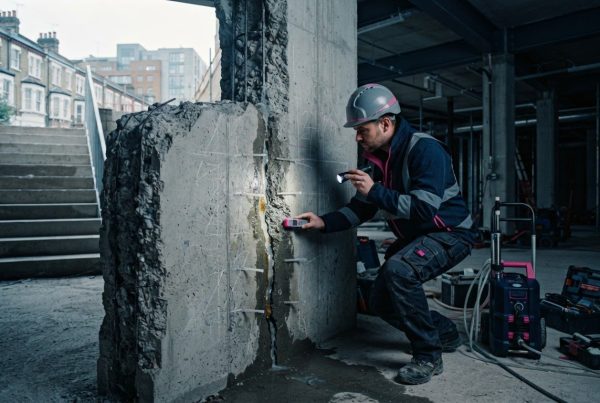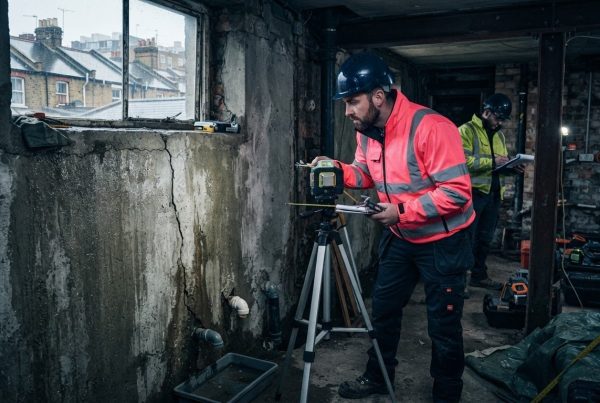

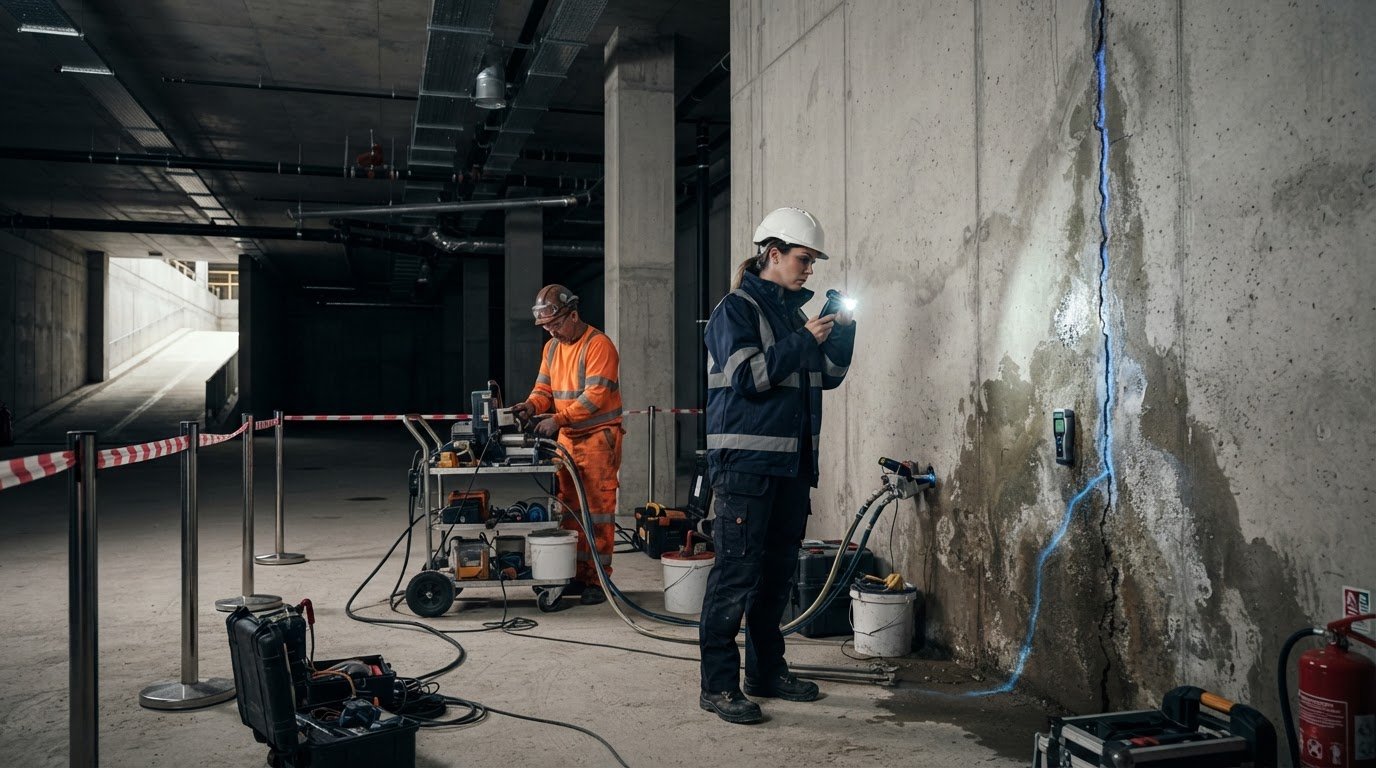
What if the visible damp patch is only the exit point, rather than the route water is taking through a commercial basement? Commercial basement leak sealing is most effective when the source and path of ingress are understood before a repair method is selected. Treating a crack or wet surface alone may leave water entering through a joint, service penetration or porous material nearby.
That uncertainty can make remedial work difficult to scope, particularly when the basement must remain in use or access is restricted. A sound assessment considers the pattern of dampness, the condition of the concrete and its interfaces, and how water behaves under changing site conditions. The repair can then be matched to the diagnosed defect and the requirements of the asset.
This article explains what evidence helps identify the likely ingress route, how injection and other leak-sealing approaches differ, and which operational details should inform project planning. It also shows how a clear project brief can support specialist assessment, appropriate repair selection and, where required, coordination with concrete repair or wider structural rehabilitation.
Key Takeaways
- Learn how to distinguish local leak control from a broader waterproofing strategy, and why visible signs alone may not identify the source.
- Use a structured inspection sequence to build a clearer picture of the likely water path before defining the repair scope.
- Compare hydrophobic and hydrophilic leak sealing with crack injection systems against the observed condition and project requirements.
- Prepare a practical project brief for commercial basement leak sealing, including affected areas, access constraints, building use and leak patterns.
- See how CCUK’s waterproofing solutions, crack injection systems and related repair services can support a project-specific scope.
Commercial basement leaks: what the symptoms reveal, and what they do not
Commercial basement leak sealing is a targeted intervention intended to control water ingress at an identified location or pathway. It differs from a broader waterproofing strategy, which considers how the below-ground structure as a whole is protected and used. A local repair may form part of that strategy, but dampness at one point does not show, by itself, where the water is entering.
Groundwater conditions and hydrostatic pressure may contribute to water moving through cracks, construction joints, or porous concrete and masonry. The route can be indirect: water may travel through a material or interface before becoming visible inside. Investigation should therefore consider the structure, its junctions and the pattern of ingress, rather than treating the wettest point as a confirmed defect.
Evidence of water ingress confirms that moisture is present. It does not, on its own, confirm the route by which water reached the surface.
Which signs help identify a basement water-ingress problem?
Staining, damp patches, active seepage and recurring wet areas are useful observations to record, not standalone diagnoses. Their value increases when they are mapped against the building layout and tracked over time. Note the precise location, approximate extent, whether water is actively moving, and when the condition appears or changes.
- Record whether the affected area is at a crack, joint, wall-floor junction, service penetration or within an apparently uninterrupted surface.
- Note timing and recurrence, including any observed relationship with rainfall, changes in site conditions or building operations.
- Photograph the area from a consistent position and include nearby structural features for context.
A photograph can show where a symptom appears, but it cannot reveal the concealed path of water through the structure. A recurring wet patch may justify further investigation without establishing whether ingress is through a crack, a junction or more permeable material. These records help engineers build an evidence-based picture and decide what needs closer assessment.
Why commercial use changes the repair brief
In a commercial building, transport asset or power and energy facility, the affected basement may contain occupied work areas, stored assets, plant or infrastructure that must remain accessible. These conditions influence how an investigation is arranged and how remedial work can be sequenced. They belong in the technical brief, not just in the arrangements made after a repair method has been chosen.
Before assessment, identify which areas are in use, what needs to remain accessible, and whether equipment or stored materials restrict access to the affected structure. Record operational constraints that could affect inspection or the setup of a work area. This helps separate the repair requirement from the practical conditions under which the work must be carried out.
For example, seepage near plant equipment may mean planning the investigation and work area around access needs. A recurring wet area in a storage space may require the location and extent of affected contents to be documented. The appropriate response depends on the asset condition, ingress evidence and site requirements. A clear brief helps align commercial basement leak sealing with those factors and reduces the risk of specifying a surface treatment without understanding the wider repair context.
How commercial basement leak sealing works: trace the water path before specifying treatment
A reliable repair scope is based on evidence about the structure and the likely route of the water, not just the visible leak. Commercial basement leak sealing can address a defined ingress pathway, but the intervention depends on what inspection shows about the affected area, adjoining construction and substrate condition.
A disciplined investigation moves from recorded observations to inspection, pathway assessment and scope definition. Each stage should inform the next. Where evidence remains incomplete, that uncertainty should be reflected in the proposed work rather than hidden by an assumption about the cause.
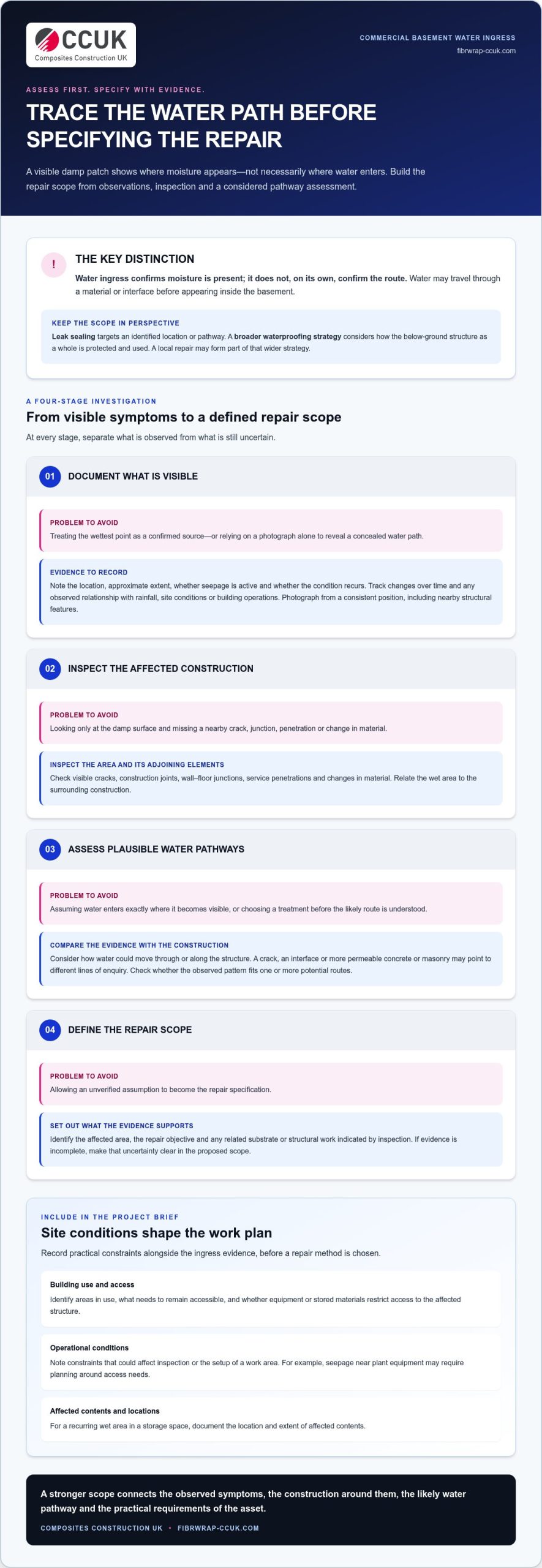
- Document observations. Record where water appears, the extent of dampness, whether seepage is active and whether the condition recurs. Include relevant site observations and changes in the pattern over time.
- Inspect the affected construction. Examine the area and adjoining elements, including visible cracks, construction joints, wall-floor junctions, service penetrations and changes in material.
- Assess plausible pathways. Consider how water could move through or along the construction, and whether the observed pattern is consistent with one or more potential routes.
- Define the repair scope. Set out the identified area, the repair objective and any related substrate or structural work indicated by the inspection.
What should a basement leak investigation examine?
The assessment should relate the wet area to the construction around it. A crack may warrant close inspection, while dampness near a joint or penetration may direct attention to that interface. Moisture distributed across porous concrete or masonry may call for a different line of enquiry from a concentrated seepage point. These are investigative cues, not diagnoses. Conclusions should be based on the inspected structure and the evidence available.
Adjoining surfaces matter. Water may travel along an interface or through the substrate before emerging at a visible point, so the apparent location of a leak cannot automatically be treated as its origin. Record the extent and pattern of moisture, recurrence, relevant site conditions and accessible construction details. If deterioration or substrate damage is observed, the scope may need to include concrete repair alongside leak sealing. Further considerations are set out in this concrete repair and structural remediation guide.
When is leak sealing different from wider waterproofing?
Leak sealing targets identified water ingress through a defined location or pathway. Wider waterproofing assessment considers protection across a larger area or the below-ground structure as a whole. The difference is one of scope, not a rule that one approach is always preferable. A localised defect may suit a focused intervention, while more extensive or distributed ingress may call for a broader assessment of the structure and its conditions.
Project teams should avoid specifying treatment solely from the extent of a stain or the convenience of access. The assessment should establish what the repair is intended to address and whether related substrate repair or structural rehabilitation is warranted. This project-specific approach helps align the intervention with the observed ingress and asset condition. For a commercial project’s water-ingress requirements, use CCUK’s contact route for leak-sealing enquiries.
Choosing a commercial basement leak-sealing approach for the observed condition
Method selection should follow assessment, not precede it. Hydrophobic leak sealing, hydrophilic leak sealing and crack injection systems are distinct approaches to consider within a project-specific repair scope. The relevant option depends on the observed ingress route, substrate condition and design requirements. None should be treated as a universal answer to basement dampness.
The water path and substrate condition matter because a sealing approach must suit the investigated route and the material it passes through.
How do hydrophobic and hydrophilic leak-sealing approaches differ?
Hydrophobic and hydrophilic leak sealing are both waterproofing solutions provided by CCUK. They are distinct categories, but the appropriate selection for a particular basement cannot be determined from the label alone. Assessment should establish the condition to be addressed and the design requirements for the repair. It should not assume material behaviour or performance outcomes that have not been established for the project.
| Approach | Role in the repair scope | Assessment focus | Relationship to observed ingress |
|---|---|---|---|
| Hydrophobic leak sealing | A category of leak-sealing intervention for consideration within the defined scope. | Consider the inspected substrate, ingress evidence and project design requirements. | Assess its relevance against the identified route. The category name alone does not establish suitability. |
| Hydrophilic leak sealing | A separate category of leak-sealing intervention for consideration within the defined scope. | Review the same project-specific evidence and requirements before selecting an approach. | Relate the proposed intervention to the investigated route rather than the visible symptom alone. |
| Crack injection systems | A system category for consideration where the repair scope concerns a crack-related ingress route. | Examine the crack and surrounding substrate as part of the structural assessment. | Its relevance depends on whether the observed ingress is associated with the crack under investigation. |
Where do crack injection systems fit in the repair scope?
Crack injection systems are a CCUK service and may form part of a project where assessment identifies a crack-related water-ingress route. They are not a solution for every form of basement damp. Moisture across porous material or at a junction may require a different investigation and scope. Where crack condition also raises structural repair questions, the wider context is explored in this structural repair and asset remediation guide.
For project teams, the comparison is a framework for assessment, not a substitute for it. Record which route is being treated, the condition of the surrounding substrate and any related repair requirements. If the evidence indicates ingress beyond a defined crack or localised route, the scope may need to consider wider waterproofing rather than relying on a single sealing intervention. Commercial basement leak sealing should be specified against the inspected asset and its requirements, with the chosen approach tailored to the project.
When preparing a repair brief, use CCUK’s contact route for project requirements to discuss the observed condition and scope.
Planning commercial basement leak sealing around access, use and asset condition
A repair brief should describe not only where water is appearing, but also how the basement operates and which conditions may shape investigation and remedial work. For commercial basement leak sealing, these details help relate the proposed scope to the asset, rather than treating the affected surface in isolation. A concise, well-organised brief gives a specialist assessment a more useful starting point.
What information helps define the project scope?
Bring together the information available before assessment. The checklist below provides a practical starting point, but it does not replace inspection or engineering judgement. Conclusions about the repair scope must be based on the structure and evidence considered for the project.
- Building use: Describe how the basement is used, including occupied areas, plant spaces, storage and any functions that rely on continued access.
- Affected locations: Identify where dampness, staining or active seepage has been observed, using drawings or annotated plans where available.
- Ingress pattern: Record when water appears, whether the condition recurs, and how its extent or location has changed.
- Construction information: Provide relevant drawings and details of visible cracks, joints, penetrations, changes in material or previous repairs.
- Access constraints: Note restricted routes, equipment, stored materials and any parts of the structure that may be difficult to inspect.
- Asset condition: Include known concrete deterioration or other structural concerns adjoining the affected area.
Previous repair records can help establish whether the current condition is new, recurring or associated with an earlier intervention. Consider them alongside current observations, not as proof that the same cause or repair scope applies today.
How can remedial work fit around commercial operations?
In an occupied building or infrastructure asset, access arrangements and work-area boundaries may influence the sequence of investigation and repair. Plant may need to remain accessible; stored materials may need to be moved to expose the affected construction; and work in an occupied space may need to be coordinated with the asset-management team. Practical arrangements depend on site conditions and the agreed scope, so consider disruption during planning rather than assuming what it will involve.
Structural condition also belongs in the discussion. If the affected area includes deteriorated concrete, the assessment may need to consider concrete repair alongside leak sealing. Coordinating related work within one project scope helps the team understand how the interventions relate, while avoiding the assumption that every leak requires broader structural remediation. Keep the repair proportionate to the inspected condition and operational requirements of the asset.
To discuss the observed ingress, access conditions and project requirements with CCUK, send a commercial project enquiry.
Delivering commercial basement leak sealing with CCUK
Composites Construction UK (CCUK) provides waterproofing solutions and crack injection systems for commercial assets. Its services include hydrophobic and hydrophilic leak sealing, as well as pipeline and liquid storage waterproofing. For a basement project, the relevant service is determined by the assessed condition and repair scope, rather than applying one standard approach to every instance of water ingress.
What CCUK brings to a project-specific assessment
CCUK provides specialist engineering and repair services across the UK, supporting projects in the Buildings, Transportation Infrastructure, and Power, Energy & Pipelines sectors. Its waterproofing solutions sit alongside concrete repair and structural rehabilitation, allowing related work to be considered where the assessed scope warrants it. The company has over 25 years of expertise in structural strengthening, concrete repair and carbon-fibre strengthening. This experience relates to those areas and is not a claim about a specific leak-sealing project.
For an asset owner or project team, a project-specific approach means considering the proposed intervention against the observed condition, intended repair objective and wider asset requirements. A localised leak-sealing scope may be distinct from broader waterproofing, while adjoining concrete repair may also be relevant if the substrate condition calls for it. Assessment informs how these scopes connect, rather than assuming they should always be combined.
What happens when a commercial team makes an enquiry?
A useful initial enquiry sets out the asset and its operational context, then summarises the water-ingress observations that prompted investigation. Include the affected location, visible pattern or recurrence, relevant drawings or previous repair information, and constraints that may influence access. This gives the project discussion a practical starting point, while leaving assessment of the structure to the appropriate inspection.
CCUK considers project requirements in relation to the individual asset and the information available. For a basement within an occupied building, the use of the affected area and access considerations help frame the discussion. For an infrastructure or energy-sector asset, describe the relevant operational context. The scope can then be considered against the observed ingress and any connected repair requirements, including concrete repair or structural rehabilitation where these form part of the assessed need.
To discuss commercial basement leak sealing requirements, describe the affected asset, the observed water ingress and the operational conditions that may shape the work. Make a commercial leak-sealing enquiry with CCUK to begin a project-specific discussion.
Move towards a repair scope that fits the asset
The next step is to turn site observations and operational priorities into a repair scope that can be assessed against the structure itself. For commercial basement leak sealing, a clear project brief keeps attention on the asset’s requirements and supports a considered choice between local intervention and related repair work. It also gives the team a practical basis for planning remedial work to support the structure’s continued use.
CCUK provides hydrophobic and hydrophilic leak-sealing solutions and crack injection systems. Where the assessed condition calls for a wider scope, concrete repairs and structural rehabilitation can also be considered as part of the project. How these services relate depends on the condition identified and the requirements of the individual asset.
Bring the affected location, available records and operational context to the discussion so it can focus on your project’s needs. Discuss a commercial basement leak-sealing project with CCUK and start planning a repair scope shaped around your asset.
Frequently Asked Questions
What causes water leaks in a commercial basement?
Water may enter through cracks, construction joints, service penetrations or porous concrete and masonry, with groundwater and hydrostatic pressure among the conditions that can contribute. External water can also reach below-ground areas through openings or adjoining construction. These are possible pathways, not a diagnosis. A damp patch beside a joint, for example, does not prove the joint is the entry point. Assessment should consider the structure and the pattern of ingress.
Can a basement leak be sealed without waterproofing the whole basement?
Yes. A localised repair may be appropriate if assessment identifies a defined ingress route and the wider structure’s condition supports that scope. For example, evidence may point to water entering at a particular crack rather than moisture affecting several areas. Do not specify commercial basement leak sealing from appearance alone. If ingress is widespread or the required protection extends beyond one location, a broader waterproofing assessment may be needed.
How does crack injection help with basement leaks?
Crack injection systems can be considered where the assessed ingress route is associated with a crack in the structure. Their role is to address that crack-related pathway, not every form of basement damp. The crack and surrounding substrate need to be examined so the proposed work reflects the observed condition. If the concrete is also deteriorated, that may call for a separate or coordinated repair scope rather than injection alone.
Are hydrophobic and hydrophilic leak sealing the same?
No. Hydrophobic and hydrophilic leak sealing are distinct waterproofing solution categories, but their names alone do not establish which is suitable for a particular asset. Selection should reflect the investigated ingress condition and the project’s design requirements. CCUK provides both approaches. Assessment should determine their relevance to the repair scope without assuming a specific material behaviour or outcome from the terminology alone.
What information should I provide about a commercial basement leak?
Provide the asset type, the exact affected location and a description of how the water appears or recurs. A marked-up plan can help locate the area, while dated photographs can show whether the pattern has changed. Include relevant drawings, previous repair records, access restrictions and details of how the space is used. These records help frame assessment, but do not replace inspection of the structure or engineering judgement.
Does basement leak sealing also repair damaged concrete?
Not necessarily. Leak sealing and concrete repair address different aspects of a project, although both may be required where the assessed condition indicates related ingress and substrate damage. If concrete around a leak is visibly deteriorated, its condition should be considered as part of the repair scope. CCUK provides concrete repairs as well as leak sealing, so related work can be considered together where the project assessment warrants it.
How should leak sealing be planned in an occupied commercial basement?
Plan around how the space operates. Identify occupied areas, plant that needs access, stored materials and routes to the affected construction. These details help shape work-area arrangements and sequencing with the asset-management team. Stored items may obstruct inspection of a wall, for example, while plant access may need to be maintained during planned activities. The practical plan depends on site conditions and the agreed scope, so share constraints early.