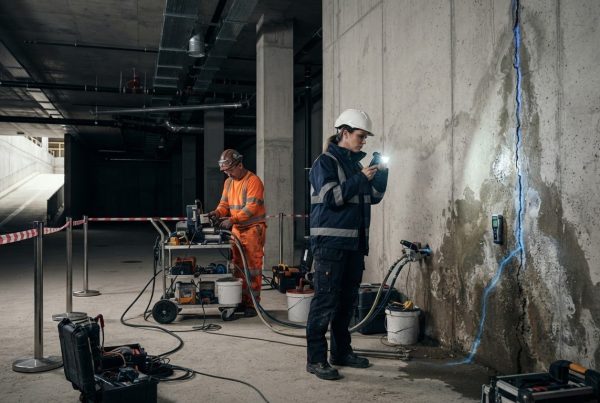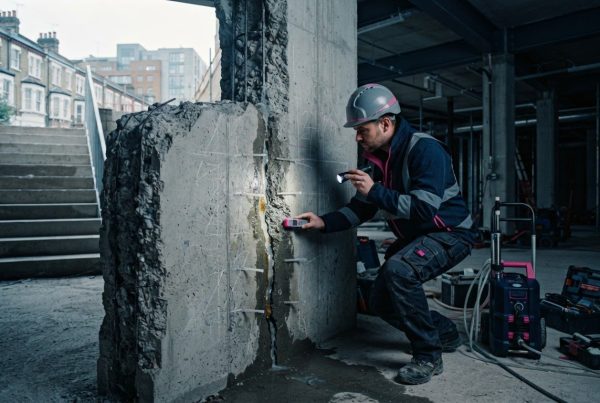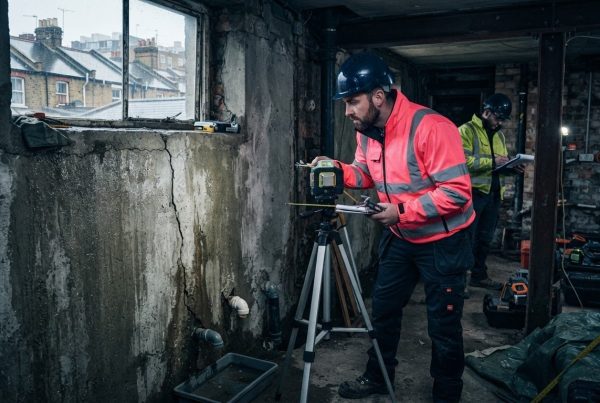


What if the key to CFRP masonry strengthening is not the amount of reinforcement, but whether it addresses the way the masonry is failing? A bonded system transfers tensile forces into the wall through the substrate and adhesive interface. Its contribution therefore depends on more than the properties of the carbon fibres: the masonry’s condition and the source of the structural deficiency also matter.
When cracking, out-of-plane movement or reduced capacity raises concern, a generic reinforcement layout may seem like a straightforward answer. But it may not address the governing failure mechanism. Bond performance cannot be considered separately from the masonry it relies on, so the intervention needs to match the structure and its assessed needs.
This article explains the failure mechanisms CFRP may be designed to address, how substrate condition and bond influence performance, and which assessment and design questions shape a project-specific approach. It also outlines how structural surveys and testing can inform the process, from diagnosing the deficiency to developing a considered strengthening design. Composites Construction UK provides a free, no-obligation carbon-fibre strengthening design service. After questionnaire completion, a dedicated design specialist provides project requirements and a quote.
Key Takeaways
- CFRP masonry strengthening should be designed around an identified structural deficiency, rather than applied simply because a wall is masonry.
- The reinforcement’s contribution depends on how load transfers through the masonry substrate and bonded interface.
- Compare CFRP with conventional stabilisation by considering the structural objective, substrate interaction and design requirements, rather than assuming one method is always superior.
- A methodical assessment, supported where appropriate by surveys and testing, helps translate observed damage into project-specific design inputs.
- Asset context, the observed issue and available assessment findings can help frame the next step: a free, no-obligation carbon-fibre strengthening design service.
CFRP Masonry Strengthening: Which Structural Problems Can It Address?
CFRP masonry strengthening is an externally applied composite intervention in which carbon-fibre reinforcement is bonded to masonry to meet a defined structural requirement. It may contribute additional tensile resistance where engineering assessment identifies a suitable role. The presence of CFRP on a wall is not, by itself, a reason to specify it: the design needs to address an identified deficiency and establish a clear load path.
Quotable definition: CFRP masonry strengthening is the project-specific application of bonded carbon-fibre reinforcement to address a diagnosed structural demand in a masonry element.
How unreinforced masonry responds to structural demand
Masonry behaviour depends on the interaction between units and mortar, the bond between them, wall geometry and the structure’s existing condition. Differences in any of these can affect how forces are carried and where cracking develops. The same visible symptom can therefore have different underlying causes.
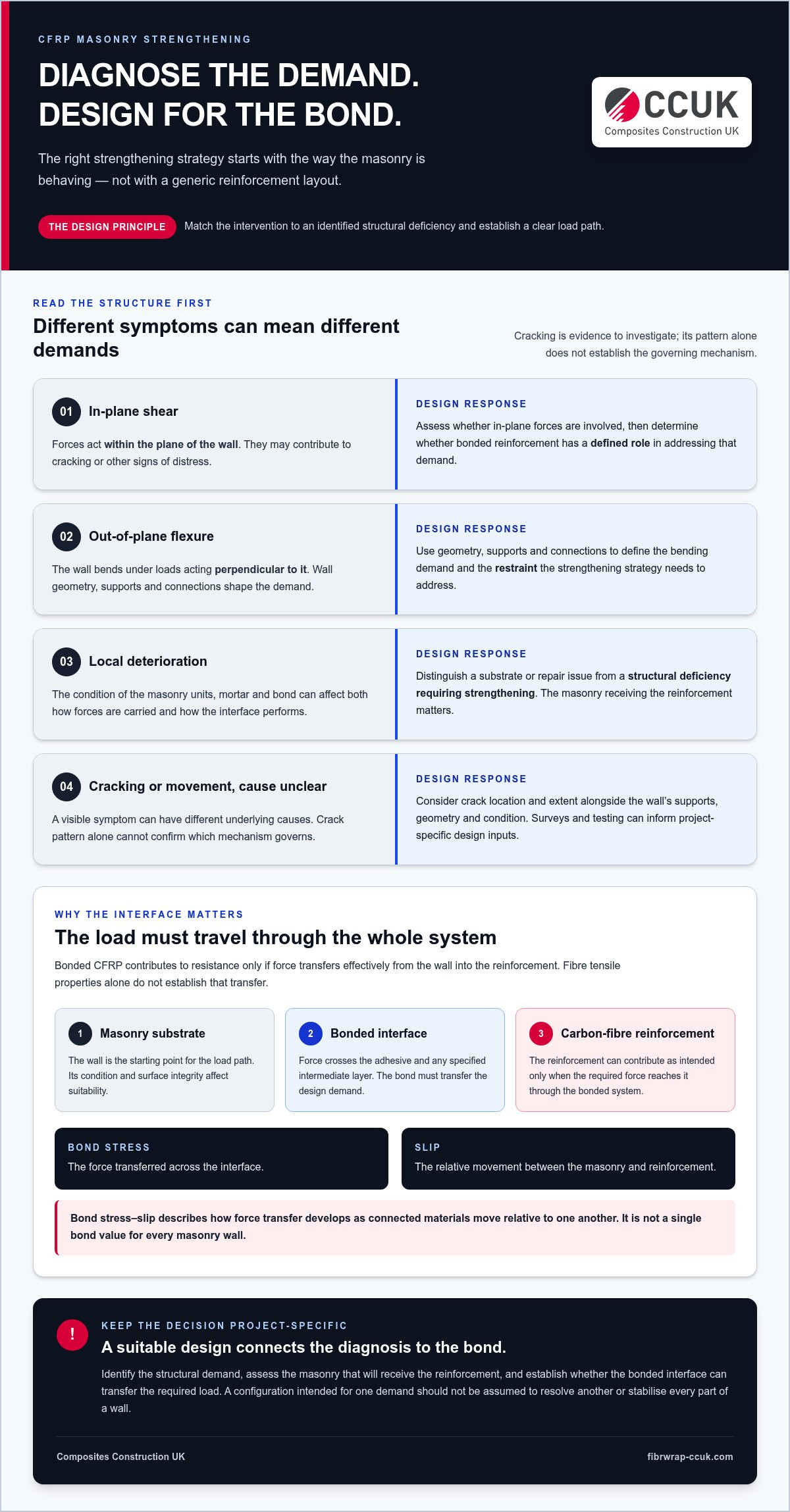
In-plane shear concerns arise when forces act within the plane of a wall; out-of-plane flexure occurs when the wall bends under loads acting perpendicular to it. These are distinct behaviours and may call for different strengthening objectives. Cracking is useful evidence, but its pattern alone does not establish the governing mechanism. Consider its location and extent alongside the wall’s supports, geometry and condition.
When CFRP may form part of a strengthening strategy
CFRP can be considered where engineering assessment identifies a suitable role for externally bonded reinforcement, such as contributing tensile resistance to a defined flexural or shear demand. The intervention must be designed for the behaviour being addressed. A configuration intended for one demand should not be assumed to resolve another or stabilise every part of a wall.
Suitability also depends on the masonry substrate and whether the required forces can be transferred through the bonded interface. General repair and structural strengthening are not interchangeable. Repointing or treating a crack may address a local defect, but does not by itself demonstrate that the wall’s structural capacity has improved. A general overview of carbon-fibre-reinforced polymer explains the composite material, while its application to masonry still requires project-specific engineering judgement.
- Shear-related demand: Assessment establishes whether in-plane forces contribute to cracking or other signs of distress, then determines whether bonded reinforcement has a defined design role.
- Out-of-plane movement: Wall geometry, supports and connections help define the bending demand and the restraint the strengthening strategy needs to address.
- Local deterioration: The condition of units, mortar and bond helps distinguish a substrate or repair issue from a structural deficiency requiring strengthening.
These distinctions guide the decision; they do not prescribe a standard layout for every wall. The CFRP system must suit the substrate and transfer the required load. If the masonry is degraded or the source of movement remains unclear, those conditions need to inform the assessment before an intervention is designed.
How CFRP Transfers Load Through the Masonry-Bond Interface
Externally bonded CFRP can contribute to a masonry element’s resistance only if force transfers effectively between the wall and the reinforcement. The load path begins in the masonry substrate, crosses the adhesive and any specified intermediate layer, then enters the carbon-fibre reinforcement. If the interface cannot transfer the design demand, the reinforcement cannot contribute as intended, whatever the fibres’ tensile properties.
Bond stress-slip describes how force transfers across a bonded interface as the connected materials move relative to one another. Bond stress represents the force transferred across the interface; slip is the relative movement between the masonry and reinforcement.
Bond stress-slip and effective load transfer
For engineers, the relationship between bond stress and slip describes how an interface responds as load is applied: how force builds, how relative movement develops and how the bond behaves as demand changes. It informs assessment of the load-transfer mechanism, but does not establish one bond value for all masonry. Units, mortar, surface condition and the specified system all affect how the interface behaves.
Research on masonry triplets examines bond behaviour in defined test arrangements. This experimental work can develop understanding of interface response, but a research result is not automatically a design value for a different wall, substrate or installation. The experimental campaign on CFRP reinforcing render for masonry walls provides relevant research context. Project design still needs to account for the actual construction and required load transfer.
Substrate condition and preparation considerations
The bond depends on the material receiving the reinforcement. Assessment considers the masonry’s condition and surface integrity, including whether units or mortar are loose, cracked, deteriorated or locally defective. A weak or unsound surface can interrupt force transfer, so substrate condition is part of the strengthening design, not merely a cosmetic concern.
Preparation requirements should follow the specified system and project design, not be assumed from generic guidance. Surface preparation, treatment of local defects and the application sequence need to suit the substrate and intended load path. The Tyfo Fibrwrap installation guide offers broader context on system installation, while masonry-specific decisions depend on project conditions.
The practical design question is not simply whether CFRP can be attached, but whether the masonry and bonded interface can transfer the forces required by the proposed intervention. Where condition or bond is uncertain, structural surveys and testing can inform the assessment. This evidence helps connect diagnosis to a considered design. Composites Construction UK’s carbon-fibre strengthening design service provides a project-specific route from engineering requirements to a proposed intervention.
CFRP and Traditional Masonry Stabilisation: Compare the Design Implications
Compare CFRP and conventional masonry interventions against the same structural requirement, rather than ranking them in the abstract. The choice depends on how the proposed measure engages with the existing wall, where forces need to transfer and what the substrate can support. A wall requiring restraint against movement presents a different design problem from masonry needing additional resistance to a defined in-plane demand.
The approaches below illustrate broad design distinctions. They are not interchangeable specifications: the selected intervention, or combination of measures, should follow assessment of the asset and its structural requirements.
| Approach | Intervention principle | Structural objective | Substrate interaction and design dependency |
|---|---|---|---|
| CFRP reinforcement | Externally bonded composite reinforcement engages with the wall through a designed interface. | May contribute to a defined strengthening demand, such as flexural or shear resistance. | Depends on substrate condition, bond and the required load path; layout and detailing are project-specific. |
| Bed-joint reinforcement | Reinforcement is incorporated into selected mortar joints as part of masonry work. | May provide reinforcement along designated joints, subject to the wall’s design requirements. | Engages with the masonry through the joint arrangement; suitability depends on construction details and the intervention scope. |
| Ties or restraint systems | Connections provide restraint between masonry elements or between a wall and supporting construction. | May address a requirement for restraint or connection rather than directly increasing wall capacity in every mode. | Depends on the condition and location of connection points, support arrangement and forces to be transferred. |
| Local masonry repair or rebuilding | Damaged units or mortar are repaired or replaced in a defined area. | Addresses local deterioration or defects; it does not automatically provide structural strengthening. | Must be compatible with adjoining masonry and the cause of damage; the repair scope depends on the observed condition. |
What engineers should compare between approaches
Start with the required structural action, then assess how each option transfers demand into the wall and its supports. Geometry, access to the relevant face or joints, substrate condition and constraints on the existing structure all affect detailing. Research examining CFRP rebars for masonry panels provides an example of composite reinforcement studied for masonry applications, but a research configuration does not determine a project design. The asset’s requirements do.
Avoiding a false choice
CFRP masonry strengthening and conventional stabilisation are not opposing answers to one universal problem. Repair addresses defects, stabilisation may provide restraint, and strengthening targets structural capacity or demand. A project may need one function or several. Claims about disruption, durability or architectural effect need to be evaluated against the proposed design and site conditions, rather than assumed from the material category alone.
For complementary approaches and their structural roles, the project-specific carbon-fibre strengthening design service can help connect the identified requirement to a considered intervention.
Assessment and Design: A Practical Route to CFRP Masonry Strengthening
A considered design starts by separating what has been observed from what is inferred. Cracks, movement or local deterioration provide evidence, but their cause and structural significance need to be assessed in context before setting a strengthening objective. CFRP design should follow the assessed structural requirement, not a generic reinforcement detail.
From observed behaviour to engineering assessment
Record the condition systematically. Useful observations include the location and pattern of cracking, wall geometry, visible condition of units and mortar, loading context and how the wall is supported. If information is incomplete, note that explicitly: an assumption about concealed construction or restraint should not be recorded as a verified site finding.
Structural surveys and appropriate testing can add evidence about the masonry and its condition, helping distinguish observed behaviour from possible explanations. The investigation should address the concern, and findings should be interpreted alongside asset information rather than in isolation. This creates a traceable basis for engineering review.
Developing a project-specific strengthening design
Once the concern has been assessed, design connects the identified deficiency to the required structural objective and a feasible load path. For CFRP masonry strengthening, this means considering how the intervention is intended to engage with the wall, what forces it must transfer and whether the substrate and available project information support that approach.
- Define the structural concern. Describe the observed behaviour and the part of the asset affected, distinguishing confirmed observations from suspected causes.
- Assess the masonry. Review the wall’s geometry, supports, visible condition and relevant survey or testing information. Record limitations and uncertainties for engineering consideration.
- Establish design inputs. Bring together the structural requirement, loading context, asset information and substrate findings. Identify gaps that could affect the proposed load path or intervention.
- Develop the intervention. Translate the assessed deficiency into a strengthening objective and project-specific design, including how the proposed reinforcement will interact with the masonry.
This sequence helps prevent an early assumption from becoming an unexamined design input. For example, a visible crack can be documented as a fact while its cause remains subject to assessment. The design should reflect that distinction until the available evidence supports a conclusion. Where further information is needed, structural surveys and testing can inform the next engineering decision.
Composites Construction UK’s design specialists use project information to establish requirements for a tailored carbon-fibre strengthening solution. The free, no-obligation design service begins with a questionnaire. After completion, a dedicated design specialist provides project requirements and a quote. Submit a carbon-fibre design enquiry to start framing the project-specific assessment.
Plan the Next Step: A Project-Specific CFRP Masonry Design
A useful design enquiry begins with a clear account of the asset and structural concern, supported by any assessment information already available. For CFRP masonry strengthening, this context helps connect the observed issue to the engineering requirement. It does not predetermine the intervention or guarantee a particular outcome.
What to prepare for a design enquiry
Gather records that describe the structure and its condition. Complete information is not essential to frame an enquiry, but distinguishing documented facts from uncertainties helps the design specialist understand what is known and what may need further consideration.
- Asset context: Identify the type and function of the asset, such as a building or transportation, power, energy or pipeline infrastructure.
- Observed issue: Describe the location and nature of the concern, including visible cracking, movement or local deterioration, and when it was noted if known.
- Available records: Include relevant drawings, photographs, survey findings or testing information, noting any limitations in the records.
- Structural context: Share known information about the wall’s geometry, supports, loading or previous interventions where available.
Drawings and photographs can help explain the project, while survey findings and testing may provide evidence about condition. These records support the design discussion but do not replace structural assessment. If information is incomplete, state that plainly rather than presenting an assumption as a confirmed site condition.
Starting the free, no-obligation design journey
Composites Construction UK offers a free, no-obligation carbon-fibre strengthening design service. It begins with a questionnaire. After completion, a dedicated design specialist provides project requirements and a quote. This sets out a route from initial project information to a considered design discussion without implying a predetermined solution.
For a masonry project, start with the relationship between the concern, available evidence and structural objective. A design enquiry can set out that relationship and include relevant records, helping frame the project-specific requirements. If assessment findings identify uncertainties, record them for engineering review rather than resolving them by assumption.
Asset teams responsible for buildings or infrastructure can use this approach to move from a general concern to a focused design enquiry. The information submitted describes the context; the dedicated design specialist then provides the project requirements and quote as part of the stated service.
Begin the free, no-obligation carbon-fibre design questionnaire to take the next step towards a project-specific design.
Take the Next Step Towards a Considered Design
The next decision is not simply whether to reinforce a masonry wall, but how to translate the structural concern into a design requirement suited to the asset. Bringing together the observed issue, available assessment and relevant project records gives that discussion a sound starting point, while leaving the intervention to be shaped by engineering review.
Composites Construction UK brings over 25 years of expertise in structural strengthening, concrete repair and carbon-fibre strengthening. Its dedicated design specialists provide project requirements and a quote following questionnaire completion, supporting a project-specific route from initial information to design.
If you’re considering CFRP masonry strengthening, set out the asset context and the concern behind the enquiry. A clear starting point can help move the project towards a considered next step without presuming the outcome before design work is undertaken.
Start your free, no-obligation carbon-fibre design journey and take the next step towards a strengthening approach informed by your project.
Frequently Asked Questions
What is CFRP masonry strengthening?
CFRP masonry strengthening uses carbon fibre reinforced polymer as reinforcement designed for a particular structural requirement. The design considers how the intervention is intended to transfer forces into the existing masonry and what role it is expected to perform. It is not a general treatment for every crack or defect. For example, a design enquiry should distinguish a local surface issue from a concern about a wall’s structural behaviour before an intervention is specified.
Can CFRP strengthen unreinforced masonry walls?
Yes. CFRP can form part of a strengthening strategy for an unreinforced masonry wall where engineering design identifies a suitable role. A wall subject to a defined shear or flexural demand may be assessed for reinforcement, but the wall type alone does not determine suitability. Its condition, geometry, supports and required load path all matter. Cracking can prompt investigation, but is not proof that CFRP is the appropriate response.
How does CFRP bond to masonry?
CFRP transfers force through a bonded interface between the composite system and the masonry substrate. Bond stress describes the force transferred across that interface, while slip is the relative movement between the bonded materials. In practical terms, the interface has to engage with the wall for reinforcement to contribute to the design. Research on masonry bond behaviour can inform engineering understanding, but its findings need to be distinguished from the design of a specific structure.
Does CFRP masonry strengthening work for every type of masonry?
No. Masonry varies in its units, mortar, bond, geometry and existing condition, and these differences affect the design problem. For instance, a wall with deteriorated mortar presents a different substrate condition from one with sound joints, even if both show cracking. Assessment establishes the relevant structural deficiency and whether CFRP has a suitable role. The intervention should be designed for the actual asset and requirement, rather than selected from a generic detail.
Will CFRP reinforcement change the appearance of a masonry structure?
The visual effect depends on the areas treated, the design and any finish or concealment requirements. Do not assume reinforcement will be invisible or leave the appearance unchanged. For a visually significant masonry façade, consider architectural context alongside structural objectives, including where reinforcement is proposed and how it relates to the existing surface. These considerations are project-specific and should inform the design from the outset.
What information is useful for a CFRP masonry design enquiry?
Available drawings, photographs, survey findings and a concise description of the concern can help explain the project. Include the affected area, observed behaviour and relevant details about the masonry where known; clearly note where information is uncertain. Existing records provide useful context, but do not replace assessment of the structure. Composites Construction UK’s free, no-obligation carbon-fibre strengthening design journey begins with a questionnaire, followed by project requirements and a quote from a dedicated design specialist.
Is the initial carbon-fibre strengthening design service free?
Yes. Composites Construction UK offers a free, no-obligation design service for carbon-fibre strengthening projects. The process starts with a questionnaire, after which a dedicated design specialist provides project requirements and a quote. This describes the design service; installation, materials and other project work are separate considerations.