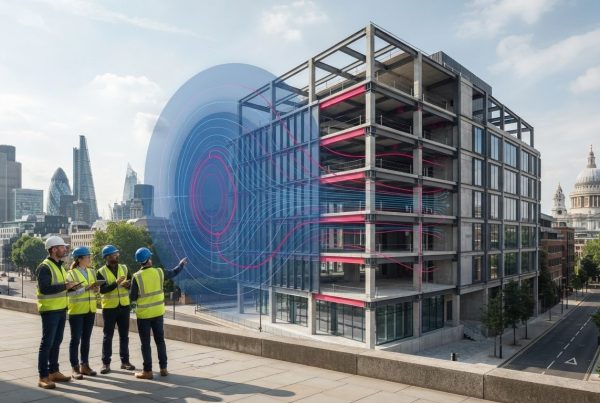

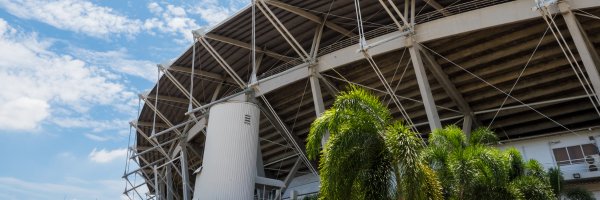
Could the structural integrity of a fifty-year-old concrete terrace reliably support the intensified dynamic loads of a modern, safe-standing crowd without necessitating a total demolition? As the UK stadium landscape evolves to meet the 2026/27 season requirements for licensed standing areas, asset controllers face the complex challenge of ageing infrastructure and escalating spectator demands. You’re likely aware that traditional repair methods often result in unacceptable operational downtime and prohibitive costs, particularly when dealing with deep-seated corrosion of original steel reinforcement. Achieving effective stadium structural strengthening UK requires a shift away from intrusive heavy engineering towards more sophisticated, material-led interventions.
This technical guide provides an expert analysis of how advanced Carbon Fibre Reinforced Polymer (CFRP) systems, such as the Tyfo® Fibrwrap® series, are utilised to modernise and extend the functional lifespan of existing sporting assets. You’ll learn about the engineering protocols required to enhance load-carrying capacity and mitigate structural deficiencies whilst remaining compliant with the 2026 Construction Products Reform White Paper. We’ll examine the specific application of composite materials in high-traffic concourses and tiered seating, offering a methodical overview of how specialised science ensures long-term safety and structural reliability.
Key Takeaways
- Understand the technical properties of the Tyfo® Fibrwrap® system, specifically how high-tensile carbon fibres and specialised epoxy resins combine to enhance structural load-carrying capacity.
- Evaluate the logistical advantages of advanced CFRP methodologies over traditional steel bonding, particularly regarding the reduction of installation timelines and the elimination of heavy lifting equipment.
- Discover the critical engineering protocols required for stadium structural strengthening UK, including the role of comprehensive structural surveys and bespoke moment-shear calculations.
- Analyse the economic and environmental benefits of prolonging the functional lifespan of sporting infrastructure through targeted reinforcement rather than full-scale demolition.
- Gain insight into the phased approach to structural modernisation, ensuring that essential venue upgrades are executed with minimal disruption to sporting schedules and spectator operations.
The Evolution of Stadium Structural Strengthening in the UK
Stadium structural strengthening UK is defined as the systematic application of advanced composite materials or supplementary reinforcements to existing elements, designed to enhance load-bearing capacity and seismic resilience. Historically, UK sporting infrastructure has faced unprecedented pressure to accommodate rising spectator numbers whilst adhering to increasingly stringent safety protocols. Whilst many iconic venues were constructed using traditional reinforced concrete, the evolution of engineering standards has necessitated a move away from heavy-set steel plate bonding. Modern methodologies prioritise high-strength, lightweight solutions that address the specific vulnerabilities of ageing assets without adding significant dead weight to the primary structure.
The trajectory of stadium design was fundamentally altered following the findings of The Taylor Report, which catalysed a transition toward all-seater venues and rigorous safety mandates. Today, compliance with the sixth edition of the ‘Green Guide’ (Guide to Safety at Sports Grounds) remains the benchmark for operational safety. Engineers must now account for complex dynamic interactions and harmonic vibrations that were perhaps under-evaluated during the original design phases of mid-century arenas. This shift requires a disciplined approach to structural remediation, ensuring that every intervention is grounded in empirical evidence and rigour.
Drivers for Structural Remediation
The primary catalyst for intervention often stems from the impact of dynamic loading and spectator-induced vibrations, particularly in stands where rhythmic movement can lead to fatigue in concrete elements. As clubs seek to increase revenue through tier expansions or the introduction of safe-standing zones, the existing slabs frequently require additional flexural or shear capacity. Environmental degradation also plays a significant role; the carbonation of original reinforced concrete often leads to the corrosion of internal steel bars, compromising the structural integrity of the terrace and necessitating urgent concrete repair.
Composite Innovation in Infrastructure
The adoption of Carbon Fibre Reinforced Polymer (CFRP) represents a paradigm shift in how specialists approach stadium structural strengthening UK. Unlike traditional steel reinforcement, which is susceptible to corrosion and requires heavy lifting equipment, CFRP systems offer an exceptional tensile-strength-to-weight ratio. These materials have a long-standing history in civil engineering bridge repairs and are now the preferred medium for ‘invisible repairs’ in arenas. By bonding ultra-thin composite layers to the concrete substrate, engineers can achieve significant strength gains whilst maintaining the architectural aesthetics and original clearances of the concourse. For more detailed insights into how these interventions are planned, review our specialist design features.
Advanced Composite Systems: The Science of Tyfo® Fibrwrap® for Arenas
The Tyfo® Fibrwrap® system represents the apex of composite science, utilising high-tensile carbon fibres impregnated with specialised epoxy resins to create a high-performance material capable of addressing structural deficiencies. This system isn’t merely a surface treatment; it’s a structural reinforcement that restores or increases the load-bearing capacity of concrete elements. The science behind the system relies on the synergy between the carbon filaments, which provide the tensile strength, and the resin matrix, which facilitates the transfer of stresses between the fibres and the substrate. Adherence to the safety benchmarks established in the Guide to Safety at Sports Grounds (Green Guide) is ensured through this rigorous material application, providing the necessary technical foundation for stadium structural strengthening UK and giving asset controllers empirical reassurance regarding long-term safety.
A critical component of this technology is the ‘wet-lay’ application process. By saturating the carbon fabric with resin immediately prior to installation, specialists ensure that every fibre is fully encapsulated. This process eliminates the risk of interlaminar voids and ensures a high-integrity bond with the prepared concrete surface. Such precision is vital for effective stadium structural strengthening UK, as it allows for the seamless integration of the composite with the existing structure. Composites also offer unparalleled durability in exposed coastal or urban stadiums, where traditional steel is often compromised by chloride-induced corrosion. Because CFRP is non-corrosive and chemically inert, it provides a permanent barrier against environmental degradation, effectively halting the cycle of decay that plagues older reinforced concrete stands.
Material Properties and Performance Metrics
CFRP systems exhibit tensile strengths that significantly surpass those of Grade S355 structural steel, often by a factor of ten, whilst maintaining a fraction of the mass. This high strength-to-weight ratio is particularly advantageous when reinforcing upper tiers or cantilevers, as it allows for substantial capacity increases without necessitating expensive foundation upgrades. Under the cyclic loading and high-frequency vibrations typically induced by modern spectator crowds, these composites demonstrate exceptional fatigue resistance. They maintain their elastic properties over millions of cycles, ensuring that the structural response remains predictable and safe throughout the asset’s extended lifespan.
Proprietary Advantages of Tyfo® Systems
The Tyfo® Fibrwrap® system is unique in its global project history and the specificity of its material formulations. Each resin is tailored to meet the thermal and environmental demands of the UK climate, ensuring consistent curing and performance regardless of regional variations. This level of quality assurance is only achievable through exclusive licensing, where installation is restricted to trained specialists who understand the nuances of composite behaviour. Technical professionals can access bespoke design solutions to determine the precise layering required for their specific structural challenges. By opting for these proven proprietary systems, venue owners can secure the future of their infrastructure through science-led engineering. If you require a technical evaluation of your facility, consulting with a specialist engineer is the recommended next step.
Comparative Analysis: CFRP vs Traditional Strengthening Methodologies
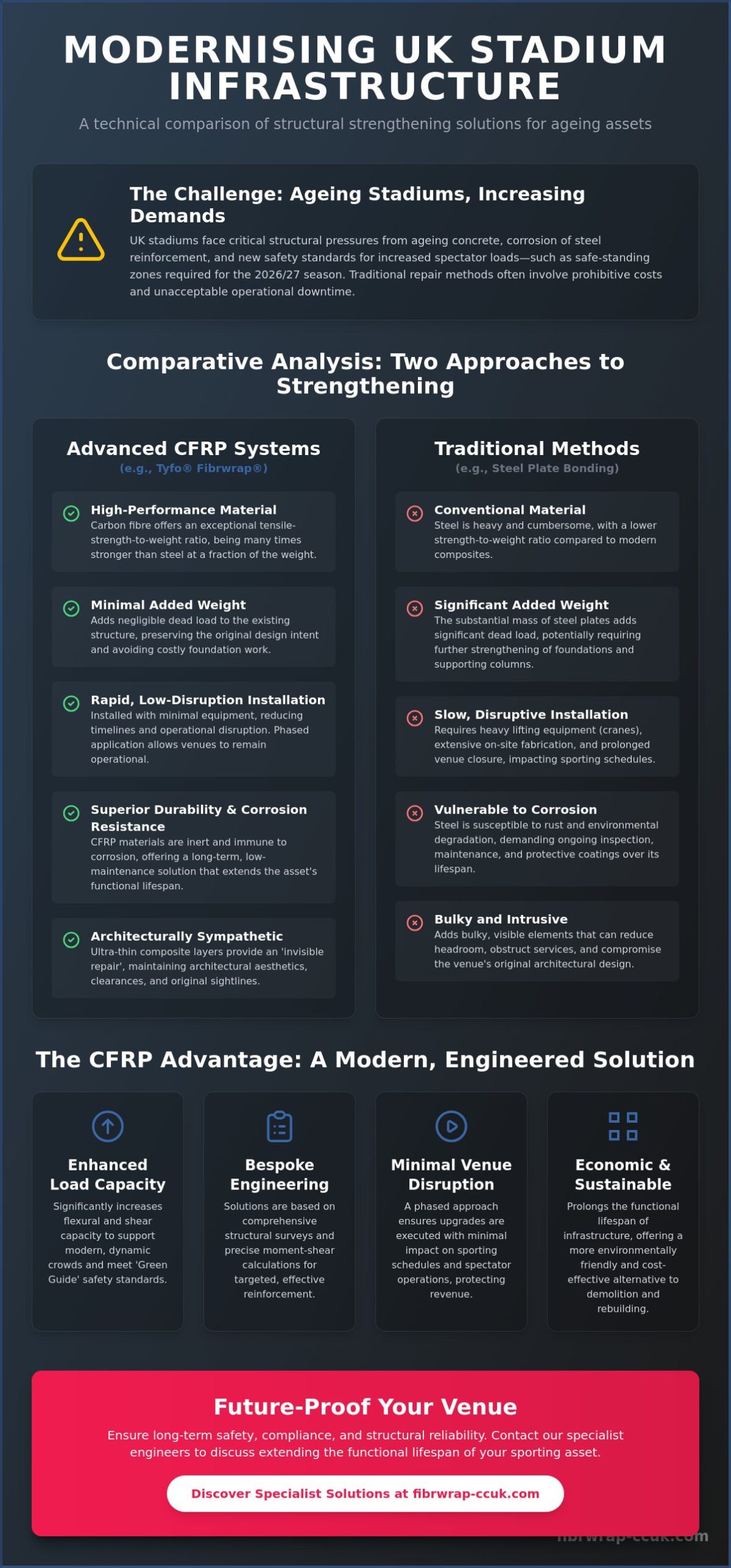
The selection of an appropriate methodology for stadium structural strengthening UK requires a disciplined evaluation of material performance, logistical constraints, and long-term asset utility. Historically, the industry has relied upon steel plate bonding or the addition of reinforced concrete jackets to address capacity deficits. Whilst these traditional techniques are well-understood, they introduce significant dead-load and require intrusive mechanical fixings that can inadvertently damage existing internal reinforcement. The adoption of advanced composite systems represents a move toward more sophisticated engineering, where the focus shifts from mass-based reinforcement to high-performance, low-profile alternatives that integrate seamlessly with the original substrate.
Logistically, the installation of structural steel in a stadium environment is often fraught with difficulty. The requirement for heavy lifting equipment and extensive temporary propping typically necessitates the total closure of affected stands, leading to substantial operational disruption. In contrast, Carbon Fibre Reinforced Polymer (CFRP) systems are hand-applied and flexible, allowing for installation in restricted-access areas without the need for welding or hot works. When considering the total cost of ownership, the initial material investment in composites is frequently offset by the drastic reduction in labour hours and the avoidance of revenue loss associated with venue downtime. This economic balance makes a compelling case for composite-led interventions in modern sporting infrastructure.
Weight and Structural Impact
The mass of a strengthening system is a critical variable, particularly when addressing upper-tier seating stands or cantilevered roof structures. Whilst structural steel plates add significant dead-load to a structure, CFRP systems provide equivalent strengthening at approximately 1/5th the weight. This reduction in added mass ensures that the original foundation capacity is not exceeded, often eliminating the need for secondary foundation stabilisation. The adhesive nature of the bond removes the requirement for mechanical anchors, preserving the integrity of the existing concrete and preventing the introduction of new pathways for moisture ingress and subsequent carbonation.
Operational Continuity
Ensuring that a venue remains functional during remediation is a primary concern for asset controllers. The application of Tyfo® Fibrwrap® allows for work to proceed in phases, enabling specific sections of a stand to be reinforced whilst adjacent areas remain open to the public. Because these systems are characterised by a rapid curing cycle, many structures can be returned to full service within 24-48 hours of application. This efficiency is further detailed in our technical overview of bespoke design solutions, which illustrates the methodical approach required to align engineering goals with match-day schedules. By prioritising materials that offer both speed and durability, specialists can extend the functional lifespan of national assets without the compromises inherent in traditional heavy engineering.
Engineering Rigour: Design and Installation Protocols for Sporting Venues
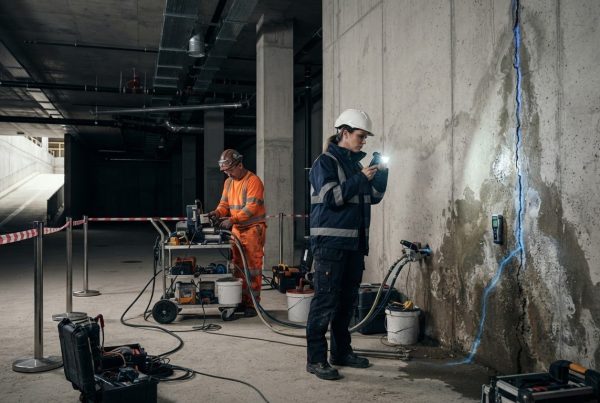
The efficacy of stadium structural strengthening UK is predicated upon a rigorous, design-led methodology that begins long before any material application occurs. A comprehensive feasibility study, supported by detailed Structural Surveys and Testing, is essential to quantify the extent of existing degradation and current load-bearing capacities. These surveys often involve carbonation analysis to determine the depth of concrete neutralisation and the subsequent risk to original steel reinforcement. By utilising this empirical data, engineers develop bespoke calculations that specify the precise volume and orientation of composite layers required to meet specific moment and shear demands. Adherence to Eurocode standards and relevant UK technical regulations ensures that every intervention is grounded in established structural principles and disciplined engineering rigour.
The Design-Led Approach
Specialist contractors must translate inspection data into robust technical specifications that address the unique geometry of the venue. Substrate preparation is the most critical phase of the installation; achieving the required bond strength is impossible without the methodical removal of laitance and the exposure of sound aggregate. During this phase, it’s often possible to integrate additional protective measures, such as Blast Mitigation Systems or Seismic Retrofitting, without significantly altering the project’s physical footprint. This holistic approach ensures that the asset is protected against a diverse range of structural threats through a single, coordinated intervention. For a more detailed look at these protocols, you can review our bespoke design solutions.
On-Site Installation Excellence
The physical application of Tyfo® Fibrwrap® requires strict environmental controls to ensure the integrity of the resin matrix. Technicians monitor ambient temperature and humidity levels throughout the saturation and curing process, as these variables directly influence the material’s final mechanical properties. Specialist teams, trained in the nuances of complex column wrapping and beam strengthening, execute the installation with surgical precision to avoid the introduction of air pockets or interlaminar defects. Post-installation quality control involves pull-off testing to verify the interlaminar bond and the adhesion to the concrete substrate, providing documented proof of structural enhancement. Long-term monitoring strategies are then established to provide venue owners with ongoing assurance of structural performance. To discuss the specific requirements of your infrastructure, we recommend contacting our technical department for a formal structural evaluation.
Specialist Contracting: Extending the Functional Lifespan of National Assets
The role of a specialist engineering contractor transcends the mere application of materials; it encompasses the disciplined stewardship of high-value national assets. CCUK positions itself as a guardian of UK infrastructure, utilising advanced engineering science to mitigate the risks associated with ageing sporting venues. Managing the complexities of a live-site stadium environment requires a methodical approach to logistics, where work schedules are precisely aligned with match-day operations to ensure zero impact on spectator safety or revenue generation. By implementing stadium structural strengthening UK through a phased, non-intrusive methodology, specialists provide a pathway to modernisation that bypasses the logistical and financial burdens of new-build construction.
Demolition is rarely the most efficient or responsible path for asset controllers facing structural challenges. The economic argument for life-extension is underscored by the avoidance of the massive capital expenditure required for total replacement. Beyond the financial considerations, the technical success of composite-led interventions provides an emotional atmosphere of absolute reliability for stakeholders. This professional sobriety ensures that every project is viewed through the lens of long-term security, where the primary objective is the preservation of structural utility through empirical evidence and engineering rigour. The result is a structure that meets modern performance requirements whilst retaining its historical and functional significance.
Sustainability and the Circular Economy
Preserving the existing concrete and steel skeleton of a stadium is a fundamental tenet of the circular economy within the construction sector. The environmental benefits of CFRP are significant, as the material’s extreme lightness results in lower transport-related emissions and minimal site waste compared to traditional cementitious over-cladding. By opting for targeted Structural Repairs and composite reinforcement, asset controllers can drastically reduce the embodied carbon footprint of their facility upgrades. This approach aligns technical capabilities with broader environmental goals, proving that structural life-extension is both an ecologically responsible and economically sound strategy for the 21st century.
Securing the Future of UK Stadiums
Proactive asset management is the only reliable method for preventing structural failure and ensuring the continued safety of the public. The long-term security provided by Tyfo® Fibrwrap® systems is verified by decades of global performance data, offering a level of reliability that traditional methods struggle to match. Understanding The Role of a Specialist Engineering Contractor is vital for any organisation tasked with the upkeep of large-scale sporting infrastructure. To ensure your venue remains compliant with evolving safety standards, we invite technical professionals to contact our engineering team for a feasibility study to determine the optimal strategy for your venue’s structural longevity.
Securing the Structural Integrity of Next-Generation Arenas
The modernisation of sporting infrastructure requires a transition from traditional, mass-heavy reinforcement to high-performance composite science. You’ve seen how Carbon Fibre Reinforced Polymer (CFRP) provides a lightweight and non-corrosive solution that drastically reduces operational downtime whilst meeting the stringent safety requirements of the Green Guide. Implementing stadium structural strengthening UK through these advanced systems ensures that existing concrete assets can safely accommodate increased dynamic loads without the need for intrusive demolition or expensive foundation upgrades. This methodical approach to life-extension aligns technical capabilities with the economic and environmental goals of the circular economy.
As the exclusive UK licensee for Tyfo® Fibrwrap® systems, CCUK brings over 10 years of specialist engineering expertise to the most complex infrastructure challenges. We provide a comprehensive design-and-install service that prioritises structural safety and long-term asset utility above all else. By grounding every intervention in empirical data and rigorous testing protocols, asset controllers can project competence and reliability to all stakeholders. We encourage you to take a proactive approach to your venue’s structural health by leveraging our proven engineering excellence. Request a technical consultation for your stadium project and ensure the long-term security of your infrastructure today.
Frequently Asked Questions
How long does CFRP structural strengthening last in a stadium environment?
Carbon Fibre Reinforced Polymer (CFRP) systems are engineered to match or exceed the remaining service life of the parent concrete structure, typically providing over fifty years of performance. Because these materials are inherently non-corrosive and resistant to chloride ingress, they don’t suffer the degradation common to traditional steel reinforcement. This longevity ensures that the structural enhancement remains effective throughout the extended functional lifespan of the asset.
Can stadium strengthening be performed whilst the venue remains operational?
Phased installation allows stadium structural strengthening UK to be executed whilst the venue remains operational, avoiding the total closures necessitated by traditional heavy engineering. The lightweight nature of the materials and rapid curing cycles of proprietary resins mean that specific sections can be returned to service within forty-eight hours. This flexibility is critical for maintaining match-day schedules and hospitality revenue during the remediation programme.
What are the fire performance ratings for Tyfo® Fibrwrap® systems?
Tyfo® Fibrwrap® systems achieve required fire resistance periods through the application of specialised intumescent coatings or cementitious topcoats tailored to the safety requirements of the venue. These protective layers are designed to maintain the structural integrity of the composite matrix for durations specified by UK building regulations, typically ranging from sixty to one hundred and twenty minutes. The specific fire protection strategy is determined during the bespoke design phase.
Is CFRP strengthening more cost-effective than traditional steel reinforcement?
CFRP is frequently more cost-effective than traditional steel reinforcement when the total expenditure, including site logistics and operational downtime, is evaluated. Whilst the raw material cost of carbon fibre is higher, the elimination of heavy lifting plant, welding, and extensive temporary propping results in significant labour savings. The reduction in venue closure time provides an additional economic advantage that often outweighs the initial material investment.
What types of stadium structural defects can be repaired using composites?
Composites are utilised to address a broad spectrum of structural deficiencies, including flexural and shear capacity deficits in beams, slabs, and columns. They are particularly effective for remediating damage caused by the corrosion of original steel reinforcement or for upgrading structures to meet modern load-bearing requirements. These systems are also employed for seismic retrofitting and the mitigation of dynamic vibration issues in tiered seating areas.
Do UK building regulations support the use of CFRP for stadium stands?
UK building regulations and Eurocode standards fully support the use of composite materials for stadium structural strengthening UK, provided the designs are executed by qualified specialists. Engineering calculations typically follow the rigorous guidelines set out in Concrete Society Technical Report 55 (TR55), which is the industry-standard reference for strengthening concrete structures. This ensures that all interventions meet the highest safety and performance benchmarks required for public infrastructure.
How does dynamic loading affect the choice of strengthening material?
The superior fatigue resistance of CFRP makes it uniquely suited to the high-frequency dynamic loading and spectator-induced vibrations characteristic of modern sporting arenas. Unlike steel, which can be susceptible to fatigue cracking under cyclic stress, carbon fibre maintains its mechanical properties over millions of load cycles. This material behaviour ensures that the strengthened elements provide predictable and consistent performance under the extreme conditions of a full-capacity crowd.
What is the typical lead time for a stadium structural survey and design?
The lead time for a comprehensive structural survey and bespoke design typically ranges from four to eight weeks, depending on the complexity of the asset. This period allows for the execution of non-destructive testing, material sampling, and the development of detailed engineering calculations tailored to the specific moment and shear requirements. A methodical approach during this phase is essential for ensuring the long-term success of the strengthening intervention.