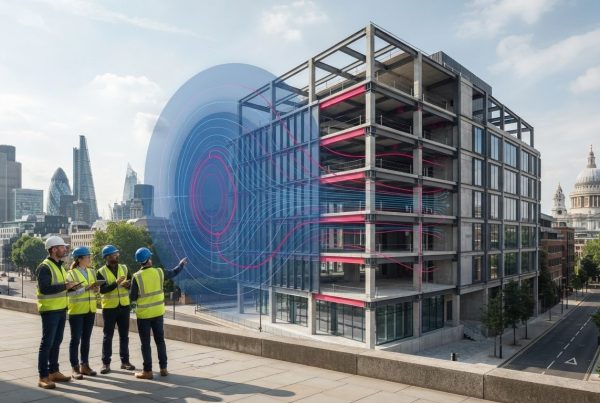

The most sustainable and fiscally responsible commercial asset isn’t the one currently being designed for the next decade, but the one already standing that’s engineered to last another fifty years. Within a regulatory environment defined by the stringent enforcement of the Building Safety Act 2022 and the impending October 2026 Building Safety Levy, the pressure on London’s asset controllers to maintain compliance whilst minimising operational disruption has never been more acute. Executing structural repair for commercial buildings London requires a departure from invasive traditional methods that displace tenants and inflate capital expenditure. It’s widely understood that total replacement is often a last resort that’s both environmentally and financially taxing.
This guide provides a technical analysis of how advanced composite technologies, such as Tyfo® Fibrwrap® systems and Carbon Fibre Reinforced Polymer (CFRP) strengthening, offer a non-intrusive path to certified engineering compliance and life-extension. We’ll examine the integration of bespoke structural design with modern material science to ensure your assets meet evolving UK building regulations without the need for total replacement. By prioritising the rehabilitation of existing reinforced concrete and masonry elements, the functional lifespan of essential infrastructure is prolonged through empirical evidence and engineering rigour.
Key Takeaways
- Understand the impact of London Clay and urban logistical constraints on the delivery of structural repair for commercial buildings London.
- Explore the application of Tyfo® Fibrwrap® and CFRP systems as high-performance, low-profile alternatives to invasive traditional steel plate bonding.
- Compare the structural footprint and lifecycle costs of traditional propping against advanced composite strengthening to optimise asset utility.
- Recognise the necessity of empirical site inspections and structural surveys in identifying latent defects and informing bespoke engineering designs.
- Assess the importance of proprietary system training and certified expertise when appointing specialist contractors for complex structural remediation projects.
Navigating the Challenges of Structural Repair for Commercial Buildings in London
London’s built environment presents a unique intersection of geological instability and dense urban morphology. The presence of London Clay, a highly over-consolidated and shrinkable soil, remains a primary catalyst for foundation movement that can propagate through the primary structural frames of high-occupancy assets. When executing structural repair for commercial buildings london, engineers must account for how these historic ground conditions interact with contemporary building materials. Managing the structural integrity of these assets often requires a specialist engineering contractor capable of navigating the complex interplay between geotechnical movement and superstructure stability. Under the full enforcement of the Building Safety Act 2022, the responsibility for maintaining a clear record of these interventions has become a legal necessity for asset controllers.
The logistical complexity of the capital’s central business districts often dictates the methodology of repair. Traditional invasive techniques are frequently incompatible with the requirements of high-density environments. Instead, a focus on empirical evidence and engineering rigour allows for the implementation of solutions that respect the building’s operational requirements whilst ensuring long-term safety. This approach ensures that structural repair for commercial buildings london is conducted with the precision required to satisfy both the Building Safety Regulator and the commercial needs of the property owners.
Urban Constraints and Site Logistics
Site access in the City or Canary Wharf often precludes the use of heavy-duty plant or traditional steel reinforcement methods. Effective remediation must be achieved within a minimal footprint to mitigate noise, dust, and vibration, ensuring that building occupancy remains viable throughout the project lifecycle. Temporary works design becomes a critical component of the remediation strategy, providing essential stability whilst permanent structural enhancements, such as Tyfo® Fibrwrap® or other composite systems, are applied. The objective is to deliver a solution that remains invisible to the tenant whilst providing the necessary load-bearing capacity.
Common Structural Defects in High-Density Assets
In London’s ageing commercial stock, reinforcement corrosion and carbonation in reinforced concrete frames are frequently observed. These defects often necessitate comprehensive Structural health monitoring to determine the rate of degradation before implementing concrete repair or masonry reinforcement. As building usage evolves, increased load requirements often exceed the original design parameters. This necessitates targeted strengthening that doesn’t compromise the existing floor-to-ceiling heights or architectural aesthetics. Identifying these latent defects early, such as lintel failure or masonry fatigue, is essential to prevent the escalation of costs and the potential for structural failure in high-risk buildings.
Advanced Carbon Fibre Reinforced Polymer (CFRP) and Tyfo® Fibrwrap® Systems
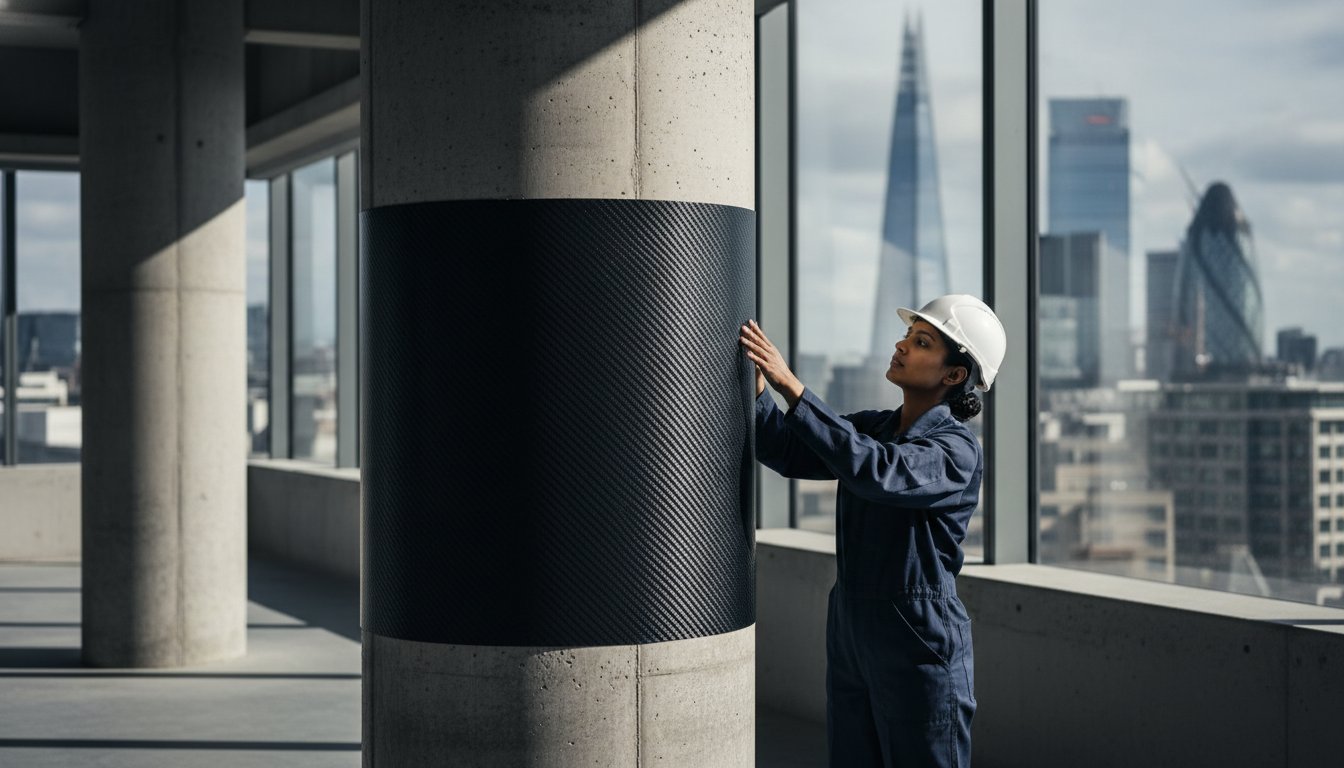
CFRP is a polymer matrix reinforced with carbon fibres for structural enhancement. For engineers tasked with structural repair for commercial buildings london, this material represents a significant advancement over traditional steel plate bonding. Whilst steel requires mechanical fixings and adds substantial dead load, Carbon Fibre Reinforced Polymer (CFRP) systems are bonded directly to the substrate with high-performance epoxy resins. The Tyfo® Fibrwrap® system, available exclusively through our UK licensee partnership, is a primary example of this technology. It allows for the rehabilitation of structural elements without the invasive propping or heavy machinery typical of conventional methods. Adherence to the Building Safety Act 2022 is streamlined when using materials with such documented performance and engineering rigour.
These composite materials integrate seamlessly with existing masonry and concrete substrates, restoring load-bearing capacity whilst maintaining the building’s original structural footprint. The application process involves saturated fabric layers that, once cured, form a high-strength jacket around the structural member. This method is particularly effective in London’s high-occupancy environments where the cost of downtime often exceeds the cost of the repair itself. By utilising these advanced materials, asset controllers can ensure the long-term security of their infrastructure with minimal disruption to daily operations.
Material Properties and Engineering Advantages
CFRP provides an exceptional strength-to-weight ratio that traditional structural steel cannot match. It’s inherently resistant to corrosion, making it ideal for the aggressive urban atmospheres found in London’s central districts where carbonation is a frequent concern. The versatility of hand-layup systems enables the strengthening of complex geometries, including tapered columns and irregular beams, that are often found in historic commercial frames. These systems are applied with minimal increase to the cross-sectional area of the structural member, preserving valuable internal space. This precision is essential for maintaining the commercial value of floor space in prime London locations.
Specialised Applications: Seismic and Blast Mitigation
Beyond standard load-bearing enhancement, advanced composites are essential for seismic retrofitting and blast mitigation in sensitive infrastructure. High-profile commercial assets in London often require enhanced ductility and energy absorption capacities to mitigate the risk of progressive collapse. When considering structural repair for commercial buildings london for high-risk assets, the ability to retrofit blast mitigation systems without altering the building’s aesthetic is a distinct advantage. Specialized fiber-wrap techniques allow engineers to increase the confinement of concrete columns, significantly improving their performance under extreme loading conditions. If you require a technical consultation on composite application, our engineering team can provide detailed feasibility assessments.
Evaluating Remediation Strategies: Traditional Repair vs. Composite Strengthening
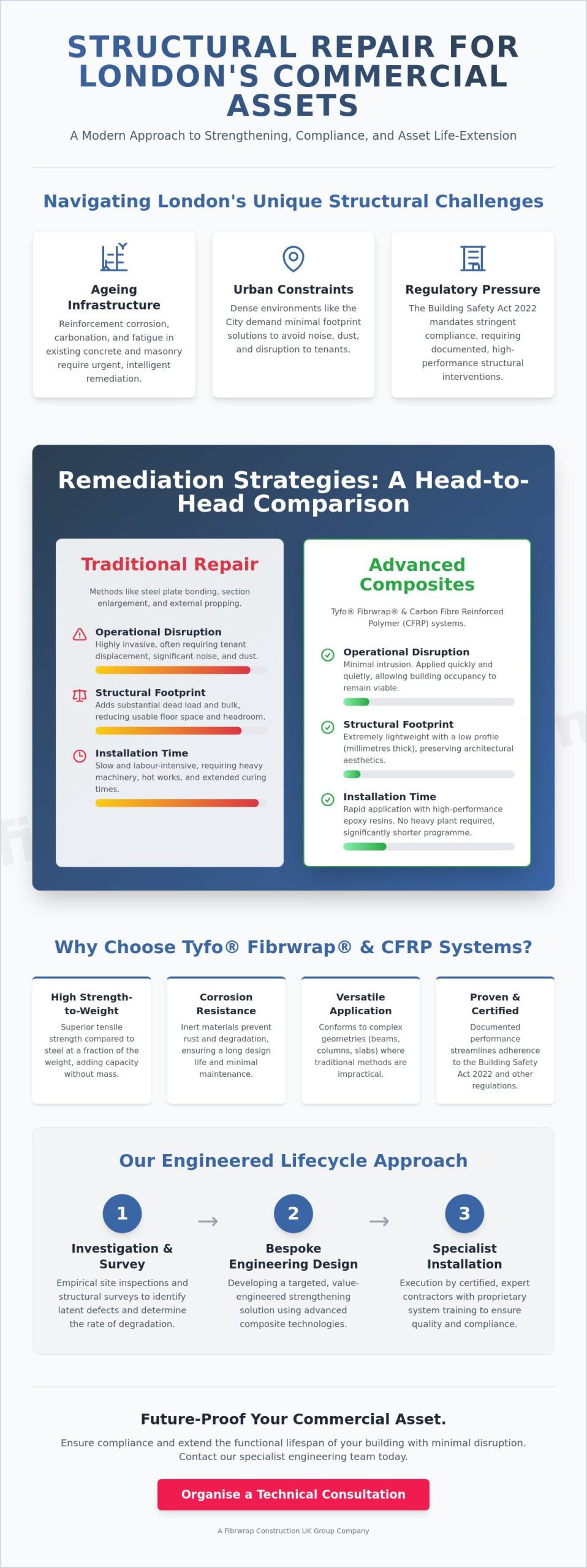
When determining the optimal methodology for structural repair for commercial buildings london, the selection typically lies between traditional mechanical reinforcement and advanced composite systems. Traditional steel plate bonding or the installation of Rolled Steel Joists (RSJs) often requires extensive propping and invasive temporary works that can compromise the building’s operational capacity. Conversely, Carbon Fibre Reinforced Polymer (CFRP) application offers a significantly reduced structural footprint, maintaining the original architectural profile of the asset. The design feature advantages of these systems are particularly evident in confined urban sites where space is at a premium and access for heavy plant is restricted.
Analysing the total cost of ownership reveals that whilst traditional repairs may appear cost-effective in the short term, the long-term asset life-extension provided by composites often yields superior economic returns. Compliance with the UK Building Safety Act necessitates a methodical approach to material selection and performance documentation. Composites reduce the risk of future remediation by providing a non-corrosive solution that maintains structural integrity over decades. The speed of application further distinguishes these materials, as the reduction in project timelines directly translates to lower preliminary costs and reduced site management overheads.
Operational Downtime and Economic Impact
The application of composite systems significantly reduces project timelines in London’s commercial centres compared to conventional steel-based interventions. Because CFRP is lightweight and applied using hand-layup techniques, the requirement for heavy lifting equipment or extensive site preparation is virtually eliminated. This is a critical consideration in premium commercial units where every square millimetre of floor space and centimetre of ceiling height is monetised. By avoiding the invasive nature of steel propping, structural repair for commercial buildings london can often be completed without the need for tenant relocation, preserving rental income and ensuring business continuity.
Structural Integrity and Longevity
Effective remediation must address the root cause of structural degradation, such as reinforcement oxidation or carbonation, rather than merely providing aesthetic patching. The long-term performance of concrete repairs is significantly enhanced when integrated with CFRP jacket systems, which provide additional confinement and load-carrying capacity. Unlike structural steel, which remains susceptible to corrosion and requires periodic maintenance or expensive protective coatings, composite materials are chemically inert. This durability ensures that the structural reinforcement remains effective over the asset’s extended lifespan, providing a stable and secure environment for occupants without the need for recurring maintenance cycles.
The Engineering Lifecycle: Design, Feasibility, and Structural Surveys
The transition from identifying a structural deficiency to executing a successful remediation project is governed by the quality of initial empirical data. For structural repair for commercial buildings london, the engineering lifecycle begins with a rigorous diagnostic phase that prioritises accuracy over speed. This phase is designed to uncover latent defects that are not visible to the naked eye, such as subsurface delamination or the chemical degradation of the concrete matrix. Structural surveys must precede any reinforcement design to ensure substrate compatibility. Without this foundational understanding, any subsequent intervention risks misalignment with the material properties of the existing host structure, potentially leading to bond failure or insufficient load-carrying capacity.
Data-driven feasibility studies are essential for determining the most appropriate material selection, whether that involves resin injection for leak sealing or full-scale CFRP jacket application. By establishing a baseline of structural health, engineers can design interventions that are proportionate to the level of risk and the desired extension of the asset’s lifespan. This methodical approach ensures that the primary goal of long-term security is achieved through disciplined science and engineering rigour.
Diagnostic Testing: Carbonation and Pull-off Tests
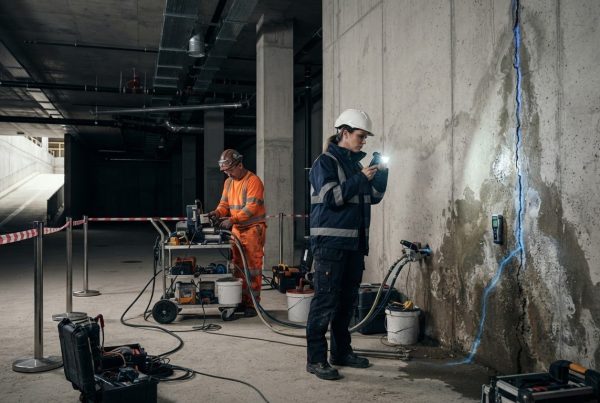
Carbonation testing is utilised to determine the alkalinity of the concrete; a reduction in pH levels often indicates that the protective passivity of the steel reinforcement has been compromised, leading to oxidation. Pull-off tests are similarly critical, as they verify the tensile strength of the substrate, ensuring that any subsequent composite application will achieve the necessary interfacial bond strength. Non-destructive testing (NDT) methods, including Ground Penetrating Radar (GPR) and ultrasonic pulse velocity testing, allow for the precise mapping of reinforcement density and the identification of internal voids. These methods provide a comprehensive map of the structure’s current state without the need for invasive or destructive sampling, which is particularly beneficial in live commercial environments.
Bespoke Design and Engineering Calculations
Once the diagnostic data is consolidated, it’s translated into bespoke engineering calculations that form the basis of the remediation strategy. These designs are developed to satisfy specific Eurocode requirements and UK building standards, ensuring that the remediation is both safe and legally compliant with the Building Safety Regulator’s expectations. For complex structural upgrades, Finite Element Analysis (FEA) is employed to model load distribution and predict the performance of the strengthened elements under various stress scenarios. We often collaborate with lead designers to integrate structural repairs into broader renovation programmes, ensuring that the life-extension strategy aligns with the asset’s future utility and load requirements. This methodical approach ensures that the final solution is tailored to the specific mechanical demands of the building.
To initiate a detailed site assessment and diagnostic survey, you can contact our technical department for professional engineering guidance.
Selecting a Specialist Engineering Contractor for National Infrastructure Projects
The appointment of a specialist engineering contractor is a prerequisite for projects involving advanced composite technology, as general contractors typically lack the proprietary training required for Tyfo® Fibrwrap® application. Structural repair for commercial buildings london involves high-stakes interventions where the margin for error in material preparation or substrate bonding is non-existent. Certified installation teams ensure that the polymer matrix is cured under precise environmental conditions, maintaining the performance standards established during the design phase. This level of technical specialisation provides asset controllers with the assurance that structural remediation will perform as intended throughout the building’s extended lifecycle.
Managing structural repair for commercial buildings london also requires a contractor capable of operating within the stringent health and safety frameworks of dense urban sites. This includes navigating the logistical constraints of high-occupancy buildings whilst ensuring that all works remain compliant with the Building Safety Regulator’s oversight. A specialist partner functions as a guardian of infrastructure, prioritising safety and empirical results over the expedited timelines often favoured by non-specialist firms. This disciplined approach is essential for maintaining the long-term security of national infrastructure assets.
This requirement for specialised expertise extends to all facets of building maintenance; for instance, ensuring the longevity of a commercial asset requires the technical proficiency of dedicated contractors such as Trenick Roofing for high-quality roof installation and replacement, which helps to safeguard the structural repairs conducted below.
Compliance with UK Building Regulations
Structural alterations must strictly adhere to Part A (Structure) of the UK Building Regulations, which governs the load-bearing capacity and stability of the building. For high-rise commercial assets, the fire performance of composite materials is a critical consideration. Specialist contractors provide the necessary third-party certification and technical documentation to validate that CFRP systems meet the required fire ratings and structural safety standards. This documentation forms a vital part of the “golden thread” of information, ensuring that every intervention is transparent, accountable, and legally compliant with evolving safety mandates; this level of professionalism is also required when asset managers explore Boiler Installation with CFS group Limited to enhance building performance.
Sustainability: Repair over Replacement
Aligning structural remediation with national sustainability and ESG goals is increasingly becoming a priority for London’s asset controllers. The carbon cost associated with the demolition and total replacement of reinforced concrete frames is substantial; by contrast, life-extension through composite strengthening significantly reduces the environmental footprint of an asset. Techniques such as masonry reinforcement allow for the stabilisation of historic facades and structural elements, preserving the architectural fabric of the city whilst upgrading its mechanical performance. Composites play a pivotal role in future-proofing buildings against climate-related structural stress, providing a durable solution that avoids the high-carbon expenditure of new construction. This focus on prolonging functional lifespan ensures that technical capabilities are harmonised with broader economic and environmental objectives.
Securing the Future of London’s Commercial Infrastructure
The rehabilitation of London’s commercial assets requires a shift from invasive demolition to sophisticated engineering remediation. We’ve explored how the integration of advanced Carbon Fibre Reinforced Polymer (CFRP) systems and rigorous diagnostic surveys allows for structural life-extension without compromising building occupancy. By addressing the specific geotechnical challenges of the capital and adhering to the requirements of the Building Safety Act, asset controllers can achieve long-term security. It’s clear that extending the utility of essential infrastructure through proven material science and empirical rigour is the most sustainable path forward for the capital’s built environment.
As the exclusive UK licensee for Tyfo® Fibrwrap® Systems, we provide a comprehensive design-to-installation service backed by over 10 years of specialist engineering expertise. Executing structural repair for commercial buildings london is a complex undertaking that demands a partner with a deep understanding of advanced composite performance. Contact our engineering team for a technical consultation to discuss your asset’s specific requirements. Protecting the integrity of the capital’s commercial stock is a vital commitment to both economic stability and long-term public safety.
Frequently Asked Questions
Is CFRP strengthening suitable for historic commercial buildings in London?
Carbon Fibre Reinforced Polymer (CFRP) is highly suitable for historic assets because its low-profile nature allows for structural enhancement without altering the architectural profile or internal floor-to-ceiling heights. Unlike traditional steel propping, these systems are bonded directly to the substrate; this ensures that the historic fabric of London’s skyline is preserved whilst meeting modern load requirements and safety standards.
How long does a typical structural repair project take for a commercial office block?
Project timelines for structural repair for commercial buildings london are frequently shorter than those involving traditional steelwork because composite systems require minimal site preparation and no heavy plant. Whilst the exact duration is dependent upon the scale of the remediation, the rapid curing times of epoxy resins and the ease of manual application allow for a methodical yet expedited construction programme that reduces overall preliminaries.
What are the signs that a commercial building requires structural remediation?
Visible indicators include longitudinal cracking, concrete spalling, and the exposure of oxidised reinforcement within the primary frame. More subtle signs such as floor slab deflection or masonry fatigue should be investigated through professional structural surveys and testing to identify latent defects before they compromise the building’s overall stability or lead to expensive emergency interventions.
Can structural strengthening be carried out whilst the building is still occupied?
Strengthening can be executed in occupied buildings because composite application involves minimal noise, dust, and vibration compared to invasive mechanical methods. The Tyfo® Fibrwrap® system is particularly advantageous in live environments as it requires a significantly smaller site footprint than traditional steel reinforcement, allowing tenants to continue their daily operations without the need for relocation or significant downtime.
How does the cost of CFRP compare to traditional steel reinforcement?
Whilst the initial material expenditure for CFRP may be higher than structural steel, the total project cost is often reduced due to lower labour requirements and shorter project durations. When evaluating the total cost of ownership, the absence of ongoing maintenance and the substantial extension of the asset’s functional lifespan provide significant economic advantages for commercial property owners and asset controllers.
What happens if concrete carbonation is left untreated in a commercial structure?
Untreated carbonation leads to a reduction in the concrete’s pH level, which eventually destroys the protective passivity of the internal steel reinforcement. This results in expansive oxidation, causing the concrete to spall and eventually leading to a loss of structural integrity that could necessitate more invasive and costly remediation if not addressed through professional concrete repair and cathodic protection.
Do composite strengthening systems require regular maintenance after installation?
Composite systems are inherently resistant to corrosion and do not require the periodic protective coatings or maintenance typically associated with structural steel elements. Once the installation is complete and the polymer matrix has cured, the system remains chemically inert; however, periodic visual inspections are recommended as part of a comprehensive structural health monitoring programme to ensure the long-term security of the asset.
Can Tyfo® Fibrwrap® be used for seismic retrofitting of older UK infrastructure?
Tyfo® Fibrwrap® is an effective solution for seismic retrofitting as it significantly enhances the ductility and confinement of existing concrete columns and masonry elements. This technology is increasingly used to future-proof older infrastructure against extreme loading scenarios, providing a high level of energy absorption that is critical for maintaining structural stability during seismic events without adding significant dead load to the building.