
The assumption that a facility must endure weeks of total operational cessation to facilitate a full slab replacement remains a costly misconception within the UK logistics sector. For many asset managers, the requirement for increasing floor load capacity in warehouse environments is often met with the daunting prospect of significant capital expenditure and prolonged downtime. We recognize that the financial implications of halting distribution, coupled with the uncertainty of existing structural integrity, create substantial barriers to facility optimization.
This guide demonstrates how advanced composite technology, specifically the Tyfo® system, allows for the structural strengthening of existing slabs without the necessity for invasive demolition. By utilizing carbon fibre reinforced polymers, engineers can achieve the required load-bearing specifications while maintaining strict compliance with UK building standards and Eurocode 2. You’ll gain a comprehensive understanding of how these bespoke engineering solutions facilitate asset life-extension, minimize business disruption, and provide a scientifically validated alternative to traditional reconstruction methods.
Key Takeaways
- Contrast dead loads and superimposed dead loads to establish a rigorous engineering baseline for assessing existing slab performance and structural safety.
- Discover advanced methodologies for increasing floor load capacity in warehouse facilities necessitated by the introduction of heavy automation or mezzanine structures.
- Evaluate the performance benefits of Carbon Fibre Reinforced Polymer (CFRP) over traditional slab thickening to achieve significant structural upgrades with minimal operational downtime.
- Examine the comprehensive remediation process, focusing on the transition from detailed asset inspection and structural testing to the implementation of bespoke engineering designs.
- Gain insight into the application of the Tyfo® Fibrwrap® system, a specialist solution designed to enhance both the flexural and shear capacity of reinforced concrete slabs.
Understanding Warehouse Floor Load Capacity: The Engineering Fundamentals
Floor load capacity is defined as the maximum weight a concrete slab can safely support before structural failure or unacceptable levels of deflection occur. This limit is determined by the compressive strength of the concrete, the reinforcement configuration, and the stability of the underlying sub-base. When considering the necessity of increasing floor load capacity in warehouse facilities, a precise audit of the current structural load must be conducted. This includes a distinction between dead loads, which represent the weight of the slab and the primary structure, and superimposed dead loads. The latter category encompasses permanent fixtures such as mezzanine floors, fire suppression systems, and fixed partitions that exert a constant force throughout the asset’s operational life.
Live loads represent the transient and fluctuating variables within the facility. These include stored inventory, palletised goods, and personnel movement. In the United Kingdom, the design and assessment of these capacities are strictly governed by the Building Regulations 2010, specifically Approved Document A, alongside Eurocode 2 (BS EN 1992) for concrete structures. These standards ensure that industrial floors are engineered to withstand the rigours of modern logistics without compromising the safety of the workforce or the integrity of the building envelope.
Beyond structural engineering, a truly safe warehouse environment relies on the preparedness of its people. Integrating regulated training from a multi-award-winning provider like JPF First Aid alongside these physical upgrades ensures that workforce safety remains a top priority during logistics expansion.
Static vs. Dynamic Loadings
Static loads are characterized by the constant pressure exerted by stationary equipment, most notably high-density racking systems and heavy machinery. These loads are predictable; however, they can cause long-term creep in the concrete if the slab wasn’t originally specified for such high concentrations of mass. Dynamic loads present a more complex challenge. These are generated by Material Handling Equipment (MHE), including forklifts and reach trucks. The vibrations and kinetic energy produced by moving vehicles, especially during rapid acceleration or heavy braking, place significantly higher stress on the slab than stationary weight. Because of these variables, dynamic loads require higher safety factors in structural calculations to prevent fatigue-induced cracking over time.
The Impact of Point Loads and Distributed Loads
A critical aspect of warehouse engineering is the distinction between a Uniformly Distributed Load (UDL) and a concentrated point load. While a UDL spreads weight evenly across a large surface area, point loads concentrate immense force through the small footprint of racking uprights or machinery feet. If the point load exceeds the slab’s punching shear resistance, localized failure can occur, leading to structural instability. Load path analysis is employed to trace how these forces are transferred from the racking through the slab and into the sub-grade. Identifying weak points in this path is the first step toward increasing floor load capacity in warehouse environments, ensuring that any structural remediation or carbon fibre reinforcement is applied where the stress concentration is highest.
Identifying the Need for Increased Structural Capacity
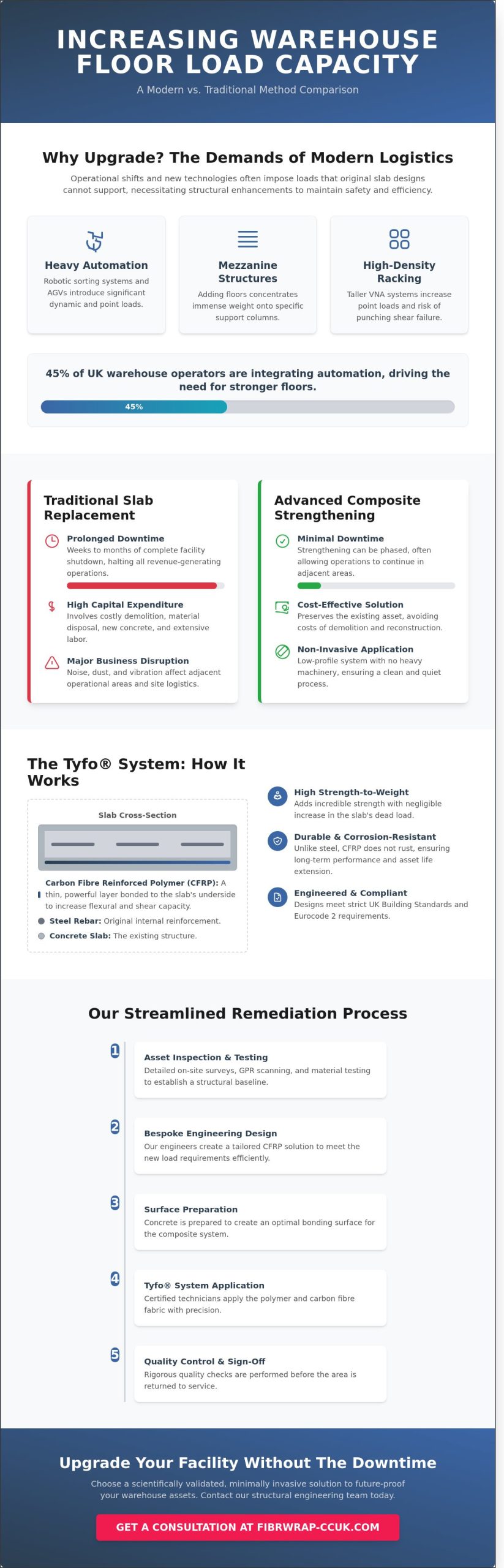
The requirement for **increasing floor load capacity in warehouse** environments often arises from a shift in operational strategy or the adoption of new logistics technologies. A 2023 industry report indicated that 45% of UK warehouse operators are currently integrating automation to combat rising labour costs. These upgrades, including the installation of heavy robotic sorting systems or high-density mezzanine levels, impose static and dynamic loads that original slab designs weren’t engineered to support. While floor strengthening is key, those planning new infrastructure can also benefit from pre-engineered solutions like those at bradberrysteel.com for robust steel building systems. When a facility transitions from general storage to a high-throughput distribution centre, the structural demands shift from distributed loads to intense point loads. Future-proofing these assets is essential to accommodate the next generation of AGVs (Automated Guided Vehicles) and AMRs (Autonomous Mobile Robots).
Assessing Current Slab Performance
Visual indicators of structural inadequacy are often the first signs that a slab is reaching its limit. In industrial environments, this manifests as longitudinal cracking, spalling at construction joints, or a visible “rocking” of slabs under forklift traffic. When racking heights are increased from standard 7-metre configurations to 15-metre VNA (Very Narrow Aisle) systems, the demand on the floor slab increases exponentially. Professional assessments must also consider the sub-grade quality. If the underlying soil exhibits poor compaction or moisture-related instability, the surface slab will suffer from excessive deflection regardless of its thickness.
The Consequences of Structural Overload
The progression of damage caused by structural overload typically begins with micro-cracking, which allows for moisture ingress and the subsequent corrosion of internal reinforcement. If these issues aren’t addressed through professional structural strengthening, the risk of catastrophic slab failure increases. Safety remains the primary concern for any asset manager. Adhering to the OSHA general requirements for storage is a fundamental step in ensuring that floor load limits are documented and never exceeded, protecting personnel from the risks of structural collapse.
Operating in an overloaded facility also carries significant legal and financial implications. Insurance premiums can rise, and liability in the event of an accident is absolute if load limits were ignored. Furthermore, uneven floors caused by slab deflection accelerate wear on material handling equipment, often increasing annual maintenance costs by 15% to 25%. To ensure long-term asset life-extension, a bespoke structural strengthening assessment from Composites Construction UK is crucial.
Traditional Methods vs. Advanced Composite Strengthening
Historically, increasing floor load capacity in warehouse environments relied on slab thickening or total replacement. Slab thickening involves casting a new reinforced concrete layer over the existing surface, which reduces clear internal height and adds substantial dead load to the foundation. Total replacement requires the complete demolition of the existing slab. This process is invasive and often necessitates a 28-day curing period for the concrete to reach its characteristic strength, stalling logistics operations for weeks or months. Civil engineers now recognise that these heavy-duty interventions aren’t always the most efficient path to structural integrity.
The introduction of Carbon Fibre Reinforced Polymer (CFRP) has transformed the approach to structural strengthening. Instead of adding mass, engineers use the Tyfo® system to enhance the slab’s internal resistance. This modern alternative utilizes advanced materials science to achieve high performance with minimal physical footprint. When comparing operational downtime, CFRP installations are completed in a fraction of the time required for traditional concrete works. A project that might take six weeks using traditional methods can often be finished in ten days using composite systems, allowing for a phased return to full operational capacity.
The Limitations of Traditional Slab Replacement
Traditional reconstruction carries a heavy environmental burden. Production of Portland cement accounts for approximately 8% of global CO2 emissions; therefore, the carbon footprint of a new 200mm slab is considerable. Business disruption is another critical factor. Excavation causes significant dust and noise pollution, which is incompatible with food-grade or pharmaceutical storage requirements. There’s also the technical challenge of integrating new slabs into existing structural frameworks. Improperly managed joints between old and new concrete often lead to differential settlement, creating long-term maintenance liabilities for asset managers.
The Advantages of CFRP Strengthening
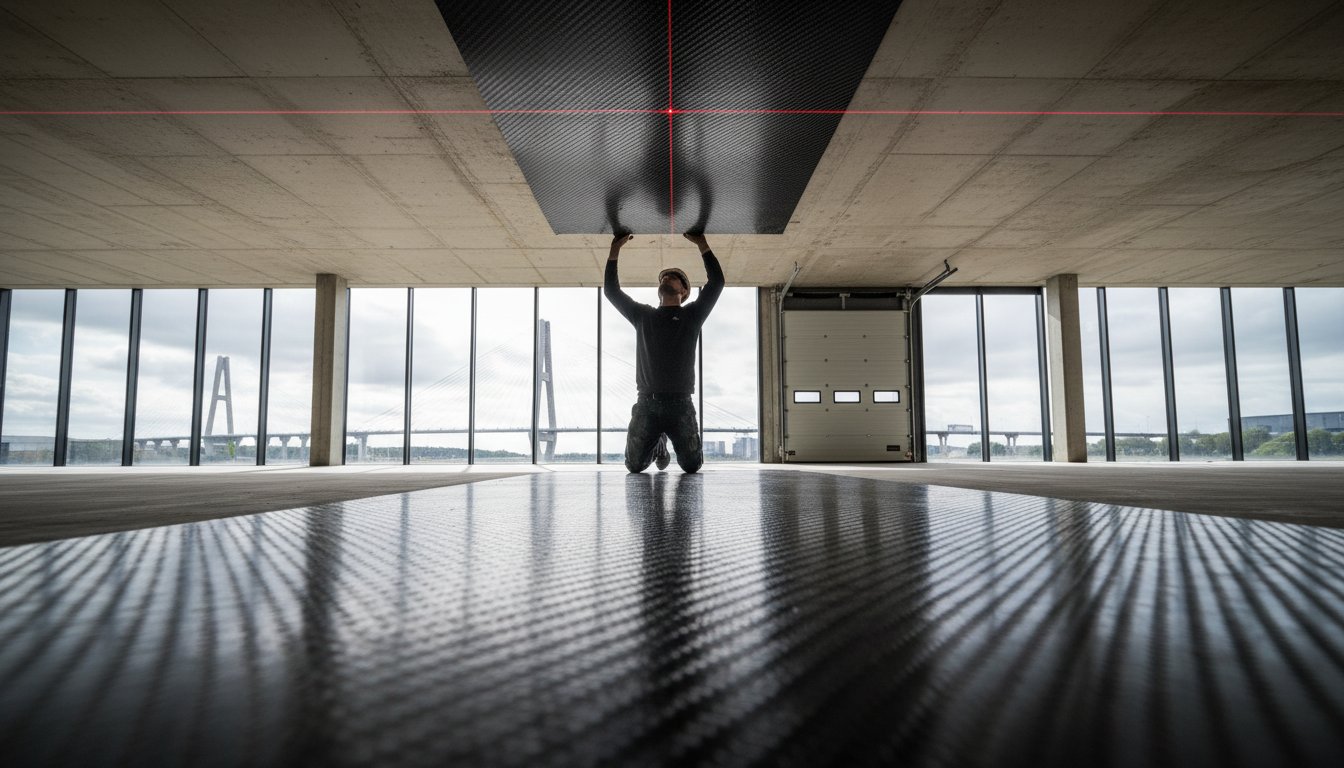
The Tyfo® system offers a sophisticated alternative through Carbon Fibre Reinforced Polymer technology. These composites provide a tensile strength significantly higher than steel while remaining exceptionally thin, often adding less than 5mm to the floor profile. It’s a non-intrusive application that maintains warehouse operations during installation. Structural strengthening is achieved by bonding CFRP strips or wraps to the slab, which adds negligible weight to the building’s overall load. This method allows for a bespoke design where specific high-stress zones, such as areas under heavy-duty racking uprights, are targeted with precision. Increasing floor load capacity in warehouse facilities through CFRP is now a primary strategy for asset life-extension in the UK, providing a cost-effective bridge between existing infrastructure and modern logistics demands.
The Structural Remediation Process: From Survey to Design
The process of increasing floor load capacity in warehouse environments begins with a rigorous diagnostic phase. Structural remediation is a precision-engineered process for asset life-extension. Before any strengthening measures are applied, the current state of the concrete slab must be quantified. This involves a series of non-destructive and semi-destructive tests to establish a baseline of structural integrity. A methodical approach ensures that the proposed solution addresses the specific deficiencies of the asset while meeting the increased performance demands of modern logistics operations.
Structural Surveys and Material Testing
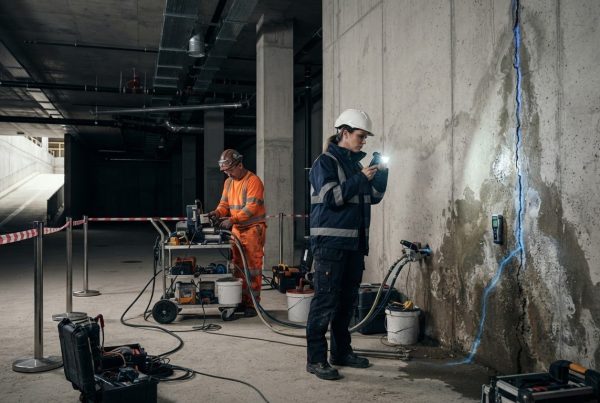
Carbonation testing is utilized to determine the depth of CO2 penetration, which can lower the pH of concrete and lead to the corrosion of internal steel reinforcement. Pull-off tests are simultaneously conducted to evaluate the tensile strength of the concrete surface; this ensures the substrate can provide the necessary bond for composite overlays. To map the internal geometry of the slab, ground penetrating radar (GPR) is employed. This technology identifies the exact location of existing rebar and detects sub-surface voids that might compromise the load-bearing capacity. These data points allow engineers to move beyond assumptions and base their designs on empirical evidence. It’s a level of detail that prevents unforeseen failures during the installation phase.
Bespoke Design and Engineering Calculations
Once the survey data is analyzed, a feasibility study dictates the optimal configuration for the Tyfo® system. Design engineers develop tailored reinforcement patterns that address the specific shear and flexural requirements of the facility. A critical component of this phase is ensuring the chemical and mechanical compatibility between the carbon fibre reinforced polymers (CFRP) and the existing concrete. It’s essential that the thermal expansion coefficients and modulus of elasticity are aligned to prevent delamination under cyclic loading.
All calculations are performed in strict adherence to Technical Report 55 (TR55), which provides the UK standard for the design of composite strengthening. This ensures that the increased load demands, whether from high-density racking or heavy automated machinery, are safely distributed. The resulting design is not a generic application but a bespoke structural solution. Quality assurance remains central to the installation phase. Every layer of the Tyfo® system is monitored for environmental conditions, such as dew point and ambient temperature, to guarantee optimal curing. This disciplined approach ensures that the structural strengthening provides long-term reliability for the asset owner.
For expert guidance on increasing floor load capacity in warehouse facilities, contact our technical team to discuss your specific project requirements.
The Tyfo® Fibrwrap® System: A Specialist Solution
As the exclusive UK licensee for the Tyfo® Fibrwrap® system, Composites Construction UK provides clients with direct access to world-leading composite technology. This system is engineered specifically for the structural strengthening of existing infrastructure, providing a non-invasive method for increasing floor load capacity in warehouse facilities. By utilizing high-strength carbon fibre reinforced polymers (CFRP), the flexural and shear capacity of floor slabs is significantly enhanced without the need for traditional, intrusive reinforcement methods.
The sustainability benefits of this approach are substantial. It’s often possible to avoid the carbon-intensive process of demolition and new material consumption by reinforcing the current structure. This asset life-extension strategy aligns with modern environmental targets, reducing the total volume of concrete and steel required for facility upgrades. The system’s performance has been validated across critical infrastructure and high-load industrial environments globally, ensuring that structural integrity is maintained under increased operational demands.
Why Tyfo® Fibrwrap® is the Industry Standard
The Tyfo® Fibrwrap® system is supported by over 30 years of comprehensive testing data and established long-term durability profiles. Its versatility allows for the simultaneous reinforcement of beams, columns, and slabs within a single, cohesive system. This integrated approach ensures that load paths are managed effectively across the entire structural frame. Because the application of composite materials requires precise environmental controls and surface preparation, it’s essential to use a specialist engineering contractor for installation. Proper execution ensures the bond between the CFRP and the substrate meets the rigorous standards required for industrial safety.
Case Studies in Warehouse Capacity Upgrades
Real-world applications in the UK demonstrate the quantifiable impact of this technology. In a 2021 project for a major logistics hub, the system was deployed to increase the point load capacity of a reinforced concrete slab by 35%. This allowed for the installation of high-density racking systems that the original floor wasn’t designed to support. Another 2023 project involved a 25% increase in shear capacity for a mezzanine floor, enabling the safe operation of automated guided vehicles (AGVs). These results were achieved without the need for structural replacement.
- 35% increase in point load capacity for heavy racking systems.
- 25% enhancement in shear capacity for mezzanine-based automated machinery.
- Zero operational downtime achieved during the application phase.
Structural remediation through composite technology offers a reliable path for businesses looking to scale their operations within existing footprints. For a detailed assessment of your facility’s potential, contact Composites Construction UK for a bespoke structural survey to determine the most effective strengthening strategy.
Securing Asset Integrity through Advanced Structural Remediation
Ensuring the long-term viability of industrial infrastructure requires a methodical approach to structural remediation. While traditional methods often necessitate significant operational downtime, the application of advanced carbon fibre reinforced polymers provides a sophisticated alternative for increasing floor load capacity in warehouse facilities. By utilizing the high tensile properties of the Tyfo® Fibrwrap® system, structural enhancement is achieved with minimal impact on the existing building footprint.
As the exclusive UK licensee for Tyfo® Fibrwrap® Systems, Fibrwrap Construction UK provides over 10 years of specialist structural strengthening experience. A comprehensive design, supply, and installation service is delivered to ensure every project meets rigorous engineering standards and safety protocols. This expert-led approach prioritizes asset life-extension, allowing for the continued safe use of essential infrastructure under increased loading conditions.
To determine the most effective strategy for your facility, consult our specialist engineers for a bespoke strengthening solution. It’s the most reliable way to guarantee the performance and safety of your warehouse floor for years to come.
Frequently Asked Questions
How much can CFRP increase a warehouse floor load capacity?
Carbon Fibre Reinforced Polymer (CFRP) systems typically provide an increase in load-bearing capacity ranging from 20% to 40% for existing concrete slabs. By utilizing the proprietary Tyfo® system, structural strengthening is achieved through high-tensile carbon fibres bonded directly to the substrate. This technical intervention allows for the accommodation of heavier racking loads or specialized machinery without the need for costly and disruptive total floor replacement.
Will my warehouse need to close during the strengthening process?
Total facility closure isn’t required as the installation of composite systems is non-intrusive and rapid. Phased implementation allows operations to continue in 50% of the floor space while the remaining area undergoes structural remediation. Because the materials are lightweight and require minimal heavy equipment, the operational impact is significantly reduced compared to traditional steel or concrete jacketing methods that often halt production for weeks.
How long does carbon fibre structural strengthening last?
Carbon fibre structural strengthening is designed to match or exceed the remaining service life of the asset, often surpassing 50 years in industrial settings. These materials are inherently resistant to corrosion and chemical degradation, which ensures long-term integrity even in harsh environments. Once the Tyfo® system is installed, it requires minimal maintenance while providing a permanent enhancement to the warehouse floor’s overall performance and safety.
Is CFRP strengthening compliant with UK building regulations?
Compliance with UK Building Regulations is maintained through strict adherence to Concrete Society Technical Report 55 (TR55) and BS EN 1504 standards. These guidelines govern the design and application of composites in the UK construction industry. Every project is engineered to meet specific safety factors, ensuring that increasing floor load capacity in warehouse environments aligns with established structural safety protocols and local planning requirements.
Can composite systems fix existing cracks in the warehouse floor?
Composite systems effectively bridge and stabilize existing cracks, though structural resin injection is typically performed first to restore the floor’s monolithic integrity. By applying carbon fibre wraps over the repaired fissures, the tensile stress is redistributed across a wider area of the slab. This prevents further propagation of cracks caused by dynamic loading or thermal movement, ensuring the floor remains durable under heavy usage.
What is the difference between a structural survey and a floor flatness survey?
A structural survey evaluates the load-bearing integrity and reinforcement of the slab, whereas a floor flatness survey measures surface regularity against TR34 standards. While flatness is critical for high-reach forklift stability and safety, structural assessments determine if the floor can support the actual weight of the racks. Both are essential data points when considering the process of increasing floor load capacity in warehouse facilities.
How do I know if my warehouse floor needs strengthening or just repair?
Strengthening is required when the intended operational load exceeds the original design capacity, such as upgrading from 30kN/m² to 45kN/m². If the issue is limited to surface spalling or joint failure without a change in use, localized repair is usually sufficient. A comprehensive structural audit identifies whether the internal reinforcement is adequate for the projected stresses of new, high-density inventory systems.
Are there specific fire rating requirements for CFRP in warehouses?
Fire performance for CFRP is managed through the application of specialized intumescent coatings that meet Class 0 or Class 1 requirements under BS 476. These protective layers insulate the epoxy resin from high temperatures, ensuring the structural strengthening remains effective during a fire event. The specific rating required depends on the building’s use category and the proximity of the strengthening to designated fire escape routes.