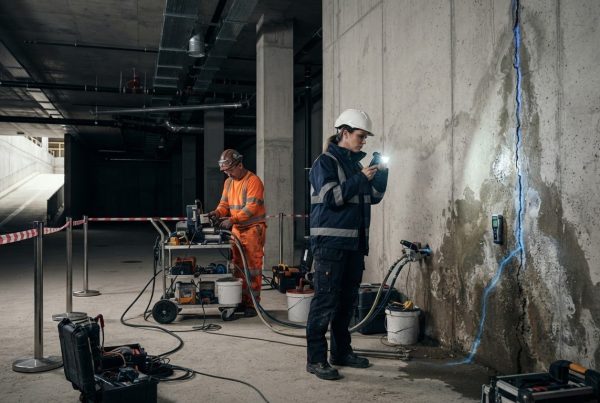


How many of the UK’s mid-century concrete frames are silently approaching a state of critical material fatigue while hidden behind modern facades? With the National Audit Office reporting in June 2023 that approximately 700,000 pupils attend schools requiring major refurbishment, the urgency for a rigorous structural assessment of aging buildings UK has never been more acute. You’re likely managing the dual pressures of stringent Building Safety Act 2022 compliance and the technical difficulty of quantifying the remaining service life of reinforced concrete and masonry assets. It’s a challenging environment where the fear of unforeseen structural failure is compounded by the need for sustainable, cost-effective management of existing infrastructure.
This professional guide offers an authoritative roadmap through the multi-staged forensic process of structural investigation, focusing on empirical data collection and risk mitigation. You’ll gain a clear understanding of how advanced methodologies, including the application of carbon fibre reinforced polymers, facilitate asset life-extension without the necessity for total reconstruction. We’ll explore the transition from intrusive site surveys to the implementation of bespoke structural strengthening solutions that ensure long-term security and regulatory adherence.
Key Takeaways
- Understand the rigorous, multi-staged forensic methodology required for a professional structural assessment of aging buildings UK, beginning with a critical desk study to evaluate historical context and load-bearing integrity.
- Identify the specific environmental and chemical stressors affecting domestic infrastructure, including the mechanisms behind carbonation, chloride attack, and the degradation of Reinforced Autoclaved Aerated Concrete (RAAC).
- Explore how advanced Non-Destructive Evaluation (NDE) techniques facilitate the transition from qualitative observation to precise quantitative data, ensuring all engineering calculations are grounded in empirical evidence.
- Evaluate the strategic shift from traditional repair methods to advanced composite solutions, such as the Tyfo® system, to achieve sustainable asset life-extension and enhanced structural strengthening.
- Gain professional insights into the bespoke design solutions required to ensure safety compliance and long-term security for complex Victorian masonry and mid-century reinforced concrete assets.
The Critical Importance of Structural Assessments for Aging UK Infrastructure
A structural assessment of aging buildings UK is defined as a systematic evaluation conducted by a chartered structural engineer to determine the integrity, safety, and load-bearing capacity of an existing structure. Within the United Kingdom, the diverse nature of the building stock presents multifaceted challenges that require specialized engineering knowledge. This includes the inherent vulnerabilities of Victorian-era masonry, the carbonation and chloride ingress found in mid-century reinforced concrete, and the more recent concerns surrounding Reinforced Autoclaved Aerated Concrete (RAAC). By late 2023, the identification of RAAC in over 230 educational settings underscored the volatility of aging assets and the necessity for rigorous, empirical data to ensure public safety.
The economic rationale for these evaluations is grounded in the prevention of prohibitive remediation costs. Early diagnostic assessments allow for the identification of latent defects before they manifest as critical failures. When structural issues are detected in their infancy, the required interventions are often less invasive and significantly more cost-effective than emergency stabilization measures. Implementing a structural assessment of aging buildings UK provides asset managers with the technical foundation needed to transition from reactive maintenance to a model of planned, predictive care.
Beyond immediate maintenance savings, companies undertaking complex engineering investigations may also benefit from government-backed financial incentives. Recoup Capital specializes in helping UK firms navigate R&D tax credits and corporate finance, ensuring that the costs of technical innovation and structural assessments are properly managed.
The Legal Framework and Statutory Requirements
The Building Safety Act 2022 has introduced a transformative regulatory landscape, particularly for ‘higher-risk’ buildings defined as those exceeding 18 metres or seven storeys. Under this legislation, the ‘Responsible Body’ or Accountable Person is legally mandated to ensure the building is structurally sound. This duty aligns with the Health and Safety at Work Act 1974, which requires the maintenance of assets to prevent structural integrity and failure. The Building Safety Regulator now provides stringent oversight, ensuring that structural assessments are treated as essential statutory obligations rather than optional maintenance tasks.
The Concept of Asset Life-Extension
Asset life-extension is the strategic application of engineering to exceed the original design life of a structure. By moving beyond simple repair towards proactive structural strengthening, engineers can utilize advanced materials like the Tyfo® system to restore and enhance load-bearing capacities. This approach offers substantial environmental benefits, as rehabilitating existing infrastructure significantly reduces the embodied carbon associated with demolition and new construction. Through comprehensive remediation, the longevity of essential assets is secured, aligning technical performance with broader sustainability goals and economic efficiency.
A Staged Methodology for Comprehensive Structural Investigations
A professional structural assessment of aging buildings UK must be executed through a disciplined, forensic sequence. This methodology ensures data integrity while maintaining cost-efficiency for the asset owner. Rather than commencing with invasive measures, a tiered approach allows for the gradual escalation of investigative intensity based on empirical findings. It’s a process that moves from the known to the unknown, ensuring that every physical test is justified by preliminary data. The role of the Chartered Structural Engineer is central here, as they must synthesize complex field data into an actionable engineering report that prioritizes long-term safety and asset life-extension.
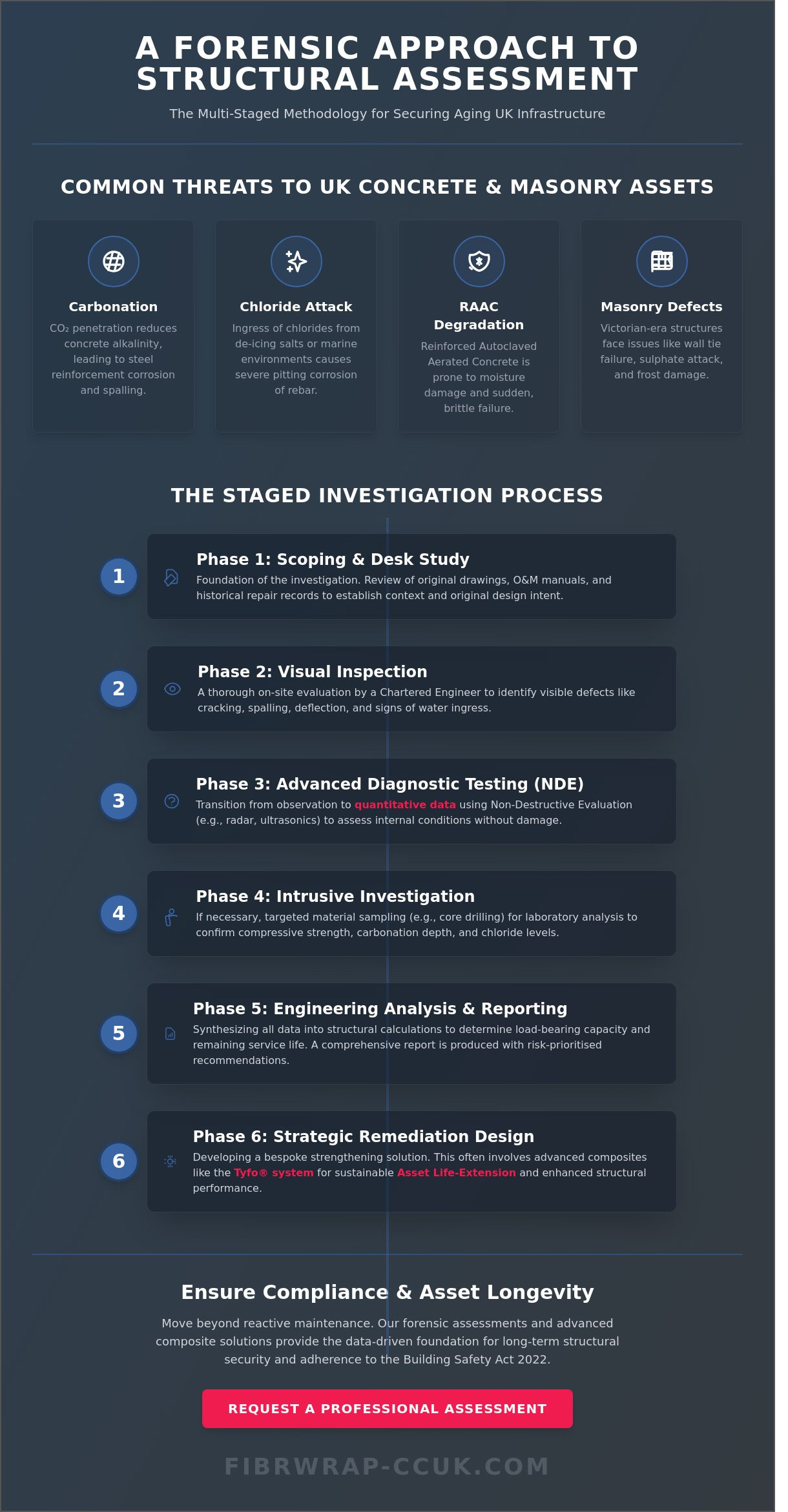
Phase 1 & 2: Scoping, Desk Study, and Preliminary Site Visit
The foundation of any robust investigation lies in the Desk Study. Engineers review original architectural drawings, Operations and Maintenance (O&M) manuals, and historical repair records to establish a baseline of the building’s evolution. Identification of critical load paths and high-stress zones is conducted during this phase to inform the on-site strategy. Adhering to UK government guidance on structural assessments ensures that the commissioning process meets rigorous professional standards. A preliminary walk-through follows, where immediate red flags such as severe masonry cracking or significant deflection are documented. This stage prioritizes the detection of urgent defects where remedial intervention is required to ensure immediate structural integrity.
Phase 3 & 4: Detailed Visual Inspection and Physical Testing
When surface observations prove insufficient, the investigation transitions from visual mapping to intrusive sampling. Systematic defect mapping utilizes industry-standard notation to record the extent of carbonation, chloride ingress, or reinforcement corrosion. Stage 4 sampling involves core drilling and the exposure of reinforcement bars to determine the residual capacity of the concrete. Chemical analysis of these samples provides the empirical data needed to calculate degradation rates. Accessing high-rise assets or complex bridge soffits often requires specialized equipment, including:
- Mobile Elevated Work Platforms (MEWPs) for rapid facade access.
- Fixed scaffolding for long-term, intensive intrusive works.
- Industrial rope access for high-tensile structures or confined spaces.
- Non-destructive testing (NDT) such as GPR to map internal reinforcement without damage.
The data gathered during a structural assessment of aging buildings UK allows engineers to design bespoke remediation plans. This often involves structural strengthening using advanced materials to restore or enhance load-bearing capacities. By utilizing the proprietary Tyfo® system, the longevity of the structure is secured through scientifically proven reinforcement methods that avoid the need for full asset replacement. This methodical transition from desk-based theory to physical evidence ensures that every engineering decision is grounded in technical reality.
Identifying Prevalent Structural Defects in Historical and 20th-Century UK Buildings
UK assets are subject to aggressive environmental stressors, including high relative humidity and residual industrial atmospheric pollutants. These factors catalyze the chemical degradation of building fabrics over decades. When conducting a structural assessment of aging buildings UK, engineers must account for the 19th-century legacy of coal combustion and its impact on masonry porosity. The interaction between moisture and legacy pollutants often leads to sulphate attack, which compromises the bond strength of traditional lime-based mortars.
Concrete Carbonation and Reinforcement Corrosion
Atmospheric carbon dioxide penetrates the concrete matrix through interconnected pores, reacting with calcium hydroxide to form calcium carbonate. This process reduces the alkalinity of the concrete, typically dropping the pH from 12.5 to below 9.0. Once this threshold is crossed, the protective passivity layer on embedded steel reinforcement is compromised. The resulting oxidation leads to the formation of ferric oxide, which expands to approximately six times the original volume of the steel. This internal expansion generates significant tensile stresses, manifesting as longitudinal cracking and eventual spalling of the concrete cover. Distinguishing between superficial surface weathering and deep-seated structural decay requires precise carbonation depth testing and half-cell potential mapping to ensure the asset’s long-term integrity.
Structural Instability in Unreinforced Masonry
Historical UK masonry often lacks modern lateral restraint mechanisms, leading to characteristic bowing or leaning in elevations. These instabilities are frequently exacerbated by the corrosion of internal wall ties or the historical removal of internal partitions. The official UK government guidance on structural assessments highlights the necessity of evaluating how previous modifications impact load distribution. Bed joint erosion, often caused by the use of inappropriate cement-rich mortars in repointing, restricts the natural moisture movement of softer Victorian bricks. Failed lintels and the subsequent arching action within the brickwork can redistribute loads onto window frames, necessitating a detailed structural assessment of aging buildings UK to determine if the Tyfo® system or other composite reinforcement is required for remediation.
Foundation issues represent a final, critical category of defect, particularly within the South East where highly plastic clay soils are prevalent. The technical challenges include:
- Subsidence: Significant volume changes in clay soils during seasonal moisture fluctuations lead to differential settlement.
- Changing Water Tables: Urban development or altered drainage patterns can shift the ground’s bearing capacity, destabilizing foundations designed for static conditions.
- Historical Industrial Pollution: Chemical contaminants in brownfield sites can aggressively attack concrete footings, leading to ‘concrete cancer’ or alkali-silica reaction (ASR).
Remediation strategies must prioritize the sustainability of repair over total replacement. By utilizing advanced carbon fibre reinforced polymers, engineers can extend the service life of these essential assets while maintaining the architectural heritage of the United Kingdom’s built environment.
Advanced Diagnostic Testing and Non-Destructive Evaluation (NDE)
The structural assessment of aging buildings UK requires a transition from subjective visual inspection to the acquisition of high-fidelity, quantitative data. This empirical approach is fundamental for the execution of modern engineering calculations, ensuring that remedial designs are based on the actual residual capacity of the material. By utilizing sophisticated diagnostic tools, engineers can evaluate the internal condition of a structure without compromising its existing integrity. This shift from qualitative observation to data-driven analysis allows for the precise determination of an asset’s remaining service life and the identification of specific failure modes that visual surveys might overlook.
Non-Destructive Testing (NDT) Techniques
Non-destructive evaluation (NDE) facilitates the mapping of internal geometries and the identification of latent defects within the concrete or masonry matrix. Cover meter surveys are deployed to determine the precise location and depth of steel reinforcement bars, which is critical for verifying compliance with historical design standards and modern safety requirements. Ultrasonic Pulse Velocity (UPV) and Ground Penetrating Radar (GPR) are utilized to detect internal voids, honeycombing, or delamination that could compromise load-path continuity.
- Cover meter surveys: These map the depth and orientation of reinforcement, allowing for accurate calculations of effective depth in flexural members.
- GPR and UPV: These tools identify subsurface anomalies and voids, providing a non-invasive look at the density and homogeneity of the material.
- Half-cell potential mapping: This technique identifies active corrosion sites by measuring the electrochemical potential of the steel reinforcement. It’s an essential tool for detecting oxidation processes before physical manifestations, such as cracking or spalling, become visible to the naked eye.
Chemical and Intrusive Analysis
While NDT provides a broad overview, chemical analysis is essential for determining the chemical health of reinforced concrete elements. Carbonation depth testing is performed using a phenolphthalein indicator on freshly exposed surfaces; a lack of color change indicates the extent to which atmospheric carbon dioxide has neutralized the alkaline environment that protects the steel. Chloride ion content analysis is similarly vital for UK infrastructure exposed to marine environments or de-icing salts, as it assesses the risk of localized pitting corrosion.
To ensure the efficacy of asset life-extension strategies, pull-off testing is conducted to measure the tensile strength of the concrete substrate. This data is mandatory when designing structural strengthening systems, particularly when specifying the Tyfo® system. The bond strength of the substrate must be verified to ensure that carbon fibre reinforced polymers (CFRP) can effectively transfer loads and provide the required seismic or structural enhancement. These tests collectively move the assessment from guesswork to a disciplined, scientific verification of structural health.
Strategic Remediation: Transitioning from Assessment to Asset Life-Extension
Once the structural assessment of aging buildings UK is finalized, the engineering focus transitions from diagnostics to the implementation of bespoke remediation strategies. Traditional methodologies, including steel plate bonding and concrete section enlargement, are frequently discarded due to the significant dead loads they impose and the extensive site preparation required. Advanced composite solutions facilitate structural strengthening without compromising the existing footprint or the architectural integrity of the asset. These engineered systems provide a pathway for asset life-extension that avoids the high carbon costs and capital expenditure associated with full-scale demolition.
The Role of CFRP in Structural Strengthening
Carbon Fibre Reinforced Polymer (CFRP) provides a tensile strength that is typically ten times greater than that of conventional steel, yet it maintains a fraction of the weight. This exceptional strength-to-weight ratio allows for the enhancement of load capacity in beams and floor slabs without necessitating additional foundation reinforcement. The Tyfo® Fibrwrap® system is particularly effective in this regard, offering a lightweight, non-corrosive alternative to traditional repairs. Its versatility is demonstrated through its application in wrapping columns for confinement, strengthening beams for flexure, and reinforcing floor slabs to accommodate increased live loads. For projects involving the installation of new flooring systems alongside structural upgrades, you can learn more about Powerpillar Ltd and their comprehensive guide to beam and block solutions. For operational environments, such as commercial hubs in London or industrial facilities in the North West, composite systems are preferred because they minimize disruption. Installations are often completed without the need for heavy machinery or the hazardous hot works associated with steel welding.
Developing a Bespoke Strengthening Strategy
Effective remediation requires the seamless integration of data derived from the structural assessment of aging buildings UK into precise engineering calculations. The design of CFRP systems is tailored to address specific structural deficiencies, whether they involve shear enhancement, flexural strengthening, or seismic retrofitting. A holistic approach is essential for ensuring long-term integrity; this often includes the use of low-viscosity resin injection to treat existing masonry or concrete cracks before the composite application. In environments where steel reinforcement has already begun to oxidize, the integration of cathodic protection systems may be required to arrest further degradation. The application of the Tyfo® Fibrwrap® system must be executed by specialized contractors who understand the nuances of resin-to-substrate bonding. This disciplined approach ensures that the structural remediation provides a permanent, maintenance-free solution that secures the asset for several decades of continued use.
Securing Infrastructure Longevity Through Technical Rigour
Maintaining the structural integrity of the UK’s built environment requires more than a visual inspection; it demands a data-driven approach rooted in advanced diagnostic testing. By identifying latent defects like reinforcement corrosion or carbonation early, asset managers can implement targeted remediation strategies that prioritise asset life-extension over costly demolition. A comprehensive structural assessment of aging buildings UK provides the empirical baseline necessary for these critical engineering decisions. It’s through this methodical evaluation that the transition to advanced materials, such as carbon fibre reinforced polymers, becomes most effective.
Composites Construction UK serves as the exclusive UK licensee for the Tyfo® Fibrwrap® system, bringing over 10 years of specialist experience in CFRP strengthening to every project. Our engineers provide a full end-to-end service, ensuring that the journey from initial NDE to final professional installation is managed with technical precision. To safeguard your infrastructure for the future, book a professional structural survey and testing session with our expert engineers. Proactive engineering ensures these structures continue to serve safely for decades to come.
Frequently Asked Questions
How often should a commercial building in the UK undergo a structural assessment?
Commercial assets should undergo a professional structural assessment every 5 to 10 years to ensure continued safety and performance. For high-rise residential structures exceeding 18 metres, the Building Safety Act 2022 necessitates more frequent reviews as part of the mandatory Safety Case File. If the building’s occupancy type changes, such as a warehouse conversion into a heavy-load data centre, an immediate evaluation is required to verify the frame’s capacity.
What is the difference between a building survey and a structural assessment?
A building survey provides a general overview of a property’s condition, whereas a structural assessment of aging buildings UK involves a technical analysis of the primary load-bearing elements. While a survey identifies surface-level issues like damp or decorative cracks, the assessment utilizes engineering calculations and material testing to determine the integrity of the hidden frame. This granular approach is essential for identifying latent defects in reinforced concrete that visual inspections often overlook.
Can an aging building be strengthened without using heavy steel supports?
It’s possible to enhance the load-bearing capacity of an aging structure without installing heavy steel sections by utilizing advanced Carbon Fibre Reinforced Polymers (CFRP). Systems like the Tyfo® range offer an exceptional strength-to-weight ratio, allowing for structural strengthening that adds less than 5mm to the original member’s profile. This methodology is particularly effective for seismic retrofitting or increasing shear strength in environments where headroom is restricted and heavy machinery access is prohibited.
What are the early warning signs that a concrete building has structural issues?
Early indicators of structural distress include longitudinal cracking, rust-coloured staining, and surface spalling where the internal reinforcement has begun to oxidise. When the internal steel expands due to corrosion, it exerts tensile pressure on the concrete cover, often leading to a 20% loss in sectional area before any visible failure occurs. Deflection in floor slabs exceeding 1/250 of the span also signals that the reinforcement’s bond or the concrete’s compressive strength is compromised.
How does the Building Safety Act 2022 affect structural assessments for aging assets?
The Building Safety Act 2022 mandates that the Principal Accountable Person for higher-risk buildings maintains a Golden Thread of information regarding the asset’s structural integrity. This legislation requires a more rigorous structural assessment of aging buildings UK to support the Safety Case Report submitted to the Building Safety Regulator. Failure to demonstrate that structural risks are managed through empirical evidence can result in significant legal penalties and the potential closure of the asset.
Is it possible to assess a building without causing damage to the finishes?
Engineers utilize Non-Destructive Testing (NDT) techniques to evaluate a building’s internal state without compromising the existing architectural finishes. Technologies such as Ground Penetrating Radar (GPR) and ultrasonic pulse velocity testing allow for the mapping of reinforcement and the detection of internal voids through 300mm of concrete. These methods provide the data needed for asset life-extension strategies while ensuring the building remains operational and aesthetically intact throughout the investigation phase.
How much does a professional structural assessment typically cost in the UK?
According to industry benchmarks, a basic structural inspection for a small commercial unit may start at £1,500; however, a comprehensive assessment for a multi-storey complex can exceed £15,000. These figures vary based on the requirement for specialized access equipment or laboratory testing of material samples extracted from the site. The final fee reflects the complexity of the structural remediation plan and the level of professional indemnity insurance required for the specific project.
What should be included in a final structural assessment report?
A professional report must include an executive summary, a detailed methodology of the testing performed, and a quantitative analysis of the current load-carrying capacity. It should feature high-resolution photographic evidence of defects alongside a prioritized schedule of structural strengthening works. Final documentation provides the technical justification for any proposed interventions, ensuring that the remediation strategy aligns with Eurocode 2 or relevant British Standards for structural design.