
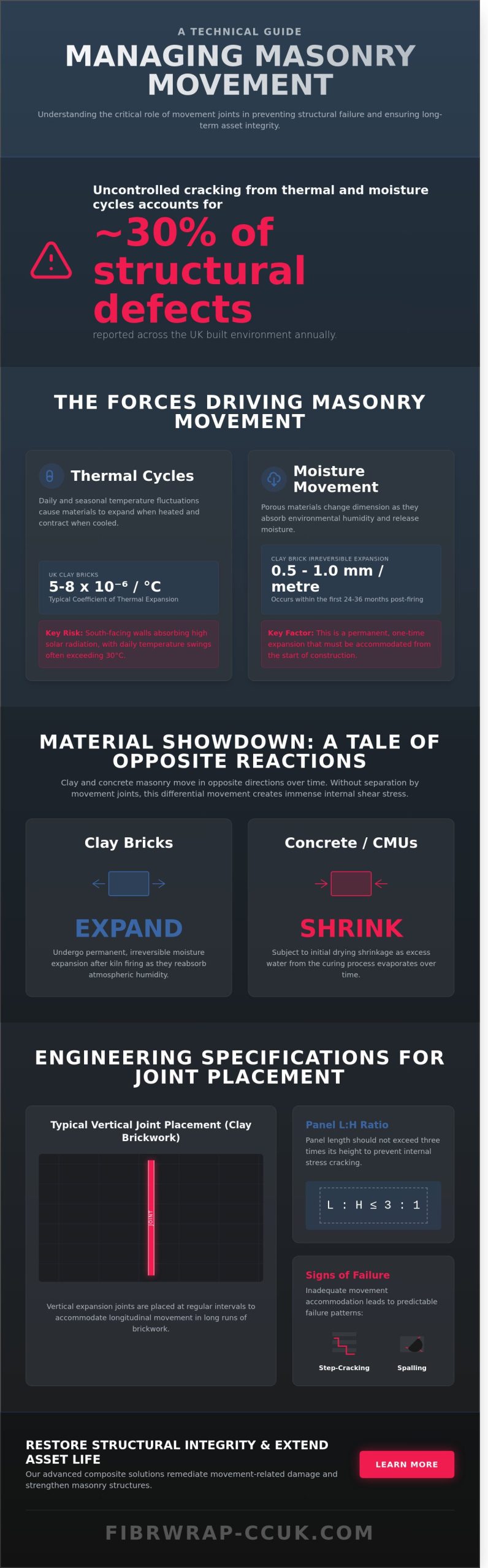
The structural integrity of a masonry façade is frequently compromised not by the load it supports, but by the relentless forces of thermal expansion and moisture-driven contraction. When these natural cycles are ignored, uncontrolled cracking occurs, representing approximately 30% of the structural defects reported across the UK built environment annually. It’s an established reality that rigid masonry must be designed to accommodate movement, or it’ll inevitably create its own relief points through structural failure.
This technical guide serves as a comprehensive engineering reference on the design, placement, and structural necessity of movement joints in brickwork to prevent masonry failure and extend the functional life of the asset. You’ll gain a detailed understanding of the material properties governing thermal and moisture-related movement while ensuring full compliance with current UK regulatory standards. The following sections provide a methodical overview of strategic joint placement, the selection of appropriate sealants, and the identification of bespoke remediation techniques for existing structural defects.
Key Takeaways
- Understand the engineering necessity of intentional discontinuities to accommodate dimensional changes and prevent uncontrolled stress-induced cracking within masonry structures.
- Examine the divergent physical properties of clay and concrete masonry units, specifically addressing why clay expands over time while concrete typically undergoes shrinkage.
- Master UK regulatory requirements for the strategic placement of movement joints in brickwork, including the application of the 3:1 panel length-to-height ratio.
- Identify the structural markers of movement failure, such as characteristic step-cracking and masonry spalling, to proactively mitigate the risk of asset degradation.
- Explore advanced remedial strategies and structural strengthening techniques, including the retrofitting of helical bars, to restore integrity and ensure long-term asset life-extension.
The Fundamentals of Movement Joints in Masonry Construction
Movement joints in brickwork are intentional, engineered discontinuities designed to accommodate the inherent dimensional changes of masonry materials. It’s necessary to view movement joints in brickwork as functional components rather than structural weaknesses. They ensure the structural integrity of a building remains uncompromised by providing a controlled space for expansion and contraction. Without these features, internal stresses accumulate until the tensile strength of the masonry is exceeded. This results in uncontrolled cracking that can jeopardize the safety of the entire envelope. An Expansion joint is a critical element in civil engineering that allows for these physical shifts without causing distress to the wider assembly.
The placement of these joints requires a bespoke design approach that considers the specific geometry and material properties of the building. Designers typically employ vertical expansion joints at intervals of 10 to 12 metres for clay brickwork to manage longitudinal movement. This strategy is often supplemented by horizontal bed joint reinforcement, which utilizes stainless steel ladder-wire to distribute lateral loads and enhance the shear capacity of the wall. While the Tyfo® system is frequently specified for composite structural strengthening, the fundamental management of movement joints in brickwork is equally critical for preventing secondary defects like water ingress. These measures mitigate the risk of thermal bridging where the building envelope’s performance is degraded. Structural strengthening through these methods is a primary focus for long-term asset life-extension.
Thermal Expansion and Contraction Cycles
UK clay bricks possess a coefficient of thermal expansion typically ranging between 5 and 8 x 10⁻⁶ per °C. Diurnal temperature fluctuations, which often exceed 30°C on a single summer day in the UK, create cumulative stress on masonry panels. South-facing elevations are particularly susceptible to these cycles because they absorb higher levels of solar radiation. This leads to surface temperatures that significantly exceed the ambient air temperature. Effective structural remediation requires a precise understanding of these thermal gradients to ensure the longevity of the facade. The movement isn’t static; it’s a constant cycle that demands a resilient engineering solution.
Moisture-Induced Dimensional Changes
Porous masonry materials undergo dimensional changes as they interact with environmental humidity and liquid water. For clay bricks, this involves an irreversible moisture expansion that occurs during the first 24 to 36 months after kiln firing. This expansion often reaches 0.5 mm to 1.0 mm per metre. It’s essential to distinguish this from reversible movement, such as the temporary swelling of cementitious mortars when saturated. A comprehensive design accounts for both factors to prevent structural distress. Fibrwrap’s engineering methodology prioritizes these calculations to maintain the integrity of the built environment through sophisticated science and rigorous material analysis.
Mechanics of Material Movement: Clay vs. Concrete Masonry
The fundamental challenge in designing movement joints in brickwork lies in the opposing physical behaviours of clay and cementitious materials. While both respond to thermal fluctuations, their long-term moisture-related movements occur in opposite directions. Clay masonry undergoes a permanent, irreversible expansion from the moment it exits the kiln. Conversely, concrete masonry units (CMUs) and calcium silicate bricks are subject to initial drying shrinkage. When these disparate materials are integrated into a single structural panel without adequate separation, the resulting differential movement generates significant internal shear stresses. These stresses often manifest as diagonal cracking or spalling, compromising the long-term durability of the facade. Precise engineering of movement joints in brickwork ensures that these forces are managed before they compromise the asset’s structural integrity.
Irreversible Moisture Expansion in Clay Bricks
Clay bricks are manufactured through high-temperature firing, a process that removes almost all chemically bound water. Upon exposure to the atmosphere, the ceramic body begins to reabsorb moisture, initiating a slow but relentless expansion. Research indicates that typical expansion rates for standard UK clay units range between 0.5mm and 1.0mm per metre over the life of the structure. This growth is irreversible. It necessitates the installation of dedicated expansion joints that remain compressible to accommodate the increasing volume of the masonry. Failure to provide these gaps leads to the accumulation of compressive forces, which can cause the outer leaf to bow or trigger the failure of wall ties. For assets showing signs of masonry fatigue, a bespoke design feature analysis can help determine if structural remediation is required to accommodate these ongoing shifts.
Drying Shrinkage in Concrete and Calcium Silicate Units
In contrast to the expansion seen in clay, concrete units experience a reduction in volume as they cure and lose their initial manufacturing moisture. This drying shrinkage is a primary driver of tensile stress within the wall. Because masonry is inherently weak in tension, shrinkage often results in vertical cracks if the movement is restrained by rigid structural elements or corners. Shrinkage joints must be positioned to allow the material to contract freely, typically at closer intervals than expansion joints in clay. The design of these joints differs significantly; they’re intended to open rather than close. When shrinkage is restrained, the resulting tensile failure can compromise the moisture barrier of the building envelope, leading to secondary issues like rebar corrosion or damp penetration. Managing these risks requires a methodical approach to joint placement that respects the specific material properties of the concrete substrate.
- Clay expands due to moisture reabsorption, requiring compressible expansion gaps.
- Concrete and calcium silicate units shrink as they dry, necessitating control joints to prevent tensile cracking.
- Mixing materials within a single panel creates differential movement risks that must be mitigated through material-specific joint design.
- Inadequate joint spacing in clay brickwork can lead to vertical expansion of 1.0mm per metre, potentially displacing coping stones or roof structures.
Engineering Specifications for Joint Placement and Spacing
In the United Kingdom, the placement of movement joints in brickwork is governed by PD 6697:2019, which provides recommendations for the design of masonry structures. For unreinforced clay brickwork, vertical joints are typically required at intervals of 10 to 12 metres, though the first joint from a return corner should be positioned within 6 metres to accommodate concentrated stresses. These parameters are influenced by the inherent moisture expansion of clay units, which can reach 0.8mm per metre over the lifespan of a building. The 3:1 rule is applied to ensure panel stability; the length of any given masonry panel shouldn’t exceed three times its height. If this ratio is exceeded, internal stresses often surpass the tensile strength of the masonry, leading to uncontrolled cracking. Special consideration is given to loadbearing walls, where vertical loads can sometimes help restrain moisture expansion, whereas non-loadbearing infill panels require more frequent detailing to prevent separation from the primary structural frame.
Calculating Maximum Joint Spacing
Determining the precise frequency of movement joints in brickwork requires an analysis of thermal and moisture movement coefficients alongside panel geometry. While standard tables provide a baseline, bespoke engineering design is utilized for complex façades where irregular openings or varying wall heights create non-linear stress distributions. Mortar selection plays a critical role in this calculation. A lower-strength M4 mortar offers greater flexibility compared to a rigid M12 mix. When high-strength mortars are specified for loadbearing requirements, the resulting stiffness reduces the masonry’s ability to accommodate internal strain. This lack of flexibility often necessitates more frequent joint intervals to prevent brittle failure at the bed joints.
Joint Design and Compressible Fillers
The efficacy of a movement joint is contingent upon the material properties of the filler and the sealant. Compressible fillers, such as cellular polyethylene or mineral wool for fire-rated applications, must be capable of compressing to approximately 50% of their original thickness without exerting excessive lateral pressure on the brickwork. A high-performance sealant is then applied to the external face to ensure weather-tightness, typically selected for a movement accommodation factor of 25% to 50%. To maintain lateral stability across the void, stainless steel wall ties or debonded dowels are installed. These dowels are fixed into one side of the joint while the other end is encased in a plastic sleeve. This allows the masonry to expand and contract freely while resisting wind loads and shear forces. Proper execution ensures the long-term integrity of the façade, preventing the ingress of water that could lead to freeze-thaw damage or internal damp issues.
To source the high-grade materials required for these engineered solutions, such as specialized sealants or sleeves, you can discover Plastiques Elastomères, a specialist in the distribution of industrial elastomers and technical plastics.
Structural Implications of Inadequate Movement Accommodation
The absence or incorrect placement of movement joints in brickwork precipitates a predictable sequence of structural failures. When thermal or moisture-induced expansion is restrained, internal compressive stresses accumulate until they exceed the tensile strength of the masonry or the shear strength of the mortar. This typically manifests as stepped cracking following the bed and perpend joints, or more severe vertical fractures that cleave directly through the clay bricks. In scenarios where expansion exceeds the available capacity of the material, masonry spalling occurs at the edges of the units. This leads to significant surface degradation and a reduction in the effective cross-sectional area of the wall.
Restrained movement doesn’t just affect aesthetics; it fundamentally alters load-path distribution. Unintended eccentricities in loading can compromise the stability of the building envelope, particularly in multi-storey structures where the cumulative effect of vertical expansion is most pronounced. Failure to incorporate sufficient movement joints in brickwork leads to a cycle of long-term asset degradation. This increases maintenance liability for asset managers, as repairs to cracked masonry are often cyclical if the underlying cause of the stress isn’t remediated through structural strengthening or the retrospective installation of joints.
Diagnosing Masonry Cracking and Displacement
Accurate diagnosis is critical to ensure that remediation strategies address the root cause rather than just the symptoms. It’s essential to differentiate between structural subsidence, which involves foundation movement, and simple movement-related fractures caused by thermal fluctuations. Detailed structural surveys and testing allow engineers to map stress concentrations and verify material properties. The installation of crack monitoring gauges, such as Tell-Tales, provides empirical data over a 6 to 12-month period to determine if the movement is active or has reached a state of equilibrium.
Secondary Effects: Water Ingress and Corrosion
Uncontrolled cracks serve as conduits for moisture, compromising the building envelope’s integrity. In the UK climate, this moisture exposure triggers freeze-thaw damage, where expanding ice within the cracks accelerates masonry breakdown. Persistent dampness also leads to the corrosion of wall ties, particularly in older stock where galvanisation may be insufficient; this process reduces the lateral stability of the cavity wall. Beyond structural risks, moisture ingress negatively impacts thermal performance, often resulting in internal damp and mould growth that affects occupant health. If you’re observing these symptoms in your asset, contact our technical team for a comprehensive structural assessment.
Remedial Strategies and Structural Strengthening for Masonry
When movement joints in brickwork are omitted during the original construction phase, the resulting thermal expansion or moisture-related movement often manifests as significant stepped or vertical cracking. Rather than resorting to costly and environmentally damaging demolition, specialist engineering techniques allow for the retrofitting of these essential features. This approach prioritises the structural integrity of the building while addressing the root cause of the distress. It’s a strategic choice that supports asset life-extension and aligns with modern ESG requirements. Refurbishment projects can save approximately 60% of the embodied carbon compared to full demolition and replacement, making remediation a technically sound and sustainable path forward.
Stabilisation of compromised masonry is typically achieved through the introduction of stainless steel helical bars. These are chemically bonded into the bed joints to bridge existing cracks and redistribute tensile loads across the masonry. This process restores the monolithic action of the wall, providing a stable substrate for further remedial works. This foundation is essential before engineers can implement more invasive articulation measures. A comprehensive understanding of masonry reinforcement for structural stabilisation and remediation is critical to selecting the correct intervention strategy for each unique asset condition.
Retrofitting Movement Joints (Stitch and Cut)
The retrofitting process involves the precise vertical cutting of the masonry at calculated intervals to create a functional expansion gap. Engineers specify the installation of bespoke slip ties and bed joint reinforcement wall ties to maintain lateral stability across the new joint while allowing for longitudinal movement. Aesthetic continuity is maintained through the careful selection of matching mortars and the application of masonry tints. This ensures the remedial works are indistinguishable from the original fabric of the building. These works are often carried out in accordance with BS 8221-1:2000 to protect the character of the asset.
Advanced Composite Strengthening for Masonry
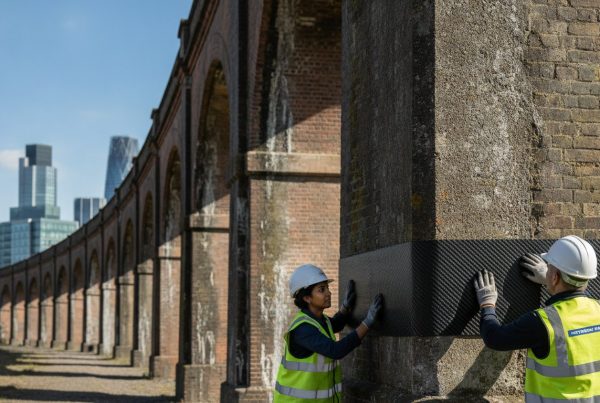
For larger assets or those requiring enhanced resilience, Tyfo® Fibrwrap® systems offer a sophisticated solution for structural strengthening. By applying Carbon Fibre Reinforced Polymer (CFRP) to the internal or external face of a masonry panel, engineers can significantly increase its out-of-plane flexural capacity. This composite technology is particularly effective for reinforcing brickwork against seismic activity or blast loads. It provides a level of ductility that traditional masonry lacks, allowing the structure to absorb energy without catastrophic failure.
Integrating these advanced materials with traditional repair methods allows for a holistic approach to asset management. It ensures that infrastructure remains safe and functional for several decades beyond its original design life. The Tyfo® system acts as a signature of quality, providing a bespoke engineering solution for complex structural challenges. If you require a detailed assessment of your masonry’s performance, you can contact our technical team for a consultation. Our focus remains on delivering long-term security through empirical evidence and engineering rigour.
Ensuring Long-Term Stability Through Advanced Structural Remediation
The long-term stability of masonry structures depends on a precise understanding of material kinetics, specifically the divergent thermal and moisture expansion rates of clay and concrete units. Failure to implement sufficient movement joints in brickwork results in cumulative stresses that compromise the building envelope and load-bearing capacity. Effective structural remediation requires more than traditional pointing; it demands a rigorous engineering approach that addresses the underlying cause of deformation. Fibrwrap Construction UK has spent over 10 years delivering specialist structural strengthening for national infrastructure projects across the United Kingdom. As the exclusive UK licensee for Tyfo® Fibrwrap® systems, our team provides comprehensive design and installation services that extend asset life cycles and restore structural integrity. These advanced carbon fibre reinforced polymer solutions ensure that even compromised masonry meets modern safety standards through scientifically proven methods. We’re committed to the preservation of the UK built environment through technical excellence and precision engineering.
Contact our engineering team for bespoke masonry reinforcement solutions to discuss your specific project requirements today.
Frequently Asked Questions
How often should movement joints be placed in a standard brick wall?
Movement joints in brickwork are typically spaced at intervals of 10 to 12 metres for clay masonry. This spacing is reduced to 7 to 9 metres for calcium silicate or concrete brickwork due to the differing thermal and moisture movement characteristics of these materials. PD 6697:2019 provides the technical framework for these requirements. Distances are often shortened to 6 metres near corners to mitigate stress concentrations that lead to vertical cracking.
What is the difference between an expansion joint and a control joint?
Expansion joints are designed to accommodate the irreversible moisture expansion inherent in clay bricks, while control joints manage the drying shrinkage common in concrete masonry. Clay bricks can expand by approximately 0.8mm per metre over their lifecycle. In contrast, concrete units may shrink by 0.5mm per metre. Failure to distinguish between these mechanisms leads to structural distress as the material behaves contrary to the joint’s intended function.
Can you retrofit movement joints into an old building that is cracking?
Retrofitting movement joints into existing structures is a standard procedure for structural remediation when original designs lack adequate provision. The process involves precise vertical saw cutting through the masonry skin, followed by the installation of debonded wall ties or stainless steel slip ties. These interventions are often combined with the Tyfo® system for structural strengthening if the integrity of the wall’s been compromised by extensive cracking.
What happens if movement joints are omitted during construction?
The omission of movement joints in brickwork leads to the accumulation of internal stresses that inevitably manifest as stepped or vertical cracking. These cracks typically appear at weak points like window openings or within 3 metres of building corners. If they’re left unaddressed, thermal expansion can cause the outer leaf to bow outwards or rotate, potentially leading to a total loss of structural stability and requiring costly reconstruction.
Are movement joints required in internal masonry walls?
Internal masonry walls require movement joints when their length exceeds 6 metres for non-loadbearing partitions or 9 metres for loadbearing elements. While internal environments are more thermally stable, moisture movement in concrete blocks still necessitates these provisions. Joints should be aligned with structural openings or changes in wall height. This ensures that internal finishes, such as plasterwork, don’t suffer from unsightly cracking due to minor structural shifts.
What is the best filler material for a movement joint in brickwork?
The most effective filler material for a movement joint is a closed-cell polyethylene foam strip, which provides a compressible backing for the weather seal. For high-quality components, Fosseway Tapes & Fixings Limited supplies a range of industrial foam tapes and adhesives specifically designed for structural durability. This material must be capable of 50% compression to accommodate maximum expansion cycles. A high-modulus polysulfide or silicone sealant is then applied to the outer 10mm to 15mm. These materials ensure a watertight finish while maintaining the flexibility required for asset life-extension.
How do I know if a crack in my brickwork is due to lack of movement joints or subsidence?
Cracks caused by lack of movement joints are usually vertical and maintain a consistent width of 2mm to 5mm throughout their length. Subsidence cracks are often diagonal, wider at the top than the bottom, and may extend through the DPC into the foundation. Structural engineers use calibrated crack gauges to monitor movement over a 12-month period. If the crack width fluctuates with seasonal temperature changes, it’s likely a thermal movement issue.
Do loadbearing walls require different joint spacing than cladding?
Loadbearing walls generally allow for slightly wider joint spacing than cladding because the vertical load provides a degree of restraint against movement. However, external cladding experiences temperature fluctuations of up to 50°C, necessitating more frequent joints to manage rapid thermal expansion. Spacing for external clay cladding is strictly capped at 12 metres. In loadbearing scenarios, the structural design must account for the transfer of loads across these joints using specialized dowels.