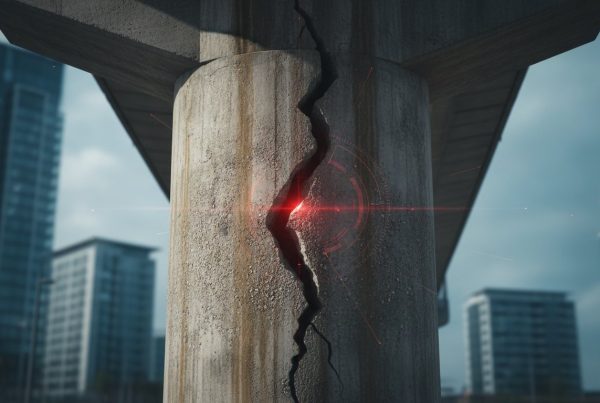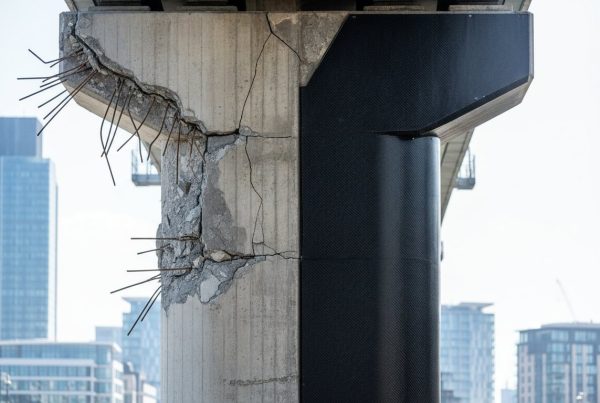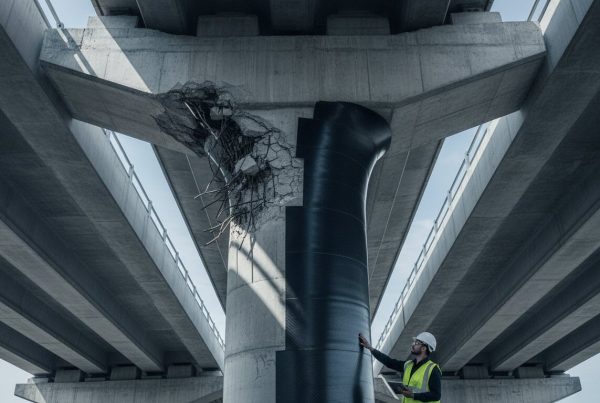

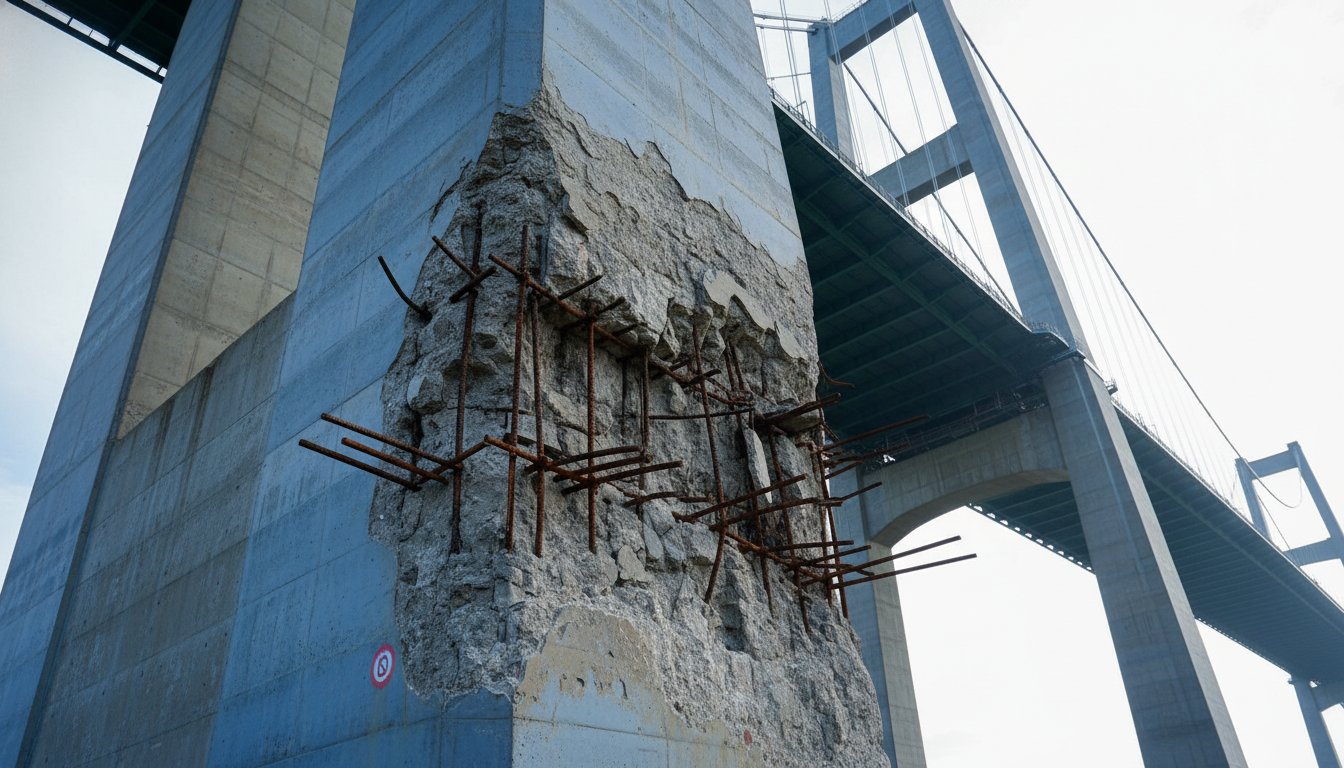
A single 50mm fragment of detached concrete often serves as the first visible indicator of a systemic failure that has been progressing silently for over a decade. For asset managers responsible for the UK’s ageing bridge decks and industrial facilities, the sight of exposed rebar and fractured masonry is a source of legitimate concern regarding long-term viability and safety. Understanding the technical spalling meaning is essential because these surface defects are rarely isolated incidents; they typically signal advanced carbonation or chloride ingress that has already compromised the internal reinforced concrete matrix.
We recognise that visible degradation creates significant uncertainty regarding the true cost of structural repair and the remaining service life of high-value assets. This guide provides a comprehensive framework for diagnosing these mechanisms, evaluating the extent of steel reinforcement corrosion, and determining the most rigorous path toward structural remediation. By examining the transition from initial moisture ingress to the eventual loss of structural integrity, we detail how modern composite solutions and the proprietary Tyfo® system facilitate asset life-extension whilst ensuring compliance with current safety standards. You’ll gain the technical insight required to move from reactive maintenance to a strategic programme of structural strengthening.
Key Takeaways
- Gain a comprehensive understanding of the spalling meaning within a structural context, specifically regarding the delamination of surface layers from concrete and masonry substrates.
- Identify the primary environmental drivers of degradation, including the mechanisms of oxide jacking and freeze-thaw cycles that compromise the integrity of UK infrastructure.
- Learn to assess the severity of structural threats by recognising “red flag” symptoms such as exposed reinforcement, significant section loss, and hazardous falling debris.
- Explore professional remediation methodologies that prioritise meticulous substrate preparation and the application of advanced primers to ensure monolithic behaviour.
- Discover how the implementation of the Tyfo® Fibrwrap® system facilitates asset life-extension by restoring and exceeding original design strength through composite strengthening.
Defining Spalling in the Context of Structural Engineering
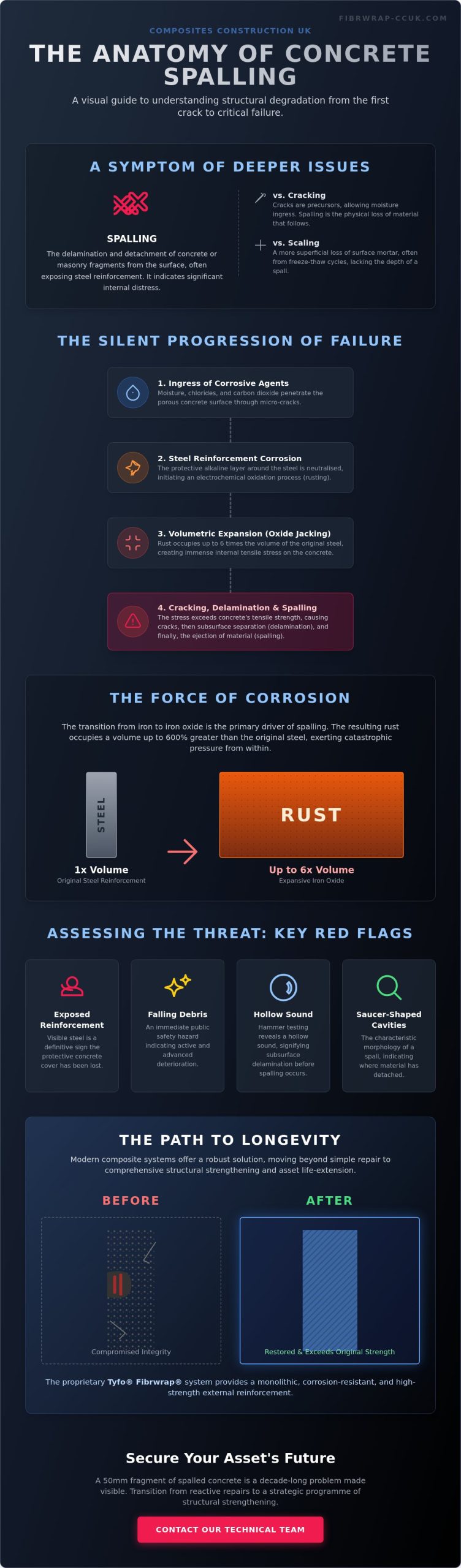
Understanding the technical spalling meaning requires a shift from viewing it as a mere surface blemish to recognising it as a critical indicator of material distress. In a general sense, the Spalling definition refers to the breaking of a material into small fragments, chips, or flakes. Within the rigorous environment of UK civil engineering, this term specifically describes the delamination of surface layers from a substrate, most frequently observed in reinforced concrete or masonry structures. It’s a physical manifestation of internal stress that has exceeded the tensile strength of the material.
Engineers must distinguish spalling from similar phenomena like scaling or pop-outs to ensure accurate diagnosis. Scaling involves the general loss of surface mortar and usually results from freeze-thaw cycles or chemical de-icing agents. Pop-outs are typically localised failures where a single piece of aggregate near the surface expands and breaks away. Spalling is more systemic. It’s considered a symptom of deeper structural pathology, often linked to the corrosion of embedded steel reinforcement or significant thermal expansion, rather than an isolated or superficial event.
The Physical Characteristics of a Spall
A spall is typically identified by its morphology, often appearing as saucer-shaped depressions where the concrete cover has detached. These cavities frequently reveal the underlying reinforcement, which may already show signs of oxidation or “rusting.” In professional terminology, a “spall” refers to the cavity left behind, whilst “spalls” are the fragments of debris that have been ejected. Spalling is the separation of surface material due to internal expansive pressures. When these pressures, often generated by the volumetric expansion of corroding rebar, exceed the capacity of the concrete cover, the material fails and separates.
Spalling vs. Cracking: Understanding the Difference
The deterioration cycle of a structure often begins with cracking, which serves as a precursor to more severe failure. Whilst cracks allow the ingress of moisture and chlorides, they don’t always signify immediate material loss. Delamination occurs when these cracks propagate parallel to the surface, creating a subsurface fracture plane. This stage is often detected during hammer testing, where a distinct hollow sound indicates that the surface layer is no longer bonded to the core.
Superficial cracking may be benign in certain non-load-bearing contexts, but the transition to spalling is rarely so. Once a spall occurs, the structural strengthening requirements change significantly because the protective alkaline environment for the steel is lost. If your asset shows these signs, you can contact our technical team
Primary Mechanisms and Environmental Drivers of Spalling
Understanding the technical spalling meaning requires a detailed examination of the electrochemical and physical processes that compromise structural integrity. In the context of UK infrastructure, these mechanisms are rarely isolated; they often act synergistically to accelerate the degradation of reinforced concrete and masonry assets. The transition from a sound surface to a spalled state is usually the result of internal pressures exceeding the material’s inherent tensile capacity.
The Chemistry of Reinforcement Corrosion
The degradation of reinforced concrete often starts with the electrochemical oxidation of the internal steel rebar. As iron converts to iron oxide, the resulting rust occupies a volume up to six times greater than the original metal. This volumetric expansion exerts significant internal tensile stresses on the surrounding concrete matrix. Because concrete possesses low tensile strength, typically only 10% of its compressive capacity, these internal pressures eventually exceed the material’s threshold. Corrosion is the #1 driver of concrete spalling in the UK. This process is often documented when engineers analyse the technical Causes of concrete spalling in aging infrastructure. The resulting fractures allow further ingress of moisture and oxygen, creating a self-sustaining cycle of decay that necessitates comprehensive structural remediation.
Environmental Factors in the United Kingdom
UK infrastructure faces unique challenges due to the temperate maritime climate. High relative humidity, which frequently exceeds 80% during winter months, accelerates the rate of carbonation. This chemical reaction occurs when atmospheric carbon dioxide reacts with calcium hydroxide in the concrete pore solution. The process lowers the pH from approximately 12.5 to below 9.0, at which point the protective passive layer on the steel reinforcement is lost. In urban centres like London or Birmingham, industrial pollutants further exacerbate masonry decay through sulphate attack.
Chloride ingress represents another critical threat, particularly for road bridges treated with de-icing salts and coastal assets. These chlorides penetrate the concrete cover to initiate localized pitting corrosion, a particularly aggressive form of metal loss. For assets located within 5 kilometres of the coastline, specific cathodic protection and bespoke structural strengthening strategies are often required to ensure long-term stability. Physical drivers also play a role; water trapped within capillary pores expands by approximately 9% upon freezing. In poorly air-entrained concrete, repeated freeze-thaw cycles create cumulative micro-cracking, eventually leading to the detachment of the concrete cover. By identifying these drivers early, asset managers can implement life-extension protocols that prioritise the sustainability of repair over total replacement.
Assessing the Severity: When is Spalling a Structural Threat?
While minor surface scaling might appear purely aesthetic, the technical spalling meaning involves a significant breach of the protective alkaline environment surrounding the steel reinforcement. Critical red flags include visible rust staining and exposed rebar. These symptoms suggest that the passive layer has failed; this allows oxidation to expand the metal’s volume by up to 600%. This expansion exerts internal pressure that eventually ejects the concrete cover. In high-rise environments or public infrastructure, the primary risk is falling debris. A single fragment of concrete falling from height poses a lethal threat to pedestrians and violates strict UK safety protocols.
Structural integrity is compromised when spalling reduces the effective cross-section of load-bearing elements. This reduction diminishes the member’s ability to resist compressive or tensile loads. Delamination represents a hidden danger. The surface may appear intact while the internal bond between the concrete and steel has already failed. This creates a hollow void that can be detected only through specialised diagnostic techniques. If left unaddressed, the total load-bearing capacity of the structure continues to diminish as the corrosion process accelerates.
The Process of Structural Inspection
Effective remediation begins with a methodical assessment of the asset’s condition. Engineers typically employ visual surveys and sounding tests, where hammer tapping identifies the distinct resonant frequency of delaminated sections. Advanced diagnostics provide deeper insight into the electrochemical state of the structure. Half-cell potential mapping identifies active corrosion zones before physical cracking occurs, whilst carbonation depth testing determines the extent of atmospheric CO2 penetration. These findings inform bespoke engineering calculations required to determine the residual strength of the element and the necessary reinforcement strategy.
Consequences of Neglect
Ignoring early signs of degradation leads to an accelerated decay cycle. Once the concrete cover is lost, the reinforcement is directly exposed to moisture and chlorides, rapidly reducing the steel’s cross-sectional area. This is particularly dangerous in tension-critical members like bridge soffits or cantilevered balconies. Under the Health and Safety at Work etc. Act 1974, asset managers are legally obligated to maintain structures in a safe condition. Failure to implement a timely Concrete spalling repair strategy can result in catastrophic failure and significant legal liability. Proactive maintenance ensures long-term asset life-extension and avoids the prohibitive costs of total reconstruction or emergency structural strengthening.
Methodologies for Professional Concrete and Masonry Repair
Remediation of deteriorated assets requires a disciplined, multi-stage engineering approach that extends beyond aesthetic restoration. The process begins with the rigorous mechanical removal of all delaminated or carbonated material until a sound, uncontaminated substrate is reached. Exposed reinforcement steel is grit-blasted to a near-white metal finish, typically meeting ISO 8501-1 SA 2.5 standards, to ensure all oxidation is eliminated. Understanding the technical spalling meaning in a structural context is vital here; it isn’t merely a surface flaw but an indication of internal pressure that has already compromised the concrete’s tensile capacity.
Once the substrate is prepared, proprietary primers and bonding agents are applied to facilitate monolithic behaviour between the original structure and the repair medium. High-performance, polymer-modified mortars are then utilised to reinstate the profile. These materials are selected for their low shrinkage properties and high compressive strength, which often exceeds 45 N/mm² after 28 days. When the loss of reinforcement cross-section exceeds a threshold of 10%, the project must transition from localised patching to comprehensive structural strengthening to restore the original design safety margins.
Traditional Repair Techniques
Hand-applied mortars remain the standard for localised defects where access is restricted. For large-scale infrastructure remediation, such as bridge soffits or maritime quay walls, sprayed concrete (shotcrete) is employed to provide a dense, high-strength layer over expansive areas. Whilst these methods are effective for volume replacement, they have limitations in high-stress environments. Traditional patches don’t always address the electrochemical imbalances within the concrete, leading to premature failure if the underlying corrosion mechanism remains active. A strategic approach to concrete repairs and structural remediation that aligns with BS EN 1504 standards is essential for ensuring these interventions deliver long-term performance.
Addressing the Root Cause
Patching alone frequently fails due to the incipient anode effect, often called the halo effect. This occurs when the new repair material creates a high-alkalinity zone that shifts the corrosion current to the adjacent, chloride-contaminated concrete. To prevent this, discrete sacrificial zinc anodes are integrated into the repair perimeter to provide cathodic protection to the steel. The remediation is finalised by sealing the structure with anti-carbonation coatings or silane-based water repellents. These barriers are essential for preventing moisture and chloride ingress, effectively extending the asset’s service life by 20 years or more. Professional diagnosis ensures the spalling meaning is interpreted correctly as a symptom of these wider electrochemical issues.
To ensure your infrastructure meets modern safety standards through bespoke engineering, explore our technical design features.
Enhancing Asset Longevity with Advanced Composite Strengthening
Once the immediate physical degradation of a structure is addressed, the focus shifts to ensuring that the remediation provides a permanent increase in load-bearing capacity. Understanding the spalling meaning in a structural context reveals that surface-level patches are often insufficient for assets subjected to modern loading requirements or aggressive environmental cycles. Carbon Fibre Reinforced Polymer (CFRP) has emerged as the definitive post-repair solution for UK infrastructure, offering a method to not only restore but frequently exceed the original design strength of reinforced concrete elements.
The application of advanced composites allows for a sophisticated approach to structural remediation. These materials are characterised by their exceptional strength-to-weight ratios, allowing engineers to apply significant reinforcement without adding substantial dead load to the structure. This is particularly critical for ageing bridges and multi-storey car parks where the existing foundations may not support the weight of traditional strengthening methods. By integrating CFRP into the repair strategy, the transition from simple maintenance to comprehensive life extension is achieved.
The Tyfo® Fibrwrap® Advantage
The Tyfo® Fibrwrap® system provides a high-strength, low-profile solution that excels in restricted environments. Unlike traditional steel plate bonding, which is heavy and requires mechanical anchors that can create new points of weakness, the Tyfo® system is bonded directly to the prepared concrete surface. This creates a seamless, non-corrosive protective barrier that effectively confines the concrete. By providing this external confinement, the system prevents the internal expansion of reinforcing bars, which is the root cause of the spalling meaning observed in deteriorating structures. The composite wrap acts as a shield against chloride ingress, ensuring the internal chemistry of the concrete remains stable for decades.
- Non-corrosive properties: CFRP does not rust, eliminating the risk of secondary spalling caused by the reinforcement itself.
- Versatility: The flexible nature of the textile allows it to be wrapped around complex geometries, including circular columns and irregular beams.
- Rapid installation: The lightweight nature of the material reduces the need for heavy lifting equipment, minimising site downtime and public disruption.
Strategic Asset Management
Adopting a strategy of structural strengthening over demolition offers significant economic and environmental advantages. In the UK, the carbon cost of new concrete production is a major concern for local authorities and private developers alike. Extending the service life of an existing asset by 25 to 50 years through composite reinforcement is a demonstrably more sustainable path than replacement. This approach preserves the embodied carbon of the original structure whilst meeting modern safety standards. It’s a methodical, evidence-based way to manage risk across a portfolio of ageing assets.
For asset managers overseeing critical infrastructure, a proactive survey is the first step in preventing catastrophic failure. Our engineers provide detailed assessments to determine the most effective strengthening protocol for your specific site conditions. Contact our engineering team for a comprehensive structural survey to safeguard the long-term integrity of your concrete assets.
Securing the Future of UK Infrastructure Through Advanced Remediation
Understanding the technical spalling meaning is vital for managing the UK’s ageing concrete assets, particularly those dating from the 1960s infrastructure expansion. When concrete begins to delaminate, it’s a clear signal that internal reinforcement corrosion has reached a critical threshold, threatening the load-bearing capacity of the structure. Effective remediation requires more than superficial patching; it necessitates a methodical approach that addresses carbonation and chloride ingress through advanced material science. We’ve seen how early intervention prevents the catastrophic loss of structural integrity in bridges and industrial facilities.
As the exclusive UK licensee for the Tyfo® Fibrwrap® system, Fibrwrap Construction UK provides a comprehensive design, supply, and installation service tailored to complex engineering requirements. Our technical team brings global expertise in blast mitigation and seismic retrofitting to every project, ensuring that structural strengthening isn’t just a temporary fix but a long-term asset life-extension strategy. By utilising carbon fibre reinforced polymers, high-performance solutions are delivered that exceed traditional repair benchmarks. We’re here to help you safeguard your assets with precision and engineering rigour.
Request a structural survey or technical consultation to begin your remediation journey.
Frequently Asked Questions
What is the most common cause of concrete spalling in the UK?
The most prevalent cause of concrete spalling across UK infrastructure is the corrosion of internal steel reinforcement, typically triggered by carbonation or chloride ingress. In coastal regions or on motorways where de-icing salts are used, chlorides penetrate the porous concrete and disrupt the protective alkaline layer around the rebar. This leads to expansive oxidation, creating internal pressures that eventually exceed the concrete’s tensile strength and cause the surface to fracture.
Is spalling concrete dangerous for the structural integrity of a building?
Spalling represents a significant risk to structural integrity because it indicates the ongoing degradation of load-bearing reinforcement. When the concrete cover is lost, the steel’s exposed to atmospheric moisture, which accelerates sectional loss and reduces the component’s capacity. Data suggests that unaddressed corrosion can lead to a 25% reduction in structural load capacity within a decade, making prompt structural strengthening essential for maintaining safety standards.
Can I simply paint over spalling concrete to stop it from spreading?
You can’t stop the spread of damage by painting over it, as this cosmetic approach fails to address the underlying electrochemical processes. Whilst a coating might hide the surface damage, the internal pressure from oxide jacking will continue until the new paint layer inevitably blisters and peels. Effective remediation requires the removal of contaminated concrete and the application of technical solutions like the Tyfo® system to ensure long-term asset life-extension.
How much does it cost to repair spalling concrete on a commercial scale?
Commercial repair costs vary based on the project’s complexity, typically ranging from £150 to £500 per square metre for standard patch repairs. According to industry benchmarks from the Concrete Repair Association, specialist infrastructure projects involving cathodic protection or carbon fibre reinforced polymers can see costs exceed £1,000 per square metre. These figures don’t include additional requirements such as heavy-duty scaffolding or bespoke traffic management plans for UK highways.
What is the difference between spalling and efflorescence?
Understanding the spalling meaning requires a clear distinction from efflorescence, which is merely the migration of soluble salts to a material’s surface. Efflorescence appears as white, powdery deposits and is primarily an aesthetic concern that doesn’t compromise structural safety. In contrast, spalling involves the physical detachment of material fragments and signifies deep-seated structural distress that requires immediate engineering intervention to prevent further decay.
How long does a professional spalling repair typically last?
A high-specification repair utilising advanced composite materials can extend a structure’s service life by 25 to 50 years. The longevity of the repair depends on the quality of the substrate preparation and the environmental conditions of the site. Systems like Tyfo® provide a robust barrier against future moisture and chloride ingress, significantly reducing the frequency of maintenance cycles compared to traditional cementitious mortar patches.
Can brickwork spall in the same way as concrete?
Brickwork is highly susceptible to spalling, particularly during the 120 ground frost days recorded annually in many parts of the UK. When moisture’s trapped within the masonry, the freeze-thaw cycle causes the water to expand, creating internal stresses that blow the face off the brick. This is often exacerbated by the historical use of hard cement mortars, which trap moisture within the softer brick units rather than allowing it to evaporate.
What is oxide jacking and how does it relate to spalling?
Oxide jacking is the mechanical process where corroding steel expands to between 2 and 7 times its original volume. This expansion generates immense internal tensile forces, often exceeding 4,000 psi, which the surrounding concrete cannot withstand. These forces result in the cracking and eventual displacement of the concrete cover, which is the primary mechanism behind the spalling observed in reinforced concrete structures across the country.