

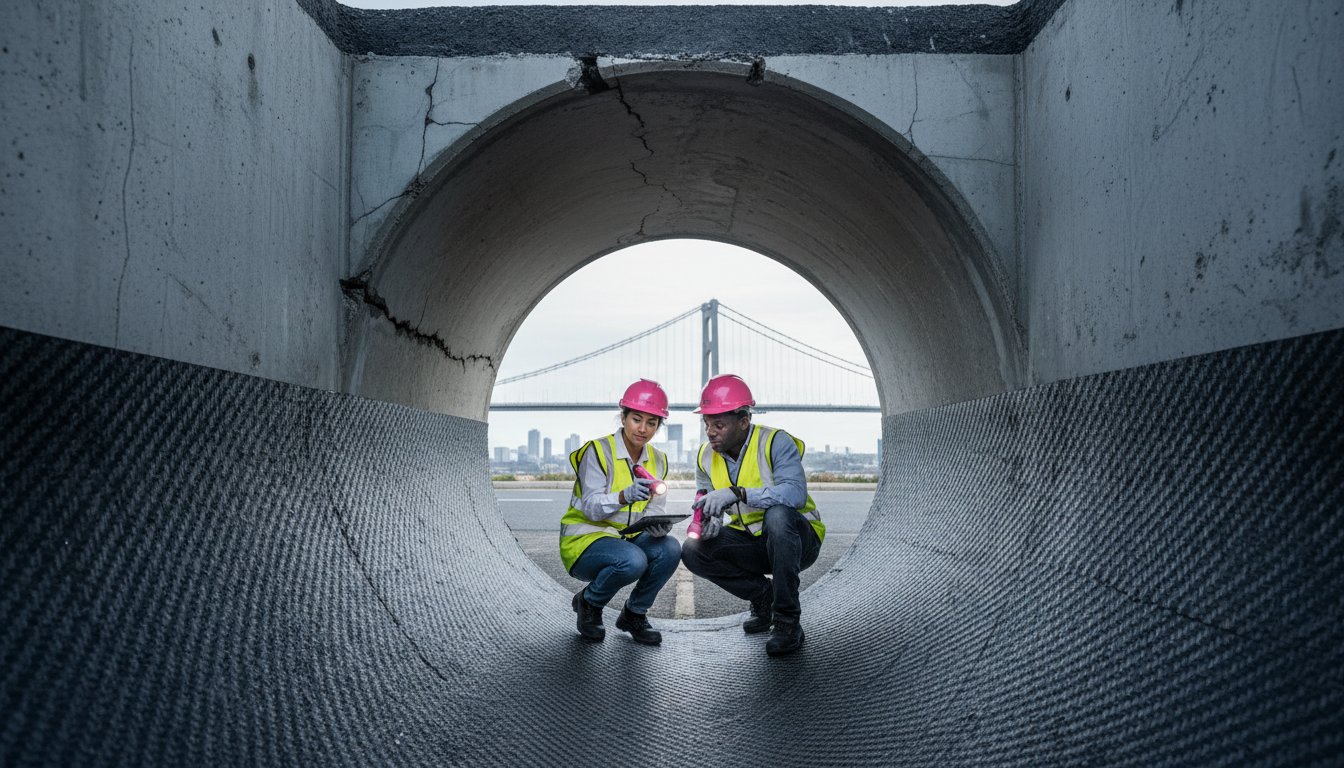
The UK’s ageing utility networks currently face an annual maintenance backlog exceeding £20 billion, a figure that highlights the critical need for sustainable asset life-extension. For engineers managing deteriorating water or wastewater infrastructure, the traditional reliance on open-cut excavation is no longer a viable default due to the prohibitive social costs and regulatory penalties associated with surface disruption. Adopting structural trenchless pipeline repair methods has become essential to maintain network reliability without the logistical burden of major civil works. It’s understood that the pressure to deliver long-term structural strengthening whilst adhering to strict UK engineering standards, such as those set by the Environment Agency and local water authorities, remains a significant challenge for modern asset managers.
This technical guide provides an expert-led analysis of high-performance rehabilitation techniques, specifically focusing on the application of carbon fibre reinforced polymers to restore the integrity of failing pipelines. You’ll learn how the Tyfo® system is utilised to provide bespoke reinforcement that withstands increasing hydraulic and seismic loads. By examining the empirical performance of advanced composite materials, we’ll demonstrate how a methodical approach to structural remediation can minimise project footprints and secure the future of essential infrastructure for decades to come.
Key Takeaways
- Understand how modern trenchless pipeline repair has transitioned from simple leak sealing to a comprehensive structural remediation strategy for critical UK infrastructure assets.
- Examine the mechanical performance of Carbon Fibre Reinforced Polymer (CFRP) systems and their capacity to absorb both hoop stress and longitudinal loads in high-pressure environments.
- Acquire the technical criteria necessary to distinguish between Class A fully structural liners and Class D non-structural methodologies when specifying Cured-In-Place Pipe (CIPP) or composite solutions.
- Identify the essential engineering data points required for pressure pipe remediation, with a focus on calculating internal operating pressures against surge pressure requirements.
- Discover how Tyfo® Fibrwrap® composite systems facilitate long-term asset life-extension and capital expenditure (CAPEX) efficiency through superior resistance to corrosive soils and aggressive chemicals.
Defining Trenchless Pipeline Repair in Modern Civil Engineering
Trenchless pipeline repair encompasses a sophisticated suite of “no-dig” technologies engineered to rehabilitate subterranean assets without the requirement for extensive surface disruption. Defining Trenchless Pipeline Repair in the current era necessitates an understanding of its evolution from rudimentary leak sealing to comprehensive structural remediation. This transition has been driven by the requirement for long-term asset life-extension in critical infrastructure. Within the UK water and gas sectors, the diagnostic phase is now underpinned by high-definition CCTV surveys. These surveys provide the empirical data essential for identifying structural deficiencies, such as circumferential cracking or joint displacement, before a bespoke engineering solution is formulated.
The economic advantages of these methods are quantifiable. Beyond the direct costs of labour and materials, the mitigation of social costs remains a primary driver for asset managers. Trenchless interventions significantly reduce the financial burden of traffic management and the associated penalties for road occupation under the New Roads and Street Works Act 1991. By maintaining service continuity during the repair process, the indirect costs to the local economy are minimised, ensuring that trenchless pipeline repair remains the preferred strategy for high-consequence infrastructure.
The Shift from Excavation to In-Situ Rehabilitation
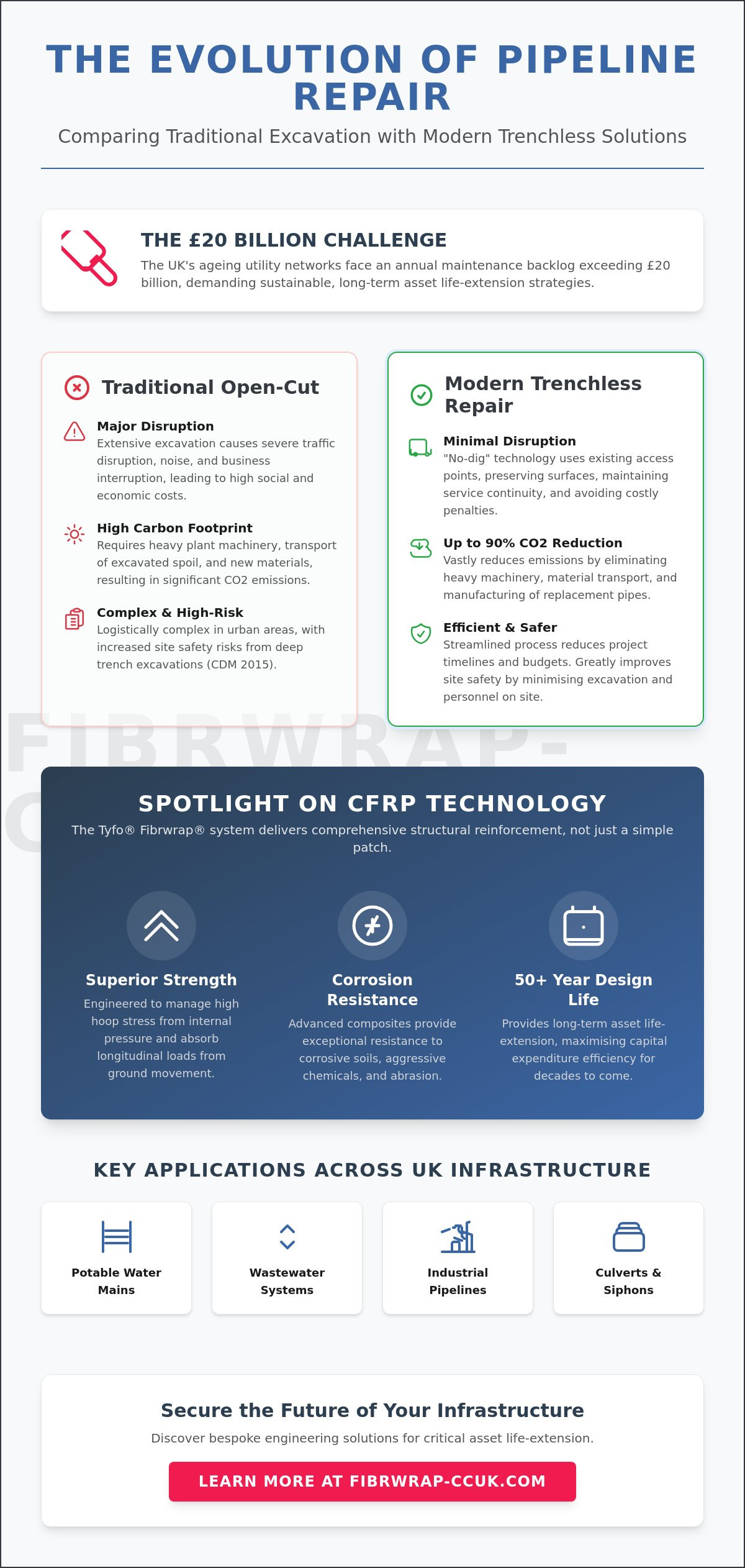
Traditional open-cut methods are increasingly viewed as unfeasible within the UK’s congested urban environments. The logistical complexity of excavating in cities like London or Manchester often results in project delays and escalated budgets. Strict adherence to the Construction (Design and Management) Regulations 2015 has further incentivised the reduction of deep-trench excavations to improve site safety. From an environmental perspective, in-situ rehabilitation offers a substantial reduction in carbon footprint. Research indicates that trenchless methods can lower CO2 emissions by up to 90% compared to traditional replacement, largely by eliminating the need for heavy plant machinery and the transport of excavated spoil.
Key Applications Across UK Infrastructure
The application of these technologies is diverse, ranging from the remediation of potable water mains to the reinforcement of wastewater systems. In the energy sector, the structural strengthening of industrial process pipelines is frequently achieved through the application of the Tyfo® system. This advanced composite technology is also critical for the rehabilitation of culverts and siphons situated beneath strategic transport links, such as those managed by Network Rail or National Highways. These interventions are designed to restore the structural integrity of the asset whilst ensuring a design life that often exceeds fifty years. For complex projects requiring specific material performance data, asset managers often consult our design-feature resources to ensure regulatory compliance.
The Mechanics of Carbon Fibre Reinforced Polymer (CFRP) Pipeline Rehabilitation
The application of Carbon Fibre Reinforced Polymer (CFRP) represents a paradigm shift in trenchless pipeline repair, particularly for high-pressure water mains and cooling water systems. Unlike traditional liners that rely on the host pipe for structural support, CFRP systems are engineered as independent structural components. These composites excel at managing hoop stress, which is the circumferential force exerted by internal fluid pressure, whilst simultaneously absorbing longitudinal loads caused by ground movement or thermal expansion. The Engineering Specifications for Trenchless Pressure Pipe Remediation documentation highlights the increasing reliance on these advanced materials within the UK’s regulated water sectors.
Within these systems, the chemistry of the epoxy resin is the most critical variable. Resins are specifically formulated to exhibit high glass transition temperatures and moisture tolerance. This ensures the composite doesn’t lose its structural modulus when exposed to the humid conditions typical of UK sewer and water networks. For large-diameter assets, such as 1,200mm diameter trunk mains, CFRP provides a bespoke solution where the thickness of a traditional CIPP liner would become prohibitively expensive or hydraulically restrictive.
Tyfo® Fibrwrap®: A Proprietary Approach to Pipeline Strengthening
Tyfo® Fibrwrap® remains a proprietary benchmark for internal pipe reinforcement. It’s designed to act as a stand-alone structural member, meaning it can carry the full internal pressure and external soil loads even if the host pipe suffers total section loss. This capability is vital for the life-extension of critical infrastructure where replacement costs would exceed £1 million per kilometre. The system is adaptable to various geometries, including bends and tees, providing a continuous structural skin. Detailed material performance data can be found in our technical guide on Pipeline Strengthening.
Installation Precision and Quality Control
Success in trenchless pipeline repair is contingent upon meticulous surface preparation. The host pipe must be cleaned to a specific profile, typically a Concrete Surface Profile (CSP) of 3 or 5, to facilitate mechanical interlocking. Achieving this substrate profile is essential for ensuring the long-term bond strength required for structural remediation.
Post-installation verification is a rigorous process that ensures every square metre meets the engineering design. This includes:
- Pull-off adhesion testing: Conducted to verify the bond strength between the composite and the host pipe.
- Saturation monitoring: Ensuring resin-to-fibre ratios remain within a 2% tolerance of the design specification.
- Thickness verification: Ultrasonic testing to confirm the cured laminate meets the required structural thickness.
For engineers interested in the technical nuances of these systems, reviewing specific design features
Structural vs. Non-Structural Lining: Assessing Rehabilitation Methodologies
The selection of a rehabilitation methodology for trenchless pipeline repair is governed by the required level of structural contribution. According to classifications recognised across UK Infrastructure, liners are categorised from Class A to Class D. A Class A liner is defined as a fully structural, stand-alone system capable of sustaining all internal hydrostatic pressures and external soil or traffic loads throughout a 50-year design life. Conversely, Class D systems function as non-structural interactive liners, primarily intended for leak prevention and corrosion protection where the host pipe remains structurally sound.
CIPP and Felt-Based Liners: Capabilities and Limits
Resin-impregnated felt liners are frequently deployed within gravity-fed sewer systems due to their cost-efficiency in non-pressurised environments. The mechanics involve an inversion or pull-in process followed by thermal or UV curing. Whilst effective for standard municipal applications, CIPP often faces limitations in high-pressure industrial conduits or environments exceeding 60°C, where resin degradation becomes a risk. Installation footprints for CIPP are typically larger than CFRP applications, requiring significant boiler or UV rig staging areas. Curing times vary from 5 to 15 hours depending on diameter and ambient conditions.
The Stand-Alone Structural Solution
A stand-alone structural solution is specified when the host pipe is assumed to possess zero residual strength, essentially treating the original asset as a temporary formwork. For high-consequence assets, Carbon Fibre Reinforced Polymer (CFRP) systems like Tyfo® provide a bespoke structural strengthening capability that felt-based CIPP cannot match. CFRP is the preferred methodology for seismic retrofitting and blast mitigation systems, as the high tensile strength of the carbon fibres absorbs energy during ground deformation or high-impact events. This methodology ensures long-term asset life-extension for critical pipelines where failure is not an option.
Alternatives such as pipe bursting or slip-lining offer different trade-offs. Pipe bursting involves the physical destruction of the host pipe to pull through a new HDPE line, which is effective for diameter upsizing but carries risks of ground heave. Slip-lining involves inserting a smaller pipe into the existing one, which inevitably reduces the hydraulic cross-section. In contrast, trenchless pipeline repair using composite liners maintains or even improves flow coefficients whilst providing a full structural replacement. Asset managers should prioritise solutions with a verified 50-year lifespan to avoid the recurring capital expenditure associated with short-term, 10-year patches.
Engineering Specifications for Trenchless Pressure Pipe Remediation
The specification of a trenchless pipeline repair solution requires an exhaustive analysis of the asset’s current physical state and its future operational demands. Engineers must compile data regarding the host pipe’s material properties, remaining wall thickness, and the presence of external hydrostatic loads. A fundamental aspect of this process involves calculating the disparity between internal operating pressure and potential surge pressures. Whilst a system might operate at a steady 10 bar, transient events can cause spikes that necessitate a more robust structural response from the composite reinforcement. Design calculations must also account for host pipe deformation and ovality. When a pipe loses its circularity, the resulting eccentricities create non-uniform stress concentrations. Our engineering protocols incorporate these geometric imperfections to ensure the Tyfo® system provides the requisite structural strengthening. Bespoke design is particularly vital for complex geometries, such as elbows and tees, where standard lining techniques often fail to maintain hydraulic and structural continuity.
The Design and Engineering Phase
We utilise the CCUK Design Feature to develop site-specific strengthening protocols that meet the unique demands of UK infrastructure. This phase relies on finite element analysis (FEA) to determine the precise number of carbon fibre reinforced polymer layers required to resist both internal and external pressures. Every design is rigorously vetted to ensure compliance with UK water industry requirements and gas safety standards. It’s this methodical approach that ensures the rehabilitated asset’s long-term integrity and performance under peak load conditions.
Navigating Access and Logistics
Effective project execution requires the identification of optimal access points to minimise disruption to surface infrastructure and local communities. Managing bypassed flows is a critical logistical challenge during the rehabilitation period, often requiring complex temporary works to maintain service continuity for residents. We conduct rigorous site surveys amongst dense underground utility networks to mitigate risks. This disciplined approach ensures that the trenchless pipeline repair is completed without compromising adjacent assets or requiring extensive excavations. For technical consultations on bespoke infrastructure remediation, contact our engineering team.
- Detailed assessment of host pipe residual strength and wall loss.
- Integration of surge pressure transients into structural design limits.
- Accounting for ovality and soil loading in composite thickness calculations.
- Utilisation of FEA for complex geometries and bespoke fittings.
- Adherence to UK-specific regulatory and safety frameworks.
Asset Life-Extension through Tyfo® Fibrwrap® Composite Systems
Utilising trenchless pipeline repair as a core component of asset management allows UK infrastructure owners to transition from reactive maintenance to strategic capital expenditure (CAPEX) efficiency. Traditional “dig and replace” methods often incur costs that exceed the value of the asset itself when accounting for traffic management, utility diversions, and environmental disruption. Carbon fibre reinforced polymers (CFRP), specifically the Tyfo® Fibrwrap® system, provide a high-modulus solution that restores the structural integrity of degraded pressure pipes and gravity culverts without the need for extensive excavation. These composite materials are chemically inert, offering exceptional resistance to aggressive chemical environments and corrosive soils that typically compromise metallic or cementitious liners. Choosing repair and structural strengthening over replacement isn’t just a financial decision; it’s a commitment to sustainable engineering that avoids the massive carbon footprint associated with new concrete production and heavy site works.
Strategic Benefits for UK Asset Managers
The primary objective of structural remediation is the extension of an asset’s operational life by a minimum of 50 years. By applying Tyfo® systems internally, engineers create a stand-alone structural member capable of resisting full internal pressure and external loads, even if the host pipe fails completely. This approach significantly mitigates the risk of catastrophic failures, which in the UK water sector can lead to substantial Section 82 fines under the Water Industry Act 1991 or severe environmental prosecution. Unlike traditional slip-lining, the ultra-thin profile of Tyfo® composites ensures that hydraulic capacity is maintained or even improved due to the smooth surface finish of the cured epoxy resin. This allows for trenchless pipeline repair that meets modern demand requirements without necessitating a larger diameter pipe. It’s a method that prioritises long-term security for critical national infrastructure.
- Restoration of structural integrity to meet current Eurocode and AWWA design standards.
- Elimination of infiltration and exfiltration in ageing Victorian brick sewers or mid-century concrete mains.
- Significant reduction in project carbon footprint by avoiding heavy machinery and mass material disposal.
- Minimal disruption to urban centres and sensitive ecological sites during the installation phase.
Commencing Your Pipeline Rehabilitation Project
Successful execution of a composite strengthening project relies on early-stage technical engagement. Composites Construction UK (CCUK) operates as a specialist engineering contractor, providing a bridge between theoretical design and site-specific constraints. The process begins with comprehensive feasibility studies and condition assessments to determine the residual strength of the existing host pipe. CCUK manages the end-to-end delivery, ensuring that bespoke designs are validated through rigorous material testing before professional installation by certified technicians. We encourage a collaborative framework where clients, consultants, and our engineering team work in unison to solve complex structural challenges. It’s this disciplined approach that ensures every project meets the highest safety and performance benchmarks. To discuss the technical requirements of your infrastructure, contact our engineering team for a technical consultation.
Advancing UK Infrastructure Through Composite Innovation
The evolution of trenchless pipeline repair from simple leak sealing to sophisticated structural remediation provides a definitive pathway for the UK’s ageing infrastructure. By integrating high-modulus Carbon Fibre Reinforced Polymer (CFRP) materials, asset managers can achieve a verified 50-year design life extension without the environmental or logistical burden of open-cut excavation. It’s a process driven by empirical performance data and the specific material properties of the Tyfo® Fibrwrap® system. Fibrwrap Construction UK serves as the exclusive UK licensee, providing a comprehensive design and installation service that’s been proven across national water and energy networks. This methodology ensures the long-term integrity of pressure pipes whilst aligning with modern sustainability mandates that favour repair over replacement. Choosing a bespoke composite solution means your critical assets are protected by the highest standards of structural engineering and material science. To begin the technical appraisal of your asset, consult with our structural engineers on your pipeline project.
Frequently Asked Questions
What is the primary difference between trenchless pipe repair and traditional replacement?
The primary difference between trenchless pipeline repair and traditional replacement is that the former utilises the existing pipe as a conduit for a new structural liner, whilst the latter necessitates the full excavation of the asset. This methodology eliminates the requirement for extensive trenching, which reduces the physical footprint of the project by approximately 85% in most UK urban environments. It’s a process that preserves the surface infrastructure and significantly lowers the carbon footprint of the remediation work.
Can trenchless methods be used for high-pressure gas or water mains?
Trenchless methods are frequently employed for high-pressure gas and water mains, provided the materials used, such as the Tyfo® system, are rated for the specific operating pressures. These carbon fibre reinforced polymer solutions are capable of managing internal pressures in excess of 1.5 MPa, ensuring the long-term structural strengthening of critical utility infrastructure. The resulting liner acts as a fully independent pressure vessel that doesn’t rely on the integrity of the original host pipe.
How long does a trenchless pipeline repair typically last?
A professionally executed repair provides a design life of 50 years, which is consistent with the rigorous UK water industry standards such as WIS 4-34-02. This longevity is achieved through the application of corrosion-resistant materials that prevent the chemical degradation often found in traditional metallic or concrete pipes. By focusing on asset life-extension, these repairs ensure that the infrastructure remains functional for several decades without the need for further intervention.
Is trenchless pipeline repair suitable for pipes with severe structural damage?
Trenchless technology is suitable for pipes with severe structural damage, including partial collapses or longitudinal cracking, as long as the conduit remains navigable for preparation and cleaning equipment. In cases where the host pipe’s integrity is compromised, the installation of a Class IV fully structural liner provides a standalone solution. This liner is engineered to support all internal hydraulic pressures and external soil loads, effectively creating a new pipe within the old one.
What are the typical access requirements for a trenchless repair project?
Access requirements for trenchless projects are minimal, typically requiring only two entry points such as existing manholes or small 2m x 3m launch pits. This streamlined footprint allows for structural strengthening in congested urban environments like central London where extensive excavation isn’t feasible due to the density of existing utility networks. Because the equipment is compact, the impact on local traffic and pedestrian movement is kept to an absolute minimum during the works.
How does the cost of trenchless repair compare to open-cut excavation?
The cost of trenchless pipeline repair is typically lower than open-cut excavation, often yielding savings between 30% and 45% when accounting for social costs and traffic management fees. While the material costs for advanced composites are often higher than traditional pipes, the reduction in heavy plant hire, labour hours, and surface reinstatement time ensures the total project expenditure remains lower. It’s a more efficient allocation of capital for large-scale infrastructure programmes.
What pipe materials can be rehabilitated using trenchless technology?
Trenchless systems can rehabilitate virtually any substrate, including cast iron, ductile iron, prestressed concrete cylinder pipe (PCCP), and vitrified clay. The Tyfo® system is particularly effective for the structural remediation of large-diameter PCCP, where internal reinforcement failure presents a risk of catastrophic burst. The versatility of composite materials ensures that a bespoke solution can be designed for any material, regardless of the pipe’s original manufacturing date or condition.
Are there specific environmental conditions that limit trenchless repair applications?
Environmental limitations are primarily related to temperature and moisture levels during the curing process of the resin systems, but these are managed through controlled installation environments. Most UK projects are completed successfully by utilising climate-controlled bypass pumping or specific epoxy formulations that cure effectively in temperatures as low as 5 degrees Celsius. It’s essential that the host pipe is properly cleaned and prepared to ensure the composite materials bond correctly to the internal surface.


