
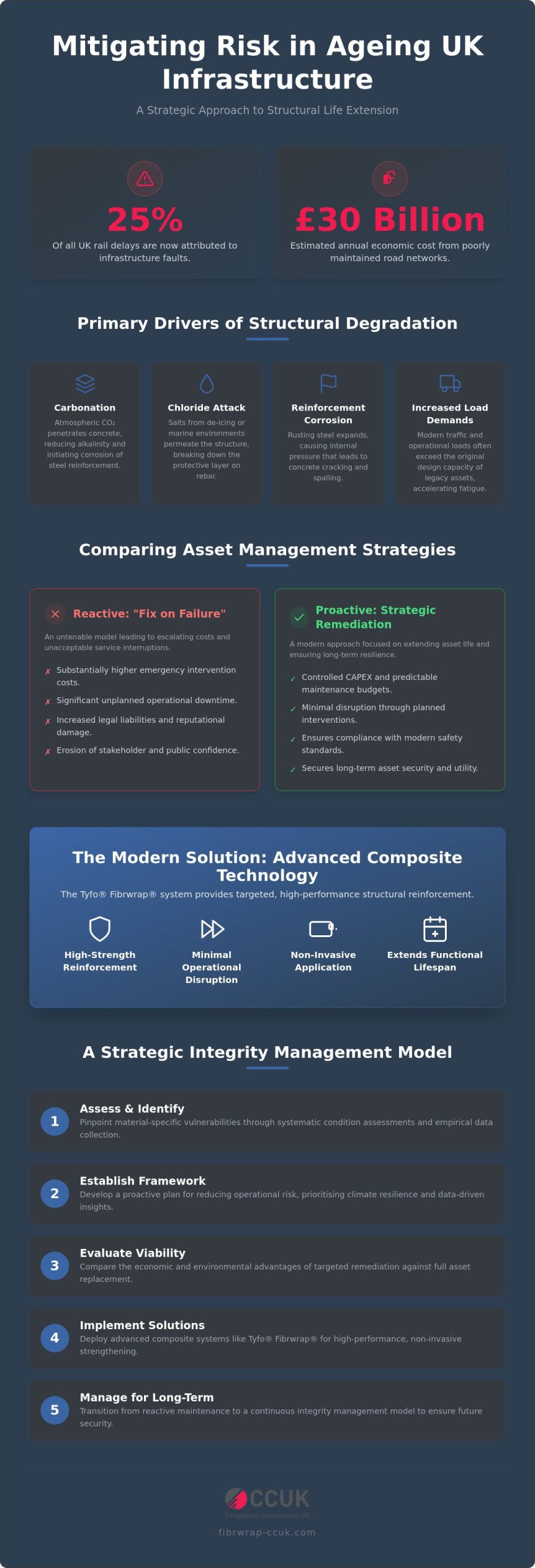
With a quarter of all UK rail delays now attributable to infrastructure faults, the financial and operational burden of our legacy built environment has reached a critical threshold. As assets such as concrete bridges and masonry viaducts exceed their original design lives, the challenge of reducing operational risk from ageing assets becomes a matter of national economic resilience. You’re likely facing the relentless pressure of escalating maintenance costs whilst attempting to meet modern safety standards with structures built decades ago. Unplanned downtime is no longer just a logistical inconvenience; it’s a significant liability that threatens the continuity of essential services.
This article outlines a strategic engineering approach to these structural vulnerabilities, demonstrating how advanced composite technology can mitigate risk more effectively than traditional methods. You’ll discover a clear framework for assessing structural integrity and an evidence-based justification for choosing targeted repair over full replacement. We’ll examine the technical performance of Carbon Fibre Reinforced Polymer (CFRP) and the Tyfo® Fibrwrap® system, providing a methodology for extending the utility of critical infrastructure through sophisticated material science and disciplined engineering rigour.
Key Takeaways
- Identify the primary drivers of structural obsolescence, including material-specific vulnerabilities such as carbonation, chloride attack, and reinforcement corrosion.
- Establish a proactive framework for reducing operational risk from ageing assets by prioritising systematic condition assessments and empirical data collection.
- Evaluate the economic and environmental advantages of structural life extension, comparing the significant CAPEX of replacement against the efficiency of targeted remediation.
- Discover the technical performance of Tyfo® Fibrwrap® systems, which provide high-strength reinforcement whilst minimising operational disruption through non-invasive application.
- Justify the transition from reactive maintenance to a strategic integrity management model that ensures long-term security and compliance with modern safety standards.
The Landscape of Ageing UK Infrastructure and Operational Risk
The UK’s built environment is currently navigating a period of unprecedented structural stress. According to the National Engineering Policy Centre’s December 2025 report, “Reviving our Ageing Infrastructure”, a significant portion of the nation’s critical assets is approaching the end of its intended service life. This transition represents a systemic challenge for asset managers who are tasked with reducing operational risk from ageing assets whilst maintaining service continuity across transport and utility networks. The sheer scale of this task is reflected in current data, which indicates that 17% of the local road network in England and Wales is in poor condition, contributing to an estimated £30 billion annual cost to the UK economy through congestion and surface deterioration.
Operational risk is the intersection of structural health and performance reliability. When structural components degrade, the risk isn’t merely a localised failure but a potential cascade that impacts wider business operations. For instance, with a quarter of all rail delays currently attributed to infrastructure faults, the link between physical asset health and operational efficacy is undeniable. The establishment of the National Infrastructure and Service Transformation Authority (NISTA) in April 2025 underscores the government’s recognition that a more disciplined, data-led approach is required to manage these vulnerabilities. These shifts in governance mirror the 2024 revisions to ISO 55000, which emphasise the necessity of climate resilience and data-driven asset management as core components of modern infrastructure strategy.
The Mechanics of Asset Ageing
Structural assets, particularly those composed of reinforced concrete or masonry, are subject to predictable yet destructive chemical processes. In the UK’s temperate maritime climate, high humidity and fluctuating temperatures facilitate the ingress of chlorides and the progression of carbonation, which eventually compromises the structural integrity of the internal reinforcement. Modern operational demands often impose axial and shear loads that far exceed the original design specifications of these historical assets. This discrepancy between legacy capacity and current demand accelerates fatigue, reducing the safety margins that were envisioned during the initial construction phases.
The Consequences of Reactive Risk Management
Adhering to a “fix on failure” model is increasingly viewed as an untenable strategy that contradicts the core principles of modern asset management. The financial burden of emergency interventions is substantially higher than that of planned strengthening; such reactive repairs often involve significant indirect costs, including legal liabilities and the erosion of stakeholder confidence. By prioritising the extension of an asset’s functional lifespan through bespoke engineering, organisations can avoid the catastrophic downtime associated with structural obsolescence. Proactive measures are essential for reducing operational risk from ageing assets, ensuring that essential infrastructure remains resilient against both environmental degradation and evolving safety regulations.
Categorising Structural Risks: Material Degradation and Obsolescence
Effective management of infrastructure requires a granular understanding of the mechanisms that compromise long-term performance. Primary drivers of structural risk are generally bifurcated into physical material degradation and functional obsolescence. Whilst the former involves the tangible decay of structural components, the latter refers to a state where the original design parameters are no longer sufficient to support modern load requirements or safety protocols. Successfully reducing operational risk from ageing assets depends on the ability to distinguish between these factors through empirical evidence rather than anecdotal observation. Precision in this categorisation ensures that remediation strategies are both technically appropriate and economically viable.
The economic and societal implications of these risks are profound. Whilst much of the discourse regarding infrastructure challenges originated in international contexts, such as the analysis of The Landscape of Ageing UK Infrastructure and its global parallels, the technical reality for UK asset controllers is often defined by localised chemical interactions. These interactions, if left unmonitored, lead to latent defects that can manifest as sudden, catastrophic failures, disrupting the business continuity discussed in previous sections.
Chemical and Physical Deterioration Profiles
In reinforced concrete structures, carbonation and chloride attack represent the most significant threats to longevity. Carbonation occurs when atmospheric carbon dioxide penetrates the concrete, lowering the pH level and causing the protective passivation layer around the steel reinforcement to dissipate. This leads to expansive corrosion, resulting in concrete spalling and a significant reduction in load-bearing capacity. Similarly, the Alkali-Silica Reaction (ASR), often found in older UK structures, causes internal swelling and cracking that compromises the matrix of the concrete itself. In masonry assets, the failure of historical tie-bars or the erosion of mortar joints often leads to progressive structural instability, necessitating specialised masonry reinforcement to restore equilibrium.
Quantifying Risk through Structural Testing
Quantifying these risks requires a methodical approach to structural testing. Non-destructive testing (NDT) techniques, such as ground-penetrating radar and ultrasonic pulse velocity, allow for the identification of internal voids and delamination without compromising the asset’s current utility. These are often supplemented by intrusive methods, including carbonation depth analysis and pull-off tests, to determine the exact bond strength of the substrate. Establishing these baselines is the prerequisite for implementing effective structural repairs. By utilising data-driven assessments, engineers can develop bespoke design solutions that address specific material weaknesses whilst reducing operational risk from ageing assets through targeted, high-performance interventions.
Evaluating the Viability of Asset Remediation vs Replacement
The decision to decommission a structural asset or invest in its rehabilitation is a critical juncture in modern infrastructure management. For technical professionals and asset controllers, the assumption that full replacement offers the most secure long-term path is increasingly challenged by the reality of restricted capital budgets and the necessity of maintaining service continuity. Reducing operational risk from ageing assets requires a methodical evaluation that balances the immediate capital expenditure (CAPEX) of new construction against the strategic operational expenditure (OPEX) of a comprehensive life extension programme. This assessment must account for both the direct costs of engineering and the indirect, often more substantial, costs associated with service disruption.
A structured approach to this dilemma prioritises the preservation of existing utility through advanced material science. By extending the functional lifespan of an asset, organisations can defer the massive financial and logistical burden of demolition and reconstruction. This strategy is particularly effective when dealing with legacy structures where the original design capacity is still fundamentally sound but requires targeted reinforcement to meet contemporary performance demands. The objective is to close the gap between current structural health and required safety standards through precise, non-invasive interventions.
Cost-Benefit Analysis of Structural Strengthening
Calculating the Total Cost of Ownership (TCO) provides a more accurate financial perspective than simple upfront estimates. Whilst the capital requirements of structural strengthening are often a fraction of those required for replacement, the true value lies in the mitigation of downtime. In sectors such as rail or energy, the economic impact of a total asset closure can quickly exceed the direct construction costs by a significant margin. Engaging specialist engineering contractors during the feasibility stage allows asset managers to access detailed data regarding the expected performance gains and remaining service life. This evidence-based approach ensures that investment is directed towards solutions that provide the highest degree of reliability and long-term security.
Environmental Impact and Embodied Carbon
Sustainability is now an integral component of structural engineering strategy. The construction industry is a major contributor to national carbon emissions, largely due to the energy-intensive production of cement and steel. Repairing and strengthening existing concrete and masonry assets is fundamentally more sustainable than demolition, as it preserves the embodied carbon already present within the structure. By adopting a circular economy model, organisations can significantly reduce their environmental footprint and align with the UK’s Net Zero targets. This approach avoids the massive waste management challenges and environmental toll of new material extraction, proving that reducing operational risk from ageing assets is entirely compatible with broader ecological and corporate responsibility goals.
A Proactive Framework for Reducing Operational Risk
Establishing a systematic approach to asset integrity management is the primary mechanism for reducing operational risk from ageing assets across complex infrastructure portfolios. This transition from reactive remediation to a disciplined, proactive framework ensures that structural vulnerabilities are addressed before they manifest as operational failures. By following a structured engineering trajectory, asset controllers can maintain compliance with evolving safety standards whilst optimising the functional lifespan of their structures. This methodical process is defined by five critical stages:
- Comprehensive Assessment: Utilising non-destructive testing and structural surveys to establish an empirical baseline of the asset’s current health.
- Gap Analysis: Conducting a rigorous comparison between the structure’s original design capacity and the performance demands imposed by modern loading requirements.
- Bespoke Engineering: Developing tailored strengthening solutions that integrate advanced material science with precise structural calculations.
- Professional Installation: Executing the remediation using specialised systems, such as CFRP or the Tyfo® Fibrwrap® system, under strict quality control protocols.
- Ongoing Monitoring: Implementing structural health monitoring to verify long-term performance and identify potential degradation trends early.
The Importance of Bespoke Engineering Design
Generic repair solutions often fail to address the specific operational risks inherent in unique civil structures. Effective life extension requires a deep integration of material science and structural engineering to ensure that the chosen intervention effectively closes the performance gap identified during assessment. By leveraging advanced design feature capabilities, engineers can specify the exact orientation and thickness of composite laminates required to resist specific shear or axial forces. This tailored approach ensures that the reinforcement is neither insufficient for the required loads nor excessively applied, providing a technically sound and cost-effective outcome.
Installation Rigour and Quality Assurance
The efficacy of any structural strengthening system is fundamentally dependent on the precision of its application. Specialist engineering contractors must maintain absolute rigour during site works to ensure that technical specifications are met and that the bond between the substrate and the reinforcement is optimal. The necessity of verifying material performance through on-site testing ensures that the theoretical design capacity is fully realised within the physical asset. Maintaining high standards of quality assurance throughout the installation phase mitigates the risk of premature system failure and provides the long-term security required for critical infrastructure continuity.
To discuss how a tailored integrity management strategy can support your portfolio, contact our specialist engineering team for a technical consultation.
Implementing Composite Solutions with Tyfo® Fibrwrap®
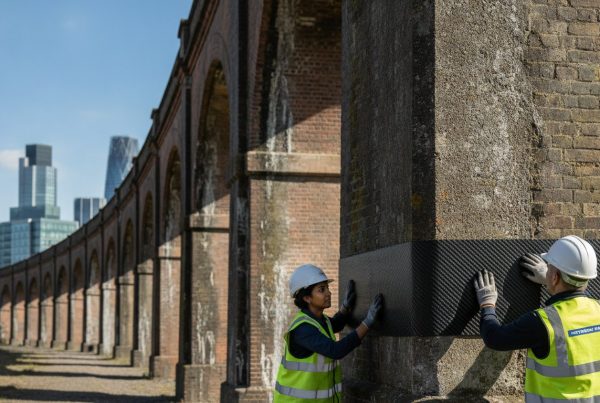
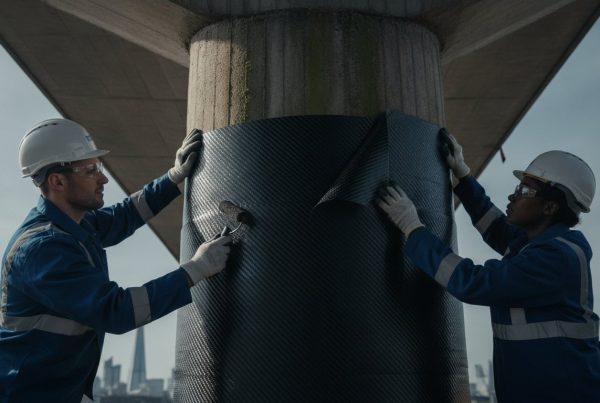
The final stage of a robust structural engineering strategy involves the implementation of high-performance materials designed to restore and enhance structural capacity. Carbon Fibre Reinforced Polymer (CFRP) has emerged as a primary instrument for reducing operational risk from ageing assets, offering a level of versatility that traditional materials cannot match. Unlike steel or concrete, these advanced composites are inherently resistant to the chemical degradation processes discussed in previous sections, such as chloride-induced corrosion and carbonation. The Tyfo® Fibrwrap® system, for which CCUK is the exclusive UK licensee, represents the pinnacle of this technology, providing a high-strength, low-weight reinforcement solution that is adaptable to a vast array of structural geometries.
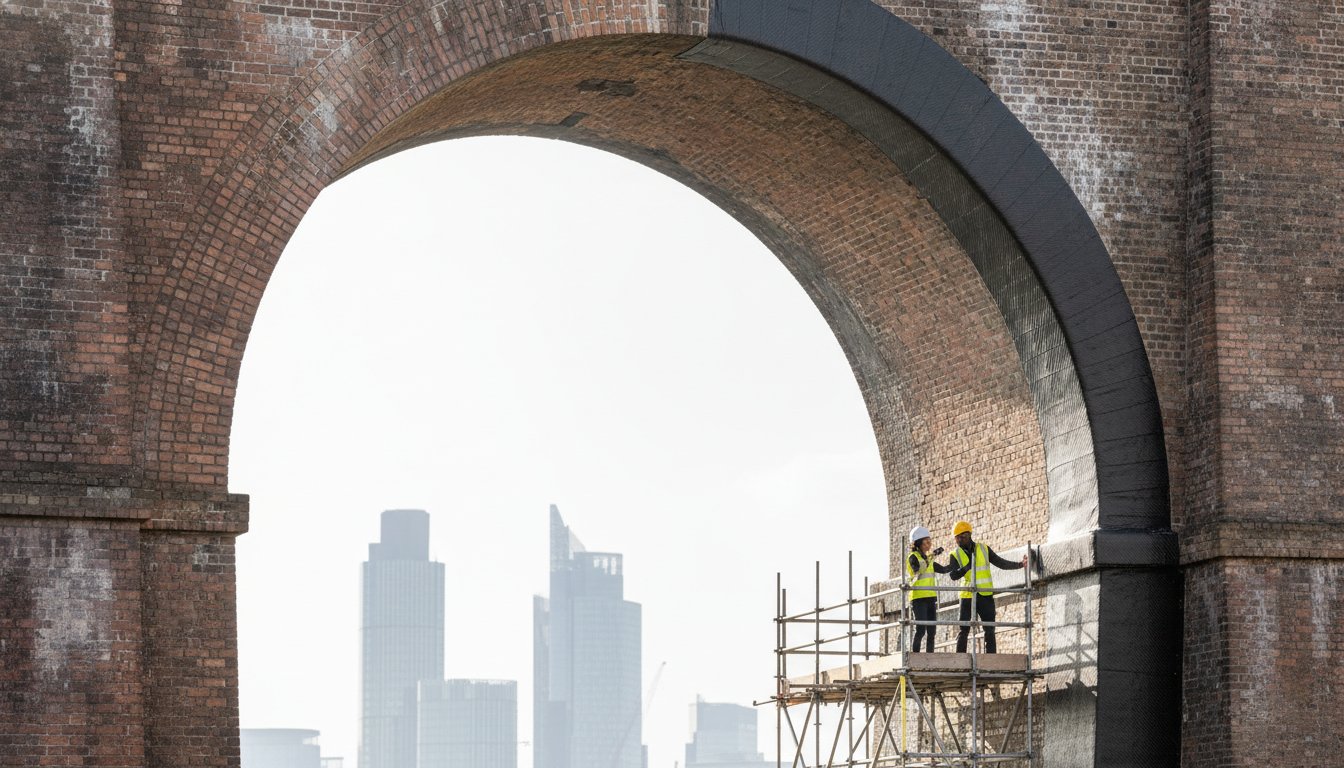
Applications for these systems are diverse, spanning bridge rehabilitation, pipeline strengthening, and seismic retrofitting. In the context of the UK’s ageing infrastructure, significant increases in load-bearing capacity are achieved by wrapping or bonding these materials to existing masonry and concrete without the need for intrusive structural changes. This capability is essential for managing the transition from legacy design specifications to modern performance requirements, ensuring that critical assets remain functional and safe for decades to come.
Minimising Weight and Maximising Performance
A compelling engineering argument is made for CFRP based on its superior strength-to-weight ratio compared to traditional steel plate bonding. Steel interventions often introduce substantial additional dead loads to a structure, which can necessitate further reinforcement of the foundations or supporting members. In contrast, CFRP adds negligible weight whilst providing equivalent or superior tensile strength. The physical properties of these materials facilitate a rapid application process, which results in significantly reduced site downtime and lower economic costs associated with service disruption. For detailed specifications on the installation process and material properties, professionals should consult the Tyfo Fibrwrap technical guide.
Securing the Future of Critical Assets
Achieving a 50+ year life extension for an asset requires materials that can withstand the rigours of complex industrial and environmental conditions. Exceptional durability is provided by advanced composites, which remain unaffected by moisture, salt, or industrial chemicals that typically compromise traditional reinforcement. This resilience makes these systems an ideal choice for reducing operational risk from ageing assets in high-stakes environments where structural reliability is non-negotiable. By integrating these sophisticated science-led solutions into a broader asset management framework, organisations can transition from a state of vulnerability to one of long-term security and sustainability.
The preservation of our infrastructure requires more than just repair; it demands a strategic engineering response that prioritises longevity and performance. Contact CCUK for an expert structural assessment of your ageing assets and discover how our bespoke composite solutions can secure your operational future.
Securing Long-Term Infrastructure Resilience
The transition from a reactive maintenance model to a disciplined, proactive integrity strategy is essential for reducing operational risk from ageing assets across the UK’s infrastructure network. By prioritising empirical condition assessments and adopting advanced composite solutions, asset controllers can successfully bridge the gap between legacy structural capacity and modern performance demands. This strategy not only preserves the embodied carbon within existing structures but also provides a technically superior alternative to the logistical and financial burden of full replacement.
As the exclusive UK licensee for Tyfo® Fibrwrap® systems, CCUK provides the engineering rigour and bespoke design expertise required to manage high-consequence infrastructure remediation. Our specialist team is focused on delivering life-extension programmes that ensure the long-term security of your most critical assets through proven material science and precise application. Take the first step towards a more resilient portfolio by choosing a strategy grounded in technical authority and engineering excellence.
Request a Specialist Structural Assessment for Your Ageing Assets
Proactive structural management remains the most effective way to safeguard the continuity of essential services for the decades ahead.
Frequently Asked Questions
What are the most common operational risks associated with ageing infrastructure?
The primary operational risks include unplanned service disruptions, catastrophic structural failure, and escalating maintenance expenditures as assets reach their design life limits. In sectors like transport and utility networks, reducing operational risk from ageing assets is essential to prevent significant economic liabilities and safety hazards that can compromise the resilience of the built environment.
How does structural deterioration impact the insurance and liability of an asset?
Structural deterioration significantly elevates the risk profile of an asset, which often results in increased insurance premiums or the imposition of restrictive policy conditions. Asset controllers bear the legal liability for structural integrity; failure to address known material degradation through documented engineering strategies can lead to severe regulatory penalties and litigation in the event of a structural incident.
Why is proactive structural strengthening more cost-effective than reactive repair?
Proactive strengthening prevents the exponential costs associated with emergency interventions and the substantial indirect losses caused by unplanned operational downtime. By investing in life extension before critical failure occurs, organisations can defer massive capital expenditure for full replacement whilst ensuring the continuous safety and performance of the structure under modern loading demands.
Can advanced composites like CFRP be used on heritage or listed structures?
Advanced composites such as Carbon Fibre Reinforced Polymer (CFRP) are highly suitable for heritage or listed structures due to their non-invasive application and low physical profile. These materials allow for significant strengthening whilst preserving the historical character and aesthetic integrity of the asset, which is often a mandatory requirement for conservation in the UK.
What is the expected life extension provided by a Tyfo® Fibrwrap® installation?
A professionally designed and installed Tyfo® Fibrwrap® system is engineered to provide a functional service life extension of 50 years or more. This longevity is achieved through the material’s inherent resistance to environmental factors, such as chloride ingress and carbonation, which typically compromise the durability of traditional reinforced concrete and masonry structures.
How do you assess the structural capacity of an asset with no original design drawings?
When original design records are unavailable, structural capacity is established through a combination of non-destructive testing (NDT) and intrusive material sampling. Ground-penetrating radar and ultrasonic pulse velocity tests are utilised to map internal reinforcement, whilst core sampling determines the current compressive strength of the concrete matrix to build an accurate structural model.
What role does structural health monitoring play in reducing operational risk?
Structural health monitoring (SHM) provides the real-time empirical data necessary for reducing operational risk from ageing assets by identifying performance anomalies before they escalate. This data-driven approach allows asset managers to transition from scheduled maintenance to a more efficient, condition-based model that prioritises interventions based on actual structural behaviour and environmental stress.
Is it possible to strengthen an asset whilst it remains fully operational?
Strengthening an asset whilst it remains fully operational is a core advantage of using composite systems like the Tyfo® Fibrwrap® system. The non-invasive nature and rapid installation process of CFRP often eliminate the need for total closures, allowing essential infrastructure, such as bridges or pipelines, to continue service throughout the remediation programme.