
The traditional assumption that structural degradation necessitates total demolition is being rendered obsolete by advancements in composite materials science. Asset controllers frequently encounter the challenges of carbonation or chloride-induced corrosion, which compromise the integrity of essential concrete infrastructure. You likely recognise that balancing the need for increased load-bearing capacity with strict regulatory compliance is a complex engineering hurdle. This guide provides an authoritative exploration of externally bonded reinforcement for concrete, a design-led system that transforms the performance of existing assets without the weight or disruption of traditional methods.
By leveraging high-performance Carbon Fibre Reinforced Polymer (CFRP) technology, including proprietary systems like Tyfo® Fibrwrap®, engineers can achieve significant structural life-extension. We’ll explore the technical specifications of these materials in alignment with BS EN 1504 and the Concrete Society’s TR55. You’ll gain a comprehensive understanding of how these lightweight solutions meet the rigorous demands of the UK’s 10-year infrastructure strategy whilst adhering to the latest standards such as BS EN 1992-1-1:2023. This analysis moves from material properties to practical application, ensuring your projects remain both safe and compliant.
Key Takeaways
- Determine how the transition from traditional steel plate bonding to advanced composite systems can enhance the longevity of critical infrastructure.
- Identify the mechanical performance characteristics of fibre-reinforced polymers and the role of epoxy resin matrices in facilitating stress transfer.
- Analyse the logistical and durability advantages of externally bonded reinforcement for concrete when compared to traditional, high-mass strengthening methods.
- Recognise why a design-led approach, supported by carbonation and chloride testing, is necessary for developing a bespoke engineering solution.
- Specify the rigorous quality assurance protocols and environmental parameters required to ensure successful installation and long-term asset security.
The Evolution of Externally Bonded Reinforcement (EBR) in UK Engineering
The discipline of structural strengthening has undergone a significant paradigm shift, transitioning from invasive heavy-engineering interventions to the sophisticated application of externally bonded reinforcement for concrete. This methodology is defined by the installation of high-strength materials onto the exterior surfaces of structural members to enhance their flexural, shear, or axial capacity. In the context of the UK’s ageing industrial landscape and transport networks, these interventions are vital for maintaining public safety and operational continuity. As the government executes its 10-year infrastructure strategy, focusing on a planned £725 billion investment between 2025 and 2035, the requirement for reliable, long-term remediation has never been more acute. This necessity is further underscored by the Planning and Infrastructure Act 2025, which aims to streamline project delivery whilst maintaining the rigorous safety standards required for critical assets.
From Steel Plates to Carbon Fibre Composites
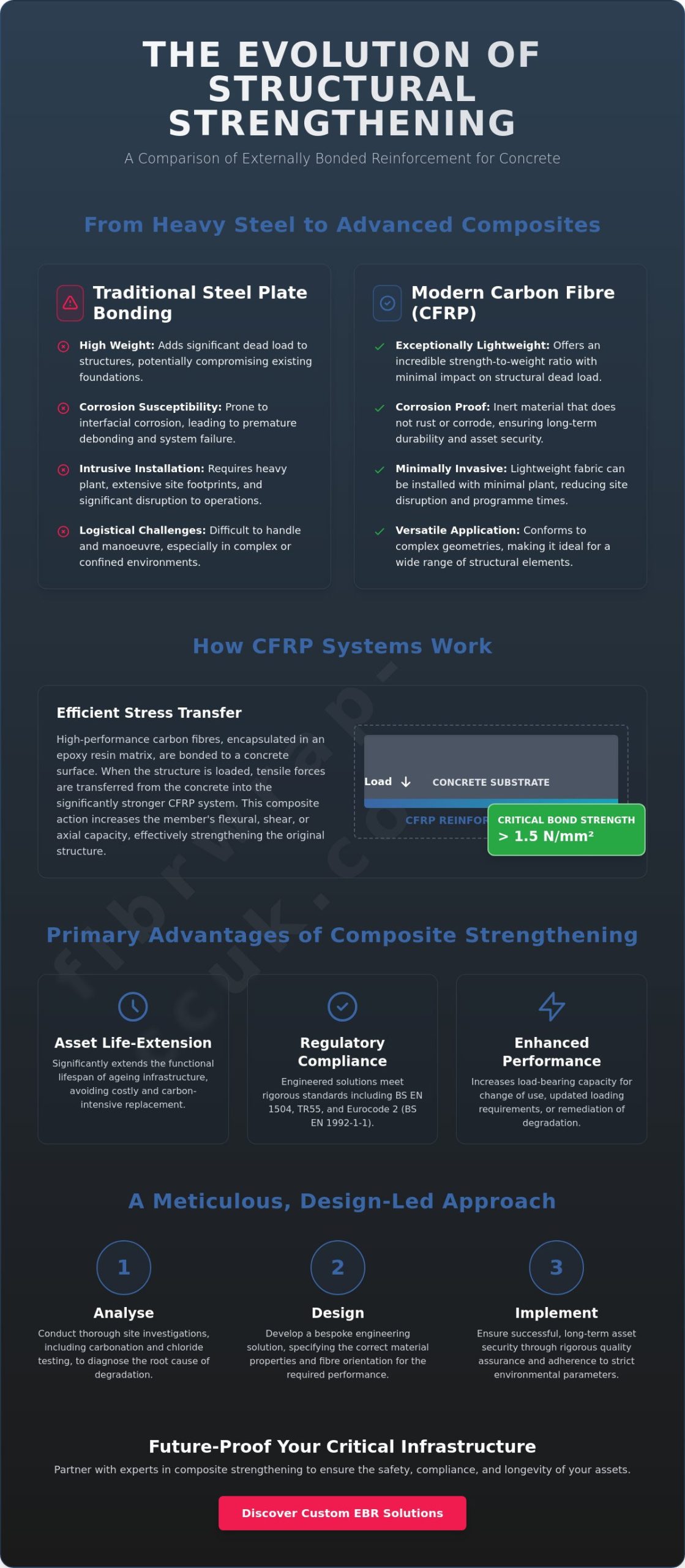
Historically, structural enhancement was often achieved through the bonding of heavy steel plates to the tension face of concrete elements. Whilst effective in increasing stiffness, this approach was frequently compromised by the inherent weight of the steel and its susceptibility to interfacial corrosion, which could lead to premature debonding. The emergence of Carbon Fibre Reinforced Polymer (CFRP) as the modern benchmark for externally bonded reinforcement for concrete has addressed these limitations. CFRP systems provide an exceptional weight-to-strength ratio, allowing for substantial load-bearing increases without adding significant dead weight to the structure. This is particularly critical in complex environments where the existing foundations or support structures lack the capacity to accommodate traditional heavy-duty strengthening. The installation process is significantly less intrusive, requiring minimal plant and reduced site footprints.
EBR as a Catalyst for Asset Life-Extension
The environmental imperative to avoid wholesale demolition is central to modern engineering practice. By implementing targeted strengthening, assets that would otherwise be decommissioned due to carbonation or chloride attack can be retained and repurposed. This aligns with the UK’s 2026 sustainability targets, where the focus has shifted from carbon-intensive new-build projects to the intelligent remediation of reinforced concrete structures. Such interventions facilitate a change in building use, ensuring that legacy assets remain functional under modern loading requirements without the ecological cost of replacement. For a deeper analysis of these methodologies, our guide on structural repairs provides further context on the broader landscape of asset remediation. This design-led approach ensures that the functional lifespan of a structure is prolonged, directly supporting the projected 2.8% growth in construction output for 2026 through the efficient use of existing resources.
Technical Mechanics and Material Properties of EBR Systems
EBR systems function as composite structures where high-modulus fibres are encapsulated within a structural epoxy resin matrix. This synergy allows for the efficient redistribution of internal stresses. In a typical application of externally bonded reinforcement for concrete, the tensile forces are transferred from the concrete substrate into the reinforcement through a high-performance adhesive bond. The integrity of this interface is paramount; the system’s efficacy is entirely dependent on the quality of the bond, which necessitates rigorous surface preparation to achieve a specific pull-off strength, typically exceeding 1.5 N/mm². This mechanical bond ensures that the composite material and the concrete substrate act monolithically under load.
Under flexural loading, the reinforcement is bonded to the tension face of the member, thereby increasing the moment capacity. In shear applications, fibres are oriented perpendicular to potential diagonal tension cracks, effectively acting as external stirrups. The precision of fibre orientation and resin saturation determines the load-carrying efficiency. For complex scenarios requiring bespoke calculations, technical professionals often review the engineering design features of advanced composite systems to ensure structural compatibility. This methodical approach guarantees that the intervention addresses the specific failure modes identified during the initial structural assessment.
The Role of Carbon Fibre Reinforced Polymer (CFRP)
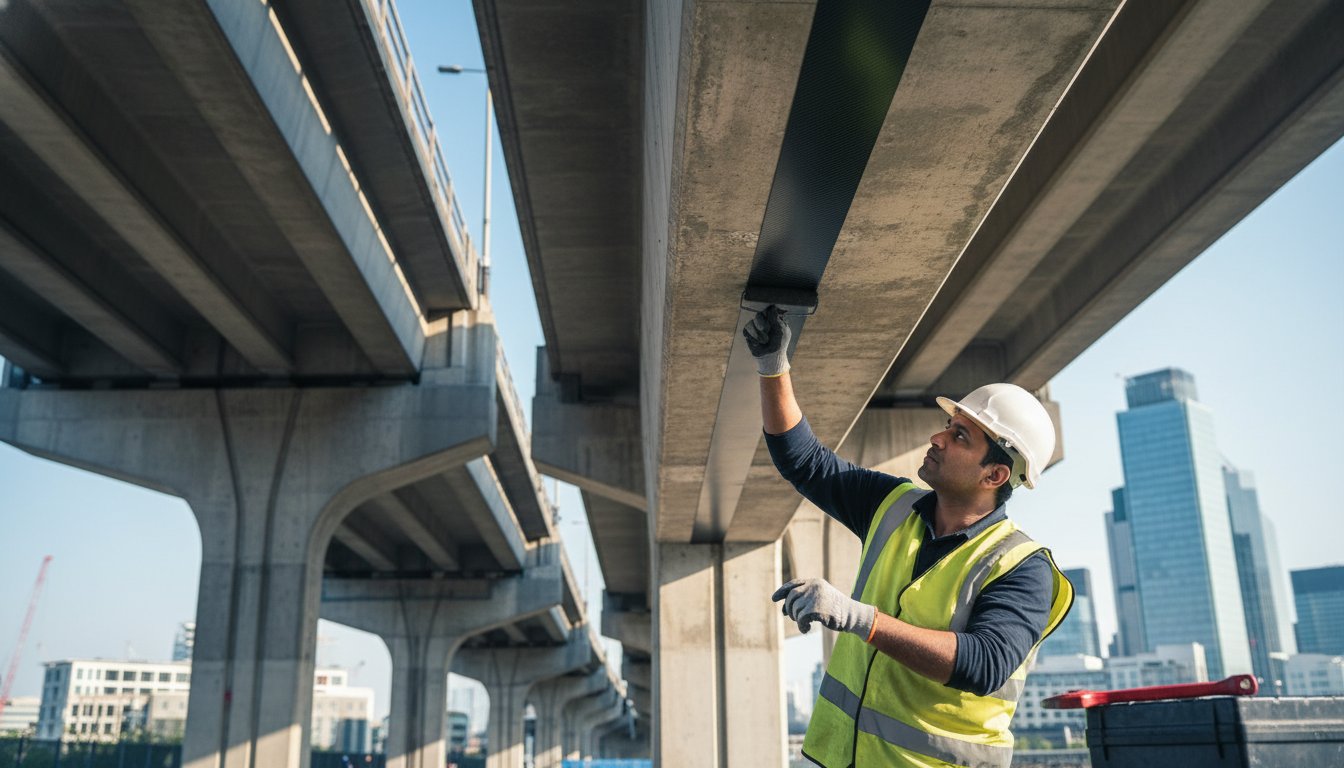
Carbon fibre is selected for its exceptional tensile properties and corrosion resistance. Pultruded CFRP plates are typically utilised for flexural strengthening due to their high longitudinal stiffness and consistent cross-sectional area. Conversely, unidirectional fabrics provide the flexibility required for column confinement or shear wrapping of beams. A critical advantage of CFRP is its thermal compatibility with concrete; the coefficient of thermal expansion is sufficiently similar to ensure that bond stresses remain within permissible limits during temperature fluctuations. This stability is essential for maintaining the long-term integrity of externally bonded reinforcement for concrete in varied UK climates.
Compliance with BS EN 1504 Standards
Adherence to BS EN 1504-4 is a non-negotiable requirement for structural bonding in the UK. This standard specifies the performance characteristics of the adhesives and the overall system, ensuring that the materials can withstand long-term environmental exposure and sustained loading. For public infrastructure, the use of CE-marked systems is mandatory to provide the necessary assurance of quality and safety. Contractors must implement rigorous testing protocols, including bond pull-off tests and resin cure monitoring, to validate that the installed system meets the design specifications. This methodical approach ensures that the life-extension of the asset is grounded in empirical performance data. Ensuring your project meets these benchmarks is a vital step in maintaining structural safety.
Comparing EBR Solutions: CFRP vs. Traditional Methods
Selecting an appropriate strengthening methodology requires a rigorous evaluation of mechanical performance, logistical constraints, and total lifecycle costs. Traditional interventions, such as steel plate bonding or concrete jacketing, have historically provided reliable increases in structural capacity. However, these methods impose significant dead weight on the existing structure and often require extensive temporary works and heavy plant. In contrast, externally bonded reinforcement for concrete utilising Carbon Fibre Reinforced Polymer (CFRP) offers a high-strength, low-mass alternative that simplifies the installation process in complex environments. The logistical advantages are particularly evident in constrained spaces like service tunnels or basement substructures, where the manual handling of heavy steel sections is often precluded by limited access and headroom.
Durability remains a primary differentiator when considering a 50-year design life. Whilst steel systems are susceptible to interfacial corrosion and require periodic maintenance of protective coatings, composite EBR systems are inherently resistant to environmental degradation and chemical attack. This superior corrosion resistance significantly reduces the long-term maintenance burden for asset owners. The speed of application also plays a critical role in project ROI; for instance, the rapid curing times of modern resins allow for a faster return to service for critical infrastructure, such as highway bridges governed by National Highways standard CD 371. Minimising traffic management durations or industrial downtime provides a clear economic advantage that often outweighs the initial material costs of advanced composites.
Tyfo® Fibrwrap®: The Proprietary Advantage
The Tyfo® Fibrwrap® system represents a specialised advancement in the field of externally bonded reinforcement for concrete. Unlike rigid pultruded plates, this system utilises a “wet-lay” application process where high-strength fibres are saturated with resin on-site before being applied to the concrete substrate. This provides unparalleled versatility for irregular geometries, such as circular columns, flared pier heads, or arched soffits. The system acts as a seamless, high-performance skin that conforms to the structural profile, ensuring uniform stress distribution. Technical professionals seeking detailed execution protocols should consult our Tyfo Fibrwrap installation guide for comprehensive specifics on saturation and placement.
Performance Comparison and Selection Criteria
The choice between strengthening systems is typically dictated by the specific defects identified during structural surveys and the required increase in load-carrying capacity. The following table illustrates the performance characteristics of the primary strengthening methodologies utilised in the UK market:
| Criteria | Steel Plate Bonding | Concrete Jacketing | CFRP (EBR) |
|---|---|---|---|
| Self-Weight | High | Very High | Negligible |
| Installation Speed | Moderate | Slow | Rapid |
| Corrosion Resistance | Low (Requires coating) | Moderate | Excellent |
| Geometric Versatility | Limited (Flat surfaces) | Moderate | High (Conforms to shape) |
For projects where structural dimensions must remain unchanged, such as maintaining bridge clearances or internal floor heights, CFRP is the optimal choice due to its low profile. Conversely, concrete jacketing might be considered where significant fire resistance or high stiffness increases are the primary drivers. However, the non-intrusive nature of CFRP makes it the preferred solution for most high-specification infrastructure remediation projects. If you require a bespoke assessment for a specific asset, you may contact our technical team to discuss your requirements.
The Design-Led Approach to Externally Bonded Reinforcement
Successful structural strengthening is never a commodity-driven process. It requires a rigorous, design-led methodology where every intervention is treated as a bespoke engineering challenge. Whilst off-the-shelf composite materials are widely available, their efficacy is entirely dependent on precise calculation and structural modelling. Modern externally bonded reinforcement for concrete relies heavily on Finite Element Analysis (FEA) to simulate complex stress distributions and identify critical areas where reinforcement is most required. This level of precision ensures that the added materials work in harmony with the existing reinforced concrete, preventing premature failure modes such as brittle debonding. Additionally, the design phase must account for temporary works; propping or shoring is often required to relieve dead loads during the application and curing of the resin matrix, ensuring the new reinforcement is fully engaged when the structure is re-loaded.
Surveying and Feasibility Studies
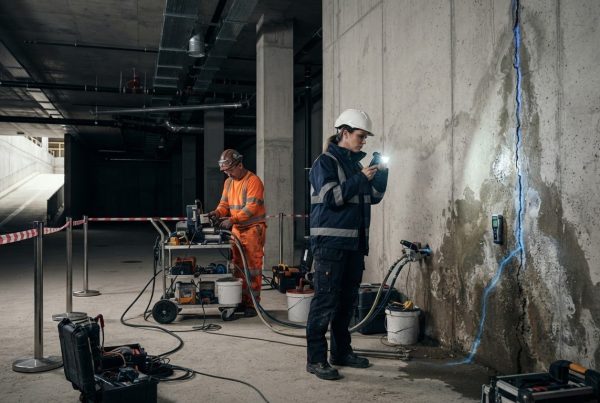
A comprehensive structural survey serves as the essential prerequisite for any strengthening project. Engineers must first identify the root causes of degradation, such as carbonation-induced corrosion or chloride attack, which can severely compromise the alkalinity of the concrete and the integrity of the internal rebar. If the substrate is fundamentally unsound, the application of externally bonded reinforcement for concrete will be ineffective. Testing protocols typically include cover meter surveys, half-cell potential mapping, and pull-off tests to evaluate the tensile strength of the concrete surface. These data points allow the design team to determine if the substrate can facilitate the necessary stress transfer between the concrete and the bonded composite. Spalling must be remediated and the substrate restored before any strengthening can commence.
Bespoke Engineering and Calculations
At Composites Construction UK, we develop tailored design solutions that address the unique load-bearing requirements of each asset. The calculation process involves determining the exact area of CFRP required to achieve the target load increase whilst maintaining the required safety margins. A critical aspect of this phase is the management of anchorage zones. Peeling stresses at the ends of the bonded plates or fabrics can lead to sudden debonding if not properly managed through mechanical anchors or extended bond lengths. Our engineers calculate these anchorage requirements with precision, ensuring the system remains secure under both serviceability and ultimate limit states. This methodical approach to engineering ensures that the life-extension of the asset is both predictable and robust. For technical guidance on your specific structural requirements, you can request a bespoke technical assessment from our engineering team.
Implementation and Quality Assurance in EBR Projects
The transition from theoretical design to physical application is the most critical phase in the life-extension of an asset. The performance of externally bonded reinforcement for concrete is fundamentally reliant on the quality of execution and the strict adherence to environmental controls. A specialist engineering contractor must manage every variable, from substrate moisture levels to resin stoichiometry, to ensure the composite system achieves its design strength. Without such rigour, the risk of interfacial failure increases, potentially compromising the structural safety of the bridge or industrial facility. Precision in execution is the final safeguard for structural reliability; whilst the design sets the parameters, the site-level application determines the ultimate success of the project.
Environmental parameters must be monitored continuously during the installation process. The substrate temperature should typically be at least 3°C above the dew point to prevent moisture condensation, which would inhibit the adhesive bond. Quality assurance is maintained through a combination of in-situ testing and laboratory analysis. Witness samples, consisting of laminates cured under identical site conditions, are often tested for tensile strength and glass transition temperature (Tg) to verify that the resin has reached its full mechanical properties. Additionally, pull-off tests are conducted on non-critical areas of the application to confirm that the bond strength meets the requirements specified in BS EN 1504-4. This creates a robust quality record that provides asset controllers with the necessary assurance of long-term security.
Precision Installation Techniques
Mechanical preparation is the first prerequisite. The concrete surface is typically grit-blasted or diamond-ground to remove laitance and expose the aggregate, achieving the required surface profile. Once the substrate is cleaned of dust and contaminants, a low-viscosity primer is applied to penetrate the pores and consolidate the surface. For wet-lay systems like Tyfo® Fibrwrap®, the fabric is saturated with a structural epoxy resin using a mechanical saturator to ensure a consistent resin-to-fibre ratio. Finally, a protective topcoat is applied. This layer is essential for providing UV resistance and can be colour-matched to ensure the strengthening system integrates aesthetically with the surrounding structure.
Long-Term Monitoring and Maintenance
Post-installation, a structured inspection regime is necessary to monitor the long-term behaviour of the strengthened member. Guidance provided in the Concrete Society’s Technical Report 57 (TR57) outlines the frequency and methodology for these assessments, focusing on bond integrity and the absence of delamination. For critical infrastructure, real-time structural health monitoring (SHM) can be integrated using fibre-optic sensors or strain gauges embedded within the composite matrix. This allows for the continuous tracking of strain levels and provides early warning of any structural changes. For asset owners seeking to implement these advanced remediation strategies, a specialist consultation can provide the technical roadmap required for successful asset rehabilitation.
Securing the Future of UK Infrastructure through Advanced Engineering
The strategic integration of externally bonded reinforcement for concrete represents a fundamental shift towards more sustainable and efficient asset management. By prioritising the remediation of existing reinforced concrete over demolition, asset owners can meet evolving regulatory standards whilst ensuring long-term structural security. This technical guide has detailed how the transition from traditional steel to advanced CFRP systems, supported by rigorous finite element analysis and BS EN 1504 compliance, provides a non-intrusive pathway to asset life-extension. The success of these interventions is predicated on the synergy between sophisticated material science and precise, site-level execution.
As an industry leader with over 10 years of specialist structural strengthening expertise, Composites Construction UK remains committed to this design-led philosophy. Our position as the exclusive UK licensee for Tyfo® Fibrwrap® systems ensures access to proprietary technology that is validated through our in-house engineering consultancy and methodical quality assurance protocols. We invite you to contact our engineering team for a bespoke EBR design and installation proposal to discuss the specific requirements of your infrastructure. Together, we can ensure that critical assets remain resilient, compliant, and functional for decades to come.
Frequently Asked Questions
What is the primary purpose of externally bonded reinforcement for concrete?
The primary purpose of externally bonded reinforcement for concrete is the enhancement of structural capacity in existing members to accommodate increased loading or remediate degradation. It’s utilised to improve flexural, shear, and axial performance whilst maintaining the original structural geometry. This methodology is essential for life-extension in assets where change of use or environmental damage, such as carbonation, has compromised the safety margins of the original design.
Is CFRP strengthening more cost-effective than traditional steel plate bonding?
CFRP strengthening is frequently more cost-effective than traditional steel plate bonding when evaluating total project expenditure and lifecycle costs. Whilst material prices for composites are higher, the reduction in heavy plant requirements, labour hours, and site downtime often leads to a lower overall contract value. Additionally, the superior corrosion resistance of CFRP eliminates the need for periodic maintenance of protective coatings required by steel systems over a 50-year design life.
How long does an externally bonded reinforcement system typically last?
A correctly designed and installed system is intended to match or exceed the remaining service life of the parent structure, typically exceeding 50 years. Longevity is contingent upon the use of high-quality resin matrices and adherence to environmental standards during application. Regular inspections, as outlined in Technical Report 57, ensure that any localised issues are identified before they impact the global integrity of the strengthening system.
Can EBR be used to repair concrete that is already spalling or corroded?
EBR cannot be applied directly to concrete that is actively spalling or contains un-remediated corrosion. The substrate must first be restored through concrete repair techniques to provide a sound, alkaline environment and a stable surface for bonding. Strengthening is a secondary phase that proceeds only after the structural integrity of the base material is verified, ensuring the composite can effectively transfer stresses into the reinforced member.
What are the main causes of debonding in EBR systems and how are they prevented?
Debonding is primarily caused by inadequate surface preparation, moisture contamination during resin curing, or excessive peeling stresses at the reinforcement ends. These risks are mitigated through rigorous substrate profiling and the implementation of bespoke anchorage solutions during the design phase. Pull-off tests are mandatory during installation to validate that the bond strength exceeds the design requirements, typically 1.5 N/mm², ensuring monolithic behaviour under service loads.
Does EBR increase the fire rating of a concrete structure?
Standard EBR systems don’t inherently increase the fire rating of a structure because epoxy resins lose mechanical strength at relatively low temperatures. If a specific fire resistance period is required, the system must be encapsulated with specialised fire-protective coatings or thick-film intumescent layers. These additional measures protect the resin matrix from reaching its glass transition temperature, thereby maintaining structural capacity during a thermal event.
How much weight does CFRP add to a structure compared to concrete jacketing?
CFRP adds negligible dead weight to a structure, typically representing less than 1% of the mass of equivalent concrete jacketing solutions. A 1.2mm pultruded carbon plate provides substantial tensile capacity without necessitating the foundation upgrades often required for high-mass traditional methods. This characteristic is particularly advantageous for strengthening bridges and multi-storey structures where the existing load-bearing capacity of the substructure is already near its designed limit.
Is a structural survey mandatory before designing an EBR system?
A comprehensive structural survey and testing programme is mandatory before the design of any externally bonded reinforcement for concrete. This assessment identifies the current condition of the reinforcement, the depth of carbonation, and the actual compressive strength of the concrete substrate. Without these empirical data points, it’s impossible to calculate the required reinforcement area or ensure that the bond will remain stable under long-term sustained loading conditions.