

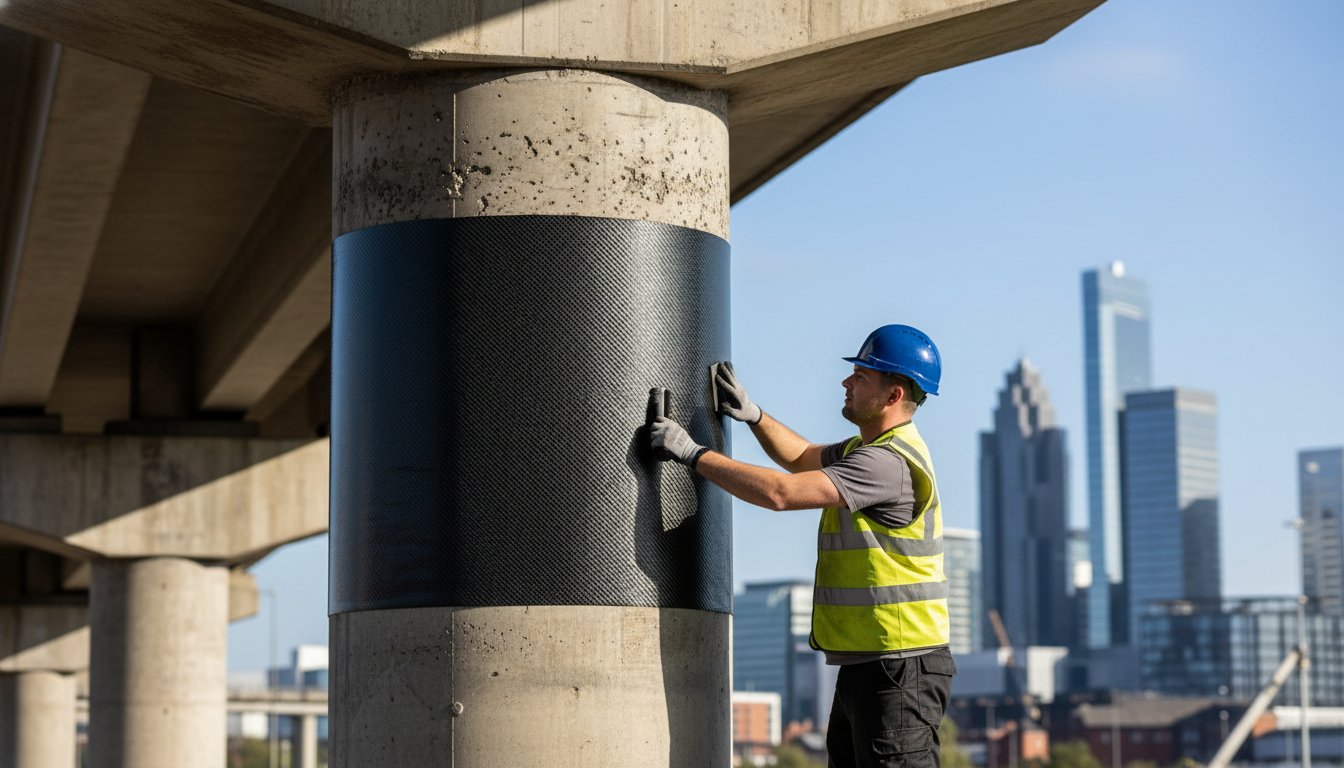
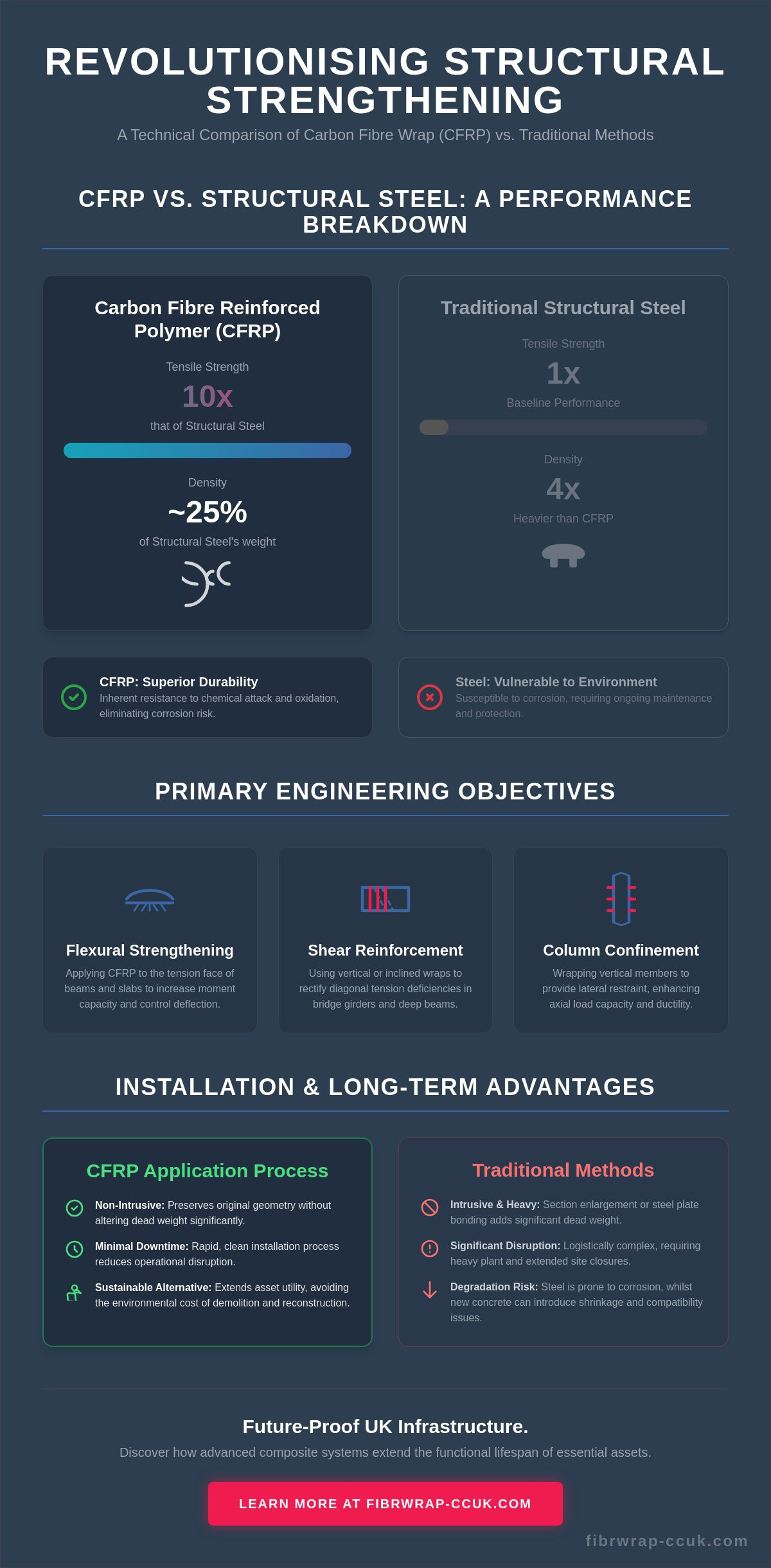
Carbon fibre reinforced polymer (CFRP) provides a tensile strength approximately ten times that of structural steel at roughly a quarter of the density, yet it remains a sophisticated intervention that many asset managers still overlook in favour of heavier, more intrusive methods. You’re likely aware that the accelerated degradation of concrete assets, coupled with the stringent requirements of the Building Safety Act 2022, necessitates a more agile approach to rehabilitation. Utilising a carbon fibre wrap for structural strengthening allows for significant increases in structural capacity, often exceeding 100%, without the dead weight or operational downtime associated with traditional concrete section enlargement.
This article provides a rigorous engineering analysis of CFRP systems, including proprietary solutions like Tyfo® Fibrwrap®, for the rehabilitation of critical UK infrastructure. We’ll explore how these systems align with the design guidance of Concrete Society Technical Report 55 (TR55) and the necessity of maintaining a “golden thread” of digital safety records. By the end of this technical overview, you’ll understand how to achieve compliance with modern UK engineering standards whilst extending the functional lifespan of essential assets through advanced material science.
Key Takeaways
- Understand the transition of high-performance composite technology from aerospace applications to the rigorous demands of civil engineering and infrastructure rehabilitation.
- Evaluate the technical superiority of carbon fibre wrap for structural strengthening, specifically its capacity to provide exceptional tensile strength without the prohibitive dead weight of traditional materials.
- Contrast non-intrusive application processes with traditional steel reinforcement methods to minimise operational downtime and avoid mechanical damage to existing substrates.
- Identify the essential diagnostic and design phases required to implement proprietary Tyfo® Fibrwrap® systems, ensuring compliance with stringent safety and regulatory standards.
- Analyse the economic and environmental benefits of prolonging asset utility through composite strengthening as a sustainable alternative to demolition and reconstruction.
The Evolution of Structural Strengthening: Defining Carbon Fibre Wrap Technology
Structural engineering has undergone a significant paradigm shift as advanced composite materials have migrated from high-performance aerospace applications into the domain of civil infrastructure rehabilitation. Carbon fibre wrap is technically defined as Carbon Fiber Reinforced Polymer (CFRP), a sophisticated composite system comprising high-modulus carbon filaments embedded within a specialised polymer resin matrix. Whilst traditional strengthening methodologies often necessitate the addition of substantial mass, the application of a carbon fibre wrap for structural strengthening allows for the precise recalibration of an asset’s load-bearing capacity without altering its original geometry or significantly increasing its dead weight.
The adaptation of this technology for the built environment was driven by the need for non-intrusive, durable solutions in challenging UK environments. Traditional methods, such as steel plate bonding or concrete section enlargement, are frequently hindered by their susceptibility to corrosion and the logistical complexity of installing heavy components. CFRP systems offer a distinct advantage through their inherent resistance to chemical attack and oxidation. This durability is coupled with an exceptional strength-to-weight ratio, where the material provides a tensile capacity approximately ten times that of structural steel whilst maintaining a fraction of the density. Consequently, these systems have become the preferred choice for engineers focused on the long-term life-extension of critical infrastructure.
The Composition of CFRP Systems
The performance of a CFRP intervention is dictated by the synergy between the carbon fabric and the bonding agent. Engineers typically specify unidirectional fabrics when the load path is clearly defined, such as in flexural reinforcement, whereas multidirectional fabrics are deployed to address complex, multi-axial stress states. The epoxy resin functions as the critical load-transfer medium, ensuring that stresses from the host substrate are effectively transitioned into the high-strength fibres. Within this technical framework, proprietary benchmarks such as Tyfo® Fibrwrap® systems are utilised to provide verified material properties that align with the bespoke engineering requirements of complex projects.
Primary Objectives of Composite Strengthening
Composite strengthening is deployed to resolve specific structural vulnerabilities that arise from increased loading requirements, design deficiencies, or material degradation. The primary engineering objectives include:
- Flexural Strengthening: The application of carbon fibre to the tension face of beams and slabs to increase their moment capacity and control deflection.
- Shear Reinforcement: The use of vertical or inclined wraps to rectify diagonal tension deficiencies, particularly in bridge girders and deep beams.
- Column Confinement: The wrapping of vertical members to provide lateral restraint, which enhances axial load capacity and improves ductility through the confinement of the concrete core.
By addressing these specific deficiencies with minimal thickness, CFRP systems ensure that the structural integrity of an asset is restored whilst maintaining its functional clearance and operational utility.
Mechanical Properties and Engineering Advantages of CFRP Systems
The mechanical profile of carbon fibre reinforced polymer systems is defined by an extraordinary tensile capacity that frequently exceeds 3,500 MPa, a value that surpasses the performance of standard structural steel by a factor of ten. Whilst steel remains a staple of construction, its weight and susceptibility to environmental degradation present significant engineering challenges. Utilising a carbon fibre wrap for structural strengthening allows for the restoration or enhancement of an asset’s integrity through a material that is significantly lighter and easier to handle. Unlike isotropic materials, the modulus of elasticity in CFRP can be precisely tailored through fibre orientation to align with the specific stress trajectories of the host structure, ensuring that reinforcement is applied exactly where it’s required.
Thermal compatibility is a critical consideration for infrastructure subjected to the fluctuating temperatures of the UK climate. CFRP systems possess a low coefficient of thermal expansion, which ensures they behave in a manner consistent with concrete and masonry substrates. This synergy prevents the development of interlaminar stresses that could otherwise lead to debonding or delamination over time. The efficacy of these materials in complex scenarios is well-documented, as seen in research regarding the Strengthening of Steel Girder Bridges Using FRP, which highlights how composite systems maintain structural performance under rigorous loading conditions.
Weight-to-Strength Efficiency
The application of a carbon fibre wrap for structural strengthening adds negligible dead load to an existing structure, a factor that is particularly vital when foundations are already operating near their design limits. Traditional steel sections or concrete jackets often require secondary strengthening of the footings to accommodate their own weight. The specific gravity of CFRP is approximately 1.6, representing a significant reduction when contrasted with the 7.8 value attributed to structural steel. For historic or sensitive structures, where additional mass could trigger further settlement or structural distress, this lightweight characteristic provides a non-disruptive path to life-extension. Technical professionals seeking to integrate these properties into an upcoming project may review our bespoke design features for more detailed system specifications.
Durability and Chemical Resistance
Composite materials are inherently non-corrosive, offering a permanent resolution to the pervasive issue of steel reinforcement oxidation. The carbon filaments remain unaffected by chlorides, sulphates, or the alkali-aggregate reactions that often plague coastal and industrial infrastructure. By encapsulating the concrete, the epoxy resin matrix acts as a high-performance barrier that significantly retards the rate of carbonation. This protective layer ensures that the underlying reinforcement is shielded from the elements, reducing the frequency of maintenance interventions and lowering the total lifecycle cost of the asset. Long-term performance data suggests that once a CFRP system is correctly installed, the requirement for subsequent structural repairs is substantially diminished.
Strategic Application: Carbon Fibre Wrapping vs Traditional Steel Reinforcement
Traditional structural interventions often rely on the mechanical attachment of steel plates, a process that inherently introduces risk to the host substrate. The requirement for extensive drilling to accommodate mechanical fixings can inadvertently damage internal reinforcement bars, potentially compromising the very asset the intervention aims to preserve. In contrast, the implementation of a carbon fibre wrap for structural strengthening utilises a high-performance adhesive bond that distributes loads uniformly across the surface area. This approach eliminates the need for invasive bolting and preserves the integrity of the existing concrete or masonry.
The application of CFRP systems is typically executed through “wet lay-up” or “pre-preg” techniques, both of which prioritise ease of handling in restricted environments. Unlike steel plate bonding, which necessitates heavy lifting equipment and temporary propping, carbon fibre fabrics are applied using manual techniques. Whilst steel is notoriously susceptible to crevice corrosion at the bond interface, carbon fibre systems maintain a monolithic, airtight seal. This encapsulation effectively prevents the ingress of moisture and oxygen, arresting the degradation cycle and ensuring long-term structural security.
Versatility remains a primary advantage of composite fabrics over rigid metallic alternatives. The pliable nature of the material allows for the seamless reinforcement of complex geometries, such as circular columns, arched bridges, and irregular pier caps. Continuous fibre paths can be maintained around corners and over curved surfaces, ensuring that the structural capacity is enhanced without the geometric constraints imposed by traditional materials.
Installation Speed and Operational Disruption
Minimising downtime is a critical requirement in live environments such as hospitals, data centres, or busy transport hubs where service interruptions are unacceptable. The use of a carbon fibre wrap for structural strengthening eliminates the need for welding, thereby removing fire risks and the associated requirement for “hot work” permits. Noise pollution is significantly reduced as the installation process avoids the heavy percussion and drilling required for steel anchorage. Project timelines are often compressed because the lightweight nature of the system allows for rapid deployment, ensuring that essential infrastructure remains operational throughout the strengthening process.
Aesthetics and Space Preservation
The ultra-thin profile of carbon fibre systems, which often measure less than 5mm in total thickness, ensures that the original architectural lines and functional clearances of a structure are preserved. This characteristic is vital for heritage assets or commercial spaces where head height and floor area are at a premium. Once the resin matrix has cured, the finished composite can be seamlessly integrated into the existing aesthetic through the application of protective or decorative coatings. Technical professionals may refer to our bespoke design features for further information on integrated structural solutions that balance high-performance reinforcement with architectural requirements.
The Engineering Lifecycle: From Structural Survey to Tyfo® Fibrwrap® Installation
The implementation of a carbon fibre wrap for structural strengthening demands a meticulous lifecycle approach that transcends simple material application. Successful rehabilitation depends on a rigorous diagnostic phase that precedes any physical intervention on the asset. A comprehensive structural survey is performed to quantify the extent of existing degradation, with a specific focus on carbonation depths, chloride ion concentrations, and the residual cross-sectional area of the internal steel reinforcement. These empirical data points inform the bespoke engineering calculations required to determine the precise volume, layer count, and orientation of the composite material. By establishing this baseline, the intervention becomes a targeted solution tailored to the specific stress states of the host structure.
Surface preparation represents the most critical variable in the longevity of the bond. The concrete substrate must be mechanically abraded to achieve a specific Concrete Surface Profile (CSP), usually through diamond grinding or grit blasting, to expose the coarse aggregate and ensure a clean, laitance-free surface. Preparation is paramount. Once the profile is verified, a high-performance primer is applied to seal the pores and improve the wetting characteristics of the subsequent saturant. The carbon fibre fabric is then meticulously impregnated with resin and applied to the substrate, ensuring that all air voids are expelled to maintain a monolithic bond between the composite system and the host concrete.
Design Standards and Compliance
In the UK, all composite strengthening designs must adhere to the Concrete Society’s Technical Report 55 (TR55), which provides the definitive framework for the design and application of fibre-reinforced polymer systems. Adherence to these standards ensures that the intervention is compatible with BS EN 1992 (Eurocode 2) and meets the heightened accountability requirements of the Building Safety Act 2022. Independent pull-off testing is conducted post-installation to verify that the bond strength of the substrate meets or exceeds the design requirements. Every design is validated by a chartered structural engineer to guarantee that the system provides the necessary safety factors for the asset’s intended lifespan.
Specialist Installation Techniques
The choice between dry and wet application methods is dictated by specific site conditions and the complexity of the structural geometry. Environmental controls are strictly monitored throughout the process, as the curing of epoxy resins is highly sensitive to ambient temperature and humidity levels. Quality assurance is maintained through the fabrication of witness panels, which are cured under identical site conditions and subsequently sent for laboratory testing to confirm tensile properties and modulus. For a more granular overview of these site procedures, technical professionals should consult the Tyfo® Fibrwrap® installation guide. To discuss the specific requirements of your infrastructure project, you may contact our technical team for a detailed consultation.
Future-Proofing UK Infrastructure: The Case for Composite Life-Extension
The UK’s transition toward a circular construction economy necessitates a fundamental reassessment of how we manage ageing infrastructure. Structural strengthening is no longer viewed as a reactive measure but as a critical component of a sustainable, long-term asset management strategy. By utilising a carbon fibre wrap for structural strengthening, engineers can recalibrate existing elements to meet modern performance criteria whilst avoiding the substantial environmental and economic costs associated with demolition. This methodology allows for the precise enhancement of load-bearing capacity, ensuring that essential assets remain functional in an era of evolving regulatory requirements and increased operational demands.
Advanced composite systems enable infrastructure to accommodate modern loading standards that were unforeseen during the original design phase. Bridges designed for historical traffic volumes, for instance, must now be upgraded to meet the 40-tonne vehicle standard to maintain the integrity of the national transport network. Composites Construction UK remains at the forefront of this technological shift, serving as the exclusive UK licensee for Tyfo® Fibrwrap® systems. This partnership ensures that technical professionals have access to proprietary, high-performance materials that are backed by decades of empirical data and successful project histories across the globe.
Sustainability and Embodied Carbon
Repairing and strengthening existing structures is inherently more sustainable than reconstruction. The carbon footprint associated with the production and application of CFRP is significantly lower than the embodied carbon found in new-build concrete and steel. By extending the functional lifespan of existing masonry and concrete, the industry reduces the volume of demolition waste sent to landfill and preserves the energy already invested in the original structure. These targeted reinforcement strategies align perfectly with the UK government’s net-zero targets for the construction sector, providing a scientifically grounded path to carbon reduction without compromising on structural safety or asset performance.
Long-Term Asset Management
Incorporating composite strengthening into a proactive maintenance programme is essential for preventing catastrophic structural failures and avoiding the prohibitive costs of emergency interventions. Specialist surveys play a pivotal role in this lifecycle, identifying candidates for strengthening before degradation reaches a critical threshold. We recommend that asset controllers integrate regular structural testing and monitoring to ensure that interventions are timed for maximum efficacy. To discuss the specific requirements of your project or to arrange a comprehensive structural assessment, please contact our engineering team to ensure your infrastructure remains secure for the next generation.
Advancing Structural Resilience through Composite Innovation
The transition toward advanced composite systems represents a sophisticated evolution in asset management that prioritises long-term reliability over temporary repair. By leveraging the technical advantages of a carbon fibre wrap for structural strengthening, engineers can achieve significant capacity increases whilst adhering to the rigorous safety requirements of the Building Safety Act 2022 and the Concrete Society’s TR55 guidance. It’s a proven methodology that aligns technical performance with commercial efficiency, ensuring that architectural integrity is preserved whilst supporting the UK’s broader net-zero objectives through the extension of functional asset lifespans.
As the exclusive UK licensee for Tyfo® Fibrwrap® systems, our team provides chartered engineering expertise in the bespoke design and installation of high-performance reinforcement solutions. We maintain a proven track record in the life-extension of critical national infrastructure, ensuring that every project is underpinned by empirical rigour and technical excellence. Consult with our specialist engineers for a bespoke structural strengthening design to secure the long-term viability of your structural assets. Safeguarding the continued utility of the built environment remains a primary objective for every intervention we undertake.
Frequently Asked Questions
How long does carbon fibre structural strengthening last?
Carbon fibre systems are generally designed to match or exceed the remaining service life of the host structure, typically targeted at 50 years or more. Because the material is inherently resistant to environmental degradation and chemical attack, it provides a stable, long-term solution that doesn’t suffer from the corrosion issues typical of metallic reinforcement. The durability of the system ensures that once the intervention is complete, the asset’s integrity is maintained without the need for frequent repeat repairs.
Can carbon fibre wrap be used on masonry and timber as well as concrete?
Whilst concrete is the most common substrate, carbon fibre wrap for structural strengthening is frequently deployed on masonry and timber elements. For masonry, it’s used to improve lateral stability or shear resistance, whereas on timber, it can reinforce decaying beams or enhance flexural capacity. Specialist primers and saturants are essential in these applications to ensure a reliable bond to these distinct, often porous, materials.
Is CFRP strengthening fire-resistant?
CFRP systems are sensitive to high temperatures, specifically the glass transition temperature of the epoxy resin, which usually ranges between 60°C and 80°C. To achieve specific fire ratings required by UK building regulations, the system must be encapsulated with fire-resistant coatings or intumescent layers. These protective measures ensure the integrity of the resin is maintained during a thermal event, preventing the premature loss of structural capacity.
What is the typical cost of a carbon fibre wrapping project?
The investment required for a CFRP project is determined by several variables, including the complexity of the structural geometry, the number of fabric layers specified, and the extent of required surface preparation. Whilst initial costs may differ from traditional methods, the total lifecycle expenditure is often lower due to reduced maintenance requirements. Technical professionals should evaluate the long-term economic advantages, such as the avoidance of significant operational downtime and the extension of asset life.
How does carbon fibre wrapping compare to steel plate bonding in terms of performance?
CFRP provides a superior strength-to-weight ratio compared to steel plate bonding and eliminates the risk of interfacial corrosion. The application process is significantly less intrusive, as the material is pliable and manually applied. This allows for the reinforcement of curved or irregular surfaces, such as arched bridges or circular columns, where rigid steel plates would be impractical or prohibitively difficult to install without heavy lifting equipment.
Does the installation of carbon fibre wrap require the building to be vacated?
Vacating the premises is rarely necessary during the installation of a carbon fibre wrap for structural strengthening. The process is characterised by low noise levels, minimal vibration, and the absence of “hot works” like welding or heavy percussion drilling. This allows for the rehabilitation of assets in live environments, such as commercial offices or healthcare facilities, with negligible disruption to daily operations or occupant safety.
Are there specific weather conditions required for the application of CFRP?
Precise environmental conditions must be maintained during application to ensure the proper curing of the epoxy resin matrix. Typically, the ambient and substrate temperatures should be above 5°C, and the moisture content of the substrate must be within the limits defined by the resin manufacturer. Humidity levels are also monitored to prevent condensation from forming on the substrate, as any moisture can compromise the bond between the composite and the structure.
What maintenance is required for a structure once it has been wrapped in carbon fibre?
Post-installation maintenance is primarily limited to periodic visual inspections to ensure the integrity of the protective topcoats and to check for any signs of mechanical damage or debonding. Because the system is non-corrosive and effectively seals the underlying substrate, the intensive maintenance cycles associated with protecting exposed steel reinforcement are effectively eliminated. This proactive approach contributes to the long-term security and functional utility of the asset.


