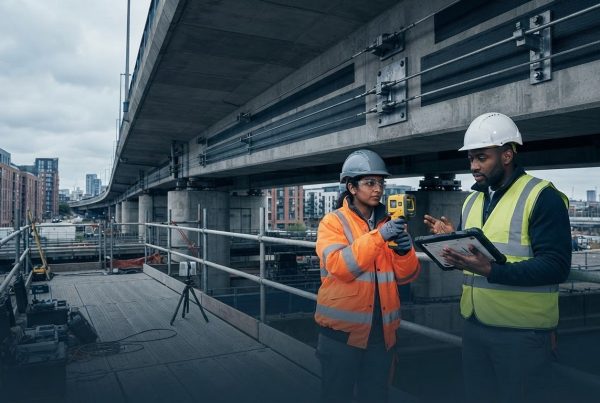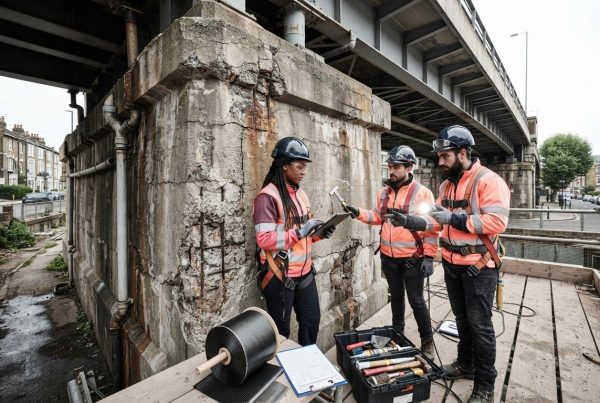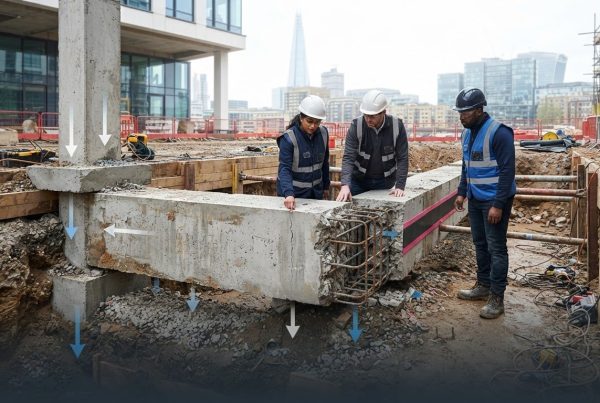

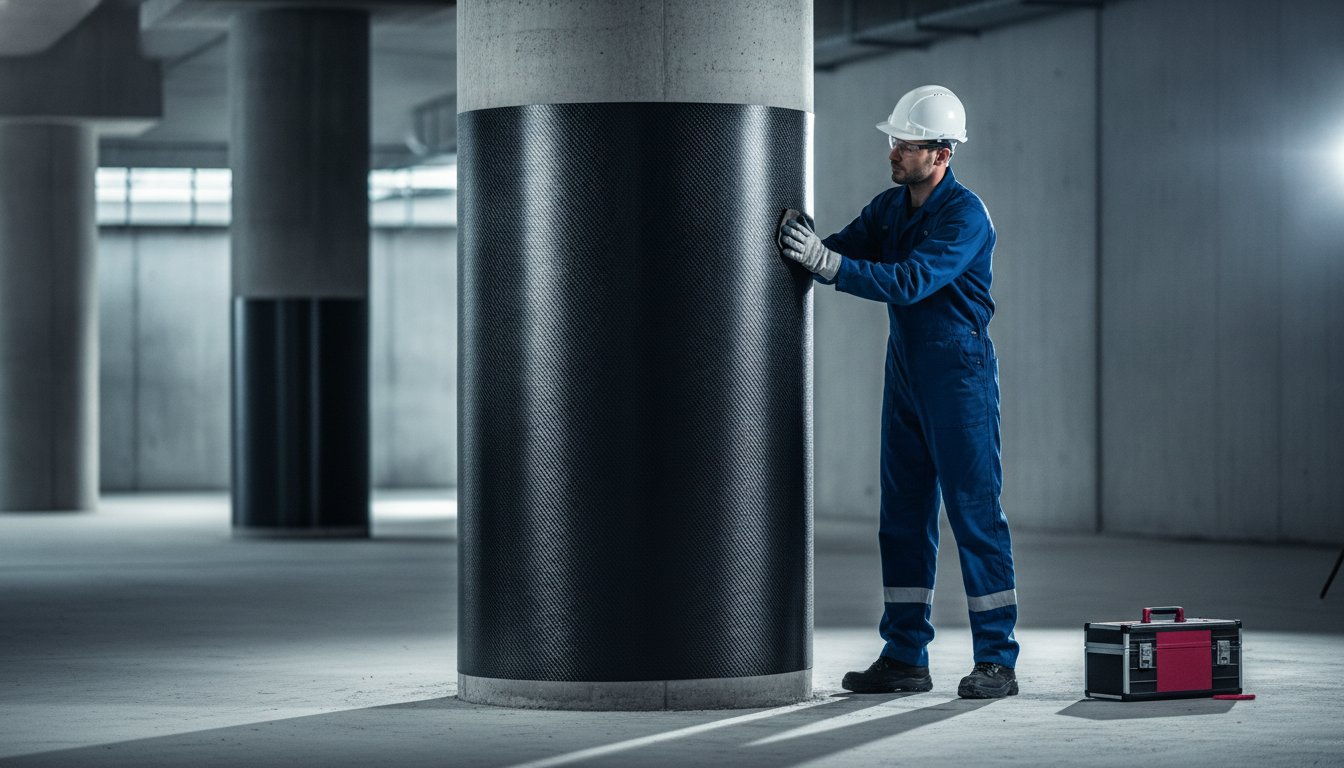
Traditional mass pour underpinning is frequently regarded as the singular definitive solution for foundation failure, yet the invasive nature of such works often causes more operational disruption than the structural defect itself. It’s understood by asset controllers that structural instability threatens the long-term viability of an infrastructure asset, whilst the constraints of heavy excavation and restricted site access frequently delay critical intervention. This technical analysis explores how carbon fibre foundation repair, specifically through the application of the Tyfo® Fibrwrap® system, provides a high-tensile, non-invasive alternative that neutralises lateral pressures without the logistical burden of traditional methods.
Validated engineering performance data is reviewed to illustrate how advanced CFRP composites deliver permanent stabilisation. This approach prioritises the sustainability of repair over replacement, ensuring the functional life-extension of essential infrastructure through disciplined engineering rigour. By utilising high-modulus materials, practitioners can achieve structural security without the footprint of heavy machinery.
Key Takeaways
- Understand the engineering principles behind carbon fibre foundation repair, specifically how high-tensile CFRP composites neutralise lateral earth pressures and restore structural integrity.
- Evaluate the performance advantages of non-invasive composite strengthening over traditional mass pour underpinning, particularly regarding site access and operational continuity.
- Examine the critical role of high-modulus epoxy resins in ensuring a monolithic bond between the composite wrap and the failing substrate for efficient load transfer.
- Identify the rigorous design requirements for foundation remediation, including the necessity of carbonation testing and bespoke calculations to determine optimal fibre density.
- Discover how the application of the Tyfo® Fibrwrap® system facilitates sustainable asset life-extension by prioritising precise structural repair over disruptive replacement.
What is Carbon Fibre Foundation Repair and How Does It Function?
Carbon fibre foundation repair represents a significant evolution in structural engineering, moving beyond the limitations of traditional masonry reinforcement towards high-performance composite technology. It’s defined as a method of structural stabilisation that utilises Carbon Fiber Reinforced Polymer (CFRP) systems to counteract forces that compromise the integrity of a building’s substructure. This system is comprised of high-tensile carbon fibres embedded within a specialist epoxy resin matrix, creating a composite material that exhibits exceptional strength to weight ratios. In commercial and industrial environments, these systems are employed to neutralise tension and resist lateral earth pressures that would otherwise lead to catastrophic structural failure.
The transition to composites is driven by the requirement for non-disruptive, permanent solutions for asset life-extension. Whilst traditional methods might involve significant excavation or the installation of heavy steel beams, CFRP systems are applied directly to the substrate surface. This minimal footprint is particularly advantageous in restricted access areas or where operational downtime must be strictly controlled. It’s a precise engineering intervention that addresses the root cause of instability without the collateral damage associated with heavy plant machinery.
The Material Science of CFRP Systems
The efficacy of these systems relies on the synergistic relationship between the carbon fibres and the polymer matrix. High-modulus carbon fibres provide the primary load-bearing capacity, offering a tensile strength that significantly exceeds that of structural steel whilst remaining a fraction of the weight. The epoxy resin serves to distribute loads evenly amongst the fibres and ensures a continuous bond with the existing concrete or masonry. Because carbon fibre is inherently non-corrosive, these systems are ideally suited for below-ground applications where moisture and soil chemicals might otherwise degrade traditional steel reinforcements. This durability ensures that the structural capacity of the foundation is maintained over a multi-decadal lifespan.
Structural Defects Suitable for Composite Remediation
Engineered composite systems are particularly effective for addressing bowing foundation walls that have succumbed to hydrostatic pressure or expansive soil movement. By bonding CFRP to the tension face of the wall, the lateral forces are effectively neutralised, preventing further deflection. These systems are also utilised for reinforcing cracked concrete footings and enhancing the load-bearing capacity of masonry substructures. Beyond standard repairs, advanced systems like Tyfo® Fibrwrap® are frequently specified for seismic retrofitting and blast mitigation, providing a ductile reinforcement layer that protects critical infrastructure foundations against extreme loading events. Detailed feasibility can be explored through specialist engineering design services to ensure the correct application of these materials.
The Technical Mechanism of CFRP Strengthening for Foundations
The efficacy of carbon fibre foundation repair relies on the precise transfer of structural loads from the compromised substrate to the high-tensile composite laminate. When a foundation element undergoes flexural or shear stress, the carbon fibre wrap acts as external reinforcement, effectively assuming the tensile loads that the original masonry or concrete can no longer sustain. This load transfer is facilitated by the development of a monolithic bond between the composite and the substrate, achieved through the application of high-modulus epoxy resins. These resins don’t just act as an adhesive; they saturate the carbon fibres to create a rigid polymer matrix that ensures the structural element behaves as a single, unified entity under loading.
Specific fibre orientation is critical for addressing distinct structural deficiencies. For instance, unidirectional fibres are typically aligned perpendicular to the direction of cracking to maximise flexural strengthening, whilst multi-directional wraps may be utilised to enhance shear capacity or provide confinement. This tailored approach allows engineers to neutralise specific failure modes without adding significant mass or altering the geometry of the foundation. Professional engineering design and feasibility studies are essential to determine the specific laminate thickness and fibre orientation required for each unique loading scenario.
Tensile Strength and Load Distribution
In the context of foundation stabilisation, carbon fibre wraps are primarily applied to the internal face of walls to neutralise the tension caused by external hydrostatic or soil pressures. By distributing localised stresses across a significantly larger surface area, the system prevents the propagation of existing cracks and inhibits the formation of new structural defects. The tensile modulus of CFRP systems used in structural remediation is engineered to exceed the performance requirements stipulated within BS EN 1504, ensuring the composite provides sufficient stiffness to limit crack widths and control deformations. This high-stiffness response is vital for maintaining the serviceability of the asset over its remaining functional life.
Durability in Subterranean Environments
Substructure repairs are subject to harsh environmental conditions that would rapidly degrade traditional steel-based interventions. CFRP systems offer inherent resistance to chemical attack from sulphate-rich soils and groundwater contaminants, making them ideal for long-term subterranean use. Maintaining bond integrity in these high-moisture environments is achieved through rigorous surface preparation and the use of moisture-tolerant primers. To ensure the absolute longevity of the repair, specialist protective coatings are often applied over the cured laminate, providing an additional barrier against abrasion and aggressive environmental agents. This focus on material durability reflects a commitment to the sustainability of repair, prioritising the permanent stabilisation of the existing infrastructure.
Carbon Fibre vs. Traditional Underpinning: A Comparative Analysis
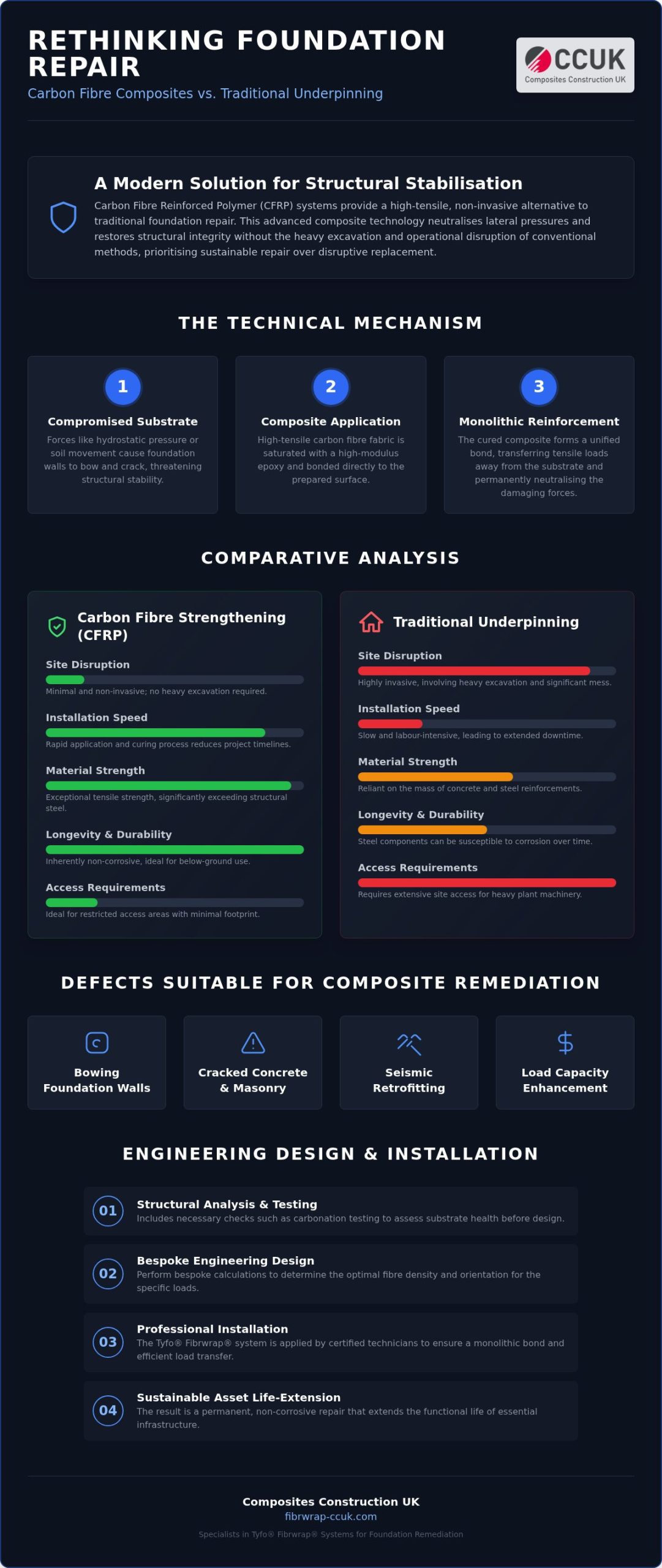
When evaluating methodologies for structural stabilisation, the selection typically rests between traditional mass pour underpinning and advanced composite systems. Traditional underpinning relies on the physical extension of the foundation into deeper, more stable soil strata, a process that necessitates extensive excavation and significant temporary works. Conversely, carbon fibre foundation repair utilises surface-applied high-modulus laminates to enhance the existing structure’s capacity to resist lateral and flexural loads. This distinction is fundamental; one method alters the foundation’s geometry through bulk material addition, whilst the other reinforces the existing substrate through advanced material science. Whilst traditional underpinning remains a valid engineering choice for certain subsidence scenarios, carbon fibre foundation repair has emerged as the superior technical alternative for addressing lateral instability in commercial assets.
Operational Impact and Site Constraints
The logistical footprint of traditional underpinning often proves prohibitive for active commercial facilities. The requirement for heavy plant machinery and the management of significant spoil volumes create substantial operational downtime. CFRP systems, however, are applied with minimal equipment, making them the preferred solution for foundations with limited internal or external access. This non-invasive approach significantly reduces the health and safety risks associated with deep excavations and complex propping sequences. Because the application process is quiet and requires no major demolition, asset functionality is maintained whilst structural repairs are conducted in situ. This ensures that critical infrastructure remains online, avoiding the fiscal penalties associated with facility closures. For those interested in how other non-invasive technologies like polyurethane injection are used to stabilise concrete surfaces, you can discover Foundation Werks and their specialist guide to concrete raising.
Cost-Effectiveness and Life-Extension
A comprehensive analysis of capital expenditure must account for both the immediate installation costs and the long-term maintenance requirements of the stabilisation method. Traditional concrete-based repairs are susceptible to future settlement and chemical degradation from sulphate-rich soils. CFRP systems offer a more durable alternative, providing inherent corrosion resistance that eliminates the need for future remedial interventions. This aligns with a circular economy framework by prioritising the sustainability of repair and the preservation of existing structural mass over carbon-intensive replacement. By extending the functional lifespan of the foundation, asset controllers can amortise the cost of repair over a significantly longer period. You can learn about our bespoke design features for foundations to understand how these systems are tailored to specific asset life-extension goals. This strategic focus on durability ensures that the structural integrity of the asset is secured without the recurring costs of traditional maintenance cycles.
Engineering Design and Professional Installation Standards
The successful implementation of carbon fibre foundation repair is predicated upon rigorous engineering design and adherence to established technical standards. It’s not a generic application; rather, it’s a bespoke structural intervention that must be tailored to the specific failure modes of an asset. In the United Kingdom, design methodologies for these systems typically align with the Concrete Society Technical Report 55 (TR55), which provides the comprehensive framework for strengthening concrete structures using fibre-reinforced polymers. Before any design work commences, a comprehensive structural survey is essential. This process includes carbonation testing and cover meter surveys to assess the current state of the substrate and ensure the existing material possesses sufficient integrity to support the intended load transfer.
Engineering calculations are utilised to determine the precise number of CFRP layers and the specific fibre density required to meet the structural demand. These calculations must account for the current deficit in load-bearing capacity whilst providing a robust factor of safety that meets UK building regulations. Without this level of technical rigour, the risk of debonding or insufficient reinforcement increases significantly. Quality control is maintained through on-site pull-off testing, which provides empirical verification that the bond strength between the composite and the substrate meets the design specifications.
Bespoke Design and Feasibility Studies
Feasibility studies involve a detailed analysis of soil conditions, hydrostatic pressure gradients, and structural loading patterns. This data allows engineers to determine the optimal fibre orientation for the specific failure mode. Unidirectional fibres are often specified for flexural strengthening in foundation walls, whereas bidirectional weaves may be utilised where multi-axial stresses are present. Engaging a specialist contractor with comprehensive professional indemnity insurance is a prerequisite for these works, ensuring that the engineering liability is clearly managed for high-consequence infrastructure projects.
Surface Preparation and Application Protocols
The longevity of the bond depends entirely on the quality of surface preparation. Concrete or masonry substrates must be mechanically abraded to reveal a sound, open-pored texture, followed by the meticulous removal of all contaminants that could inhibit adhesion. Environmental conditions, particularly ambient temperature and humidity, must be strictly monitored and controlled during the application and curing of epoxy resins, especially in subterranean conditions where moisture levels are often elevated. For a broader overview of these methodologies, readers may consult our Structural Repairs: A Technical Guide to Asset Remediation. To ensure your project meets these exacting standards, you should contact our specialist engineering team to arrange a formal feasibility assessment.
The Tyfo® Fibrwrap® Advantage for Foundation Remediation
The Tyfo® Fibrwrap® system is established as a pre-eminent solution in the field of advanced structural composites, offering unparalleled performance for complex foundation remediation. As the exclusive UK licensee for these systems, Composites Construction UK (CCUK) provides the technical expertise required to implement these sophisticated materials across a range of critical assets. The system’s efficacy isn’t merely theoretical; it’s supported by extensive independent testing and decades of empirical data. This rigorous validation ensures that when carbon fibre foundation repair is specified, the resulting stabilisation meets the highest global standards for safety and longevity.
Success has been documented across diverse sectors, from the reinforcement of bridge abutments to the stabilisation of high-pressure pipeline supports and large-scale commercial building footings. Unlike generic composite products, Tyfo® systems are engineered to provide specific material properties, such as precise tensile modulus and chemical resistance, which are vital for subterranean durability. This level of innovation allows for the rehabilitation of structures that might otherwise require complete replacement, directly supporting the objective of infrastructure life-extension through disciplined material science.
Proven Performance in High-Consequence Infrastructure
The application of Tyfo® systems extends beyond standard stabilisation to include seismic retrofitting and blast mitigation for critical substructures. These advanced composites provide the necessary ductility to absorb and dissipate energy during extreme loading events, a feature that’s often unattainable with traditional concrete or steel reinforcements alone. For a more detailed exploration of the application process, refer to our Tyfo® Fibrwrap® Installation: A Technical Guide. This history of success in high-consequence environments provides asset controllers with the assurance that their infrastructure is protected by a system with a proven project history in the most demanding conditions.
Partnering with a Specialist Engineering Contractor
Achieving a successful outcome requires more than high-quality materials; it necessitates a partner capable of delivering an end-to-end service. This begins with a detailed feasibility study and continues through to professional installation by certified technicians. By managing the entire process, CCUK ensures that every stage of the repair complies with national safety standards and rigorous quality assurance protocols. This integrated approach eliminates the risks associated with fragmented supply chains and ensures that the final structural strengthening performs as designed. We invite technical professionals to contact our engineering team for a structural assessment to discuss the specific requirements of their asset. This collaborative model ensures that the most appropriate composite technology is deployed to secure the long-term integrity of the foundation.
Securing Infrastructure Longevity through Advanced Composites
The transition toward carbon fibre foundation repair represents a significant advancement in the maintenance of critical infrastructure, offering a high-tensile alternative to the invasive footprint of traditional underpinning. It’s clear that the successful stabilisation of an asset depends on the precise alignment of material science with rigorous engineering design. By utilising the Tyfo® Fibrwrap® system, asset controllers can achieve permanent structural reinforcement whilst avoiding the operational downtime associated with heavy excavation. CCUK remains the exclusive UK licensee for these proprietary systems, providing bespoke feasibility studies and specialist installation to ensure long-term structural life-extension. This technical approach prioritises the sustainability of repair, ensuring that existing foundations are reinforced to meet modern loading requirements. To determine the most effective strategy for your specific project, you should consult with a specialist engineer regarding your foundation stabilisation requirements. Embracing these engineered solutions ensures the ongoing safety and utility of essential infrastructure assets across the United Kingdom.
Frequently Asked Questions Regarding Structural Composite Stabilisation
Is carbon fibre foundation repair as strong as steel reinforcement?
Carbon fibre reinforced polymers (CFRP) often possess a higher tensile strength-to-weight ratio than traditional structural steel. When correctly engineered and bonded to a foundation wall, CFRP can neutralise lateral earth pressures more effectively than steel beams. Steel alternatives require mechanical fastening and often lack the monolithic bond achieved with high-modulus composite resins. This ensures the structural element behaves as a single unit under stress, providing superior resistance to deflection.
How long does a carbon fibre foundation repair typically last?
When designed and installed by a specialist engineering contractor, a carbon fibre foundation repair is considered a permanent structural solution. The materials are inherently resistant to corrosion, chemicals, and moisture. This durability ensures the repair often outlasts the remaining functional lifespan of the original structure, provided the underlying substrate remains stable. It’s a method that prioritises long-term asset life-extension over temporary fixes or traditional maintenance cycles.
Can carbon fibre be used on foundations with significant water ingress?
Whilst CFRP is highly resistant to moisture, active water ingress must be managed before and during the installation process. Techniques such as resin injection or leak sealing are often utilised in conjunction with carbon fibre wrapping. This ensures a dry substrate for the epoxy bond, which is critical for long-term structural integrity. Once the seal is established, the composite system provides a durable barrier against future environmental stress and hydrostatic pressure.
What is the typical downtime for a building during CFRP installation?
One of the primary advantages of carbon fibre foundation repair is the minimal operational impact on the asset. Unlike traditional underpinning, which requires heavy excavation and temporary works, CFRP is applied directly to the surface of the existing structure. This allows for the building to remain occupied and functional whilst the repairs are conducted. It’s an ideal solution for critical infrastructure where downtime results in significant fiscal or operational penalties.
Does carbon fibre foundation repair require planning permission in the UK?
In most cases, structural repairs to existing foundations don’t require planning permission as they’re classed as maintenance or remediation. However, if the asset is a listed building or the works involve significant structural alterations, it’s essential to consult with a structural engineer. Adherence to UK building regulations must be verified for all major interventions to ensure the safety and compliance of the infrastructure asset throughout its extended life.
How do you verify the bond strength of the carbon fibre wrap?
Quality assurance is maintained through on-site pull-off testing, also known as adhesion testing, following the curing of the epoxy resin. This process ensures that the bond between the CFRP and the substrate meets the technical specifications defined in the engineering design. It provides empirical evidence of the repair’s structural efficacy and ensures the system will perform as intended under long-term structural loading and aggressive subterranean environmental conditions.
Can carbon fibre repair be used on both concrete and masonry foundations?
CFRP systems are highly versatile and can be engineered to stabilise both reinforced concrete and masonry substructures. The bespoke design process accounts for the specific material properties of the substrate to ensure the optimal resin selection and fibre orientation. This allows for precise reinforcement that addresses the unique failure modes of different foundation types, ensuring the structural loads are distributed effectively across the strengthened element.
Is carbon fibre foundation repair suitable for residential properties?
Whilst the technology is highly effective for residential use, Composites Construction UK (CCUK) specialises in commercial, industrial, and infrastructure projects. Our engineering services and the Tyfo® Fibrwrap® system are designed for high-consequence assets where technical rigour and bespoke design are paramount. If you require support for residential or commercial foundation issues in other areas, you can check out Crown Leveling Inc. for specialist repair solutions. We focus on large-scale interventions that require specialist knowledge of advanced material science and structural life-extension to maintain essential public and private infrastructure assets.