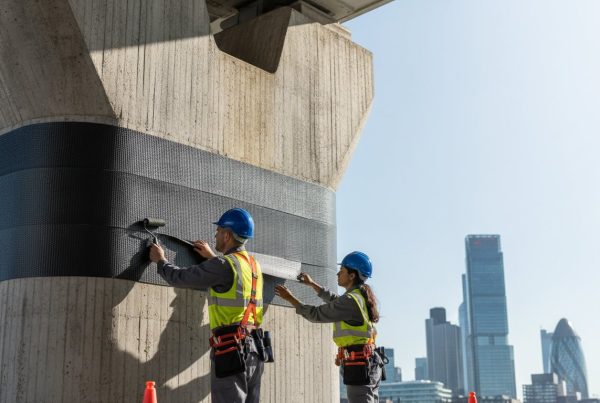


With concrete orders across the United Kingdom experiencing a national decrease of approximately 28% over the past four years, the engineering sector is witnessing a fundamental shift towards the preservation of existing assets over new-build projects. You’re likely managing ageing infrastructure whilst addressing the stringent safety requirements of the Construction Products Reform White Paper published on 25 February 2026. It’s a complex environment where traditional steel reinforcement often proves too disruptive or adds prohibitive weight to critical structures. This guide provides an expert-led technical analysis of how CFRP structural strengthening UK systems, including the proprietary Tyfo® range, ensure rigorous compliance with CD 371 and Concrete Society Technical Report 55.
We’ll examine the empirical performance of composite materials that meet the 1.5 MPa tensile strength requirements of BS EN 1542:1999, offering a methodical approach to asset life-extension. By reviewing current standards such as BS EN 1504-4:2004 and the forthcoming Annex J of Eurocode 2, this analysis demonstrates how advanced polymers deliver increased load-bearing capacity whilst maintaining structural integrity. Our review outlines the strategic transition from trade-focused to safety-focused regulation, providing the technical clarity required for sophisticated B2B asset management.
Key Takeaways
- Understand the critical role of carbon fibre reinforced polymers in structural remediation and how these high-strength composites facilitate essential infrastructure rehabilitation.
- Gain technical insight into the mechanics of composite action and the specific role of the modulus of elasticity in maintaining structural integrity.
- Ensure rigorous compliance with UK engineering standards, including the Concrete Society Technical Report 55 (TR-55) and Highways England bridge strengthening protocols.
- Compare the efficiency of CFRP structural strengthening UK against traditional steel plate bonding to optimise installation speed and minimise structural weight.
- Discover the necessity of bespoke design through comprehensive structural surveys to ensure the long-term life-extension of critical assets.
Understanding CFRP Structural Strengthening in the UK Construction Sector
The application of Carbon Fibre Reinforced Polymer (CFRP) within the British built environment represents a sophisticated evolution in material science, transitioning from high-performance aerospace applications of the late 20th century to a foundational tool for modern civil engineering. Within the specific sector of CFRP structural strengthening UK, these systems are now prioritised for the remediation of critical infrastructure where traditional steel reinforcement is deemed unsuitable due to weight constraints, corrosive environments, or limited site access. The UK construction industry’s 1.3% decline in output during the final quarter of 2025 has accelerated a strategic pivot toward asset life-extension. Asset managers are increasingly opting for advanced composite solutions to avoid the substantial carbon costs and capital expenditure associated with full-scale demolition and replacement, particularly as the Construction Products Reform White Paper of February 2026 heightens the focus on safety and product traceability.
The Core Components of CFRP Systems
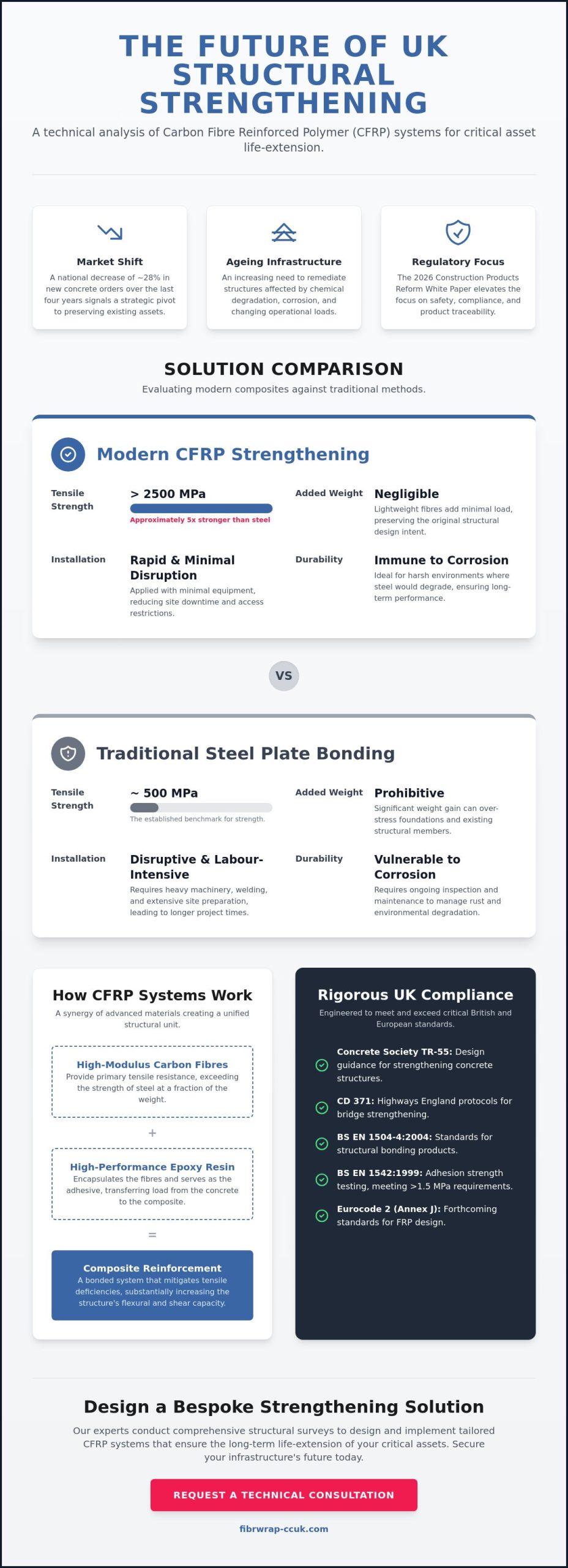
The efficacy of a composite reinforcement system is fundamentally dependent upon the synergy between its constituent parts, which are engineered to function as a unified structural unit. High-modulus carbon fibres provide the primary tensile resistance; these fibres possess a tensile strength that’s significantly higher than that of conventional structural steel, yet they contribute negligible weight to the host structure. These filaments are encapsulated within a high-performance epoxy resin matrix, which serves as the medium for load transfer from the existing concrete substrate to the composite reinforcement. Fibrwrap Construction UK implements the proprietary Tyfo® Fibrwrap® system, which is a bespoke solution that’s been subjected to rigorous empirical testing to ensure long-term performance under the varied climatic conditions of the United Kingdom.
Primary Drivers for Structural Strengthening
Structural remediation is typically necessitated by several distinct engineering and economic factors. Chemical degradation, specifically carbonation or chloride-induced reinforcement corrosion, remains a primary concern for the UK’s ageing concrete assets. Beyond environmental deterioration, changes in the operational use of a commercial or industrial facility often require an immediate increase in load-bearing capacity to meet modern standards. Additionally, when assessing the requirement for CFRP structural strengthening UK, the need for seismic retrofitting or blast mitigation on critical infrastructure has become a standard component of comprehensive risk management. By developing a bespoke design feature, engineers can effectively address these vulnerabilities, ensuring the structural integrity of the asset is maintained without the disruption inherent in traditional reconstruction methods.
The Engineering Science Behind Carbon Fibre Reinforced Polymers
The efficacy of a composite reinforcement system relies fundamentally upon the mechanics of composite action, where the host concrete and the CFRP reinforcement function as a single, unified structural element. This synergy is achieved through the efficient transfer of interfacial shear stresses across the bond line. Whilst concrete is inherently proficient in resisting compressive forces, its tensile capacity is limited. By externally bonding high-strength polymers, the tensile deficiencies of the substrate are mitigated, allowing for a substantial increase in the flexural and shear capacity of the member. The UK experience with CFRP demonstrates that the long-term success of these interventions is contingent upon the quality of the bond interface and the adhesive shear strength of the resin matrix.
Material Properties and Performance Metrics
When evaluating materials for structural remediation, the performance metrics of carbon fibre are unparalleled. Tensile strengths for these composites typically exceed 2500 MPa, which is approximately five times the characteristic strength of standard UK structural steel (460 MPa). However, engineers must distinguish between raw tensile strength and the modulus of elasticity. Because carbon fibre is an anisotropic material, its mechanical properties are highly directional. Strength is concentrated along the longitudinal axis of the filaments, meaning the orientation of fibres is critical to the structural performance of the system. Misalignment by even a few degrees can result in a measurable reduction in effective reinforcement. Furthermore, the thermal expansion characteristics of CFRP are remarkably compatible with concrete, reducing the risk of debonding during the thermal cycling common in the British climate. These systems also provide an impermeable barrier against moisture ingress and chemical attack, effectively halting the progression of reinforcement corrosion. The same material science principles that underpin structural concrete strengthening are equally applicable to pipeline infrastructure, where carbon fibre pipe wrap repair systems restore hoop and axial strength to deteriorating metallic assets without excavation or service interruption.
The Tyfo® Fibrwrap® Advantage
Fibrwrap Construction UK maintains exclusive technical pedigree through the application of the Tyfo® system, a tested, high-performance composite for infrastructure that’s been validated through decades of empirical research. In the context of CFRP structural strengthening UK, a distinction is made between pre-cured laminate plates and wet-layup fabric wraps. Pre-cured plates offer high stiffness for flat, linear surfaces such as bridge soffits or floor slabs. Conversely, the wet-layup Fibrwrap® system allows for bespoke application around complex geometries, including circular columns and irregular pier caps, providing a level of versatility that traditional steel jacketing cannot replicate. This methodical approach to material selection ensures that the specific structural defect is addressed with precision. For engineers seeking to optimise the performance of an ageing asset, a review of our bespoke design features provides further insight into the technical integration of these advanced systems.
Compliance and Performance Standards for UK Strengthening Projects
The execution of CFRP structural strengthening UK projects is governed by a rigorous regulatory framework designed to ensure the long-term safety and stability of the nation’s infrastructure. Primary design guidance is derived from the Concrete Society Technical Report 55 (TR-55), which provides the fundamental engineering principles for strengthening concrete structures using fibre composite materials. For highway structures, compliance with CD 371, published by Highways England in March 2020, is mandatory. This standard aligns with Eurocode principles and dictates the specific requirements for the design and installation of fibre-reinforced polymers on the strategic road network. Following the publication of the Construction Products Reform White Paper on 25 February 2026, there’s an increased emphasis on the “General Safety Requirement” and the digital traceability of all composite materials used in structural remediation.
Adherence to UK CA marking remains a critical component of quality assurance, ensuring that products meet the specified performance criteria for structural bonding as outlined in BS EN 1504-4:2004. Beyond material certification, health and safety protocols during the application of epoxy resins are paramount. Operatives must manage the risks associated with volatile organic compounds (VOCs) and exothermic reactions during the curing process. Professional sobriety in project management requires that these safety measures are integrated into the method statement, reflecting the critical nature of the engineering environment.
Design Guidelines and Safety Factors
Engineering calculations for composite systems must account for specific partial safety factors that differ significantly from those applied to traditional steel or concrete. TR-55 defines these factors based on the material type, the application method, and the anticipated environmental exposure over the asset’s remaining lifespan. Fire performance is another critical consideration, necessitating compliance with Building Regulations Part B. Because the structural integrity of the resin matrix can be compromised at elevated temperatures, the application of bespoke intumescent coatings or cementitious renders is often required to maintain the design load-bearing capacity during a fire event. Every project requires a unique set of calculations to ensure these variables are managed with precision.
Quality Control and Site Testing
Rigorous site testing is the only way to verify that the theoretical design translates into physical performance. Before any composite is bonded, pull-off tests must be conducted in accordance with BS EN 1542:1999 to determine the tensile strength of the concrete substrate. A minimum characteristic tensile strength of 1.5 MPa is required; if the substrate fails to meet this threshold, it’s unsuitable for externally bonded CFRP. During the installation phase, witness testing and the preparation of site-cured samples are standard procedures. These samples are subsequently subjected to laboratory analysis to confirm that the glass transition temperature and lap-shear strength meet the requirements of the design features specified for the project. This methodical approach to quality control ensures that the life-extension of the asset is grounded in empirical evidence rather than assumption.
Evaluating CFRP Against Traditional Structural Reinforcement Methods
A methodical evaluation of structural remediation options often involves a comparison between Carbon Fibre Reinforced Polymers and traditional steel plate bonding. Whilst steel has historically been the default material for reinforcement, its application is frequently limited by its significant self-weight and the requirement for heavy lifting equipment. In contrast, CFRP systems provide a high-strength-to-weight ratio that allows for manual installation without the need for temporary propping or mechanical anchors. For projects involving CFRP structural strengthening UK, the thickness of the reinforcement is typically measured in millimetres rather than centimetres, which ensures that floor-to-ceiling heights remain virtually unaffected. This is a critical consideration for commercial assets and heritage buildings where the preservation of internal volume and structural aesthetics is paramount.
Disruption levels represent a primary differentiator in the selection process. Steel installation often requires extensive drilling into the substrate, creating noise, dust, and vibration that can be prohibitive in live environments such as hospitals, data centres, or railway stations. CFRP application is a non-invasive process that minimises operational downtime. Although the initial material expenditure for composites may be higher, a comprehensive cost-benefit analysis often favours CFRP when considering the 20 to 40 per cent premium associated with complex London-based logistics and the long-term maintenance savings derived from the material’s inherent corrosion resistance. This durability eliminates the cycle of rust treatment and repainting required for exposed steelwork.
When to Choose CFRP Strengthening
CFRP is particularly effective for column confinement, beam flexural strengthening, and slab reinforcement where the goal is to increase load-bearing capacity without adding mass. It’s the preferred solution for seismic retrofitting and blast mitigation where ductility is required. Engineers should refer to our technical resource, the engineer’s guide to the strengthening of concrete beams using CFRP, for a detailed breakdown of application methodologies. However, traditional underpinning or structural steelwork may still be necessary in cases where the concrete substrate’s tensile strength falls below the 1.5 MPa threshold required by BS EN 1542:1999.
The Sustainability Argument: Repair vs Replacement
The environmental benefits of asset life-extension are becoming central to corporate ESG goals. With concrete orders across the UK experiencing a national decrease of approximately 28% as of January 2026, the industry is increasingly focused on the circular economy. Repairing a structure with carbon fibre significantly reduces the carbon footprint compared to full demolition and reconstruction. By avoiding the waste associated with new-build projects, asset managers can align their structural repairs with broader environmental objectives whilst ensuring compliance with the new safety-focused regulatory framework. To discuss the technical requirements of your specific project, contact our engineering team for a professional consultation.
Strategic Asset Life-Extension: Designing a Bespoke Strengthening Solution
The objective of strategic asset life-extension is to transform a deteriorating structure into a resilient, long-term asset through the application of sophisticated engineering principles. Unlike reactive maintenance, a bespoke strengthening solution requires a comprehensive understanding of the existing structural behaviour. This process begins with an exhaustive structural survey and condition assessment, where the residual capacity of the host material is quantified. Collaborative design between the asset manager and the specialist contractor is essential to ensure that the proposed CFRP structural strengthening UK solution addresses the specific failure modes identified, whether they’re flexural, shear, or axial in nature. Professional installation by trained technicians is mandatory, as the performance of the Tyfo® system is entirely dependent upon the bond integrity achieved during the application phase.
Long-term monitoring remains a critical component of the life-extension strategy. Following the implementation of the composite system, periodic inspections are conducted to verify that the reinforcement continues to perform as designed. This methodical approach ensures that critical UK infrastructure remains compliant with the evolving safety standards introduced in the Construction Products Reform White Paper of February 2026. By treating the strengthening process as a strategic investment rather than a temporary repair, asset managers can secure the long-term security of essential facilities whilst meeting stringent ESG objectives.
The Path to Successful Project Delivery
Successful project delivery is achieved through a disciplined four-step trajectory that prioritises engineering rigour over speed of installation:
- Step 1: Feasibility study and non-destructive testing (NDT). Techniques such as ultrasonic pulse velocity or cover meter surveys are employed to map internal defects and reinforcement layout without compromising the structure.
- Step 2: Detailed design and finite element analysis (FEA). Complex stress distributions are modelled to determine the precise volume and orientation of carbon fibres required for the intervention.
- Step 3: Surface preparation. Grit blasting or mechanical grinding is performed to achieve the required Concrete Surface Profile (CSP), ensuring the substrate is free from laitance and contaminants.
- Step 4: Precision application. The CFRP structural strengthening UK system is applied under controlled conditions, with careful management of resin pot life and environmental humidity to prevent delamination.
Investment and Budgeting for CFRP Works
Determining the financial requirements for structural remediation involves several variables that extend beyond simple material costs. Access requirements, such as specialized scaffolding or rope access, often represent a significant portion of the project budget. Additionally, the volume of composite material and the extent of necessary concrete repair work are influenced by the substrate’s current condition. For a detailed analysis of market rates and financial planning, engineers should consult our guide on structural repair company cost. To initiate a professional evaluation of your asset, contact our engineering team for a feasibility assessment.
Securing the Future of UK Infrastructure through Advanced Composites
The strategic transition from traditional demolition to asset life-extension is now a fundamental requirement for the United Kingdom’s built environment. By integrating the high-performance mechanics of carbon fibre with the rigorous compliance standards of Concrete Society Technical Report 55, engineers can achieve significant increases in load-bearing capacity without the prohibitive mass of structural steel. Fibrwrap Construction UK, as the exclusive UK Tyfo® Fibrwrap® Licensee, leverages over 10 years of specialist engineering expertise to ensure every project meets both TR-55 and Highways England standards. This methodical approach to CFRP structural strengthening UK ensures that structural remediation is grounded in empirical evidence and engineering rigour.
As regulatory requirements move toward the safety-focused framework outlined in the February 2026 White Paper, the selection of a proven composite system becomes critical for long-term asset security. Safety remains our priority. Our team provides the technical clarity and bespoke design required to navigate these complex structural challenges with absolute reliability. We invite you to Request a Bespoke Structural Strengthening Design to begin the process of extending the lifespan of your critical infrastructure assets. Investing in sophisticated science today ensures the enduring integrity of our essential structures for decades to come.
Frequently Asked Questions
What is the typical design life of a CFRP structural strengthening system?
CFRP systems are designed to align with the remaining service life of the host structure, which is typically specified as 50 years or more in accordance with Concrete Society TR-55 guidelines. This durability is contingent upon the resin matrix being protected from direct ultraviolet radiation and extreme thermal cycling. Unlike steel, the carbon filaments are chemically inert and don’t suffer from oxidation, ensuring the CFRP structural strengthening UK remains effective throughout the asset’s extended lifespan.
Can CFRP be used to strengthen historic or listed masonry structures?
Carbon fibre is highly effective for the reinforcement of historic masonry, as it provides a low-profile solution that doesn’t alter the building’s architectural character. The system’s high strength-to-weight ratio allows for the stabilisation of vaulted ceilings or cracked facades without the mass of traditional steel ties. Because the application is non-invasive, it’s frequently approved for use on Grade I and Grade II listed structures where aesthetic preservation is a mandatory requirement.
How does CFRP perform in a fire compared to structural steel?
Unprotected CFRP systems are more sensitive to elevated temperatures than structural steel, as the epoxy resin matrix typically reaches its glass transition temperature between 60°C and 80°C. However, when integrated with bespoke intumescent coatings or cementitious barriers, these systems can achieve fire ratings of up to four hours. Whilst steel begins to lose significant structural capacity at 550°C, a protected composite system maintains its bond integrity by insulating the polymer from direct thermal exposure.
Is it possible to apply carbon fibre strengthening whilst a building is still in use?
It’s entirely possible to execute structural remediation whilst a facility remains operational, which is a primary advantage of composite technology over traditional methods. The installation process is characterised by a lack of heavy plant and minimal noise generation, making it suitable for sensitive environments like hospitals or data centres. Because the materials are lightweight and manually applied, the requirement for extensive site hoarding or structural propping is significantly reduced.
What are the main causes of bond failure in CFRP applications?
The primary causes of bond failure are inadequate surface preparation and the presence of moisture within the concrete substrate at the time of application. Successful adhesion requires the substrate to have a minimum tensile strength of 1.5 MPa as verified by pull-off testing in accordance with BS EN 1542:1999. If laitance, oils, or previous coatings aren’t thoroughly removed through grit blasting, the mechanical interlock between the resin and the concrete will be compromised, leading to premature delamination.
Does the UK government provide grants for infrastructure life-extension projects?
Direct government grants for private infrastructure life-extension aren’t standard, but projects often qualify for significant tax incentives such as Land Remediation Relief or R&D tax credits. Following the Construction Products Reform White Paper of 25 February 2026, strategic funding is increasingly directed toward assets that demonstrate high safety and sustainability metrics. Asset managers often find that the capital expenditure is offset by the long-term reduction in maintenance costs compared to traditional reconstruction.
How much does CFRP structural strengthening cost per square metre in the UK?
Indicative costs for CFRP structural strengthening UK projects in 2026 range between £150 and £350 per square metre for fabric wrapping, whilst plate bonding typically costs between £200 and £500 per linear metre. These figures are subject to project complexity and geographic location, with a 20% to 40% premium often applied to works within London and the South East. Final budgeting is determined by the specific material volume and access requirements identified during the feasibility stage.
What level of surface preparation is required for a successful CFRP bond?
Successful application requires the concrete substrate to be prepared to a Concrete Surface Profile (CSP) of 3 to 5, which ensures a sufficiently textured surface for resin penetration. This is achieved through methodical grit blasting or mechanical grinding to remove the weak outer layer of cement paste. All dust and debris must be removed using industrial vacuums to ensure that the bond interface remains uncontaminated before the primer is applied.