


The efficacy of blast mitigation systems is traditionally measured by the thickness of reinforcement, yet modern engineering demonstrates that structural ductility, rather than sheer mass, is the primary determinant of survival during an explosive event. You likely recognise that the hardening of critical infrastructure often presents a conflict between essential safety requirements and the physical limitations of the original design. Traditional steel hardening frequently introduces prohibitive weight penalties and requires intrusive construction works that compromise operational continuity.
It’s understood that the risk of progressive collapse and catastrophic spalling must be managed without sacrificing the long-term integrity of the asset. This technical guide explores how advanced composite systems enhance structural resilience whilst maintaining the original architectural footprint. By examining the performance of the Tyfo® system, which has undergone over 500 structural and material tests, we’ll demonstrate how these solutions align with the rigorous 2025 ASTM F1642/F1642M-25 standards and the 62 new mandatory requirements established in the 2024 API RP 752 and 753 updates. You’ll gain a comprehensive understanding of how bespoke carbon fibre reinforced polymers facilitate asset life-extension and ensure occupant safety through sophisticated energy-absorption science.
Key Takeaways
- Identify the technical distinctions between blast protection and consequence management to define precise safety objectives for your structural strengthening programme.
- Understand the mechanics of peak overpressure and impulse duration to effectively mitigate the risk of high-velocity concrete spalling in reinforced structures.
- Compare the performance of strength-based composite blast mitigation systems against traditional mass-based hardening to eliminate unnecessary dead loads on existing foundations.
- Navigate the complexities of bespoke engineering calculations whilst ensuring adherence to stringent UK regulatory standards, including NPSA and MOD specifications.
- Discover how the application of Tyfo® Fibrwrap® supports asset life-extension and operational continuity through non-intrusive, scientifically proven structural remediation.
What are Blast Mitigation Systems in Structural Engineering?
Within the discipline of structural engineering, blast mitigation systems represent a comprehensive suite of technical interventions designed to attenuate the destructive effects of explosive overpressure. While the term is often conflated with blast protection, a clear distinction exists between the two. Protection typically refers to the hardening of a structure to resist a predefined threat level without failure. In contrast, mitigation focuses on consequence management, where the primary objective is the preservation of life and the prevention of progressive collapse, even when significant structural damage is sustained. It’s a strategy that prioritises the survival of the asset’s core skeleton over the preservation of non-critical components.
The design and implementation of blast mitigation systems must account for a spectrum of threats, ranging from person-borne improvised explosive devices (PBIEDs) to high-yield vehicle-borne improvised explosive devices (VBIEDs). Structural integrity is the fundamental layer of any security strategy; if the primary load-bearing members fail, secondary measures such as perimeter fencing or glazing films become redundant. In high-risk environments, the focus is placed on enhancing the load-path redundancy of the building, ensuring that if one element is compromised, the remaining structure can redistribute the weight to prevent a total collapse.
The Role of Ductility in Blast Resilience
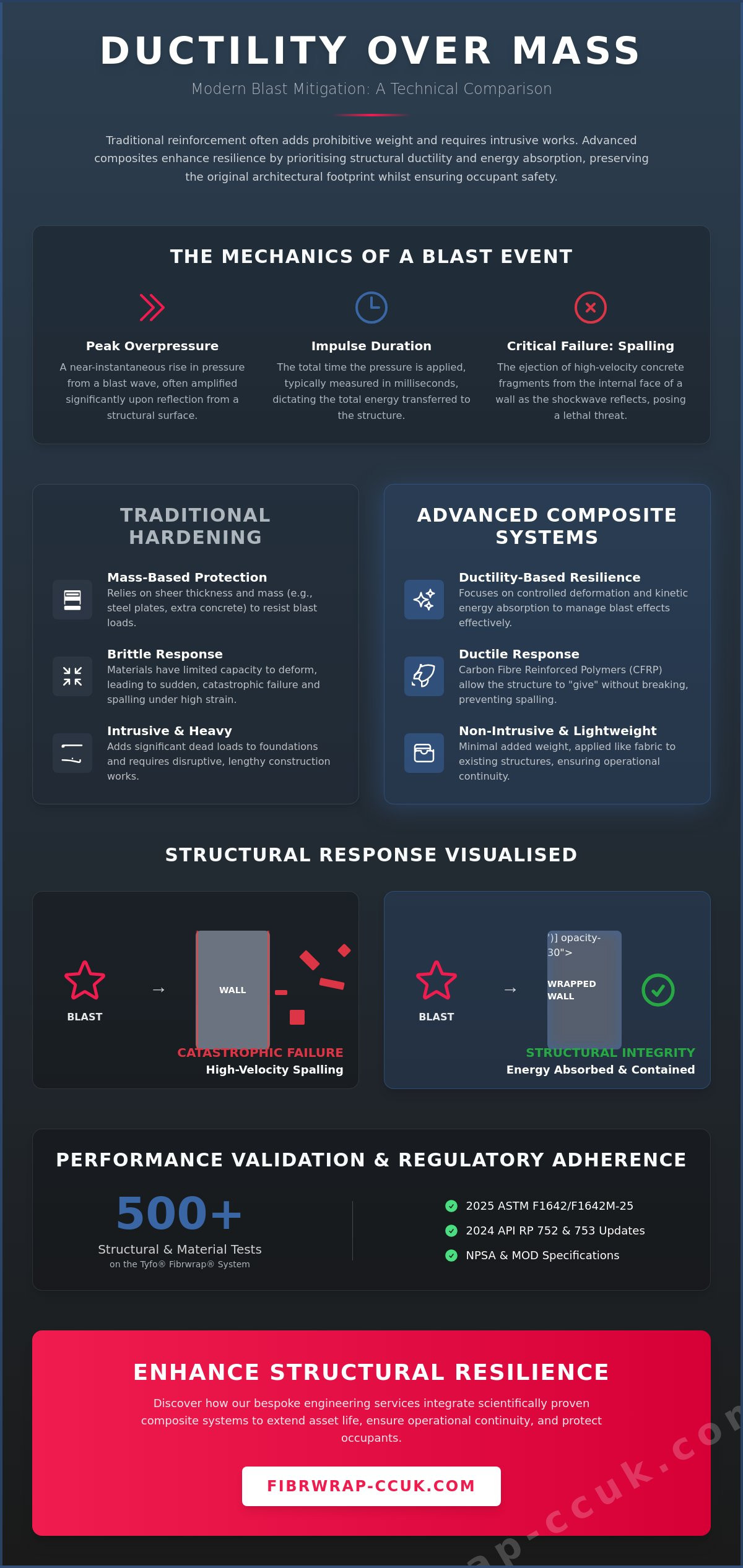
Resilience in the face of dynamic loading is fundamentally dependent on material ductility. Brittle materials, such as unreinforced masonry or standard high-strength concrete, possess limited capacity to deform under high-strain rates, often resulting in sudden, catastrophic failure. By integrating advanced composite systems, such as carbon fibre reinforced polymers (CFRP), structural elements are imbued with a high degree of toughness. These composites facilitate controlled deformation and kinetic energy absorption. This allows the structure to “give” without breaking, effectively containing the structural response and preventing the ejection of lethal fragments from the internal face of the walls.
Structural Strengthening vs. Glazing Protection
A common oversight in infrastructure hardening is the disproportionate focus on glazing systems at the expense of the supporting framework. Whilst high-specification glazing is essential for reducing glass-related injuries, it’s the structural frame that must ultimately transfer the resulting loads to the foundations. If the columns or transfer beams are not sufficiently reinforced, the entire facade may fail as a single unit. A holistic approach involves the application of the Tyfo® system to primary structural members, ensuring that the building’s skeleton remains intact whilst secondary mitigations perform their intended function. You can explore our bespoke engineering services to see how these systems are integrated into existing architectural designs.
The Mechanics of Blast Loads and Composite Response
Blast waves are characterised by a near-instantaneous rise in peak overpressure followed by a rapid decay into a negative pressure phase. When this shockwave encounters a structural surface, the resulting reflected pressure is often significantly higher than the incident pressure, sometimes by a factor of eight depending on the angle of incidence and the proximity of the detonation. The duration of this impulse, though typically measured in milliseconds, dictates the total energy transferred to the structural asset. Effective blast mitigation systems must be engineered to manage these dynamic loads by controlling the structural response in real-time, ensuring that the energy is dissipated without causing immediate failure of the primary load-bearing elements.
A critical failure mode in conventional reinforced concrete is the phenomenon of spalling. This occurs when the initial compressive shockwave travels through the element and reflects off the internal face as a tensile wave. Since concrete possesses inherently low tensile strength, this reflection causes the surface to fracture, ejecting high-velocity fragments into the occupied space. Carbon Fibre Reinforced Polymer (CFRP) applications, specifically the Tyfo® Fibrwrap® system, address this vulnerability by providing external reinforcement that intercepts these tensile forces. The composite serves to contain the material, effectively preventing fragmentation and ensuring that the internal environment remains survivable for occupants even if the core material is compromised.
Energy Absorption and Spall Mitigation
The efficacy of CFRP in blast environments is derived from its ability to provide passive confinement. By wrapping a concrete or masonry member, the composite prevents the outward expansion of the core under extreme axial and lateral pressure. Technical evaluations have demonstrated that composite-wrapped members can achieve rotation angles exceeding 10 degrees, which is significantly higher than the capacity of unreinforced sections, whilst maintaining structural integrity. This energy dissipation is vital for reducing the fragmentation zone. It’s a method that relies on the high-strain rate performance of the Tyfo® system to absorb kinetic energy through controlled deformation rather than brittle fracture.
Preventing Progressive Collapse
Progressive collapse is often triggered by the sudden loss of a primary load-bearing column, leading to a disproportionate failure of the surrounding bays. In a blast scenario, columns are subjected to extreme lateral displacement whilst simultaneously supporting vertical gravity loads. The Tyfo® system enhances both the shear and flexural capacity of these members, allowing them to undergo significant deformation without losing their axial load-bearing functionality. This methodology leverages principles originally developed for seismic retrofitting, adapted here to manage the high-strain rates associated with explosive threats. For a detailed analysis of your asset’s specific requirements, you can review our technical design features to understand the bespoke calculations required for such remediation.
Composite Wrapping vs. Traditional Blast Hardening
Traditional methodologies for structural reinforcement frequently rely on the principle of mass-based resistance, where the addition of thick reinforced concrete jackets or the bonding of heavy steel plates is utilised to absorb impulsive energy. Whilst these techniques are well-established within the industry, they impose significant dead loads upon existing foundations, which often necessitate costly and intrusive underpinning works to maintain structural stability. In contrast, strength-based blast mitigation systems utilising carbon fibre reinforced polymers offer a high strength-to-weight ratio that achieves equivalent or superior structural resilience without the associated mass. This distinction is critical when retrofitting existing assets that were not originally designed to accommodate the substantial weight of conventional hardening materials.
The installation of composite systems is significantly more efficient than traditional alternatives, particularly in environments with restricted site access. Steel plate bonding requires heavy lifting equipment and complex welding procedures, which present fire risks and require extensive operational downtime. Conversely, the Tyfo® system is hand-applied and flexible, allowing it to be installed around complex geometries and in confined spaces where heavy machinery cannot operate. This non-intrusive approach ensures that the original architectural profile of the building is preserved, which is a paramount consideration for heritage-listed structures or high-specification commercial environments where aesthetic integrity must be maintained alongside security enhancements.
Weight and Space Efficiency
For projects governed by strict floor-loading limits or limited clearances, the low-profile nature of carbon fibre reinforced polymers provides a distinct engineering advantage. A typical concrete jacket may increase the cross-sectional dimensions of a column by 150mm or more on all sides, whereas a comprehensive composite wrap rarely exceeds a thickness of 10mm. This minimal footprint eliminates the need for extensive structural modifications and ensures that valuable internal floor space is not compromised. By avoiding the addition of significant dead weight, engineers can bypass the requirement for foundation strengthening, significantly reducing the total project timeline and capital expenditure.
Durability and Asset Life-Extension
The long-term performance of structural remediation is often compromised by the susceptibility of traditional materials to environmental degradation. Steel reinforcement is prone to corrosion, particularly in aggressive industrial or coastal environments, which can lead to spalling and a reduction in the protective capacity of the mitigation system. Advanced composites are inherently resistant to chemical attack and oxidation, ensuring that the structural strengthening remains effective for the duration of the asset’s service life. This focus on durability supports the sustainability of repair over replacement, facilitating meaningful asset life-extension through scientifically proven materials science. You can refer to our guide on Tyfo® Fibrwrap® installation for a detailed analysis of the application methods that ensure these performance standards are met.
Design Considerations and Engineering Standards
The engineering of blast mitigation systems isn’t a prescriptive exercise; it’s a rigorous analytical process that requires site-specific data and sophisticated modelling. Every project begins with a comprehensive threat assessment to define the peak overpressure and impulse duration the structure must withstand. These parameters are heavily influenced by standoff distances and the potential charge weight of the threat, whether person-borne or vehicle-borne. It’s essential that these calculations are grounded in empirical evidence, moving beyond generic safety factors to ensure the structural response remains within the predicted elastic or plastic limits during a dynamic event.
Adherence to international and UK-specific standards is non-negotiable for high-security infrastructure and critical assets. Design methodologies are frequently benchmarked against the 2025 ASTM F1642/F1642M-25 standard for airblast loadings and the updated API RP 752 and 753, which became effective in June 2024 and incorporated 62 new mandatory requirements for facility siting. By aligning with National Protective Security Authority (NPSA) and Ministry of Defence (MOD) specifications, engineers ensure that the remediated asset provides a reliable level of protection. This holistic approach also considers secondary hazards, integrating structural strengthening with fire resistance, often utilising Tyfo® systems with specific UL Design Numbers such as X842 or N790 to maintain integrity under thermal stress.
Technical Specifications and Bespoke Design
Precise structural response prediction requires the use of advanced finite element analysis (FEA) software to simulate the interaction between the blast wave and the composite-wrapped elements. This allows engineers to determine the exact number of carbon fibre layers and the specific orientation of the weave required to resist the calculated shear and flexural demands. You can examine how these parameters are applied in practice by reviewing our bespoke design features for complex infrastructure. These models ensure that the ductility of the member is optimised to absorb energy without reaching the point of rupture.
The Importance of Specialist Contracting
The performance of any composite system is fundamentally dependent on the quality of the installation and the integrity of the bond between the material and the substrate. Specialist contracting is required to manage the precise surface preparation and resin saturation levels that ensure the Tyfo® system performs as tested. With over 500 structural and material tests conducted on these systems, the empirical data supports their reliability, but only when applied under strict quality assurance protocols. If you’re managing a complex facility upgrade, you can contact our engineering team for a technical consultation regarding your specific asset requirements.
Implementing Tyfo® Fibrwrap® for Critical Infrastructure
Composites Construction UK provides a comprehensive lifecycle approach to the deployment of blast mitigation systems, spanning from initial feasibility modelling to the final application of the proprietary Tyfo® system. As the exclusive licence holder for Tyfo® Fibrwrap® technology within the UK, the organisation ensures that every project benefits from a system that’s been validated through more than 500 structural and material tests. This exclusivity guarantees that asset managers receive a technically superior solution that is both bespoke and compliant with international safety mandates. It’s a process that prioritises empirical performance over generic reinforcement, ensuring that the structural remediation is precisely calibrated to the identified threat profile.
The application of these advanced composites isn’t limited to high-rise commercial structures; its versatility extends to critical transport infrastructure, such as bridges, and high-hazard industrial environments including petrochemical facilities. A primary advantage of this technology is the mitigation of operational disruption. Unlike traditional methods that require heavy plant and significant site clearance, the hand-applied nature of the Tyfo® system allows for structural strengthening to be conducted whilst the facility remains operational. This ensures that the integrity of the asset is enhanced without the economic penalties associated with prolonged downtime. It’s a methodical approach that respects the functional requirements of the building whilst addressing its structural vulnerabilities.
Multi-Hazard Protection: Blast and Beyond
The engineering rigour required for explosive threat mitigation often overlaps with other critical structural requirements. The Tyfo® system is frequently utilised for seismic retrofitting, where the same principles of ductility and confinement protect against extreme lateral loads. Additionally, for utility providers, pipeline strengthening using these composites provides a robust barrier against both internal pressure fluctuations and external geohazards. This multi-hazard capability ensures that masonry and concrete assets receive long-term stabilisation, addressing vulnerabilities such as shear failure or flexural deficiency within a single, scientifically-led remediation programme. For operators managing aging underground infrastructure, our technical guide on pipeline rehabilitation and CFRP-based asset life-extension provides a detailed examination of how these same composite principles are applied to extend the service life of deteriorating mains beyond 50 years.
Next Steps for Asset Managers
Implementing a robust security strategy begins with a detailed structural survey to identify latent vulnerabilities within the existing framework. Following this, a phased implementation plan is developed to prioritise high-risk areas, ensuring that security upgrades are managed logically and within budgetary constraints. This structured trajectory ensures that every intervention is grounded in engineering necessity. If you require a technical evaluation of your infrastructure’s resilience, you should contact our engineering team to arrange a formal consultation and site assessment.
Securing Infrastructure through Advanced Materials Science
Effective blast mitigation systems have evolved beyond the reliance on sacrificial mass, shifting instead toward the application of sophisticated composite science that prioritises structural ductility and energy dissipation. By leveraging the high-strain rate performance of carbon fibre reinforced polymers, critical assets can be remediated to align with the 62 new mandatory requirements of the 2024 API RP 752 and 753 standards without compromising operational continuity. The Tyfo® system, which has been validated through more than 500 structural and material tests, provides a scientifically proven methodology for ensuring that primary load-bearing members maintain their axial capacity during extreme dynamic events.
As the exclusive UK licensee for Tyfo® Fibrwrap® systems, Composites Construction UK offers the specialist engineering expertise required to manage complex structural strengthening projects from initial modelling to final certification. Our proven track record in critical infrastructure protection ensures that your asset life-extension goals are achieved with empirical rigour and professional sobriety. You’re encouraged to request a technical consultation for your blast mitigation project to define the most efficient remediation strategy for your specific facility. Protecting the long-term integrity of your infrastructure is a disciplined process that begins with expert-led design.
Frequently Asked Questions Regarding Blast Mitigation
What is the difference between blast-resistant and blast-mitigating systems?
Blast-resistant systems are engineered to withstand a specific explosive threat with negligible structural damage, whereas blast mitigation systems focus on consequence management and life safety. Mitigation strategies acknowledge that structural damage may occur but prioritise the prevention of progressive collapse and the reduction of lethal fragment ejection. This distinction is critical for asset managers who must balance security requirements with the practicalities of retrofitting existing infrastructure.
How does CFRP strengthening prevent progressive collapse during an explosion?
Carbon fibre reinforced polymers prevent progressive collapse by increasing the ductility and load-path redundancy of primary structural members. By providing external confinement to columns and beams, the Tyfo® system allows these elements to undergo significant lateral displacement whilst maintaining their axial load-bearing capacity. This ensures that the structure can redistribute gravity loads even if a specific element is compromised, preventing a localised failure from escalating into a total collapse.
Can blast mitigation systems be installed in occupied buildings without full closure?
Yes, composite systems are designed for installation whilst buildings remain occupied because the application process is non-intrusive and requires no heavy machinery. Since the materials are hand-applied and cured in situ, there’s no requirement for the welding or extensive demolition associated with steel plate bonding. This allows for structural remediation to be conducted in phases, ensuring that operational continuity is maintained throughout the project duration.
Are composite blast mitigations suitable for heritage or listed buildings in the UK?
Composite mitigations are ideally suited for UK heritage assets because they possess an extremely low profile, typically adding less than 10mm to the structural cross-section. This minimal thickness allows the original architectural character and historic fabric to be preserved whilst significantly enhancing structural resilience. The Tyfo® system provides a discreet method of structural strengthening that often satisfies the stringent requirements of conservation officers for non-intrusive safety upgrades.
How do blast mitigation systems integrate with fire safety regulations?
These systems are integrated with fire safety through the application of bespoke intumescent coatings or cementitious fireproofing layers that are tested to specific regulatory standards. The Tyfo® system utilised in these applications carries specific UL/ULC Design Numbers, such as X842 for columns and N790 for beams, ensuring the reinforcement maintains its integrity for up to four hours. This multi-hazard approach ensures compliance with both security mandates and UK building fire safety regulations.
What is the typical lifespan of a CFRP blast mitigation retrofit?
The design life of a CFRP retrofit typically exceeds 50 years when installed in accordance with manufacturer specifications and industry standards. Unlike traditional steel hardening, which is susceptible to corrosion and oxidation, advanced composites are inherently resistant to environmental degradation and chemical attack. This durability ensures that the blast mitigation systems remain effective for the entire service life of the asset without the need for significant remediation.
Do blast mitigation systems require ongoing maintenance or inspection?
Ongoing maintenance requirements are minimal, though it’s recommended that the systems are included in the building’s standard five-year structural survey cycle. Periodic visual inspections ensure that the bond integrity between the composite and the substrate remains uncompromised by building movement or accidental impact. Because these are passive systems, they don’t require the mechanical servicing or electronic monitoring associated with active security measures.
Can these systems be applied to masonry walls as well as reinforced concrete?
These systems are highly effective when applied to both masonry and reinforced concrete substrates, providing essential fragmentation control for unreinforced brickwork. When a masonry wall is subjected to an explosive load, the composite wrap prevents the wall from shattering into high-velocity projectiles. The 2026 Unified Facilities Supplement 4-026-01 specifically highlights the efficacy of such reinforcement for resisting forced entry and explosive threats across varied material types.


