

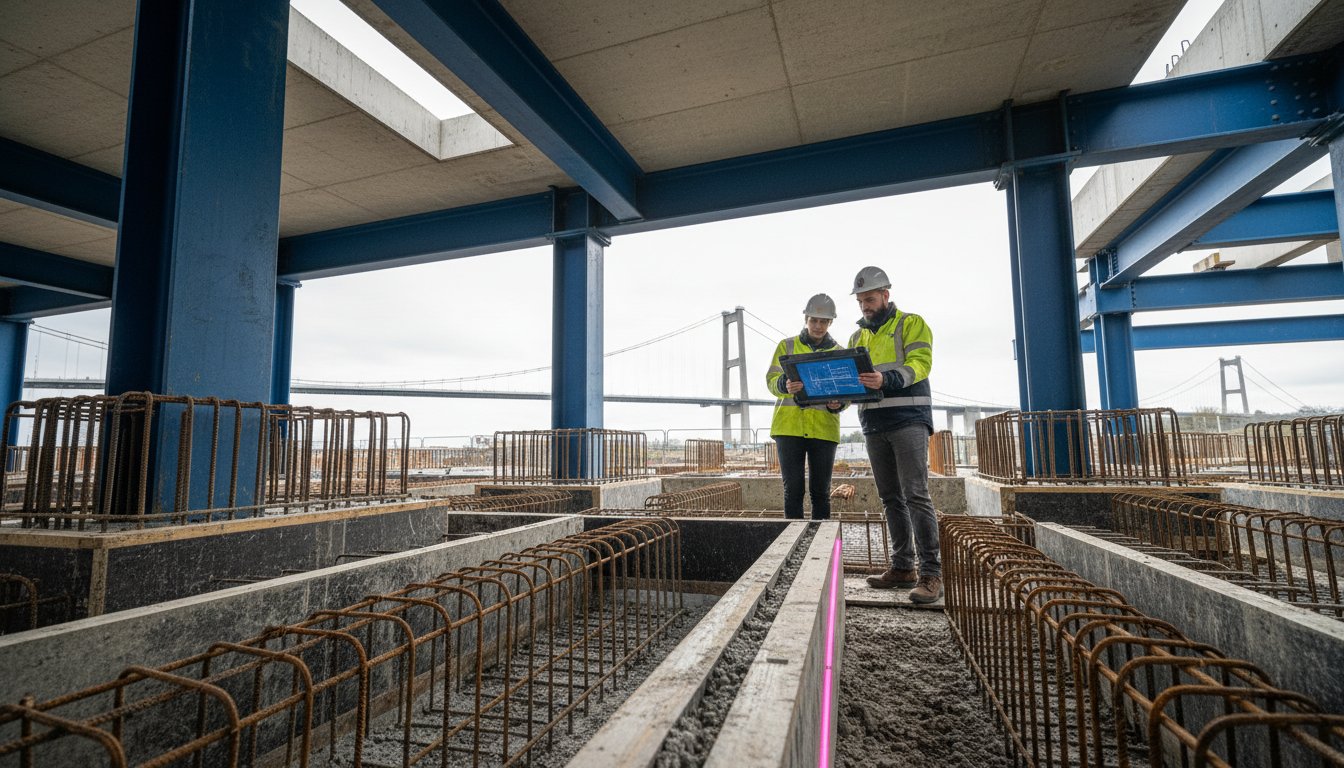
If a 2.5mm differential settlement can jeopardise the structural integrity of a high-value commercial asset, why is the initial estimation of underpinning cost so frequently detached from the underlying geotechnical complexities? It’s widely recognised amongst the UK engineering community that foundation failure is not merely a structural concern but a significant threat to asset valuation and operational continuity. The financial implications of remediation are often viewed with trepidation, particularly when the potential for prolonged business disruption is factored into the project’s feasibility study.
This technical briefing provides a comprehensive framework for understanding the variables that dictate the fiscal and engineering requirements of structural remediation in 2026. You’ll gain a precise understanding of how soil morphology, building load requirements, and the selection of advanced materials influence the total expenditure. By examining the shift from traditional mass concrete methods to sophisticated life-extension technologies like the Tyfo® system, we’ll outline how a bespoke approach to structural strengthening ensures long-term security whilst optimising capital allocation for essential UK infrastructure.
Key Takeaways
- Identify the critical engineering drivers, such as soil subsidence and increased loading requirements, that mandate structural strengthening to preserve the integrity of UK infrastructure.
- Analyse the primary technical variables, ranging from foundation depth to site accessibility, that fundamentally influence the total underpinning cost for commercial and industrial assets.
- Assess the comparative advantages and cost-benefit ratios of traditional mass concrete versus specialist mini-piling methodologies within restricted-access environments.
- Recognise the essential indirect costs associated with UK regulatory compliance, including the Party Wall etc. Act 1996 and mandatory geotechnical investigations.
- Develop a proactive asset management strategy that prioritises long-term remediation and life-extension through expert-led design and end-to-end installation.
Understanding Underpinning: Why Structural Integrity Dictates Investment
Underpinning is defined as the engineering process of strengthening the foundation of an existing structure to ensure its long-term stability and load-bearing capacity. This intervention becomes necessary when the original foundation is no longer capable of supporting the building’s weight, often due to changes in soil conditions or the structural requirements of the asset. Understanding Underpinning involves a forensic analysis of the sub-surface environment to determine the most appropriate method for load transfer, whether through mass concrete, beam and base, or mini-piled systems.
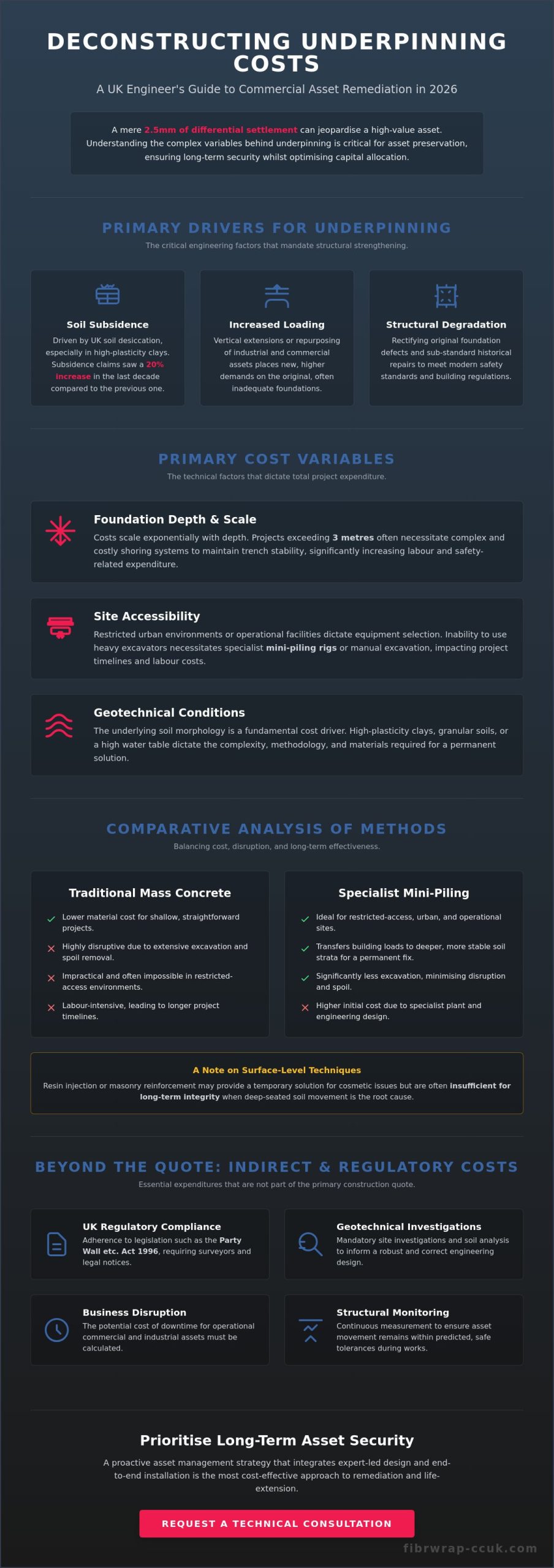
The engineering rationale for these works typically stems from three critical factors: soil subsidence, increased loading requirements, or the remediation of structural degradation. Whilst the initial underpinning cost may appear substantial, it’s essential to view this expenditure as a proactive investment in asset life-extension. For commercial infrastructure, the choice is often between essential remediation and the risk of catastrophic structural failure. A “lowest-bid” approach frequently results in higher long-term expenditure, as sub-standard repairs often fail to address the root cause of movement, leading to repetitive remedial cycles that escalate total project costs.
The Primary Drivers for Underpinning in the UK
In the United Kingdom, soil desiccation is a primary driver for foundation failure, particularly in the South East where high-plasticity clay soils are prevalent. Environmental data from 2023 indicated a 20% increase in subsidence claims compared to the previous decade, largely attributed to more frequent periods of prolonged dry weather. Additionally, the repurposing of industrial assets often necessitates vertical extensions, which place higher demands on existing footings. Structural surveys conducted during the pre-construction phase frequently identify original foundation defects that require immediate rectification to meet modern safety standards and building regulations.
Underpinning vs. Foundation Stabilisation
It’s vital to distinguish between deep-level underpinning and surface-level stabilisation techniques for cost-efficiency. Whilst surface-level resin injection or masonry reinforcement may provide a temporary solution for cosmetic issues, these methods are often insufficient for long-term integrity when deep-seated soil movement is present. Identifying when minor subsidence repair is inadequate requires the expertise of a chartered structural engineer. The engineer’s role is to calculate the necessary depth of remediation based on geotechnical reports, ensuring the underpinning cost is justified by a permanent solution that secures the asset’s structural future. This methodical approach prioritises safety and the performance of structural strengthening systems over short-term financial savings.
Primary Variables Influencing Underpinning Cost for Commercial Assets
The determination of an accurate underpinning cost for commercial infrastructure requires a rigorous assessment of the physical environment and the structural load-path. The depth and scale of the existing foundation are the primary drivers of expenditure. As the required depth of the new foundation increases, the volume of material and the intensity of labour scale exponentially. For instance, projects exceeding a depth of 3 metres often necessitate complex shoring systems to maintain trench stability, which adds a layer of indirect cost to the primary excavation work. Larger footprints also require more extensive structural monitoring to ensure that the building’s movement remains within the predicted tolerances during the remediation process.
Site accessibility dictates the selection of plant and machinery. In restricted urban environments or operational industrial centres, the inability to deploy standard heavy excavators necessitates the use of specialist mini-piling rigs or hand-digging techniques. These constraints don’t just extend the project timeline; they increase the day rate of the operation. Soil composition further complicates the engineering requirements. Clays, silts, and peats each exhibit distinct load-bearing behaviours. Research into micropile remediation techniques demonstrates that expansive soils require specific grouting pressures and pile depths to counteract seasonal volume changes, a factor that must be accounted for in the initial budget. Subterranean infrastructure, such as high-voltage cables or Victorian-era drainage systems, often requires diversion or protective bridging, which can account for up to 12% of the total underpinning cost in dense metropolitan areas like London or Manchester.
Technical Factors and Site Constraints
Working within confined spaces or live operational environments demands a high level of logistical precision. Temporary works design is essential to maintain the structural integrity of the asset while it remains unsupported during the transition phase. If the site is situated in a high-water table area, specialist dewatering equipment must be deployed to prevent trench inundation. These systems require constant monitoring and specific discharge permits from local water authorities, contributing to the daily operational overhead. For projects requiring high-level technical oversight, you can consult with our engineering team to assess site-specific risks.
Material Selection and Engineering Specification
The choice of material significantly affects the final project valuation. While mass concrete remains a standard for shallow remediation, steel piling and advanced resin injection systems offer alternative performance profiles at varying price points. Through structural design and engineering, material usage is often optimised to reduce the overall weight and footprint of the foundation. High-performance composites, including carbon fibre reinforced polymers, are increasingly utilised for structural strengthening to achieve asset life-extension without the need for massive excavation. This approach prioritises the sustainability of repair over replacement, aligning technical outcomes with long-term financial efficiency.
Comparative Analysis: Traditional Mass Concrete vs. Specialist Engineering Methods
Traditional mass concrete underpinning remains the primary selection for shallow foundation remediation where soil conditions are favourable and access is unrestricted. This method involves excavating sections beneath the existing wall and pouring high-grade concrete to extend the foundation depth. Whilst the initial capital expenditure (CAPEX) for materials is relatively low, the total underpinning cost is often inflated by the intensive labour requirements and the sequential nature of the works. It’s a process that demands precision but lacks the speed of modern alternatives.
Traditional Methods: Mass Concrete and Beam and Base
Mass concrete is the standard approach for shallow foundations. It relies on manual or small-scale mechanical excavation, which is inherently time-consuming. The beam and base method provides a more engineered solution for structures with complex load distributions. By utilising reinforced concrete beams to transfer loads to strategic bases, engineers achieve more predictable structural behaviour. However, these traditional techniques frequently result in longer project durations. Data from 2024 site audits suggests that manual excavation methods can increase site presence by 25% compared to mechanical alternatives. This leads to higher indirect costs through prolonged site management and operational downtime.
Modern Engineering: Piling and Composite Integration
Modern structural remediation has shifted towards high-precision solutions like mini-piling. This method is particularly effective in restricted access environments or for sensitive commercial structures where vibration must be minimised to protect existing integrity. Mini-piles can be installed to depths exceeding 15 metres with minimal disruption. They offer a superior cost-benefit ratio when soil stability is poor or when the structure requires deep load transfer.
The integration of advanced materials further enhances the longevity of foundation works. A critical component in contemporary remediation is the Tyfo Fibrwrap installation, which is used to increase the axial and flexural capacity of columns and beams post-underpinning. This composite strengthening approach allows for the reinforcement of the superstructure without the weight penalties of traditional steel or concrete jackets. It’s a bespoke solution for asset life-extension.
When evaluating the total underpinning cost, asset managers must consider the speed of execution. Modern engineering solutions reduce the site footprint and accelerate the programme. Using CFRP (Carbon Fibre Reinforced Polymer) systems alongside piling can reduce overall remediation timelines by up to 40%. This efficiency ensures that essential infrastructure remains operational. It aligns technical performance with long-term economic sustainability and safety standards.
Beyond the Quote: Indirect Costs and Regulatory Compliance in the UK
When calculating the total underpinning cost, asset managers must account for statutory requirements that precede physical excavation. The Party Wall etc. Act 1996 represents a primary financial consideration for projects involving shared boundaries. Surveyor fees for a single Award typically range from £1,000 to £2,500 per neighbour, depending on the complexity of the structural interface. These costs are non-negotiable legal obligations designed to protect the interests of all parties and prevent protracted litigation. Mandatory geotechnical investigations and structural surveys provide the empirical basis for the design, ensuring that the selected remediation strategy is appropriate for the specific soil strata. Whilst these assessments require upfront investment, they’re essential for mitigating the risk of design failure.
Business disruption is another critical factor that’s often overlooked during the budgeting phase. Site closures or restricted access can lead to substantial financial impact, particularly for commercial assets where operational downtime affects revenue. However, investing in a professional, engineered solution can facilitate lower long-term insurance premiums. Insurers recognise that rigorous structural remediation, backed by comprehensive data, significantly reduces the likelihood of future subsidence claims. It’s a strategic move that prioritises asset life-extension over temporary fixes.
Regulatory Fees and Professional Oversight
Building Control fees are calculated based on the project value and require independent site inspections to verify compliance with UK Building Regulations. A chartered structural engineer’s oversight is essential for the final certification of works, providing the necessary sign-off on structural integrity. During the assessment phase, technical teams often conduct carbonation testing and pull-off tests to determine the substrate’s residual strength. These tests ensure that any carbon fibre reinforced polymers or traditional materials used in the process will bond effectively to the existing structure. Budgeting for these precise diagnostics prevents costly errors during the implementation of structural strengthening measures.
Planning for Contingencies in Structural Remediation
A 10-15% contingency fund is a standard requirement in structural engineering to manage the financial risks of unknown subterranean conditions. These funds are often utilised when excavation reveals unmapped drainage or historical masonry defects that weren’t visible during initial inspections. Such discoveries can increase the underpinning cost beyond the initial estimate if not properly anticipated. In many cases, foundation issues are accompanied by superstructure instability that requires masonry reinforcement to restore the building’s equilibrium. Addressing these secondary defects concurrently is the most cost-effective method for ensuring long-term stability.
For expert guidance on navigating the regulatory and technical complexities of foundation remediation, contact our specialist engineering team for a professional consultation.
Strategic Asset Management: Integrating Underpinning into Long-Term Remediation
Transitioning from reactive structural repairs to a proactive asset care strategy is essential for the longevity of industrial infrastructure. Foundation instability often results in operational downtime that exceeds the direct cost of remediation. When asset managers evaluate the underpinning cost, it’s vital to frame the expenditure as a capital investment in asset life-extension. Industry data from 2025 indicates that comprehensive structural strengthening typically requires an investment of 15% to 30% of the cost of total asset replacement. This proactive approach facilitates future structural upgrades and seismic retrofitting; it ensures the building remains compliant with evolving safety standards without the need for demolition.
The Specialist Contractor Advantage
Procurement friction is significantly reduced through the engagement of a specialist contractor who provides integrated design, supply, and installation services. This end-to-end model ensures that the technical specifications established during the design phase are executed with precision on-site. For critical national infrastructure, adherence to rigorous engineering standards is non-negotiable. The use of proprietary systems, such as the Tyfo® system, provides exclusive access to high-performance composite solutions that are specifically engineered for complex load-bearing requirements. These systems offer superior durability compared to traditional methods. This is a critical factor in the long-term financial analysis of the underpinning cost.
- Integrated contracts eliminate the communication gaps between designers and site teams.
- Proprietary carbon fibre reinforced polymers (CFRP) provide high strength-to-weight ratios for a minimal structural footprint.
- Seismic retrofitting capabilities are embedded into the initial remediation design to future-proof the asset.
- Compliance with UK building regulations is managed through a single point of responsibility.
Next Steps for Asset Managers
The first stage in any remediation project is the commissioning of a detailed structural survey. This investigation must identify the root cause of instability. It might be soil subsidence, increased floor loading, or environmental degradation. A bespoke remediation plan is then developed to balance speed of execution with structural integrity. These plans are designed to minimise site disruption, allowing operations to continue whilst the foundation is secured. Asset managers should focus on solutions that provide a documented history of performance in similar industrial environments. High-quality strengthening offers a far superior ROI compared to the recurring costs of temporary fixes.
Professional engineering consultation is the most effective way to determine the optimal strategy for your facility. Contact Composites Construction UK to discuss the specific requirements of your next project and secure the long-term stability of your infrastructure.
Optimising Asset Longevity Through Strategic Structural Remediation
Effective foundation remediation requires a shift from viewing structural repair as a reactive expense to seeing it as a strategic investment in asset life-extension. Calculating the total underpinning cost involves more than just the initial excavation; it necessitates a comprehensive evaluation of soil mechanics, load-bearing requirements, and the long-term performance of the chosen materials. Traditional mass concrete methods often fail to meet the rigorous demands of modern critical infrastructure. By contrast, the implementation of advanced composite solutions ensures enhanced resilience against seismic activity and blast threats whilst minimising site disruption.
As the exclusive UK licensee for Tyfo® Fibrwrap® systems, our specialist engineering team provides national UK coverage for complex remediation projects. We’ve delivered structural strengthening solutions for major infrastructure assets, ensuring they meet the stringent safety standards required in 2026 and beyond. Prioritising these advanced engineering methodologies protects both the physical integrity of the building and the financial security of the asset owner. It’s essential to partner with specialists who understand the nuances of UK regulatory compliance and material science.
Discuss your structural strengthening requirements with our expert engineering team to ensure your project benefits from industry-leading technical expertise and proven results. Your infrastructure’s future remains our primary focus.
Frequently Asked Questions
How much does underpinning cost per metre in the UK?
The average underpinning cost for commercial properties in the UK typically ranges between £1,500 and £3,500 per linear metre according to 2024 industry benchmarks. These figures fluctuate based on the required depth of the new foundations and the prevailing geotechnical conditions. Mass pour concrete methods often sit at the lower end of this scale; whilst complex piling solutions for deeper strata require higher capital expenditure.
Can I claim the cost of underpinning on my commercial building insurance?
Commercial building insurance policies often cover the cost of underpinning if the subsidence is caused by an insured peril such as a sudden escape of water from underground pipes. However, insurers frequently exclude claims arising from gradual soil shrinkage or defective design. It’s essential to review the specific terms of the policy, as a standard excess for subsidence claims in the UK is frequently set at £1,000 or higher.
Is underpinning always necessary for subsidence repair?
Underpinning isn’t always the mandatory response to subsidence, as approximately 70% of cases are resolved through non-invasive measures like vegetation management or drainage repairs. If the structural movement is deemed non-progressive by a chartered engineer, alternative structural strengthening techniques may be utilised. These bespoke solutions focus on stabilising the existing fabric rather than extending the foundation depth.
How long does the typical commercial underpinning project take to complete?
A standard commercial underpinning project usually requires a timeframe of 4 to 10 weeks to reach completion. This schedule accounts for the methodical excavation of individual bays and the necessary curing times for concrete or grout. Larger industrial facilities or sites with significant structural instability may see timelines extend beyond 16 weeks to ensure the safety of the workforce and the integrity of the asset.
What is the most cost-effective method of underpinning for restricted access sites?
Mini-piling is the most cost-effective and technically viable method for structural remediation in restricted access environments. This technique utilises compact rigs that can navigate doorways as narrow as 750mm, which reduces the need for extensive demolition. It’s a preferred choice for urban commercial centres where traditional excavation equipment can’t be deployed without significant logistical disruption.
Does underpinning increase the value of a commercial property?
Underpinning functions primarily as a mechanism for asset life-extension and price stabilisation rather than providing a direct increase in market value. A property with a history of subsidence can suffer a 20% reduction in valuation if the foundations aren’t certified as stable. Completing these works restores the property to its full market potential and ensures it remains an insurable and mortgageable asset.
What are the main risks of delaying underpinning works?
Delaying necessary foundation work risks a 50% increase in total underpinning cost as structural damage migrates from the substructure to the primary frame. Prolonged movement leads to the shearing of utility connections and the compromise of fire-safety compartments. In extreme scenarios, local authorities may issue dangerous structure notices under the Building Act 1984, which necessitates immediate and costly emergency intervention.
Do I need a party wall agreement for underpinning foundations?
You must serve a formal notice under the Party Wall etc. Act 1996 if the proposed underpinning is within 3 to 6 metres of a neighbouring structure. This legal requirement ensures that the interests of all parties are protected during the excavation process. Failure to secure an agreement can lead to an injunction, which halts the project and incurs substantial legal fees for the building owner.


