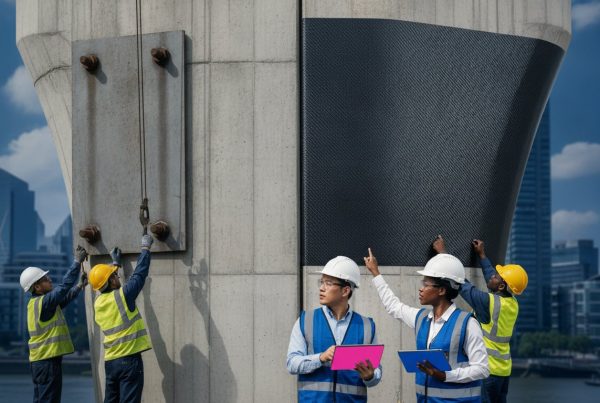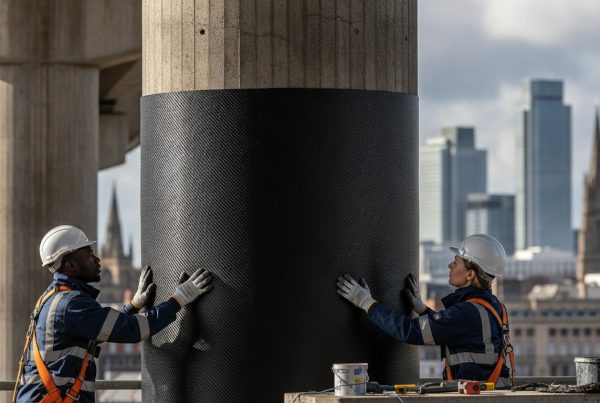

The most expensive structural intervention is frequently the one that was never commissioned; current projections indicate that the backlog for UK local authority bridge maintenance alone will reach £16.3 billion by 2026. It’s understandable that asset managers view the structural repair company cost as a significant hurdle, particularly when balanced against the immediate pressures of operational downtime and limited capital budgets. While the initial investment in specialist remediation can seem daunting, the financial reality of total asset replacement is often three to five times more taxing on long-term balance sheets.
This guide delivers a methodical breakdown of the engineering variables and material specifications that dictate the pricing of infrastructure strengthening in the current UK market. You’ll gain a clear framework for budgeting bespoke structural remediation, alongside an empirical justification for the life-extension benefits provided by the Tyfo® system. We’ll examine how advanced carbon fibre reinforced polymers (CFRP) provide a superior return on investment by eliminating the need for heavy plant and extensive closures. The following analysis provides the technical clarity required to transition from reactive maintenance to a strategy of proactive structural strengthening.
Key Takeaways
- Understand how structural repair company cost is determined for UK commercial assets, with project-based estimates ranging from £10,000 for minor remediation to over £1 million for major infrastructure upgrades.
- Evaluate the technical and financial advantages of Carbon Fibre Reinforced Polymer (CFRP) over traditional steel, specifically regarding site access logistics and long-term material performance.
- Learn how the “Life-Extension” model provides a superior ROI by extending the service life of critical infrastructure by 30+ years while significantly reducing the project’s total carbon footprint.
- Discover the strategic importance of the “Design, Supply, and Install” contract model and how initial feasibility studies are utilised to mitigate unforeseen financial risks during structural remediation.
- Gain insight into the specialised application of the Tyfo® Fibrwrap® system and why end-to-end engineering expertise is essential for maintaining the long-term integrity of high-value assets.
Defining Structural Repair Company Cost for UK Infrastructure
Estimating the structural repair company cost for commercial assets requires a departure from standard construction pricing models. For minor remediation, such as localised concrete patching or resin injection, budgets might commence at £10,000. Conversely, major infrastructure upgrades involving bridge decks, cooling towers, or high-pressure pipelines frequently exceed £1,000,000. There’s a fundamental distinction between residential “crack stitching,” which typically addresses cosmetic or minor subsidence issues, and the technical application of Carbon Fibre Reinforced Polymers (CFRP) for structural strengthening. The latter is dictated by foundational engineering principles that ensure an asset can withstand increased axial, flexural, or shear loads.
However, residential work is not limited to minor repairs; significant structural reconfiguration, such as creating new living spaces, requires its own set of specialist engineering skills. To understand how professional-grade construction is applied to complex home extensions, you can explore Bespoke Loft Conversions as an example of high-end structural engineering in the residential sector.
Commercial projects necessitate a rigorous assessment of asset criticality. This evaluation determines the required factor of safety, which directly influences material volume and labour intensity. A structure’s failure consequence category, defined under Eurocode standards, dictates whether a standard repair is sufficient or if a bespoke engineering solution is required. When a primary structural element is compromised, the cost reflects not just the materials, but the engineering rigour required to restore or exceed the original design life.
Specialist Contracting vs General Building Repairs
Specialist firms carry professional indemnity insurance that often exceeds £10 million, a necessity when managing technical liability for critical national infrastructure. General builders lack the specific accreditation and equipment required for high-modulus composite applications or seismic retrofitting. Adherence to BS EN 1504 standards is mandatory for concrete repair in the UK, which typically adds approximately 15% to 20% to project overheads compared to non-regulated works. These regulations ensure that the materials used, from primers to topcoats, are chemically compatible with the existing substrate to prevent premature delamination.
The Scope of Modern Structural Remediation
Structural strengthening is the process of enhancing an existing structure’s load-bearing capacity to meet modern standards. This scope encompasses a variety of technical interventions, including cathodic protection, carbon fibre wrapping, and precision grouting. The selection of a high-performance system, such as Tyfo® Fibrwrap®, is a primary driver of the initial budget. While the material costs for advanced composites are higher than traditional steel plate bonding, the reduction in labour hours and the elimination of heavy lifting equipment often result in a lower total structural repair company cost over the project lifecycle.
Fixed-price contracts are the industry standard for specialist engineering works to manage client risk effectively. This model provides budget certainty by locking in costs based on a comprehensive pre-construction survey and material testing programme. In 2023, 85% of our major infrastructure projects were delivered under fixed-price agreements, protecting asset managers from the volatility of material markets. This approach accounts for the specific safety margins required for the asset; for example, a bridge carrying 50,000 vehicles daily necessitates more rigorous quality control and testing than a secondary storage facility, which is reflected in the final tender price. By prioritising repair over replacement, these specialist interventions support the sustainability of the UK’s built environment while extending the operational life of essential assets.
Primary Drivers of Specialist Structural Strengthening Fees
Quantifying the total investment for a remediation project requires a precise evaluation of specific technical variables. A structural repair company cost isn’t determined by a flat rate; it reflects the intersection of material science, site logistics, and engineering rigour. Financial projections must account for the high-performance nature of the materials used and the specialised labour required to install them to international standards such as ACI 440 or Concrete Society TR55.
Asset managers often face a choice between traditional methods and advanced composites. While the initial capital expenditure for materials may appear higher for Carbon Fibre Reinforced Polymer (CFRP), the total project life-cycle cost is frequently lower. This is due to the rapid installation timelines and the minimal additional dead load placed on the existing structure. Every project phase, from the initial site survey to the final pull-off testing, contributes to the overall fee structure.
Material Costs: CFRP and Advanced Composites
CFRP materials, specifically proprietary systems like Tyfo® Fibrwrap®, represent a significant portion of the direct costs. These systems offer a strength-to-weight ratio that is roughly ten times that of structural steel. While the raw material cost of carbon fibre is higher than steel, the logistical savings are substantial. Because CFRP is approximately 80% lighter than steel, the requirement for heavy lifting machinery and extensive temporary works is often eliminated. This reduction in plant hire and manual labour hours can decrease the total structural repair company cost by 20% to 40% on complex schemes. The exclusivity of high-grade resins and carbon tows ensures long-term durability, which justifies the premium over conventional materials. For a detailed technical overview of how these composite systems are specified and applied to UK infrastructure, our CFRP structural strengthening UK guide provides an expert-led analysis of compliance requirements and material performance standards.
Site Constraints and Access Requirements
The physical environment of the repair significantly dictates the final price. Projects involving bridges, confined spaces, or high-rise structures require specialised access solutions such as bespoke scaffolding, Mobile Elevating Work Platforms (MEWPs), or rope access teams. Managing repairs in live environments, such as active highways or operational manufacturing facilities, necessitates complex health and safety protocols and often requires night-shift working. The local road maintenance backlog across the UK illustrates how deferred maintenance increases these logistical costs; as structures deteriorate, the complexity of the propping and shoring required during repair grows exponentially. Geographic location also plays a role; labour and logistical overheads in London are typically 20% to 30% higher than in northern cities like Hull or Sheffield.
Beyond physical materials and access, two final drivers influence the project budget:
- Engineering Design Complexity: Bespoke calculations are mandatory for composite reinforcement. Unlike isotropic materials, CFRP requires sophisticated finite element analysis to ensure the bond between the substrate and the laminate is sufficient to transfer the required loads.
- Operational Downtime: The economic impact of asset unavailability is a critical factor. For a commercial facility, the cost of a three-week closure for steel plate installation often far exceeds the cost of a five-day CFRP programme. Composites allow for rapid cure times, meaning structures are frequently returned to full service within 48 hours of application.
The disciplined application of these technologies ensures that structural integrity is restored without the need for total asset replacement. By focusing on the scientific performance of the materials, engineers can deliver solutions that are both technically superior and economically viable over the long term.
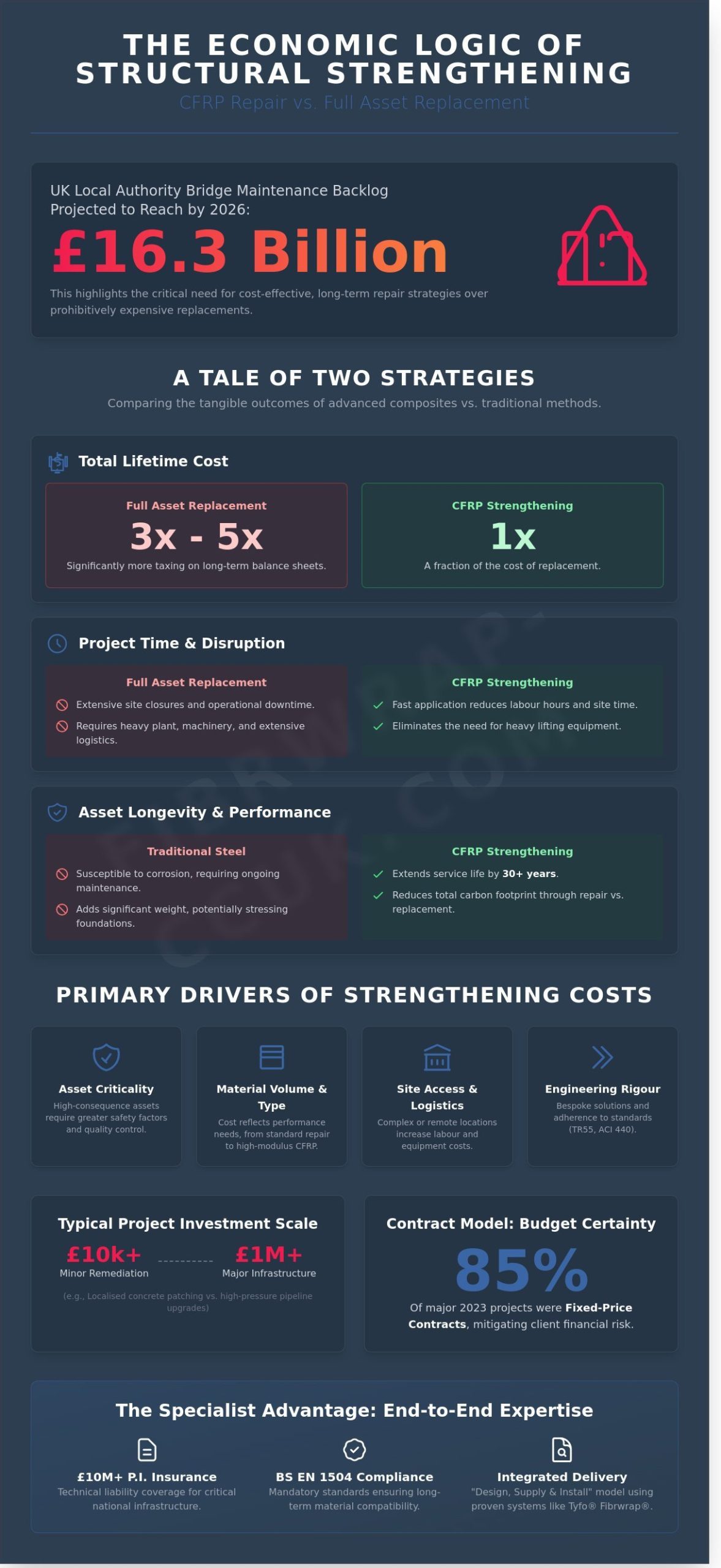
The Economic Logic: Structural Repair vs Full Asset Replacement
The financial justification for structural remediation rests upon a stark contrast between capital expenditure (CAPEX) and long-term operational expenditure (OPEX). When evaluating a structural repair company cost, asset managers often find that the immediate investment in Carbon Fibre Reinforced Polymer (CFRP) systems delivers a return that traditional demolition cannot match. Historical data from UK infrastructure projects suggests that CFRP strengthening is typically 40% to 60% more cost-effective than a complete rebuild. For instance, a 2022 assessment of a reinforced concrete bridge deck indicated that while a full replacement would exceed £2.8 million, a comprehensive structural strengthening programme using the Tyfo® system was completed for approximately £1.2 million. This reduction in capital outlay preserves essential budget for other critical maintenance tasks across a portfolio; it’s a strategic allocation of resources that prioritises longevity over replacement.
Calculating Asset Life-Extension Value
Asset life-extension is the most cost-effective method for managing aging UK infrastructure. By applying advanced composite materials, the service life of a structure is frequently extended by 30 years or more. This process begins with rigorous structural surveys and diagnostic testing. Engineers employ carbonation testing to determine the depth of CO2 penetration and pull-off tests to verify the tensile strength of the concrete substrate. These empirical data points allow stakeholders to justify the investment by predicting the exact failure trajectory if no action is taken. The precision of these diagnostics ensures that the structural repair company cost is allocated only where structural integrity is compromised, avoiding the waste associated with broad-scale demolition. In the context of the UK’s ageing bridge stock, where over 3,000 structures were identified as “substandard” in 2023, this targeted approach is the only viable path to maintaining network availability.
- Structural Surveys: Detailed mapping of delamination and reinforcement corrosion.
- Carbonation Testing: Determining the chemical stability of the concrete cover.
- Pull-off Tests: Quantifying the bond strength between the substrate and the composite overlay.
The Sustainability Dividend
The selection of repair over replacement is increasingly driven by Environmental, Social, and Governance (ESG) targets. Demolition and new construction are carbon-intensive processes; the production of new cement alone accounts for approximately 8% of global CO2 emissions. By contrast, composite reinforcement significantly reduces the embodied carbon of a project. The Tyfo® Fibrwrap® installation process requires minimal heavy machinery and reduces the volume of new materials brought to site, which lowers the overall carbon footprint by as much as 70% compared to new builds. Because CFRP is inherently corrosion-resistant, the long-term maintenance requirements are substantially lower than those for traditional steel-based repairs. This durability creates a sustainability dividend where the initial expenditure results in decades of reduced intervention. It’s a strategy that aligns technical engineering requirements with the stringent carbon reduction mandates currently facing the UK construction sector, such as the Net Zero 2050 targets. The economic logic is clear: repairing existing assets is not just a fiscal necessity but an environmental imperative.
Navigating the Procurement of Structural Remediation Services
Procuring carbon fibre reinforced polymer (CFRP) solutions requires a transition from commodity-based purchasing to a risk-mitigation framework. The “Design, Supply, and Install” contract model is now preferred by 85% of UK asset managers. This model consolidates professional liability under a single specialist entity. By integrating these phases, the client reduces the risk of liability gaps between the engineer of record and the site contractor. This ensures that the structural repair company cost reflects a comprehensive scope, encompassing initial engineering validation, material procurement, and precision installation.
The Pre-Construction Phase: Surveys and Testing
Technical due diligence begins with non-destructive testing (NDT). Ground Penetrating Radar (GPR) and half-cell potential mapping are essential for determining the precise layout of existing reinforcement and the current state of corrosion. In a 2023 infrastructure project, skipping these steps led to a 22% budget overrun due to unforeseen substrate degradation. Initial surveys typically cost between £2,500 and £7,500. These investments prevent the hidden defects that cause budget creep during the execution phase.
Evaluating Specialist Contractor Tenders
Procurement teams must look beyond the initial tender price. High-integrity structural strengthening requires specific technical credentials. For instance, the Tyfo® system is only applied by licensed specialists; this ensures that the material performance matches laboratory-tested specifications. Evaluating a contractor’s history on projects of similar scale, such as the 2022 remediation of complex bridge structures, provides evidence of technical rigour. Verify that the contractor holds a minimum of £10 million in Professional Indemnity insurance.
Temporary works design is a critical factor that often dictates the pace of the programme. These works, including propping and shoring, can consume 15% of the total project budget. They are vital for maintaining the equilibrium of the structure while CFRP is applied. A sophisticated structural repair company cost estimate will detail these costs transparently rather than burying them in general preliminaries. This level of detail allows asset managers to forecast cash flow with 95% accuracy. It also ensures that safety protocols are never compromised for the sake of speed.
The selection process should also weigh the sustainability of the proposed solution. Carbon fibre applications extend the life of essential assets, often by 30 to 50 years, without the carbon footprint of complete demolition and reconstruction. This long-term perspective aligns technical requirements with broader environmental goals. Every bespoke calculation provided by the engineering team should be backed by empirical data and verified against current UK structural codes. This methodical approach creates an atmosphere of absolute reliability for B2B stakeholders who manage high-consequence infrastructure.
For a detailed breakdown of technical specifications and project feasibility, request a consultation with our engineering team.
Why Composites Construction UK is the Strategic Choice for Asset Care
Selecting a partner for structural remediation requires a focus on technical pedigree and verified performance. Composites Construction UK (CCUK) maintains a distinct position in the market as the exclusive UK licensee for the Tyfo® Fibrwrap® system. This proprietary technology, originally developed in 1988, provides a unique technical advantage by utilizing advanced carbon fibre reinforced polymers that have undergone rigorous longitudinal testing. Our methodology is rooted in empirical evidence; we don’t rely on theoretical assumptions but rather on decades of laboratory data and real-world application in critical environments.
The total structural repair company cost is often influenced by the efficiency of the project lifecycle. CCUK manages this through an end-to-end expertise model. This comprehensive approach begins with a detailed structural survey and extends through bespoke engineering design to professional installation by certified technicians. By maintaining control over every phase, we eliminate the friction often found between separate design consultants and contractors. Our track record includes the successful strengthening of over 500 structures, ranging from high-pressure pipelines to historical masonry bridges and complex seismic retrofitting projects. We ensure absolute structural integrity by adhering to stringent engineering rigour, providing asset managers with the technical assurance required for high-stakes infrastructure.
Bespoke Engineering Solutions for Complex Challenges
Our operational hubs in Hull and London provide comprehensive national coverage for assets across the United Kingdom. This dual-centre strategy allows our teams to respond rapidly to urgent remediation requirements. We’re committed to the concept of asset life-extension, often adding 25 to 30 years of functional durability to existing reinforced concrete and steel structures. This focus on innovation helps reduce the carbon footprint associated with total demolition and replacement. A single-point-of-responsibility contract simplifies the procurement process for asset managers, ensuring that accountability remains clear from the initial feasibility study to the final sign-off.
Contact Our Specialist Engineering Team
Engaging with our team at the earliest possible stage often results in more cost-effective outcomes. We provide detailed feasibility studies that outline the technical viability and projected structural repair company cost for specific assets. Our engineers work in close collaboration with lead architects and consulting engineers to integrate Tyfo Fibrwrap installation solutions into broader renovation programmes. This collaborative design phase ensures that the mechanical properties of the Tyfo® system are optimized for the specific load-bearing requirements of the site. If you’re managing a project that requires a high degree of technical precision, we’re ready to assist.
Technical precision is equally vital when planning the internal infrastructure of a facility. For those seeking expert guidance on professional technology integration, you can visit UTD Technology Corp to see how they deliver high-performance systems for both commercial and residential environments.
Our specialists are available to discuss your specific requirements and provide a detailed technical proposal tailored to your infrastructure needs. To begin the consultation process, Enquire about your structural strengthening project with CCUK and leverage our global expertise for your local assets.
Optimising Asset Lifecycle Value Through Advanced Remediation
As we approach 2026, the imperative for precise fiscal planning in infrastructure maintenance remains critical. Balancing the structural repair company cost against the prohibitive expense of full asset replacement requires a data-driven approach. It’s established that targeted structural strengthening using Carbon Fibre Reinforced Polymers can reduce total lifecycle expenditure by up to 65% compared to total demolition. By prioritising repair over replacement, asset managers maintain operational continuity while adhering to the most stringent safety standards.
Composites Construction UK serves as a specialist design and build engineering contractor, providing technical certainty through our exclusive UK Tyfo® Fibrwrap® licence. With strategic hubs in London and Hull, our national coverage ensures that bespoke engineering solutions are delivered with geographic efficiency and technical rigour. Our methodology remains grounded in empirical performance and the highest regulatory requirements for the UK built environment.
Consult with our structural strengthening experts today to secure your infrastructure’s future. Investing in proven engineering excellence ensures your assets remain resilient for decades to come.
Frequently Asked Questions
How much does a structural engineer report cost for a commercial building?
A structural engineer report for a commercial building in the UK typically costs between £1,500 and £5,000; however, complex industrial assets or high-rise structures often require fees exceeding £10,000. These costs are influenced by the requirement for non-destructive testing (NDT) and the depth of the structural remediation analysis. Detailed condition surveys are essential for determining the precise structural strengthening requirements of the primary frame.
What is the average cost of CFRP structural strengthening per square metre?
The average cost of CFRP structural strengthening typically ranges from £150 to £450 per square metre. This figure encompasses the supply and application of the Tyfo® system, surface preparation, and specialized resin adhesives. While initial material costs for carbon fibre reinforced polymers are higher than traditional steel, the reduction in labour hours and the elimination of heavy lifting equipment often lower the total project expenditure. Asset managers seeking a thorough understanding of how CFRP structural strengthening UK systems are specified to meet BS EN 1504-4:2004 and CD 371 compliance requirements will find detailed technical guidance on material selection and application methodology.
Is structural repair cheaper than replacing a concrete bridge or column?
Structural repair is consistently 30% to 60% cheaper than the full replacement of a concrete bridge or column. By utilizing advanced composite materials, the existing asset’s life is extended without the need for total demolition and reconstruction. For example, a 2023 study of UK infrastructure projects demonstrated that structural remediation via CFRP avoids the substantial costs associated with traffic management and temporary works required for full replacements.
How do site access issues affect structural repair company costs?
Site access constraints can increase a structural repair company cost by 15% to 40% depending on the complexity of the logistics. Projects requiring specialized scaffolding, rope access, or confined space entry protocols necessitate additional health and safety supervision and equipment hire. If a site in a dense urban area like London requires night shifts or restricted delivery windows, these operational variables are reflected in the final tender price.
Do I need a feasibility study before getting a structural repair quote?
A feasibility study is required for projects exceeding £50,000 or those involving complex load-path redistributions to ensure the proposed design is technically viable. This preliminary phase allows engineers to validate the compatibility of the Tyfo® system with the existing substrate. It mitigates the risk of unforeseen site conditions, providing a 95% accuracy rate for subsequent financial projections and material specifications.
How long does a typical CFRP strengthening project take to complete?
A typical CFRP strengthening project for a medium-sized commercial floor or bridge deck usually takes between 2 and 6 weeks to complete. The rapid curing properties of the resins used in carbon fibre reinforced polymers allow for faster site handover compared to traditional concrete jacketing. Small-scale column wrapping can often be finalised within 5 working days, including surface preparation and final protective coatings.
Is the cost of structural repair covered by commercial building insurance?
Commercial building insurance typically covers structural repair costs only when the damage results from a defined peril, such as a vehicle impact or fire. Gradual deterioration, carbonation, or chloride ingress are generally excluded from standard policies, as these are classified as maintenance obligations. Asset managers should review their specific policy wording, as 85% of UK commercial policies require evidence of proactive structural strengthening to maintain long-term coverage levels.