
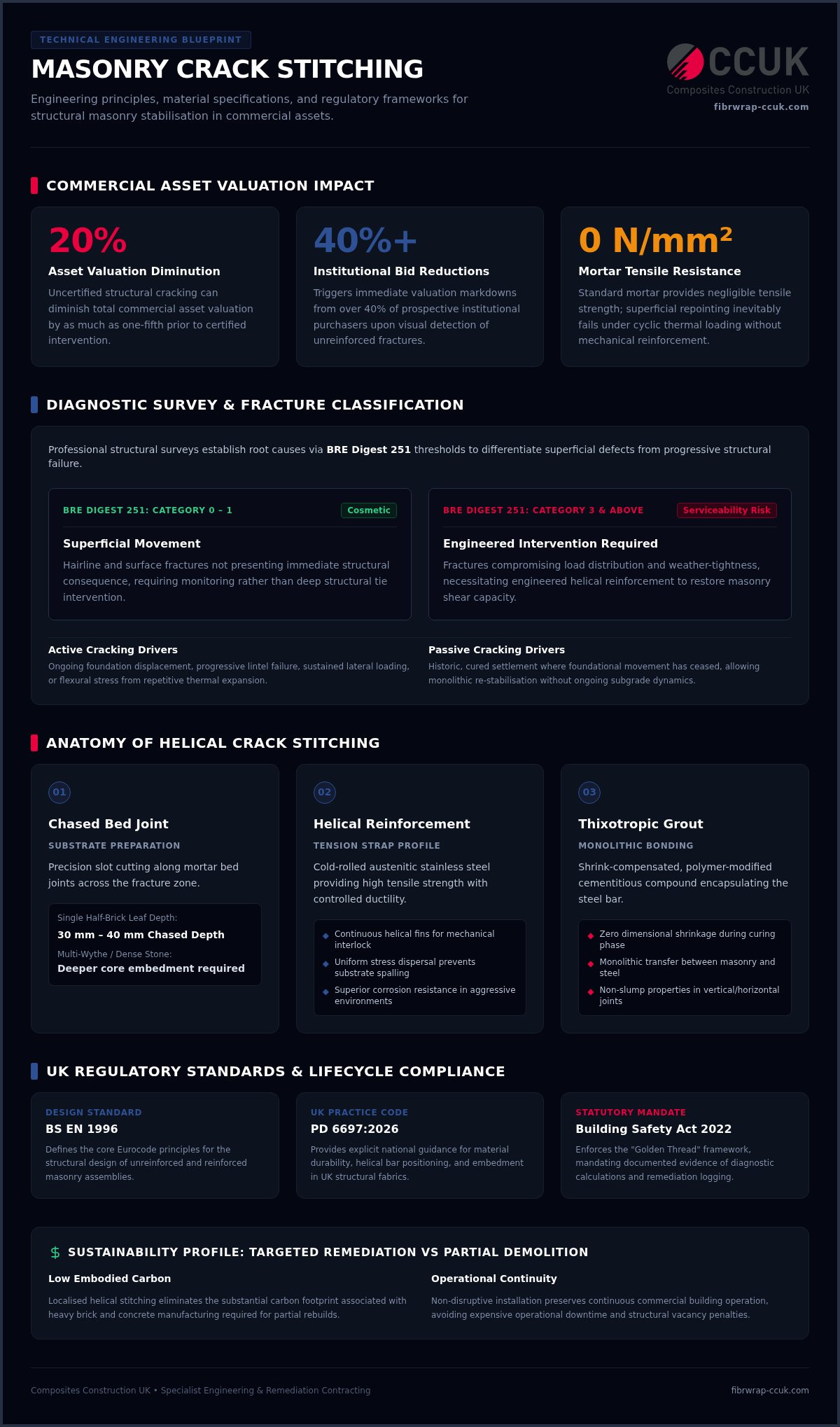
Did you know that uncertified structural cracking can diminish a commercial asset’s valuation by as much as 20%, whilst frequently triggering immediate bid reductions from over 40% of prospective institutional buyers? For asset controllers and structural engineers, the appearance of a fracture represents more than a superficial defect; it is a critical indicator of progressive structural failure that necessitates a rigorous, evidence-based response. When addressing these vulnerabilities, masonry crack stitching serves as a sophisticated remedial intervention, designed to restore tensile integrity and lateral load transfer without the prohibitive costs or operational disruptions associated with partial demolition.
You likely recognise that the efficacy of any structural repair is predicated on a precise understanding of the underlying cause, whether it involves thermal cycling or historic settlement. This technical guide provides a comprehensive analysis of the engineering principles, material specifications, and professional standards defined by BS EN 1996 and PD 6697:2026. By examining the application of high-tensile helical reinforcement and thixotropic bonding grouts, we’ll outline how a methodical approach to masonry reinforcement ensures long-term stabilisation and compliance with the most stringent UK building regulations, ultimately extending the functional lifespan of essential infrastructure.
Key Takeaways
- Understand how helical profiles redistribute tensile loads across fractured masonry to restore structural integrity and prevent progressive asset deterioration.
- Identify the critical material specifications for austenitic stainless steel reinforcement to ensure corrosion resistance and long-term durability in aggressive environments.
- Learn why thixotropic, shrink-compensated grouts are essential for establishing a monolithic bond between the reinforcement and the existing masonry substrate.
- Discover the professional installation standards for masonry crack stitching, focusing on precision bed joint chasing and substrate preparation for critical commercial assets.
- Recognise how bespoke engineering design and feasibility studies mitigate the risk of remedial failure whilst extending the functional lifespan of industrial infrastructure.
Understanding Masonry Crack Stitching: Structural Integrity and Remediation
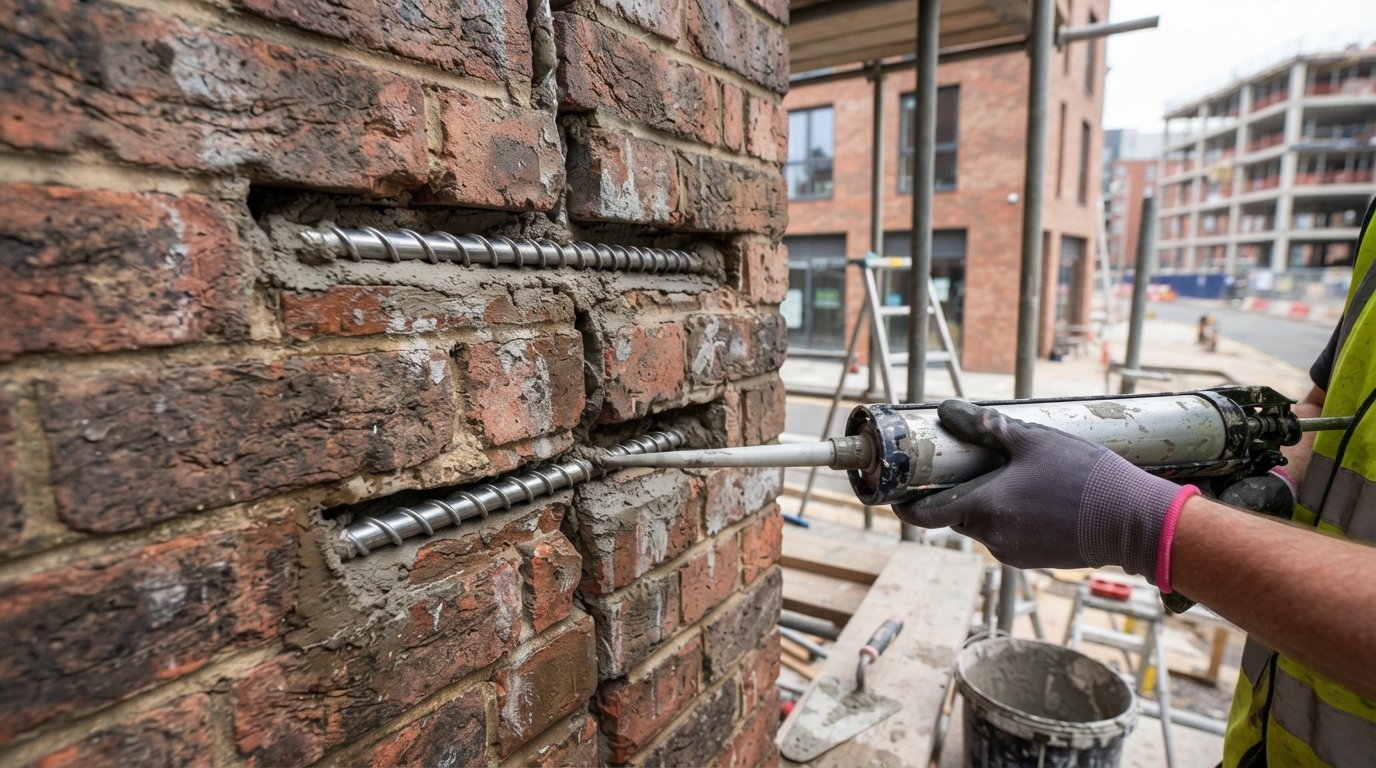
Masonry crack stitching is a sophisticated, non-disruptive remedial technique utilised to stabilise fractured elevations without the requirement for extensive and invasive reconstruction. By embedding high-tensile helical bars into the mortar bed joints across a fracture, the system effectively redistributes tensile loads that the unreinforced masonry can no longer sustain. Whilst surface-level repointing may provide a temporary aesthetic improvement, it fails to address the underlying structural deficiency because mortar offers negligible tensile resistance. Under subsequent loading or thermal cycling, an unreinforced fracture will inevitably reappear or widen, potentially leading to progressive instability. Masonry crack stitching represents a permanent, engineered reinforcement method designed to restore the structural capacity of compromised masonry assets whilst accommodating natural thermal and moisture-related fluctuations.
The Mechanics of Structural Cracking
Effective remediation begins with a rigorous distinction between active and passive cracking. Active fractures, often driven by ongoing foundation movement, progressive lintel failure, or significant lateral loading, require distinct engineering considerations compared to passive cracks resulting from historic, cured settlement. In large-scale commercial facades, thermal expansion often induces stresses that exceed the masonry’s natural flexural capacity, resulting in characteristic stepped or vertical fractures. A professional structural survey is mandatory to determine the root cause, typically utilising BRE Digest 251 thresholds to assess whether movement is cosmetic (Category 0 to 1) or represents a serviceability risk (Category 3 and above). Without this diagnostic phase, any reinforcement may simply transfer stress to adjacent masonry, leading to secondary failures in the substrate.
Sustainability: Repair vs Replacement
The decision to implement engineered repairs rather than opting for demolition significantly reduces the embodied carbon associated with the production and transport of new construction materials. By prolonging the functional lifespan of commercial infrastructure through targeted interventions, asset owners achieve substantial economic and environmental benefits. Integrated structural repairs ensure that critical assets remain operational, avoiding the high carbon footprint of concrete and brick manufacture required for full-scale replacement. This approach aligns with the Building Safety Act 2022 mandates for maintaining the “Golden Thread” of structural information, ensuring that every remedial action is logged as part of a long-term, sustainable asset management strategy.
The Engineering Science Behind Helical Bar Reinforcement
The technical efficacy of masonry crack stitching relies upon the metallurgical properties of cold-rolled, austenitic stainless steel. Unlike standard carbon steel rebar, helical reinforcement is manufactured to deliver high tensile strength whilst maintaining sufficient ductility to accommodate structural movement. The unique fins of the helical profile significantly increase the specific surface area available for mechanical interlocking. This geometry ensures that the bond between the bar and the cementitious grout is distributed uniformly along the entire length of the reinforcement, preventing localised stress concentrations that could lead to substrate spalling.
Engineers determine the frequency and depth of bar installation by analysing the density of the masonry and the specific load requirements of the elevation. Typically, for half-brick single leaves, a chased depth of 30 mm to 40 mm is specified; however, multi-wythe walls or dense stonework may necessitate deeper embedment to ensure the reinforcement sits within the core of the structural member. This precision in design allows the helical profile to act as a tension strap, redistributing loads across the fracture boundary and restoring the masonry’s collective shear capacity.
Tensile Strength and Yield Points
Helical bars exhibit an ultimate tensile strength ranging from 1,050 to 1,200 N/mm², which is more than double the yield of standard British high-yield carbon rebar. A single 6mm bar typically provides a mean tensile load capacity of approximately 8.39 kN, making it suitable for standard brickwork repairs. In contrast, 8mm bars, which achieve capacities exceeding 11 kN, are specified for heavy-duty commercial applications or where the masonry density requires higher resistance. For complex assets, bespoke engineering calculations are essential to verify that the chosen diameter and spacing will effectively bridge the fracture without over-stiffening the structure.
Corrosion Resistance in Harsh Environments
Subsurface oxidation represents a significant risk to structural longevity, particularly in coastal or industrial atmospheres where chloride ions can penetrate masonry pores. Grade 304 stainless steel is the standard specification for inland environments; however, Grade 316 is mandatory for assets located within 5 km of the sea or in high-salinity road splash zones. This molybdenum-bearing alloy provides superior pitting resistance, ensuring that the reinforcement remains chemically stable over the asset’s extended lifespan. By selecting the correct metallurgical grade, the risk of expansive corrosion is mitigated, preserving the integrity of the repair amongst the most challenging environmental conditions.
Selecting Grout and Bar Specifications for Load-Bearing Walls
The structural efficacy of masonry crack stitching is fundamentally dependent upon the performance of the bonding medium utilised to secure the reinforcement within the substrate. For commercial infrastructure, the selection of a thixotropic, shrink-compensated cementitious grout is mandatory to ensure the development of a monolithic bond between the helical bar and the masonry. Thixotropic properties are particularly critical for load-bearing applications; they ensure the grout remains stable within vertical or overhead bed joints during the injection and curing phases, preventing the formation of voids or slumping that would inevitably compromise the load path. Unlike standard mortars, these engineered grouts are formulated to match the thermal and moisture movement characteristics of the wall, ensuring that the reinforcement and the substrate function as a single, cohesive unit under stress.
Whilst two-part chemical resins are occasionally specified for rapid loading in non-porous stonework, high-performance cementitious grouts remain the preferred choice for broader structural remediation. These grouts provide superior fire resistance and vapour permeability, which is essential for maintaining the breathability of historic or solid-wall masonry. By facilitating the natural migration of moisture, cementitious systems prevent the entrapment of water behind the repair zone, a common cause of subsurface spalling in older assets. This dual focus on mechanical performance and chemical compatibility ensures the long-term stabilisation of the structure whilst adhering to the stringent requirements of UK building standards.
Grout-to-Masonry Bond Strength
The development of a high-capacity mechanical interlock is achieved through the interaction between the helical fins of the bar and the hardened grout matrix. Engineered grouts typically achieve a 28-day compressive strength exceeding 55 N/mm², providing a robust anchor that can withstand significant shear and tensile forces. To verify the integrity of the remedial intervention, professional contractors utilise standardised testing protocols, such as pull-off tests, to confirm that the axial tensile bond strength meets the design specification. Standard DIY-grade mortars lack the necessary shrink-compensation and bond strength, often leading to de-bonding at the grout-masonry interface when the structure is subjected to live loads or thermal cycling.
Bespoke Design Specifications
Effective masonry crack stitching must be calibrated to the specific modulus of elasticity of the host substrate to avoid the creation of localised “hard spots” that could induce secondary cracking. For complex commercial facades, the reinforcement strategy often incorporates bespoke design features that account for the unique load distribution of the building. This tailored approach is particularly vital when addressing risks of disproportionate collapse, where strategic reinforcement is required to ensure that the failure of a single masonry element does not lead to a catastrophic structural event. By aligning the material properties of the reinforcement with the specific requirements of the asset, engineers can ensure a durable and compliant remediation strategy.
The Professional Installation Process for Large-Scale Assets
Execution of masonry crack stitching on industrial infrastructure or commercial facades demands a methodical sequence that prioritises structural continuity and site safety. Unlike domestic interventions, large-scale assets such as retaining walls or bridge abutments require specific engineering tolerances to ensure the remediation accommodates significant lateral loads. The process commences with the precision chasing of bed joints, typically at depths of 30 mm to 40 mm for standard masonry or up to 55 mm for multi-wythe solid walls. Each chase must extend a minimum of 500 mm past either side of the fracture boundary to ensure adequate anchorage and stress distribution. Once the joints are cut, they’re thoroughly cleaned using high-pressure air or water to remove all detritus, as residual dust will inevitably compromise the bond between the substrate and the thixotropic grout.
Following preparation, a systematic injection of shrink-compensated grout is performed, into which the stainless steel helical bar is firmly embedded. A secondary layer of grout is then applied to encapsulate the reinforcement, ensuring a monolithic connection. The final stage involves finishing the joint to match the existing masonry profile, followed by rigorous quality control. For critical assets, this verification may include the installation of wireless digital strain sensors to track displacement over time, providing empirical evidence of structural stabilisation. If your project involves complex load-bearing requirements, you should contact our specialist engineering team to discuss bespoke installation standards.
Temporary Works and Site Safety
Maintaining structural stability whilst the repair is in progress is paramount, particularly when dealing with tapered fractures or compromised lintels. Temporary propping or shoring is often integrated into the worksite plan to mitigate the risk of localised collapse during the chasing phase. Health and safety protocols for working at height on infrastructure must be strictly enforced, incorporating bespoke scaffolding or high-reach cradles where necessary. Environmental controls, including the use of M-class dust suppression systems, are utilised to protect both the workforce and the surrounding public from airborne silica during masonry cutting.
Concealed Repairs for Heritage Assets
For Grade I or II listed structures, the requirement for an invisible finish is as critical as the structural reinforcement itself. Specialist techniques are employed to hide the helical bars deep within the mortar bed, allowing for a final pointing layer that utilises lime-based mortars matched to the original texture and colour. This approach ensures that the asset’s aesthetic integrity is preserved whilst its functional lifespan is extended. For a detailed breakdown of these specialised techniques, refer to our masonry reinforcement guide, which explores the nuances of heritage asset life-extension.
Specialist Design and Contracting: The CCUK Approach
CCUK operates as a specialist engineering contractor, moving beyond the traditional procurement of retail repair kits to provide a comprehensive design-and-build service. For critical infrastructure, masonry crack stitching is not merely a product application; it’s a component of a wider structural strategy. Our end-to-end design, supply, and installation model ensures that every intervention is preceded by rigorous feasibility studies. These assessments are vital for identifying underlying geotechnical or structural issues that might otherwise cause remedial failure. By undertaking bespoke engineering calculations, the risk of transferring stresses to adjacent masonry is mitigated, ensuring the long-term stabilisation of the asset.
In complex environments, such as waterfront installations or industrial facilities, masonry reinforcement is often integrated with advanced composite technologies. As the exclusive UK licensee for Tyfo® Fibrwrap® systems, CCUK can combine traditional helical stitching with carbon fibre reinforced polymer (CFRP) strengthening to address multi-axial loading requirements. This integrated approach allows asset controllers to address diverse failure modes within a single, coordinated programme of works. The focus remains on the sustainability of repair over replacement, extending the functional lifespan of essential infrastructure through scientifically proven methodologies.
Beyond Crack Stitching: Holistic Structural Care
Structural integrity often requires a multi-layered response where crack stitching is paired with lateral restraints and bed joint reinforcement to manage out-of-plane movement. This holistic perspective is fundamental to the role of a specialist engineering contractor in structural life-extension. By addressing the building envelope and the internal load path simultaneously, engineers can ensure that the remediation complies with the Building Safety Act 2022 and other relevant UK standards. This methodology provides a level of security that generic repair methods can’t match, particularly for assets of high economic or historic value.
Consult CCUK for Structural Remediation
Asset owners and technical professionals are encouraged to request a formal technical assessment for any commercial or industrial structure showing signs of distress. Our commitment to engineering rigour ensures that every bespoke repair design is grounded in empirical evidence and material science. To initiate a consultation regarding your infrastructure requirements, you may contact the CCUK engineering team for a tailored remediation strategy. Our specialists remain attentive to regional requirements whilst delivering global expertise in the field of structural strengthening and asset life-extension.
Securing Asset Integrity through Engineered Remediation
The restoration of structural integrity in commercial masonry demands a transition from cosmetic repair to engineered stabilisation. By utilising the metallurgical superiority of helical reinforcement and the bond strength of thixotropic grouts, masonry crack stitching provides a non-disruptive solution that effectively redistributes tensile stresses across fractured elevations. This methodology ensures compliance with current UK building standards whilst prioritising the sustainability of repair over the carbon-intensive alternative of demolition. The successful extension of an asset’s functional lifespan is predicated on this rigorous alignment of material science and structural engineering.
As the exclusive UK licensee for Tyfo® Fibrwrap® systems, CCUK provides national coverage for major infrastructure projects, ensuring that every intervention is supported by bespoke engineering calculations and rigorous site preparation. For asset controllers seeking to mitigate progressive failure, professional design remains the most reliable safeguard against future instability. We invite you to consult our engineers for a bespoke masonry repair design that addresses the unique requirements of your infrastructure. Your proactive approach to structural care ensures the continued safety and long-term value of your commercial assets.
Frequently Asked Questions
Is masonry crack stitching a permanent structural solution?
Masonry crack stitching is considered a permanent remedial solution provided that the original cause of the fracture has been identified and stabilised. By embedding stainless steel helical bars into the bed joints, the system restores the masonry’s tensile capacity and prevents further separation of the fracture. It’s an engineered intervention that, when designed correctly, matches the design life of the host structure, offering a reliable alternative to the costly and disruptive process of partial demolition.
Can crack stitching be used on all types of masonry, including stone and flint?
Yes, the system is adaptable to various substrates, including natural stone, flint, and multi-wythe brickwork. Whilst bed joints in standard brickwork are uniform, stone and flint elevations require precision chasing into the mortar matrix, often necessitating bespoke bar lengths and deeper embedment. The use of thixotropic, shrink-compensated grouts ensures a monolithic bond even within the irregular voids typically found in historic rubble-fill walls, maintaining the structural continuity of the entire elevation.
How does crack stitching compare to traditional underpinning for subsidence?
Crack stitching and underpinning address different structural failures and are often used as complementary techniques. Underpinning is required when active subsidence involves foundation rotation or soil instability, whilst crack stitching is specified to restore the integrity of the masonry once the ground movement is cured. Stitching is a non-disruptive, low-carbon alternative to underpinning only in cases where movement is passive and the foundation remains structurally sound under current loading conditions.
What is the typical depth and length required for a helical bar installation?
Typical installations utilise helical bars with lengths of 1,000 mm to 1,500 mm to ensure a minimum anchorage of 500 mm on either side of the fracture. For standard half-brick leaves, the engineered chasing depth is between 30 mm and 40 mm. In thicker commercial walls or solid stone infrastructure, this depth is often increased to 55 mm to ensure the reinforcement sits within the central core of the masonry, providing optimal lateral load redistribution.
How does the system handle thermal expansion and contraction in brickwork?
The helical profile of the reinforcement bars allows them to act like a high-tension spring, accommodating natural thermal expansion and contraction within the masonry. This axial flexibility ensures that the repair doesn’t over-stiffen the wall, which could otherwise lead to secondary fracturing in adjacent bricks. By distributing thermal stresses uniformly along the length of the bar, the system maintains structural stabilisation whilst allowing the building envelope to breathe and cycle naturally.
Is professional design required for masonry crack stitching on commercial buildings?
Professional design is mandatory for commercial assets to ensure compliance with the Building Safety Act 2022 and BS EN 1996. For higher-risk buildings, structural interventions must be supported by bespoke engineering calculations and logged within the digital Golden Thread of information. Asset controllers rely on specialist contractors to provide these technical specifications, as uncertified repairs lack the necessary empirical validation required by the Building Safety Regulator and institutional insurers during asset valuations.
Can crack stitching be performed on listed or heritage structures?
Yes, masonry crack stitching is frequently specified for Grade I and II listed structures due to its non-destructive and concealed nature. By utilising lime-compatible grouts and matching the final pointing to the historic mortar profile, the reinforcement remains invisible once installed. This approach preserves the aesthetic integrity of heritage facades whilst providing the necessary tensile strengthening to prolong the asset’s functional lifespan without compromising its significant historic fabric or regulatory status.
What happens if the underlying cause of the masonry crack is not addressed?
If the underlying cause of movement remains active, the masonry crack stitching system will eventually fail or cause stress to transfer elsewhere. If foundation subsidence or lintel rotation continues, the reinforced zone will remain rigid, forcing the masonry to rupture immediately adjacent to the repair. This highlights the critical importance of conducting a comprehensive structural survey and feasibility study before installation to verify that the root cause of the distress has been successfully remediated.