

Traditional assumptions suggest that resisting an explosive event requires immense physical mass; however, the most effective structural blast protection UK infrastructure can employ relies on ductility and energy dissipation rather than sheer volume. It’s a common misconception that thicker concrete is the only viable defence against high-magnitude pressure waves. In many critical environments, adding mass is neither feasible nor structurally sound.
You likely recognise the significant engineering challenge of upgrading older masonry or concrete assets where the risk of progressive collapse is high and the spatial constraints for traditional reinforced concrete walling are prohibitive. Ensuring compliance with stringent UK safety regulations often feels at odds with the physical limitations of existing urban architecture and the need for operational continuity.
This guide provides a comprehensive engineering analysis of modern blast mitigation strategies, focusing on how advanced material performance can secure critical infrastructure whilst meeting regulatory standards. We’ll explore the physics of blast loads and identify the most efficient materials for high-performance retrofitting, ensuring long-term structural integrity.
We will examine the application of proprietary systems such as Tyfo® Fibrwrap® and the role of Carbon Fibre Reinforced Polymer (CFRP) in enhancing resilience. By prioritising the sustainability of repair and reinforcement over demolition, asset controllers can extend the functional lifespan of essential structures whilst ensuring absolute security through sophisticated science and engineering.
Key Takeaways
- Distinguish between blast hardening and blast mitigation to select strategies that manage structural response through ductility rather than simple increases in mass or stiffness.
- Understand why Carbon Fibre Reinforced Polymer (CFRP) is a superior medium for structural blast protection UK applications, particularly in constrained environments where traditional heavy walling is unfeasible.
- Ensure full compliance with UK Building Regulations and Eurocode 1 (BS EN 1991-1-7) by incorporating advanced material performance characteristics into the structural design phase.
- Explore how proprietary Tyfo® Fibrwrap® systems provide bespoke reinforcement for masonry and concrete, significantly reducing the risk of progressive collapse during high-magnitude events.
- Implement a methodical, engineering-led installation process that prioritises the sustainability of repair and reinforcement to extend the functional lifespan of critical infrastructure.
Understanding Structural Blast Protection in the UK Context
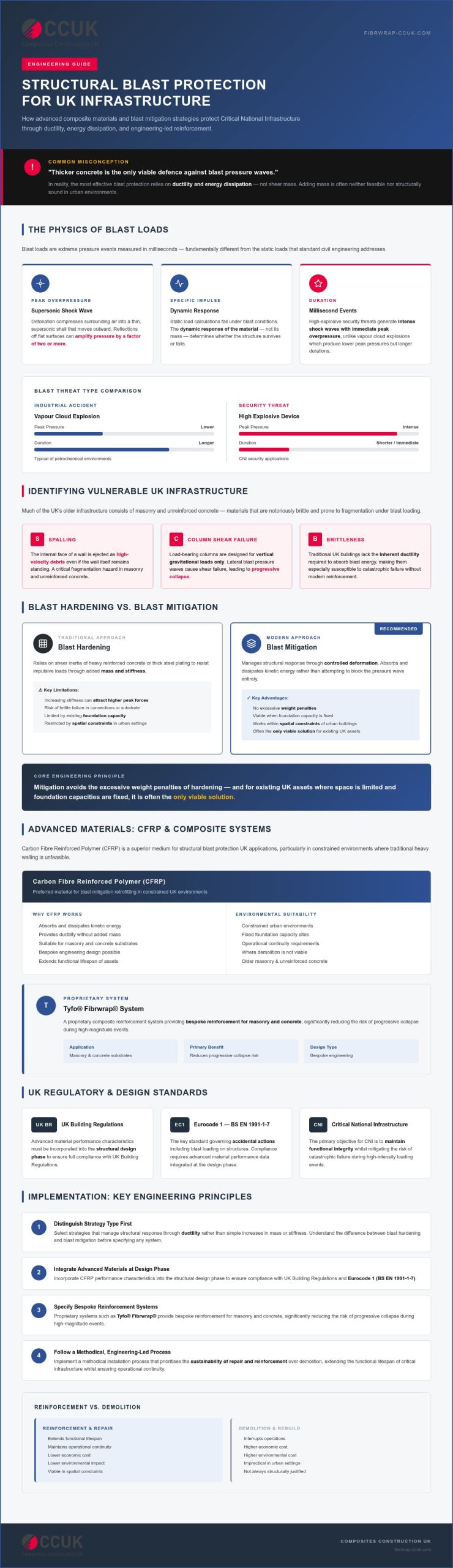
Structural blast protection UK is defined by the requirement to manage high-intensity, short-duration loading events that significantly exceed the design parameters of standard civil engineering. Unlike static loads, which remain constant over time, blast loads involve a rapid release of energy that subjects a structure to extreme pressure in milliseconds. This discipline is essential for securing Critical National Infrastructure (CNI) across the United Kingdom, where the objective is often to maintain the functional integrity of an asset whilst mitigating the risk of catastrophic failure.
A clear distinction must be made between industrial accidents, such as vapour cloud explosions typically found in petrochemical environments, and security-related threats involving high explosives. Vapour cloud events generally produce lower peak pressures but longer durations, whereas security threats generate intense shock waves with immediate peak overpressure. Integrating protection systems into existing assets often forms a key part of broader life-extension strategies, prioritising the sustainability of reinforcement over the economic and environmental cost of demolition.
The Mechanics of Blast Loads
Engineering for blast resilience requires a deep understanding of the shock wave, characterised primarily by its peak overpressure and specific impulse. When a detonation occurs, the surrounding air is compressed into a thin, supersonic shell that moves outward. This wave interacts with structural geometry in complex ways; for instance, reflections off flat surfaces can amplify the pressure experienced by the building by a factor of two or more. Engineers must move beyond static load calculations, as the dynamic response of the material determines whether the structure survives or fails. Static calculations fail here.
Identifying Vulnerable Infrastructure
Much of the UK’s older infrastructure consists of masonry and unreinforced concrete, materials that are notoriously brittle and prone to fragmentation. During a blast event, these materials can fail through spalling, where the internal face of a wall is ejected as high-velocity debris even if the wall itself remains standing. Load-bearing columns are particularly vulnerable to lateral blast forces. These elements are designed to support vertical gravitational loads; however, a lateral pressure wave can cause a shear failure that leads to progressive collapse. Traditional UK buildings often lack the inherent ductility required to absorb such energy, making bespoke engineering design and strengthening necessary for modern compliance.
Blast Mitigation vs. Blast Hardening: Technical Distinctions
Blast hardening has traditionally been the default approach for structural blast protection UK projects, characterised by the addition of significant mass and stiffness to a building’s primary frame. This methodology relies on the sheer inertia of heavy reinforced concrete or thick steel plating to resist impulsive loads. However, increasing stiffness can often be counterproductive; a stiffer structure attracts higher peak forces, potentially leading to brittle failure modes in the connections or the substrate itself. The hardening approach is frequently limited by the existing foundation capacity and the spatial constraints of urban infrastructure.
Modern engineering has shifted towards blast mitigation, a more sophisticated strategy that manages the structural response through controlled deformation. Rather than attempting to block the pressure wave entirely, mitigation systems aim to reduce damage by absorbing and dissipating the kinetic energy. For existing UK assets, where space is limited and foundation capacities are fixed, mitigation is often the only viable solution. It avoids the excessive weight penalties of hardening whilst maintaining the architectural integrity of the original structure. This transition from resistance to resilience ensures that the building remains functional even after a high-magnitude event.
Energy Dissipation through Ductility
The efficacy of mitigation is rooted in material ductility. Advanced composites, such as Carbon Fibre Reinforced Polymer (CFRP), exhibit high tensile strength and significant strain capacity, allowing structural elements to undergo large deformations without catastrophic rupture. This material toughness is critical; it converts the energy of the blast wave into internal work, preventing the sudden release of energy that causes brittle failure. Energy dissipation in the context of CFRP blast protection is the process by which the composite wrap absorbs the impulse of an explosion, preventing the brittle fragmentation of the underlying masonry or concrete. Achieving this level of resilience requires a bespoke engineering design that accounts for the specific dynamic properties of the asset.
Preventing Progressive Collapse
A primary objective in any blast-resistant design is the prevention of progressive collapse, where the failure of a single load-bearing member triggers a disproportionate failure of the entire structure. Mitigation systems provide essential “tie-force” capacity, effectively binding the structural components together to ensure they act as a unified system. This ensures that if a column or wall is compromised, the remaining elements can redistribute the loads through alternative paths. By establishing this load-path redundancy, engineers can prevent the domino effect that often plagues multi-storey UK structures during accidental or intentional explosive events, securing the safety of the occupants and the asset’s long-term utility.
Advanced Materials for Blast Resilience: The Role of Composites
The selection of materials for structural blast protection UK infrastructure has evolved significantly, moving away from traditional heavy-duty cladding towards advanced Carbon Fibre Reinforced Polymer (CFRP) composites. CFRP serves as a high-performance medium that bridges the gap between structural strengthening and dynamic blast resilience. Its primary advantage lies in its ability to provide extreme tensile strength whilst remaining remarkably lightweight, a characteristic that is essential when retrofitting existing assets that cannot support additional dead loads. These materials enable a level of ductility that is unattainable with conventional masonry or unreinforced concrete.
CFRP and Tyfo® Fibrwrap® Systems
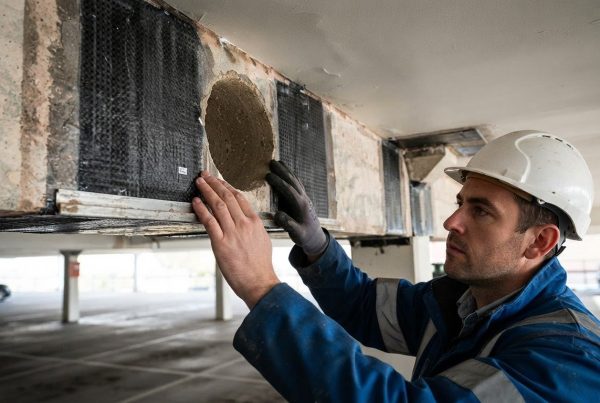
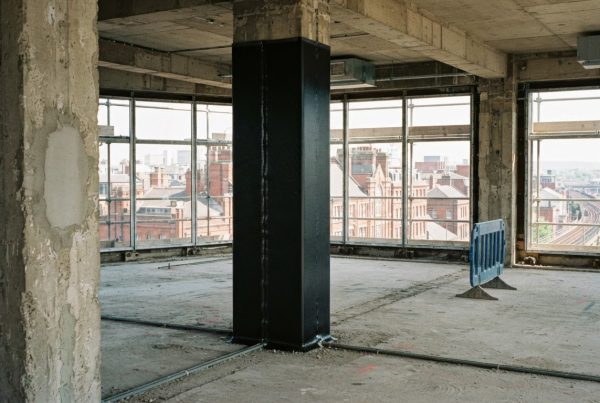
The Tyfo® Fibrwrap® system is a proprietary composite solution consisting of high-strength carbon or glass fibres saturated with a specialised resin matrix. During the engineering design phase, the orientation of these fibres is meticulously planned to align with the predicted blast load paths, ensuring maximum efficiency in energy absorption. When applied to load-bearing columns, the system provides a confinement effect that prevents the brittle failure of concrete and contains internal fragmentation. This process is equally effective for walls and floor slabs, where the composite wrap acts as a secondary structural skin to maintain integrity during a pressure wave. You can learn about Tyfo® Fibrwrap® installation and its role in bespoke structural reinforcement.
Comparison with Traditional Steel Reinforcement
When compared to traditional steel plate bonding, composite systems offer several technical and operational advantages. Steel reinforcement is inherently heavy, often requiring mechanical anchors that can create stress concentrations in the substrate; additionally, its susceptibility to corrosion necessitates long-term maintenance cycles. Conversely, CFRP is non-corrosive and maintains its performance characteristics in harsh environments without degradation, ensuring the long-term structural integrity of the asset. This durability is a cornerstone of sustainable infrastructure management.
Installation speed is another critical factor for UK infrastructure managers. Because composite wraps are applied as a flexible fabric, they require no heavy lifting equipment or complex welding, which significantly reduces operational downtime. The low-profile nature of the wrap, typically only a few millimetres thick, ensures that the original footprint of the structural members is preserved. This aesthetic and spatial efficiency makes composites the preferred choice for high-traffic or architecturally sensitive environments where traditional steel jacketing would be obtrusive. By choosing these advanced materials, engineers can prioritise the sustainability of repair over replacement, extending the functional lifespan of the asset through sophisticated material science.
Design Standards and Regulatory Frameworks for UK Blast Protection
Compliance with structural blast protection UK standards is governed by a framework of statutory requirements and technical codes. The UK Building Regulations, specifically Requirement A3, mandate that buildings are designed and constructed to ensure that the structure won’t be susceptible to disproportionate collapse. This regulatory baseline is supplemented by BS EN 1991-1-7 (Eurocode 1: Accidental Actions), which provides the technical basis for designing against identifiable accidental actions, including internal explosions. For critical assets, these general codes are often superseded by more stringent, classified government standards that dictate higher levels of resilience for security-sensitive infrastructure. Every project requires bespoke engineering calculations to account for the unique dynamic response of the specific asset, moving beyond the generic assumptions found in standard civil engineering practices.
Risk Assessment and Feasibility
A rigorous risk assessment must establish the Design Basis Threat (DBT) before any physical intervention occurs. This process involves determining the potential explosive magnitude, stand-off distances, and the specific vulnerability of the structural frame to high-strain-rate loading. The Importance of Structural Surveys cannot be overstated during this phase; they provide the empirical data regarding existing material strengths, reinforcement layouts, and structural defects that inform the final design. Without accurate baseline data, the mitigation system won’t achieve the required performance parameters, potentially leaving the structure vulnerable to the very forces it’s intended to resist.
Computational Fluid Dynamics (CFD) and Blast Modelling
Modern engineering relies heavily on Computational Fluid Dynamics (CFD) to simulate the complex interaction between blast waves and structural geometries. These software packages allow specialists to predict the dynamic structural response with high precision, identifying areas of stress concentration that may not be apparent through simplified hand calculations. CFD modelling is critical for bespoke blast design in 2026 because it enables the simulation of non-linear material behaviour and the precise mapping of pressure-time histories across irregular surfaces. This ensures that the selected Tyfo® Fibrwrap® configuration provides the required level of protection whilst minimising material waste. These simulations are validated against empirical testing data from proprietary systems to ensure absolute reliability in real-world scenarios. To ensure your asset meets current UK regulatory requirements through bespoke engineering, contact our specialist engineering team for a technical consultation.
Implementing Structural Blast Mitigation: From Design to Installation
The successful implementation of structural blast protection UK relies on a disciplined, multi-phase approach managed by specialist engineering contractors. Standard construction practices are insufficient for the high-strain-rate requirements of blast mitigation; instead, a rigorous sequence of survey, design, preparation, and application must be followed. This methodical progression ensures that every variable, from the initial substrate strength to the final environmental conditions during curing, is controlled. Surface preparation is particularly critical, as the integrity of the bond between the composite material and the substrate determines the system’s performance under dynamic loading. Mechanical abrasion or high-pressure water jetting is typically employed to achieve the required surface profile, ensuring that the resin matrix can achieve a robust mechanical interlock with the concrete or masonry.
Bespoke Engineering Solutions
Every asset presents unique structural challenges that require tailored interventions. Engineers must determine the precise number of CFRP layers and fibre orientations needed to resist the design basis threat whilst considering the existing condition of the structure. This level of customisation allows for the integration of blast protection with other essential remediation services, such as cathodic protection or resin injection for leak sealing. By addressing multiple structural requirements simultaneously, asset controllers can maximise the efficiency of the intervention and ensure the sustainability of the repair. You’re encouraged to explore our bespoke design features to understand how these systems are engineered for specific infrastructure requirements.
Professional Application and QA
The installation of Tyfo® Fibrwrap® systems must be performed by certified technicians who understand the nuances of composite application. Quality assurance is maintained through a series of stringent testing protocols, including pull-off tests to verify bond strength and the analysis of material witness samples. These tests provide empirical evidence that the installed system meets the specifications defined during the design phase. Comprehensive documentation and final certification are provided upon completion, ensuring that the asset meets all UK regulatory standards for structural robustness and resilience. Long-term monitoring programmes may also be established to ensure the continued performance of the blast-strengthened members throughout their extended functional lifespan, providing asset owners with the absolute reliability required for critical infrastructure.
Securing Infrastructure Resilience through Advanced Engineering
The evolution of structural blast protection UK has shifted the engineering focus from rigid resistance to sophisticated energy dissipation. By prioritising ductility through advanced Carbon Fibre Reinforced Polymer (CFRP) systems, asset controllers can mitigate the risk of progressive collapse without the prohibitive weight of traditional hardening methods. This technical approach ensures that critical assets remain compliant with current UK Building Regulations whilst extending their functional lifespan through sustainable reinforcement rather than demolition.
As the exclusive UK licensee for Tyfo® Fibrwrap® systems, Composites Construction UK provides a full end-to-end design and installation service backed by over 25 years of infrastructure experience. Our specialist consulting contractors utilise bespoke computational modelling to validate material performance against specific threat profiles, ensuring absolute reliability in high-consequence environments. To ensure your asset is secured against modern threats, consult our specialist engineers for a blast mitigation feasibility study. We’re here to help you navigate the complexities of structural resilience with proven science and engineering rigour.
Frequently Asked Questions
What is the primary difference between blast hardening and blast mitigation?
Blast hardening focuses on increasing the mass and stiffness of a structure to resist impulsive loads through sheer inertia. Conversely, blast mitigation involves managing the structural response by prioritising ductility and energy absorption. Whilst hardening can attract higher peak forces, mitigation systems such as Tyfo® Fibrwrap® allow for controlled deformation. This approach reduces the risk of brittle failure in the primary frame, making it a more efficient strategy for existing infrastructure.
Can Tyfo® Fibrwrap® be applied to historic or listed buildings in the UK?
Tyfo® Fibrwrap® is frequently utilised for the structural blast protection UK historic assets require because of its low-profile application. The composite wrap is typically only a few millimetres thick, ensuring the original architectural footprint remains unaltered. Because the system is applied as a flexible fabric, it can conform to irregular masonry geometries. This provides a discrete reinforcement solution that enhances resilience whilst respecting the requirements of heritage conservation and listed building consent.
How long does a typical structural blast protection installation take?
Installation timelines are significantly shorter than those associated with traditional steel plate bonding or concrete jacketing. Because the composite system is lightweight and requires no heavy lifting equipment or complex welding, site preparation and application proceed rapidly. Typical projects benefit from fast resin cure cycles, often allowing for a return to full operational capacity within 24 to 48 hours of application. The exact duration depends on the total surface area and the complexity of the asset.
Is structural blast protection required by UK law for commercial buildings?
Compliance with UK Building Regulations, specifically Requirement A3 regarding disproportionate collapse, is mandatory for all significant structures. Whilst not every commercial building requires specific structural blast protection UK measures, those classified as Critical National Infrastructure or high-occupancy assets must meet stringent robustness standards. Eurocode 1 (BS EN 1991-1-7) provides the technical framework for accidental action design. Engineers must conduct a site-specific risk assessment to determine if enhanced protection is legally mandated.
Does CFRP strengthening add significant weight to the existing structure?
Carbon Fibre Reinforced Polymer (CFRP) systems add negligible weight to an existing structural frame. Their high strength-to-weight ratio means that a few millimetres of composite can provide the equivalent tensile reinforcement of much thicker steel plating. This is a critical advantage for older assets where the foundation capacity is already reaching its limit. By using CFRP, engineers avoid the need for costly foundation underpinning that would be required for heavier, traditional hardening methods.
Can blast mitigation systems be integrated with fire protection measures?
Blast mitigation systems can be seamlessly integrated with specialised fire protection measures to meet comprehensive safety requirements. Once the Tyfo® Fibrwrap® system is installed, it can be finished with intumescent coatings or cementitious renders that provide the necessary fire resistance rating. This dual-layer approach ensures that the structural members are protected against both the impulsive forces of an explosion and the subsequent thermal loads, maintaining integrity throughout a multi-hazard event.
What maintenance is required for carbon fibre blast reinforcement?
Maintenance requirements for carbon fibre reinforcement are exceptionally low due to the material’s inherent non-corrosive properties. Unlike steel reinforcement, CFRP won’t degrade when exposed to moisture or aggressive chemical environments. Long-term monitoring typically involves periodic visual inspections and non-destructive testing, such as pull-off tests, to ensure the continued integrity of the bond. This durability makes it a highly sustainable choice for prolonging the functional lifespan of critical infrastructure assets across the country.
How does blast protection prevent progressive collapse in masonry structures?
In masonry structures, blast protection prevents progressive collapse by providing a “tie-force” capacity that binds individual units together. This reinforcement prevents the brittle fragmentation and spalling that typically occurs when masonry is subjected to lateral pressure waves. By creating a continuous, ductile skin, the system ensures that the structure can redistribute loads through alternative paths if a primary member is damaged. This load-path redundancy is essential for preventing a localised failure from escalating.