
The structural integrity of the United Kingdom’s ageing parking infrastructure is currently being challenged by a convergence of accelerated environmental degradation and the unanticipated load demands of modern electric vehicles. It’s widely understood by asset controllers that the financial and operational costs associated with traditional demolition and reconstruction are often unsustainable. This guide provides a comprehensive engineering perspective on car park structural repair UK, focusing on the transition from reactive maintenance to advanced asset life-extension. Readers will gain technical insights into the diagnosis of reinforcement corrosion, the design of bespoke strengthening solutions using Tyfo® Fibrwrap® systems, and the strategic implementation of repairs that ensure compliance with current structural standards. By prioritising the sustainability of repair over replacement, the functional lifespan of essential infrastructure can be extended whilst minimising the disruption to revenue-generating operations. The following sections detail the empirical evidence and material science required to secure long-term structural security for complex parking facilities.
Key Takeaways
- Understand the evolving regulatory landscape and the technical necessity for car park structural repair UK to address the challenges posed by ageing multi-storey infrastructure.
- Identify the primary chemical mechanisms of structural deterioration, specifically the progression of carbonation and chloride ion ingress within semi-enclosed parking environments.
- Evaluate the performance benefits of Carbon Fibre Reinforced Polymer (CFRP) strengthening compared to traditional methods, prioritising superior strength-to-weight ratios and corrosion resistance.
- Gain insights into the rigorous engineering lifecycle, encompassing detailed structural surveys, carbonation testing, and the development of bespoke composite reinforcement specifications.
- Explore the application of proprietary Tyfo® Fibrwrap® systems as a sustainable method for extending the functional lifespan of essential assets with minimal operational disruption.
Evaluating the Landscape of Car Park Structural Failure in the UK
The definition of car park structural repair UK within the British civil engineering sector encompasses a range of interventions designed to restore or enhance the load-bearing capacity of reinforced concrete elements. A significant proportion of the United Kingdom’s multi-storey car park (MSCP) inventory was constructed between the 1960s and 1980s, an era when design codes didn’t account for modern environmental stressors or current vehicle specifications. Consequently, many facilities have reached the end of their anticipated service life, presenting complex engineering challenges that demand sophisticated remediation strategies.
The proliferation of electric vehicles (EVs) introduces a critical variable. The average weight of a modern EV is significantly greater than its internal combustion engine predecessor, often pushing structural components toward their ultimate limit state. This increased load often exceeds the original design parameters, necessitating structural reinforcement to maintain safety margins. Safety remains the priority.
Choosing structural life-extension over full asset replacement aligns with carbon reduction targets. Demolition and reconstruction represent a significant expenditure of embodied carbon; conversely, targeted remediation provides a lower-cost, high-performance alternative. It’s a method that prioritises the retention of existing assets through advanced material science and engineering rigour.
The Mechanism of Concrete Degradation in Parking Structures
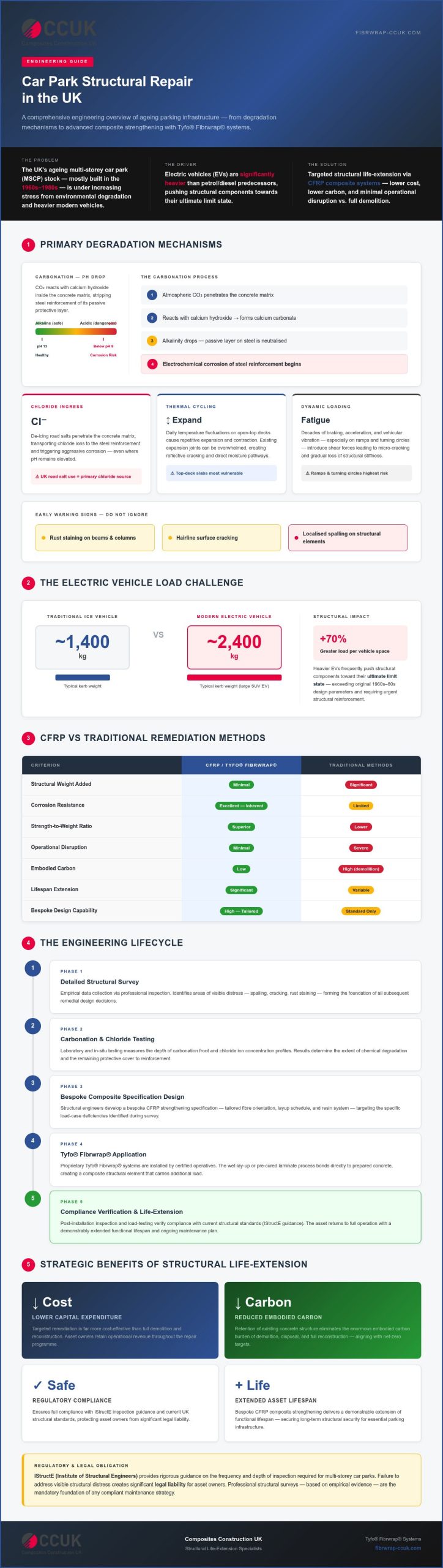
The degradation of parking infrastructure is primarily driven by chemical ingress. Chloride ions, transported by de-icing salts from the UK road network, penetrate the concrete matrix and initiate the corrosion of steel reinforcement. Simultaneously, carbonation occurs as atmospheric carbon dioxide reacts with calcium hydroxide, lowering the concrete’s pH and stripping the steel of its passive protective layer. Early warning signs, such as rust staining, hairline cracking, or localised spalling on beams and columns, indicate that the structural integrity is being compromised. These indicators shouldn’t be ignored.
Regulatory Compliance and Asset Owner Obligations
Compliance with safety standards is a legal imperative for asset owners. The Institute of Structural Engineers (IStructE) provides rigorous guidance on the frequency and depth of inspections required for MSCPs. Failure to address visible distress can lead to significant liability issues. Professional structural surveys are the foundational component of any maintenance strategy, ensuring that remedial designs are based on empirical data rather than speculative assessments.
Technical Drivers of Structural Degradation in Parking Facilities
Carbonation initiates when atmospheric carbon dioxide penetrates the concrete matrix, reacting with calcium hydroxide to form calcium carbonate. This chemical transition reduces the alkalinity of the concrete, typically from a pH of 13 to below 9, which subsequently neutralises the passivating layer that protects the embedded steel reinforcement. Within the scope of car park structural repair UK, addressing this pH shift is critical to preventing widespread electrochemical corrosion across the structural frame. It’s a slow process, but the results are often catastrophic if left unmanaged.
Beyond chemical degradation, physical stressors such as thermal cycling play a significant role in asset decline. Top-deck parking areas are particularly vulnerable to diurnal temperature fluctuations, which cause repetitive expansion and contraction of the concrete slabs. These movements often exceed the capacity of existing expansion joints, resulting in reflective cracking that provides direct pathways for moisture and contaminants to enter the structure.
Vehicular movement introduces dynamic loading and fatigue. Constant acceleration and braking cycles, particularly on ramps and turning circles, subject the structure to significant shear forces and vibrations. Over decades, these stresses can lead to micro-cracking and the gradual loss of structural stiffness, eventually compromising the asset’s overall stability.
Chloride Ingress and Reinforcement Corrosion
Chloride-induced corrosion is a primary driver of deterioration in UK parking infrastructure. De-icing salts, carried into the facility by vehicles during winter months, dissolve into a brine that penetrates the porous concrete via capillary action. Once the chloride ions reach the reinforcement, they initiate an aggressive pitting corrosion. The resulting iron oxide occupies a volume significantly larger than the original steel, generating internal tensile stresses that inevitably lead to delamination and concrete spalling. According to the principles established in BS EN 1504, chloride-induced corrosion is recognised as a primary cause of reinforcement depassivation when concentrations exceed a specific critical threshold.
To mitigate these risks, surface-level interventions are often employed alongside structural repairs. For instance, high-performance floor coatings provided by specialists like I Can Epoxy serve as an essential barrier, preventing the initial ingress of salt-laden moisture into the concrete substrate.
Increased Load Demands and Modern Vehicle Specifications
The structural capacity of many older car parks is being tested by the significant increase in vehicle kerb weights. Whilst a typical family car in the 1970s weighed approximately 1,000kg, modern sports utility vehicles (SUVs) and electric vehicles (EVs) frequently exceed 2,500kg. This represents a substantial increase in the static and dynamic loads applied to floor slabs that weren’t designed for such intensities. To accommodate these modern demands, CFRP structural strengthening UK is often required to enhance the flexural and shear capacity of the existing concrete. Implementing a robust strategy for car park structural repair UK ensures that these assets remain safe for the next generation of heavier vehicles. For asset controllers concerned with evolving load profiles, a detailed design-led review of structural capacity is a prudent next step.
CFRP Strengthening vs Traditional Concrete Remediation Methods
In the field of car park structural repair UK, the selection of remediation materials is governed by the specific performance requirements of the asset. While traditional steel plate bonding has historically been utilised to enhance flexural capacity, Carbon Fibre Reinforced Polymer (CFRP) has emerged as the technically superior alternative. CFRP systems possess a tensile strength significantly higher than structural steel whilst maintaining a fraction of the weight. This high strength-to-weight ratio allows for the application of reinforcement without introducing significant dead loads to the existing structure. It’s a critical consideration for ageing slabs already burdened by modern vehicle weights.
The Superiority of Composite Systems in Car Park Environments
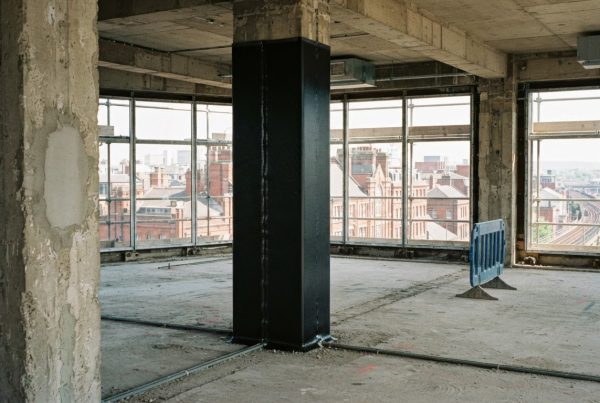
The application of Tyfo® Fibrwrap® systems offers distinct advantages in the semi-enclosed, chloride-rich environments typical of UK parking facilities. Unlike steel, which remains susceptible to the same corrosive mechanisms that necessitated the repair, CFRP is inherently non-corrosive and resistant to chemical attack. Its low profile is particularly beneficial in multi-storey car parks where headroom is often constrained. These thin composite laminates provide substantial shear and flexural strengthening without compromising vehicle clearance. The installation process is methodical and rapid. It requires minimal heavy plant and facilitates shorter operational shutdowns. This efficiency translates to a reduced carbon footprint, supporting broader sustainability goals by extending the utility of the original concrete frame.
Traditional Concrete Repair Limitations
Standard remediation often relies on localised patch repairs, which may fail to address the underlying electrochemical causes of deterioration. If the contaminated concrete surrounding the reinforcement isn’t sufficiently removed, the “incipient anode effect” can trigger accelerated corrosion in adjacent areas. Traditional methods involving the addition of steel sections or concrete jackets also impose a substantial weight penalty. This can potentially require further foundation strengthening. For a more detailed analysis of these challenges, reference can be made to the technical guide on concrete repairs. By opting for advanced composites, asset controllers ensure a durable, long-term solution that avoids the repetitive cycle of reactive maintenance.
The Engineering Lifecycle: Survey, Design, and Specification
The successful execution of car park structural repair UK depends on a disciplined engineering lifecycle that prioritises empirical data over visual assumptions. It’s a methodical process that transitions from initial diagnostic testing to the formulation of a bespoke technical specification. This rigorous approach ensures that every remedial intervention is precisely calibrated to the specific structural deficiencies and environmental stressors of the asset. Superficial repairs are avoided in favour of scientifically validated solutions.
Structural Condition Assessment and Testing
A comprehensive assessment begins with non-destructive testing (NDT) to map the extent of internal degradation. Half-cell potential mapping and cover meter surveys are utilised to identify active corrosion zones and reinforcement depth without compromising the concrete’s integrity. These findings are supplemented by pull-off tests, conducted in accordance with BS EN 1542, to verify that the substrate’s tensile strength is sufficient for effective composite bonding. It’s through this granular data that bespoke design solutions are formulated, ensuring the remediation strategy is grounded in the actual physical state of the structure.
Bespoke Design and Technical Specification
The design phase involves complex engineering calculations to determine the required tensile strength and bond stress for the Tyfo® Fibrwrap® system. These calculations must account for the redistributed loads and the enhanced flexural or shear capacity required to meet modern vehicle weight demands. Compliance with UK Building Regulations is maintained by integrating fire protection measures, such as intumescent coatings, into the material specification. Engineering rigour is essential when designing lateral restraint systems to ensure that the global stability of the car park is maintained during the redistribution of structural loads. This precision prevents the over-specification of materials whilst guaranteeing long-term safety. Furthermore, for projects that require formal planning submissions, you can learn more about ML Traffic Engineers UK for the transport planning and traffic engineering documentation necessary to support your application.
Temporary works design remains a critical component of the remediation programme. It provides the necessary propping and shoring to support the structural frame whilst degraded concrete is removed and reinforcement is treated. Without this temporary support, the risk of localised structural instability during the works is significantly increased. Safety is never compromised for the sake of speed. For technical guidance on implementing a compliant and durable repair strategy, asset managers should contact our specialist engineering team to discuss their specific infrastructure requirements.
Structural Life-Extension via Tyfo® Fibrwrap® Systems
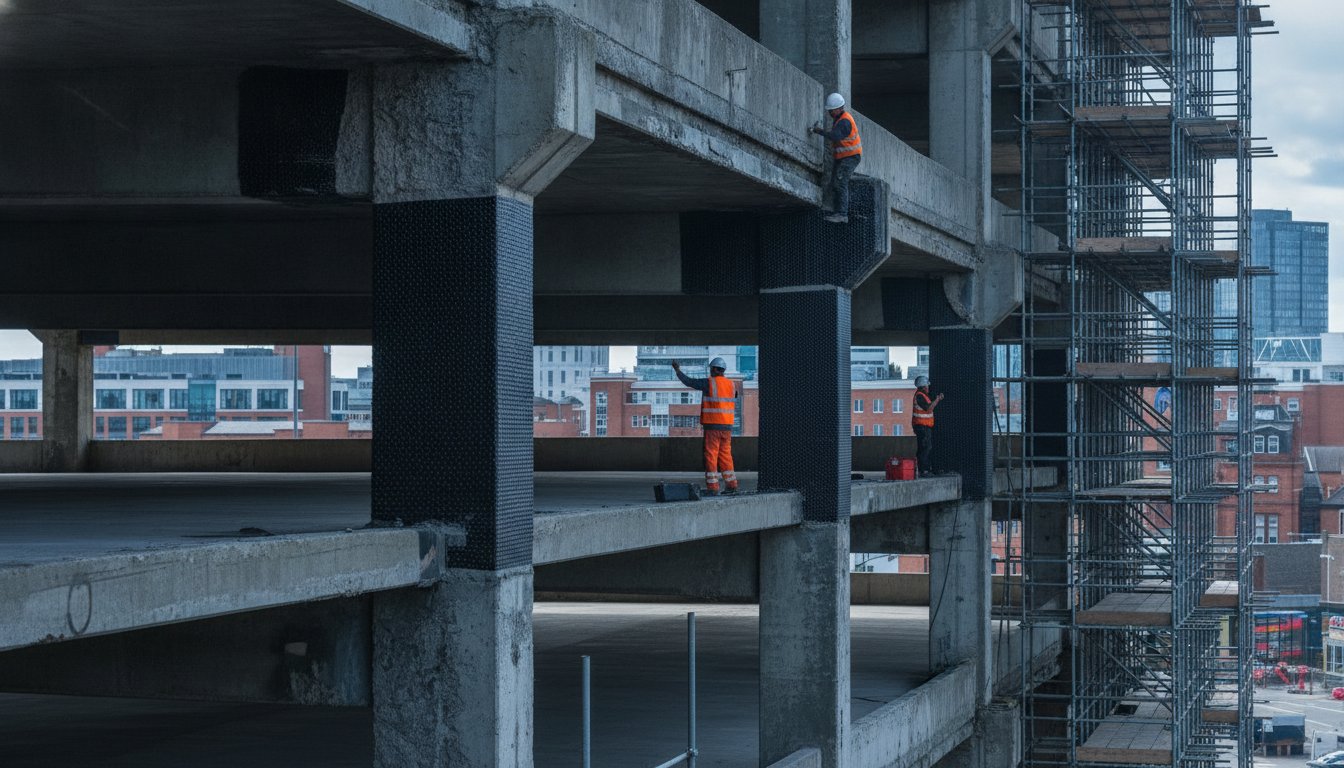
The Tyfo® Fibrwrap® system represents the apex of composite technology for car park structural repair UK. It’s a proprietary solution that combines high-strength carbon, glass, or aramid fibres with specialised epoxy resins to create a high-performance laminate. This system is distinguished by its extreme versatility, allowing for the targeted strengthening of diverse structural elements including primary beams, support columns, floor slabs, and shear walls. By increasing the load-carrying capacity of these members without the addition of significant mass, the original architectural profile of the facility is preserved. The system’s effectiveness is evidenced by its successful implementation across a range of national infrastructure projects where traditional methods were deemed insufficient.
The successful deployment of these materials requires a high degree of technical expertise. A specialist engineering contractor acts as a critical partner in this process, bridging the gap between theoretical design and site-specific implementation. This partnership ensures that the remediation strategy is not only compliant with UK structural standards but is also tailored to the unique degradation profile of the parking infrastructure. Precision is paramount.
Implementation Excellence and Quality Control
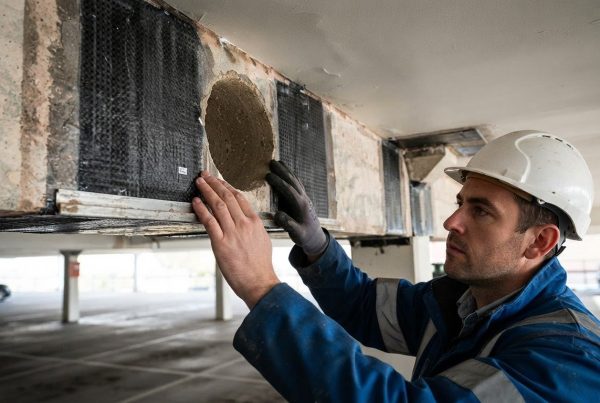
The application of Tyfo® Fibrwrap® systems demands meticulous precision to ensure the designed bond strength is achieved. Whether utilising a hand-layup technique or machine saturation, the saturation of the fibre matrix must be uniform to prevent voids or delamination. Strict environmental controls are maintained during the resin curing phase, as ambient temperature and humidity levels directly influence the final mechanical properties of the composite. Post-installation verification is a standard requirement, often involving acoustic sounding or thermographic imaging to confirm the integrity of the bond. These quality assurance protocols guarantee that the structural performance meets the rigorous requirements specified during the design phase.
Future-Proofing Parking Infrastructure
Composite technology provides a pathway for the flexible repurposing of existing parking levels, particularly as urban requirements evolve. By integrating CFRP strengthening with cathodic protection systems, a comprehensive remediation strategy is created that addresses both current structural deficiencies and future corrosion risks. This dual approach effectively future-proofs the asset against the increasing loads of modern transport. The sustainability of this life-extension strategy is clear; it avoids the environmental cost of new construction whilst ensuring the asset remains a safe, revenue-generating component of national infrastructure. Asset managers seeking to secure the long-term utility of their facilities are encouraged to contact CCUK for a technical consultation.
Securing the Future of UK Parking Infrastructure
The preservation of the United Kingdom’s parking infrastructure necessitates a decisive shift from reactive maintenance to evidence-based structural life-extension. It’s clear that addressing the dual challenges of chemical degradation and evolving load demands requires the precision of advanced composite materials. By prioritising the sustainability of repair over the high carbon cost of replacement, asset controllers can effectively secure the functional utility of their facilities for decades. Precision is paramount. The integration of rigorous structural surveys with the application of proprietary Tyfo® Fibrwrap® systems ensures that interventions are both technically robust and operationally efficient. As the exclusive UK licensee for these systems, CCUK provides the specialist design and build engineering expertise required to navigate complex car park structural repair UK projects across national infrastructure. This methodical approach to remediation provides the long-term security and safety margins essential for modern parking environments. Technical professionals can ensure their assets remain resilient by adopting these scientifically validated solutions. Consult our specialist engineers for a bespoke car park structural repair solution to begin the process of asset life-extension.
Frequently Asked Questions
How long does car park structural repair typically take using CFRP?
Composite systems facilitate a significantly accelerated programme compared to traditional steel plate bonding or concrete jacketing. While the precise duration is contingent upon the scale of the structural deficiencies, the absence of heavy plant and the rapid saturation process often reduce on-site time by over 50% relative to conventional remediation. This efficiency is critical for maintaining facility availability and minimising the duration of operational interruptions.
What are the main causes of structural failure in UK car parks?
Structural deterioration in UK parking infrastructure is primarily driven by chloride-induced corrosion from road salts and the progression of carbonation, which neutralises the concrete’s alkaline protection. These chemical mechanisms are exacerbated by the increased static and dynamic loads of modern vehicles and the repetitive stresses of thermal expansion. Identifying these root causes through detailed surveys is essential for effective car park structural repair UK.
Can Tyfo® Fibrwrap® be used on both concrete and masonry car park elements?
Tyfo® Fibrwrap® is a highly versatile composite system suitable for both reinforced concrete and masonry structural elements. It’s frequently specified for the flexural and shear strengthening of concrete beams and slabs, as well as the confinement of columns and the reinforcement of masonry shear walls. This adaptability allows for a holistic approach to remediation across diverse structural components within a single facility without requiring multiple disparate systems.
How much does car park structural repair cost compared to rebuilding?
Remediation using advanced composites is consistently more cost-effective than full asset reconstruction. While specific figures are subject to engineering design requirements, the sustainability of repair over replacement is evident through the avoidance of demolition costs, reduced operational downtime, and the preservation of embodied carbon. Investing in targeted structural strengthening typically represents a fraction of the capital expenditure required for a new build whilst extending asset life.
Is it possible to keep the car park operational during structural strengthening?
Operational continuity is often maintained during the installation of composite systems due to their low-profile nature and the minimal equipment footprint required. Unlike traditional methods that demand extensive propping and large-scale exclusion zones, CFRP application can be phased to allow continued vehicular access. This strategic approach ensures that revenue-generating activities aren’t entirely suspended whilst critical car park structural repair UK is performed by specialist engineering teams.
What is the expected lifespan of a CFRP structural repair?
Composite repairs are designed to provide long-term durability, with an anticipated service life that often exceeds 30 to 50 years when correctly specified and installed. Because Carbon Fibre Reinforced Polymer is inherently non-corrosive, it doesn’t suffer from the same degradation mechanisms as steel. The longevity of the repair is further secured through the application of protective UV coatings and the adherence to regular structural inspection cycles.
Does structural strengthening help with the increased weight of electric vehicles?
Structural strengthening is specifically designed to address the increased load demands posed by modern SUVs and electric vehicles. By applying CFRP laminates to the underside of floor slabs and beams, the flexural and shear capacity of the existing concrete frame is significantly enhanced. This intervention allows older structures to safely accommodate modern kerb weights that often exceed original design parameters by a substantial margin.
What regulations govern the structural safety of car parks in the UK?
The structural safety of UK parking facilities is primarily governed by the Building Regulations and the detailed inspection frameworks provided by the Institution of Structural Engineers (IStructE). Compliance is also measured against BS EN 1504, which outlines the standards for the products and systems used for the protection and repair of concrete structures. Adhering to these rigorous standards is a legal and ethical obligation for all asset controllers.