
The traditional cycle of bridge demolition and reconstruction is increasingly regarded by asset controllers as an unsustainable engineering response to the escalating challenge of ageing infrastructure. You are likely contending with the compounding pressures of chloride ingress and carbonation, alongside restrictive weight limits on legacy assets that were never designed for the load cycles of the modern transport network. The logistical burden and fiscal impact of protracted traffic management during traditional remedial works often prove as prohibitive as the structural defects themselves. This technical guide demonstrates how high-performance composite technologies, specifically Tyfo® Fibrwrap® systems, facilitate comprehensive bridge abutment strengthening whilst bypassing the need for heavy-duty plant or excessive dead weight additions. By integrating advanced Carbon Fibre Reinforced Polymer (CFRP) applications with specialist engineering rigour, it’s possible to restore structural integrity and secure a verified 50-year design life extension. We shall examine the material science and installation methodologies that allow for rapid rehabilitation without the operational disruption associated with full replacement.
Key Takeaways
- Identify the primary mechanisms of structural deterioration, such as chloride ingress and carbonation, that compromise the load-bearing integrity of ageing abutments.
- Evaluate the technical advantages of bridge abutment strengthening using Tyfo® Fibrwrap® systems to achieve significant life-extension without the weight penalties of concrete jacketing.
- Understand the necessity of bespoke engineering design and rigorous structural calculations when integrating advanced composite materials into existing infrastructure frameworks.
- Recognise the critical role of substrate preparation and environmental control during the installation process to ensure the long-term performance of epoxy resin systems.
- Analyse the economic and operational benefits of structural rehabilitation, focusing on the reduction of capital expenditure and the minimisation of traffic management durations.
Structural Challenges in Bridge Abutment Integrity
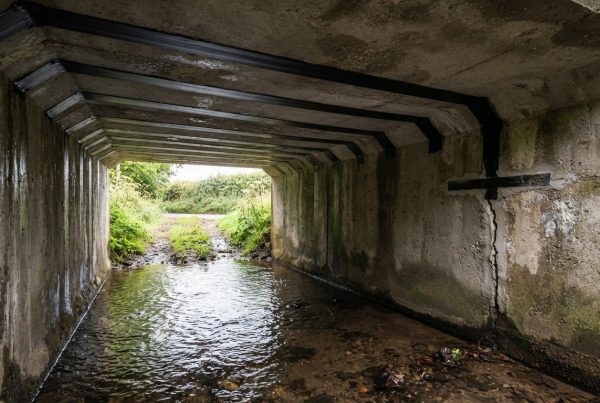
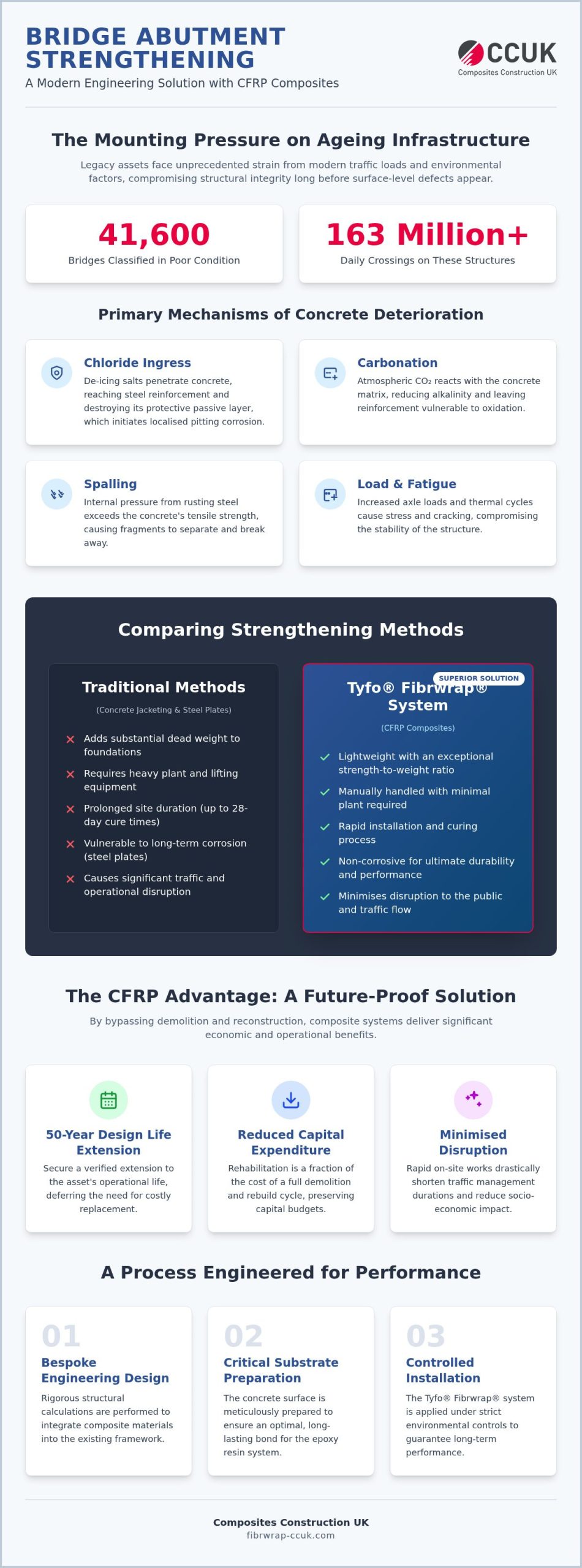
The bridge abutment functions as a critical interface, managing the simultaneous demands of vertical load transfer from the superstructure and the lateral pressures exerted by the retained soil. Understanding What is a Bridge Abutment? is fundamental for asset managers, as these components must maintain equilibrium under complex environmental and mechanical stresses. Legacy assets face unprecedented strain. Those designed to historical standards are now subjected to axle loads and traffic volumes that far exceed their original design parameters. The 2025 National Bridge Inventory data indicates that approximately 41,600 bridges are currently classified in poor condition, representing a significant portion of the infrastructure that supports over 163 million daily crossings. Visual checks alone aren’t enough. Surface-level inspections frequently mask deeper structural deficiencies, as subsurface chemical reactions often compromise structural integrity long before surface cracking becomes apparent. This necessitates a proactive approach to bridge abutment strengthening to prevent catastrophic failure.
The Mechanics of Concrete Deterioration
Chloride ions, often introduced via de-icing salts during winter maintenance programmes, migrate through the concrete’s capillary pores to reach the steel reinforcement. Once the chloride threshold is breached, the protective passivation layer on the steel is destroyed, initiating localised pitting corrosion. Carbonation presents a parallel threat; atmospheric carbon dioxide reacts with calcium hydroxide in the concrete matrix, reducing the alkalinity and leaving the reinforcement vulnerable to oxidation. Spalling is the physical separation and ejection of concrete fragments from the primary structure, occurring when the internal expansive pressures generated by the oxidation of steel reinforcement exceed the tensile strength of the concrete cover.
Load Redistribution and Structural Fatigue
Structural fatigue is often exacerbated by thermal expansion and contraction cycles, which place immense strain on abutment joints and bearing seats. If movement is restricted by debris or seized bearings, the resulting horizontal forces can induce significant cracking in the abutment stem. Differential settlement further complicates this, as uneven ground movement leads to parasitic stresses in wing walls and can compromise the global stability of the structure. Whilst masonry abutments often display resilience through their mass, they lack the tensile capacity of reinforced concrete, making them particularly susceptible to lateral displacement under modern surcharge loads. Meticulous structural design features are therefore essential to ensure that any intervention for bridge abutment strengthening addresses these specific load paths and restores the asset’s functional capacity.
Comparing CFRP Strengthening with Traditional Methods
Historically, bridge abutment strengthening relied on concrete jacketing or the bonding of heavy steel plates. These methods, whilst established, present significant engineering drawbacks for modern infrastructure. Concrete jacketing adds substantial dead weight to the structure. This often necessitates further foundation assessment or costly piling to accommodate the increased mass. Curing times for traditional concrete can extend to 28 days, prolonging lane closures and increasing the socio-economic cost of traffic management. Even modern alternatives like Sprayable UHPC for Retrofit, whilst offering superior compressive strength, still require significant substrate preparation and material volume compared to composite systems.
Steel plate bonding was once the preferred standard for flexural and shear reinforcement. However, the risk of interfacial corrosion between the steel and the concrete remains a critical vulnerability. Handling heavy steel plates requires specialist lifting equipment and extensive temporary works. This increases both the safety risk on site and the total project duration. In contrast, Carbon Fibre Reinforced Polymer (CFRP) systems offer a non-corrosive, lightweight solution that can be manually handled and applied with minimal plant, making them a superior alternative for complex bridge environments.
Technical Performance Benchmarks
CFRP exhibits a strength-to-weight ratio that’s significantly higher than structural steel. This allows for the restoration of structural capacity with negligible increases in the abutment’s cross-section or dead load. In aggressive highway environments, where de-icing salts and carbonation are prevalent, CFRP’s inherent corrosion resistance is a decisive factor. The speed of application is another primary advantage. Tyfo® Fibrwrap® systems can be installed and cured rapidly, often allowing for the removal of traffic management measures much sooner than traditional methods. If you have a specific project requirement, you can contact our engineering team for a preliminary assessment of your asset.
Long-Term Durability and Maintenance
It’s a more sustainable engineering choice to extend the functional utility of an existing bridge rather than pursuing demolition. The carbon footprint of a CFRP repair is a fraction of that required for full asset replacement. Modern composite systems are designed for a 50-year design life, aligning with the stringent requirements of major UK infrastructure owners. Future inspections are simplified; whilst traditional concrete jacketing can hide ongoing corrosion, CFRP remains stable and can be monitored through various non-destructive testing (NDT) techniques. This focus on longevity ensures that bridge abutment strengthening provides a robust, long-term solution for ageing assets. For more information on how these systems integrate with existing structures, visit our design feature page.
Engineering Design for Abutment Reinforcement
Effective bridge abutment strengthening requires a transition from generic remedial work to bespoke structural engineering. Every bridge project presents a unique set of variables, including the original design code, the current state of material degradation, and the projected future load cycles. Unlike soil-centric stabilisation methods, structural reinforcement must address the specific bearing capacity and tensile requirements of the concrete or masonry face. Engineering design begins with a comprehensive analysis of existing load paths, ensuring that any composite intervention is fully integrated into the structural framework. This process involves precise calculations to determine the required thickness, orientation, and anchorage of the reinforcement to satisfy modern safety factors.
Compliance with UK bridge standards and relevant Eurocodes is non-negotiable. Designers must account for shear, flexural, and axial load requirements whilst ensuring that the strengthened element maintains compatibility with the rest of the structure. The use of Carbon Fibre Reinforced Polymer (CFRP) allows for a highly targeted approach. By varying the quantity and direction of the fibres, engineers can reinforce specific zones of high stress without altering the global stiffness of the bridge. This precision is essential for maintaining the intended behaviour of the structure under varying thermal and mechanical conditions.
The Tyfo® Fibrwrap® System Advantage
The Tyfo® Fibrwrap® system is more than a material; it’s a fully integrated engineering solution. Its primary advantage lies in its versatility. The system’s high-strength fibres can be oriented to address complex stress patterns that traditional materials simply cannot match. Whether the requirement is for confinement of a pier or the shear strengthening of a retaining wall, the system is tailored to the specific geometry of the asset. To understand how these principles are applied in practice, you can learn more about our design feature capabilities. This bespoke design-and-build approach ensures that the bridge abutment strengthening is both efficient and durable.
Seismic and Blast Mitigation Considerations
Modern infrastructure must also be resilient against extreme loading events, such as accidental vehicle impacts or seismic activity. Differentiating between static strengthening and dynamic energy absorption is critical. Whilst static reinforcement focuses on load-bearing capacity, dynamic mitigation requires increased ductility. Composite systems enhance the structure’s ability to undergo significant deformation without brittle failure, effectively absorbing and dissipating kinetic energy. This additional layer of security is particularly vital for critical transport links where the consequences of structural collapse are catastrophic. By prioritising ductility alongside strength, engineers can safeguard legacy assets against the unpredictable demands of the 21st century.
Installation Protocols for Composite Systems
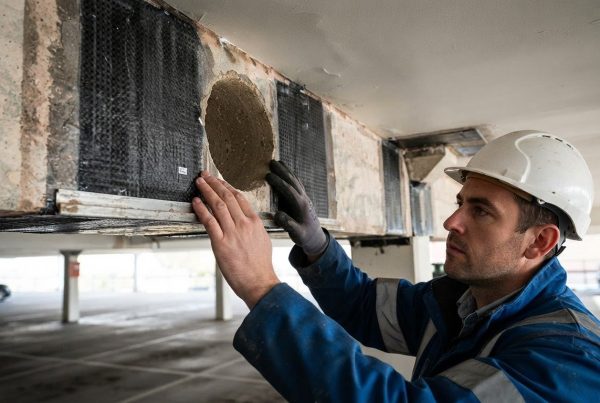
The efficacy of bridge abutment strengthening is fundamentally contingent upon the bond integrity between the Carbon Fibre Reinforced Polymer (CFRP) and the concrete substrate. Unlike generic repair methods, infrastructure-grade composite application requires rigorous surface preparation to ensure load transfer is achieved without interfacial failure. Initial protocols involve mechanical grit blasting to remove laitance and contaminants, achieving a specific surface profile that facilitates mechanical interlocking. Any existing structural defects, such as active cracking, must be addressed via resin injection to restore the monolithic behaviour of the abutment before the composite layers are applied.
Environmental control is a critical variable throughout the installation phase. Epoxy resins are highly sensitive to ambient temperature and moisture levels; therefore, the substrate must be kept within specified dew point margins to prevent bond degradation. During the wet-layup process, the carbon fibre fabric is thoroughly saturated with a proprietary resin saturant, ensuring that every filament is encapsulated. This meticulous saturation is vital for achieving the design-stiffness required to meet the structural life-extension goals of the project.
Site Preparation and Concrete Remediation
Before the application of any composite system, all areas of spalled concrete must be removed to expose the underlying reinforcement. If rebar corrosion is present, it’s treated with specialist primers to arrest further oxidation and prevent future expansion. You can explore our comprehensive guide to concrete repairs for a detailed analysis of these remedial techniques. A critical quality benchmark is the pull-off strength of the prepared concrete; design specifications typically require a minimum tensile strength of 1.5 MPa to ensure the substrate can support the anticipated shear stresses from the CFRP system.
Application and Curing Procedures
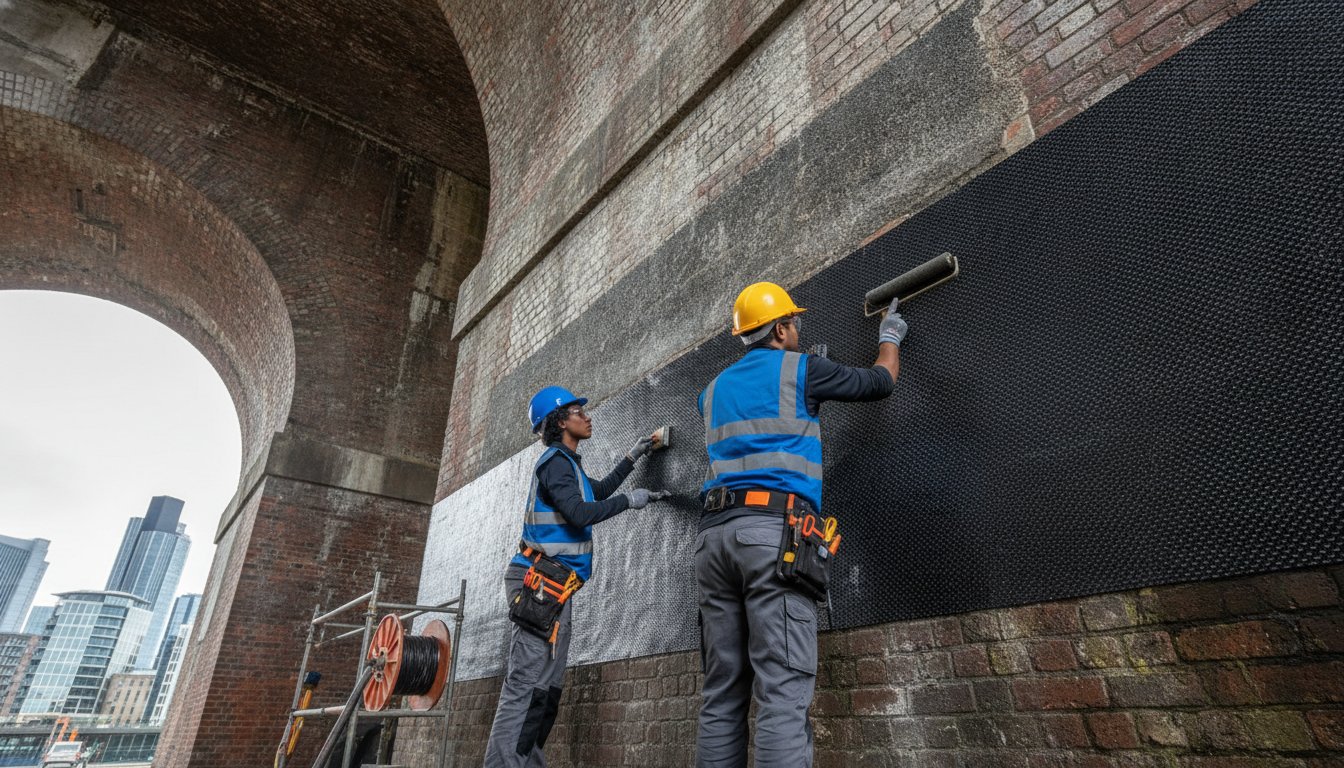
The installation of Tyfo® Fibrwrap® follows a methodical sequence: the application of a primer and smoothing putty, followed by the primary saturant and carbon fibre layers. In the variable UK climate, curing times are carefully monitored using witness panels. These panels are cured in identical conditions to the main structure and undergo laboratory testing to verify that the material properties match the design assumptions. Once the system has reached full cure, a protective topcoat is applied. This layer provides essential UV resistance and allows for aesthetic integration with the existing structure. To ensure your asset benefits from these rigorous protocols, you should contact our specialist team for a technical consultation.
Strategic Asset Management and Life-Extension
Strategic asset management requires a disciplined shift from reactive maintenance to proactive structural life-extension. For bridge abutments, the economic case for strengthening is compelling when comparing the capital expenditure (CAPEX) for full replacement against the operational expenditure (OPEX) of targeted reinforcement. Full replacement often involves astronomical costs; these aren’t limited to material and labour but include the socio-economic impact of prolonged road closures and traffic diversions. By opting for bridge abutment strengthening using advanced composites, asset owners can achieve a verified 50-year design life extension whilst significantly reducing the duration of traffic management measures. This approach aligns with broader environmental goals by preserving the embodied carbon within existing concrete and masonry structures, effectively future-proofing the network against evolving load demands and climate-induced stressors.
The Role of the Specialist Engineering Contractor
The complexity of integrating modern materials into legacy infrastructure necessitates an end-to-end design and build approach. A specialist contractor provides value beyond simple installation by taking accountability for the entire structural outcome, from the initial survey and testing to final quality assurance. This integrated model reduces project risk and ensures that the specific material properties of the Tyfo® Fibrwrap® system are correctly accounted for in the bespoke engineering calculations. Understanding the role of a specialist engineering contractor is essential for local authorities and asset controllers seeking to maintain national infrastructure resilience. Collaborative engagement ensures that regional requirements are met through sophisticated science and engineering rigour.
Conclusion: Building a Resilient Network
In summary, bridge abutment strengthening using Carbon Fibre Reinforced Polymer (CFRP) provides a lightweight, non-corrosive, and high-strength solution for the UK’s ageing bridge network. It allows for the rapid restoration of structural integrity without the weight penalties or logistical hurdles of traditional concrete jacketing. The transition toward intelligent infrastructure prioritises the scientific rehabilitation of existing assets over the carbon-intensive cycle of demolition and reconstruction. This strategy ensures that critical transport links remain functional, safe, and sustainable for decades to come. If you’re managing a deteriorating asset or an ageing bridge structure, you should contact our engineering team for a feasibility study to evaluate the most effective life-extension strategy for your specific project.
Securing National Infrastructure through Advanced Engineering
The technical path to structural life-extension is defined by the integration of high-performance materials and bespoke engineering design. By addressing the root causes of deterioration through bridge abutment strengthening, asset controllers can bypass the logistical and financial burdens of full reconstruction. The adoption of Tyfo® Fibrwrap® systems ensures that legacy assets are not only restored to their original capacity but are enhanced to meet modern load requirements for a verified 50-year design life.
As a specialist design and build engineering contractor and the exclusive UK licensee for Tyfo® Fibrwrap®, we bring a proven track record in national infrastructure projects to every intervention. Our in-house consultancy capabilities allow for a seamless transition from structural survey to rapid installation, minimising downtime whilst maximising safety. It’s possible to transform ageing bridges into resilient components of a modern transport network through disciplined scientific application. We invite you to consult with our structural engineers on your next bridge project to explore how these advanced systems can secure the longevity of your essential assets.
Frequently Asked Questions
How long does bridge abutment strengthening with CFRP typically last?
Bridge abutment strengthening using Carbon Fibre Reinforced Polymer (CFRP) is engineered to provide a functional life-extension of 50 years or more. The system’s inherent resistance to corrosion and chemical degradation ensures that the structural integrity of the asset is maintained without the need for frequent remedial interventions. This design life aligns with the requirements of major infrastructure owners, provided the installation is carried out by specialist contractors using verified material systems.
Does the strengthening process require a full bridge closure?
A full bridge closure is rarely required during the application of composite systems. Because CFRP materials are lightweight and require minimal heavy plant for installation, work can often be conducted during off-peak periods or via targeted lane management. This significantly reduces the socio-economic impact of traffic disruption compared to traditional concrete jacketing, which often necessitates protracted closures for curing and the removal of heavy formwork.
Is CFRP strengthening suitable for masonry bridge abutments as well as concrete?
CFRP systems are highly effective for reinforcing both concrete and masonry bridge abutments. In masonry structures, the composite layers provide the tensile capacity that the original material lacks, effectively resisting lateral earth pressures and surcharge loads. The flexibility of the carbon fibre fabric allows it to conform to irregular masonry surfaces, ensuring a continuous bond that stabilises the structure whilst preserving its historical aesthetic profile.
How does the cost of CFRP strengthening compare to traditional concrete jacketing?
Whilst the material cost of CFRP may be higher than traditional concrete, the total project cost is often significantly lower. This is due to the reduction in labour hours, the elimination of heavy lifting equipment, and the substantial savings on traffic management. When conducting a CAPEX versus OPEX analysis, the long-term durability and minimal maintenance requirements of composite systems offer superior value over the asset’s extended lifespan.
What are the primary design standards used for composite strengthening in the UK?
In the United Kingdom, composite strengthening projects are typically designed in accordance with Concrete Society Technical Report 55 (TR55) and relevant Eurocodes. These standards provide the necessary framework for calculating the required reinforcement areas and safety factors. Our in-house engineering team ensures that every bespoke design meets these rigorous criteria, providing asset owners with the assurance that the strengthened structure complies with all national safety and performance regulations.
Can Tyfo® Fibrwrap® be applied to wet or damp concrete surfaces?
Standard epoxy resins require a dry substrate to achieve an optimal bond; however, specialist Tyfo® Fibrwrap® resins are available for applications where moisture is present. For most bridge projects, we implement environmental controls to ensure the concrete surface remains within specified dew point margins. If a substrate is persistently damp, specific moisture-tolerant primers are utilised to ensure the integrity of the bond is never compromised by environmental conditions.
How does the system affect future structural inspections of the bridge?
The low-profile nature of CFRP systems means they don’t significantly alter the geometry of the bridge, facilitating easier visual inspections of adjacent components. Whilst the composite layer covers the concrete surface, various non-destructive testing (NDT) techniques, such as acoustic emission or thermography, can be employed to monitor the bond and the underlying substrate. This allows asset managers to maintain a rigorous inspection regime without the obstructions associated with thick concrete jackets.
What level of surface preparation is required for a successful bond?
Successful bridge abutment strengthening depends on achieving a high-quality mechanical bond. This requires the removal of all laitance, oil, and loose debris through mechanical grit blasting or high-pressure water jetting. The objective is to reach a surface profile comparable to Concrete Surface Profile (CSP) 3 to 5. Any significant voids or surface irregularities are then smoothed using structural putties to ensure the carbon fibre fabric achieves full contact with the substrate.