

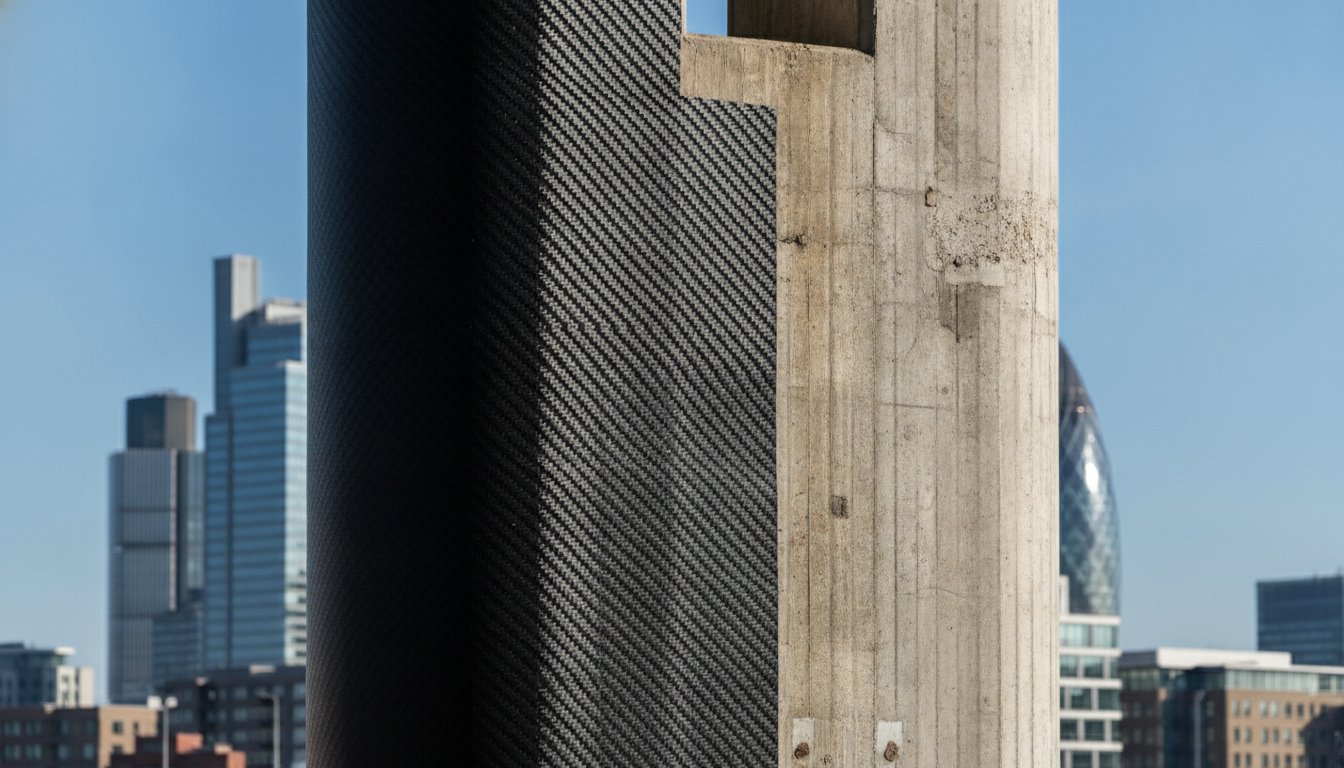
Whilst traditional concrete remediation often necessitates cyclical maintenance every decade, Carbon Fibre Reinforced Polymer (CFRP) systems are engineered to provide a definitive structural resolution for the remaining design life of an asset. Technical professionals and asset controllers frequently enquire exactly how long does carbon fibre reinforcement last when evaluating the lifecycle costs of critical infrastructure against the rising price of fabricated structural steel, which increased by 8.2% in the year preceding March 2026. It’s acknowledged that a level of professional caution exists regarding the long-term behaviour of composite materials over a fifty-year horizon, particularly whilst operating under the rigorous compliance requirements of the Building Safety Act 2022.
This article clarifies the technical reality of CFRP lifespan, illustrating how specialist engineering and adherence to UK TR55 guidance ensure these systems outlast conventional repairs. We’ll examine the empirical evidence surrounding resin matrix durability, the influence of environmental stressors on bond integrity, and the specific methodologies required to achieve a certified 100-year design life. By understanding the interaction between high-performance carbon fibres and advanced epoxy resins, engineers can specify reinforcement solutions with absolute confidence in their long-term security and structural performance.
Key Takeaways
- Understand the distinction between chemically inert carbon filaments and the total polymer matrix to determine how long does carbon fibre reinforcement last in complex structural applications.
- Learn how the selection of high-specification resins and protective coatings mitigates degradation from UV radiation, moisture ingress, and thermal cycling.
- Evaluate the lifecycle benefits of CFRP compared to traditional steel plate bonding, particularly regarding the elimination of hidden interfacial corrosion risks.
- Identify the critical engineering protocols, including structural surveys and testing, required to facilitate a certified 50 or 100-year design life.
- Explore how proactive structural life-extension aligns with UK Net Zero objectives by circumventing the high carbon cost associated with new concrete infrastructure.
What is the Theoretical Lifespan of Carbon Fibre Reinforcement?
The durability of structural interventions remains a primary concern for asset managers tasked with maintaining the integrity of aging infrastructure. When assessing how long does carbon fibre reinforcement last, it’s essential to distinguish between the atomic stability of the raw material and the practical service life of the installed system. Unlike metallic alloys, carbon fibre possesses a crystalline structure that’s inherently resistant to the electrochemical reactions that cause rust and section loss. This fundamental chemical difference allows for a shift in engineering philosophy from reactive repair to permanent life-extension.
The Science of Inert Materials
Carbon atoms arranged in a hexagonal lattice are chemically inert. They don’t react with oxygen or moisture, meaning the filaments themselves don’t suffer from the expansive oxidation that plagues traditional steel rebar. Whilst steel has a finite fatigue limit and will eventually fail after a specific number of stress cycles, Carbon-fiber reinforced polymer (CFRP) exhibits what’s effectively an infinite fatigue life under typical service loads. This resistance to cyclic loading makes it an ideal candidate for bridges and rail infrastructure where vibration is constant. Whilst the carbon fibres themselves are virtually eternal, the service life of a reinforcement system is dictated by the polymer matrix and the bond to the substrate.
Design Life vs. Material Life
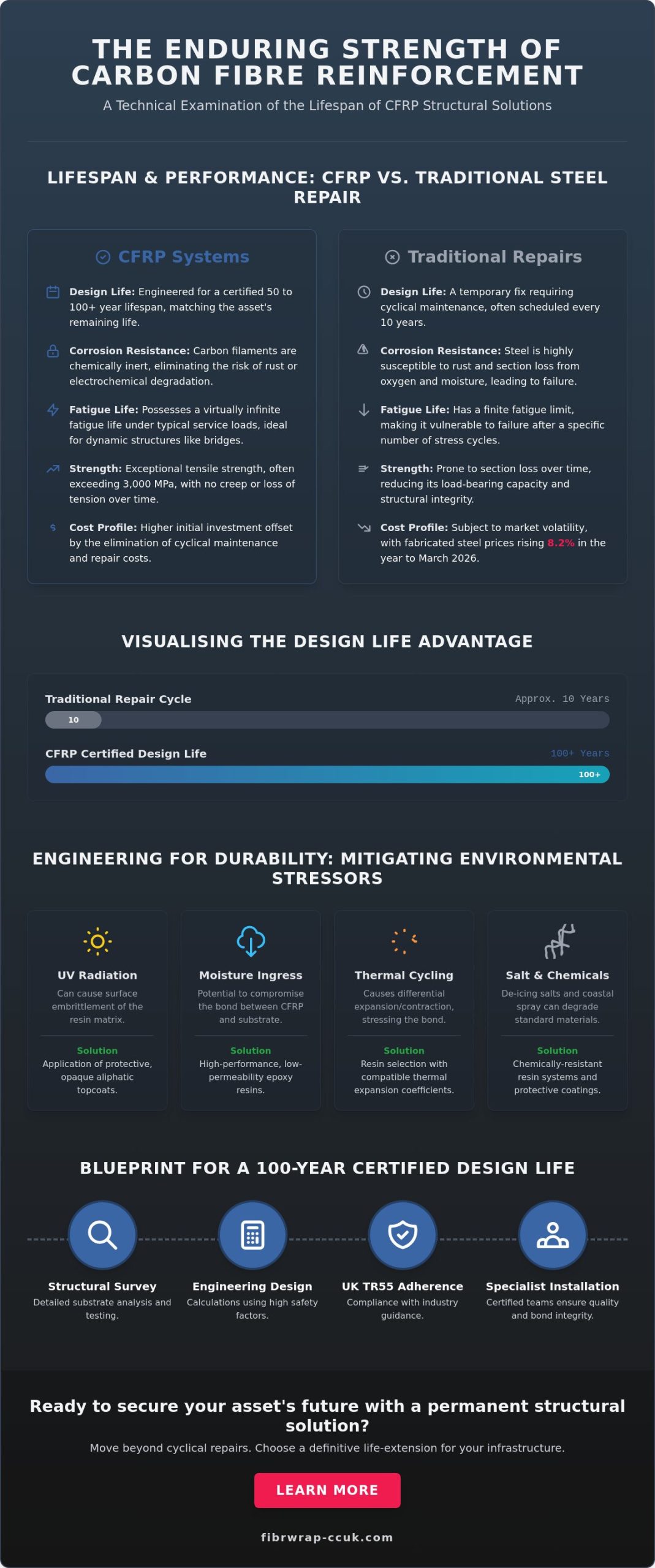
In structural engineering, “Material Life” refers to the physical existence of the product, whereas “Design Life” refers to the period during which the system performs its intended function without requiring major intervention. UK infrastructure projects typically demand a design life of 50 to 100 years. To achieve this, systems like Tyfo® Fibrwrap® are specified with high safety factors that account for long-term environmental loading. Professional engineering teams use specific design calculations to ensure that the tensile strength, which can exceed 3,000 MPa, remains sufficient even after accounting for potential reduction factors over many decades. This methodical approach ensures the reinforcement remains robust throughout the entire duration of the structure’s operational requirements.
The theoretical longevity of these systems is supported by the fact that carbon fibre doesn’t creep or lose tension over time when subjected to sustained loads. This stability is a significant advantage over other composites or traditional materials. When integrated into a properly prepared concrete or masonry substrate, the CFRP becomes a monolithic part of the structure. It’s this synergy between the inert fibre and the protective resin matrix that allows engineers to confidently predict that how long does carbon fibre reinforcement last is often limited only by the lifespan of the host building itself. By adhering to UK TR55 guidance, designers can mitigate the risks of delamination, ensuring the bond remains secure for the 50-year or 100-year horizon required by modern building safety standards.
Critical Factors That Influence CFRP Durability in the UK
The question of how long does carbon fibre reinforcement last in the UK is inextricably linked to environmental variables and the chemical integrity of the polymer matrix. Whilst the carbon filaments are fundamentally inert, the resin acts as the primary conduit for load transfer and the shield against external stressors. In the British climate, infrastructure is subjected to high humidity and salt spray, particularly in coastal regions or on highway bridges treated with de-icing salts. These conditions necessitate a system-based approach where the material properties are matched to the specific site requirements to prevent premature degradation.
Managing UV and Thermal Degradation
Resin matrices are sensitive to ultraviolet (UV) radiation, which can cause surface embrittlement if left unprotected. High-performance installations utilise aliphatic topcoats to provide an opaque barrier against UV-induced breakdown. Thermal cycling also presents a challenge; however, the coefficient of thermal expansion for CFRP is closely aligned with that of structural concrete. This compatibility minimises interfacial stresses during seasonal temperature fluctuations, preventing the delamination that often affects rigid steel plate bonding. For indoor or tunnel applications, fire protection coatings are mandated to ensure the system maintains its structural capacity during high-heat events.
Chemical Resistance and Cathodic Protection
CFRP systems demonstrate exceptional resilience amongst aggressive industrial chemicals and saltwater environments. Unlike steel, which undergoes expansive corrosion when exposed to chlorides, composites remain stable in wastewater treatment plants and maritime structures. Studies on the long-term durability of CFRP repairs indicate that even after two decades of service, properly engineered systems retain their design strength with negligible section loss. These materials also integrate seamlessly with cathodic protection systems, as the non-metallic nature of the reinforcement doesn’t interfere with the electrochemical prevention of rebar corrosion.
The longevity of any strengthening project is ultimately dictated by the condition of the host substrate. A bond is only as strong as the concrete it’s attached to. This requires meticulous surface preparation, often involving grit blasting or mechanical grinding to achieve a specific Concrete Surface Profile (CSP). Pull-off testing is subsequently conducted to verify that the substrate’s tensile strength meets the minimum requirements for the 50-year design life. If you’re managing a compromised asset, consulting a specialist for a bespoke design assessment is the most reliable way to determine exactly how long does carbon fibre reinforcement last for your specific project constraints.
By addressing these critical factors through rigorous engineering, the functional lifespan of the reinforcement is significantly extended. It’s this attention to detail during the installation phase that distinguishes a temporary patch from a permanent structural solution. When the resin quality, environmental protection, and substrate preparation are synchronised, the resulting system provides a level of durability that traditional materials simply cannot match.
CFRP vs. Traditional Strengthening: A Lifespan Comparison
When evaluating how long does carbon fibre reinforcement last, it’s necessary to contrast its performance against traditional methodologies such as steel plate bonding and concrete section enlargement. Traditional interventions often introduce secondary failure modes that compromise the very assets they’re intended to preserve. Steel plates, whilst providing immediate tensile capacity, create a vulnerable bond interface where ‘hidden’ corrosion can propagate undetected. This electrochemical degradation typically necessitates a rigorous maintenance schedule, with repainting and sealant inspection cycles required every five to ten years to prevent interfacial delamination.
In contrast, Carbon Fibre Reinforced Polymer (CFRP) systems offer a ‘fit and forget’ profile. Because the materials are non-metallic, the risk of galvanic corrosion is entirely eliminated. Furthermore, the exceptional weight-to-strength ratio of CFRP ensures that strengthening is achieved without significantly increasing the dead load of the structure. Traditional section enlargement, which involves casting additional concrete jackets, often accelerates the settlement of foundations and increases the long-term fatigue on original structural elements. By avoiding this added mass, CFRP maintains the global stability of the asset whilst providing the required localised reinforcement.
The Corrosion Advantage
The primary driver of longevity in composite systems is their immunity to the chloride-induced corrosion that destroys steel reinforcement. This advantage is particularly evident in maritime and highway environments where exposure to aggressive agents is constant. Empirical evidence from bridges strengthened over 30 years ago confirms that these systems show zero degradation at the bond line when installed correctly. By utilising advanced structural repairs to prepare the substrate, the resulting composite-to-concrete bond is frequently stronger than the concrete’s own cohesive strength, ensuring the intervention remains effective for the remainder of the structure’s service life.
Lifecycle Cost Analysis (LCCA)
A comprehensive Lifecycle Cost Analysis often reveals that whilst the initial CAPEX of composite materials may be higher than steel, the long-term OPEX is substantially lower. This economic efficiency is driven by the absence of recurring maintenance and the speed of Tyfo® Fibrwrap® application, which reduces site overheads and traffic management costs. Scientific models for Long-Term Performance Prediction demonstrate that CFRP laminates retain nearly all their tensile capacity even under accelerated aging conditions. When considering how long does carbon fibre reinforcement last in a financial context, the ability to extend an asset’s utility by 30 to 50 years without further intervention represents a significant return on investment compared to the total replacement of the structure.
By shifting the focus from initial material cost to total lifecycle performance, it becomes clear that CFRP is the superior choice for permanent structural remediation. The sustainability benefits are equally compelling; by prolonging the functional lifespan of existing infrastructure, asset managers can avoid the significant carbon expenditure associated with new concrete construction. This alignment of engineering rigour, economic value, and environmental responsibility positions composite strengthening as the definitive solution for modern asset management.
Engineering for Permanence: How to Maximise CFRP Lifespan
The durability of a composite intervention isn’t merely a product of the material itself but is the result of a disciplined engineering workflow. To determine how long does carbon fibre reinforcement last in a real-world setting, one must look at the rigour of the installation process. A methodical approach ensures that the theoretical longevity of the carbon filaments is translated into a permanent structural reality. This process follows a precise sequence designed to eliminate the variables that typically lead to the failure of traditional repairs.
The engineering sequence follows five critical phases:
- Substrate Validation: Conducting structural surveys and testing to establish the baseline tensile capacity and chemical health of the concrete.
- Bespoke Calculation: Developing design models that account for long-term environmental loading and the specific geometry of the asset.
- Mechanical Profiling: Utilising grit blasting or high-pressure water jetting to achieve a specific Concrete Surface Profile (CSP), ensuring a superior mechanical bond.
- Validated Installation: Applying professional systems like Tyfo® Fibrwrap® under controlled conditions to ensure laminate consistency.
- Environmental Shielding: Implementing protective topcoats and establishing long-term monitoring protocols to track performance over decades.
The Role of Bespoke Design
Off-the-shelf reinforcement kits often fail to provide the long-term security required for critical infrastructure because they don’t account for the unique stress profiles of a specific structure. Utilising specialist engineering contractors to oversee the design-supply-install chain is essential for risk mitigation. This integrated approach ensures full compliance with CS 455 (The strengthening of concrete structures) and other relevant UK standards. By tailoring the fibre orientation and resin selection to the project’s specific requirements, engineers can guarantee that the system meets its 50-year or 100-year design life objectives.
Quality Control During Installation
The chemical reaction required for resin curing is highly sensitive to environmental conditions. Precision during this phase is non-negotiable; humidity and temperature must be strictly logged to prevent compromised bond integrity. Quality control is further validated through the creation of witness panels on-site, which are subsequently tested to ensure the cured laminate properties match the design assumptions. Pull-off testing is also performed directly on the structure to verify that the bond to the substrate exceeds the cohesive strength of the concrete itself. These rigorous checks provide the empirical evidence needed to answer how long does carbon fibre reinforcement last with absolute certainty. For a technical consultation on your asset’s requirements, you can contact our engineering team to discuss bespoke remediation strategies.
The Future of Asset Management: Is CFRP the Final Solution?
The paradigm of modern civil engineering is shifting from reactive maintenance toward proactive structural life-extension. As the UK’s infrastructure ages, the emphasis has been placed upon the preservation of existing assets rather than the carbon-intensive cycle of demolition and reconstruction. When considering how long does carbon fibre reinforcement last in this context, it’s evident that CFRP isn’t merely a temporary intervention but a strategic component of long-term asset management. This transition is supported by empirical data and the integration of digital technologies that allow for real-time performance monitoring.
Sustainability and the Circular Economy
The environmental case for composite strengthening is compelling, particularly regarding the reduction of embodied carbon. By prolonging the functional life of existing concrete assets, CFRP reinforcement acts as a critical tool in reducing the construction industry’s carbon footprint. For instance, pipeline rehabilitation using carbon fibre systems avoids the significant environmental disruption and carbon expenditure associated with traditional trenching and replacement. This approach aligns directly with UK Net Zero targets, as it minimises the requirement for new cement production, which remains one of the most significant sources of global CO2 emissions.
Advancements in materials science are currently introducing ‘smart’ composites into the structural landscape. These systems incorporate embedded fibre-optic sensors or conductive layers that facilitate real-time health monitoring of the reinforcement bond. By providing a continuous stream of data regarding strain and temperature, these technologies remove the uncertainty often associated with how long does carbon fibre reinforcement last in high-stress environments. This data-driven approach allows asset controllers to manage their portfolios with unprecedented precision, ensuring safety whilst optimising maintenance budgets.
Partnering for Long-Term Structural Integrity
The success of these sophisticated engineering solutions depends on a unified delivery model where design, material supply, and installation are managed under a single point of accountability. CCUK’s end-to-end approach ensures that every project benefits from the technical rigour required for a 100-year design life. This quality assurance is further bolstered by the exclusive UK license for Tyfo® Fibrwrap® systems, providing access to proprietary materials that have been validated through decades of global project history and rigorous testing protocols.
CFRP remains the most durable and sustainable choice for 21st-century infrastructure challenges. Its resistance to corrosion, high fatigue limit, and minimal weight make it the definitive solution for extending the utility of essential assets. As the industry moves toward a circular economy, the focus on repair over replacement will only intensify. To ensure your infrastructure meets modern safety and environmental standards, consult with our engineering team to design your asset’s life-extension strategy today.
Securing the Future of Critical Infrastructure
Empirical evidence confirms that the query of how long does carbon fibre reinforcement last is answered by the precision of the initial engineering design and the rigour of the installation process. Whilst the carbon filaments are fundamentally eternal, the system’s longevity is secured through the application of proprietary resin matrices and advanced protective coatings. By transitioning from reactive remediation to proactive life-extension, asset managers ensure their structures remain compliant with UK safety regulations for the remainder of their operational design life.
As the exclusive UK licensee for Tyfo® Fibrwrap® systems, we provide an expert design-supply-install service specifically tailored to the complex requirements of national infrastructure. Our proven track record across bridges, pipelines, and commercial buildings demonstrates that composite strengthening remains the definitive choice for sustainable asset remediation. Please Request a Technical Consultation for Your Strengthening Project to discuss a bespoke strategy for your structural assets. Permanent security is achievable through the application of advanced materials science and disciplined engineering.
Frequently Asked Questions
Does carbon fibre reinforcement degrade in sunlight?
UV radiation can cause surface degradation of the epoxy resin matrix, but this is mitigated through the application of UV-resistant aliphatic topcoats. These coatings act as an opaque barrier, ensuring the load-bearing fibres remain shielded from ultraviolet breakdown. Without these protective layers, the resin’s chemical bonds could weaken over several decades, potentially compromising the transfer of stress between the concrete and the reinforcement.
Can CFRP be used for fire-rated structures?
CFRP systems are suitable for fire-rated structures when integrated with certified fire-protection coatings. Whilst raw resin has a specific glass transition temperature where it begins to soften, the application of intumescent or cementitious overlays ensures the system maintains its structural capacity during a fire event. These specialised coatings are mandated in commercial and residential settings to meet UK building safety regulations.
How does saltwater affect the lifespan of carbon fibre strengthening?
Saltwater has negligible impact on the performance of carbon fibre, making it superior for maritime infrastructure and coastal bridges. Unlike steel, carbon fibre doesn’t suffer from chloride-induced corrosion, which is a primary factor in determining how long does carbon fibre reinforcement last in aggressive environments. The resin matrix provides an additional layer of protection, preventing saltwater from reaching the concrete substrate and causing rebar oxidation.
Is it possible to inspect the concrete under the carbon fibre wrap later?
Inspection of the substrate remains possible through non-destructive testing (NDT) methodologies such as acoustic sounding or infrared thermography. These techniques allow engineers to detect voids, moisture ingress, or delamination at the bond interface without compromising the integrity of the wrap. Regular monitoring is often part of a long-term asset management strategy for critical infrastructure projects.
What happens if the carbon fibre reinforcement is accidentally impacted?
Accidental impact requires a technical assessment by a specialist to determine if the damage is superficial or structural. Localised abrasions are often remediated with resin injection or patch overlays to restore the protective matrix. If the impact has caused significant fibre fracture, a bespoke design calculation is performed to determine if a supplementary wrap is required to maintain the original design capacity.
How does the lifespan of CFRP compare to traditional steel plate bonding?
The service life of CFRP is significantly longer than steel plate bonding because it eliminates the risk of interfacial corrosion. Steel plates frequently fail due to hidden oxidation at the bond line, which can lead to sudden delamination. CFRP provides a permanent solution that doesn’t require the 5-10 year repainting and maintenance cycles associated with metallic reinforcement systems.
Does the resin used in CFRP become brittle over time?
High-specification resins are engineered to maintain their mechanical properties and chemical stability without becoming brittle under normal service conditions. The polymer matrix is selected based on its thermal resilience and resistance to moisture ingress, ensuring the system remains durable enough to accommodate seasonal structural movements. Proper quality control during the curing process is essential to ensure these long-term properties are achieved.
What is the typical warranty or design life offered for a Tyfo® Fibrwrap® installation?
Tyfo® Fibrwrap® installations are typically engineered for a 50-year or 100-year design life in accordance with UK structural standards like TR55. This ensures that how long does carbon fibre reinforcement last aligns perfectly with the operational requirements of major infrastructure and commercial developments. The specific design life is documented in the technical calculations provided by the specialist engineering contractor at the project’s inception.


