

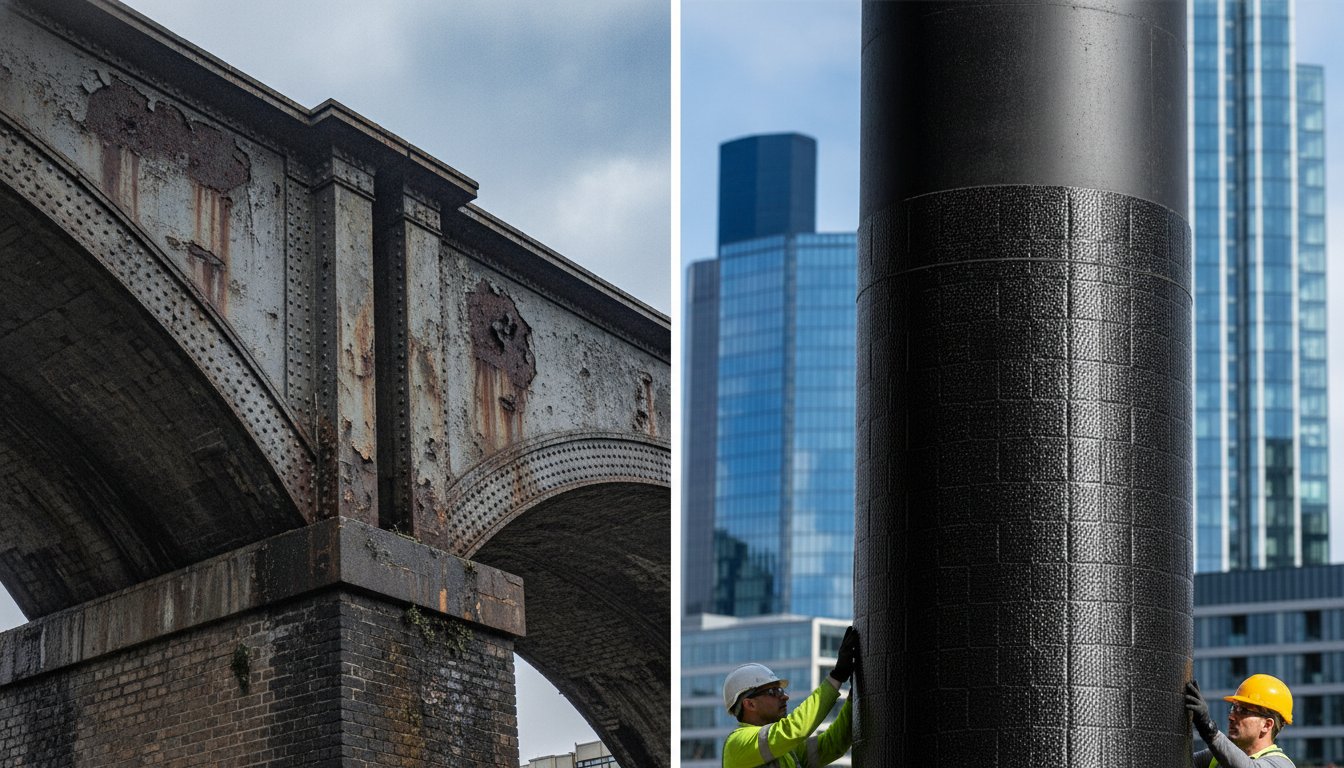
Carbon fibre can be up to ten times stronger than steel by weight, yet many asset controllers still default to traditional metal plates when addressing structural decay. When considering carbon fibre vs steel reinforcement which is better, the decision often hinges on the specific constraints of the remediation environment, particularly where corrosion or weight limits are critical factors. You likely recognise that whilst steel rebar remains a staple for new builds, its susceptibility to oxidative degradation often necessitates frequent, disruptive maintenance cycles that compromise the long-term utility of the asset.
This article provides a technical evaluation of advanced composites, such as the Tyfo® Fibrwrap® system, compared to conventional steel reinforcement for structural remediation and life-extension. You’ll gain a data-backed justification for material selection that prioritises reduced maintenance and minimal site disruption. We’ll examine material properties, the impact on building occupancy, and how established standards like ACI 440.2R are shaping the future of infrastructure safety through the lens of engineering rigour and empirical evidence.
Key Takeaways
- Understand the fundamental shift from traditional ferrous reinforcement to advanced polymer composites within the context of the UK’s aging infrastructure challenges.
- Evaluate technical performance data to determine carbon fibre vs steel reinforcement which is better for projects requiring superior tensile strength and high weight-to-strength ratios.
- Analyse the logistical advantages of CFRP wrapping over steel plate bonding, specifically regarding reduced site footprints and the mitigation of operational downtime.
- Apply a robust decision-making framework to balance initial CAPEX against long-term OPEX when selecting materials for critical asset life-extension.
- Identify how engineered solutions like the Tyfo® Fibrwrap® system provide a non-invasive alternative to total asset replacement through advanced structural remediation.
The Evolution of Structural Reinforcement: From Steel to Advanced Composites
The United Kingdom’s civil infrastructure is currently under significant pressure, as many bridges, car parks, and industrial facilities constructed in the mid-20th century reach critical stages of degradation. Traditionally, The Evolution of Structural Reinforcement was defined by the integration of steel rebar within the concrete matrix to compensate for the material’s inherent lack of tensile strength. Whilst this remains the standard for primary reinforcement in new construction, the methodology for structural remediation has shifted towards advanced polymer composites. Specialist engineering contractors now utilise these materials to extend the functional lifespan of assets without the invasive requirements of total replacement. This approach distinguishes between the primary rebar used during initial casting and the secondary strengthening systems applied externally to remediate existing structural deficits. When determining carbon fibre vs steel reinforcement which is better for a specific project, the decision must be grounded in the structural requirements and environmental conditions of the site.
The Limitations of Traditional Steel Reinforcement
The use of steel plates for structural strengthening presents several engineering challenges, most notably the material’s susceptibility to oxidation. In harsh environments, such as coastal regions or structures exposed to de-icing salts, chloride-induced corrosion leads to expansive pressures that cause concrete spalling and significant section loss. Additionally, the substantial dead weight of heavy steel sections can impose new loads on an already compromised structure, potentially necessitating further foundation work. The logistics of transporting and manipulating bulky steel members in confined spaces often lead to extended project timelines and increased operational disruption, which are often unacceptable in high-traffic or essential service environments.
The Emergence of CFRP as a Structural Solution
Carbon Fibre Reinforced Polymer (CFRP) represents a sophisticated marriage of high-strength carbon fibres and a protective polymer resin matrix. Originally developed for the stringent performance requirements of the aerospace and automotive sectors, CFRP has been adapted for civil engineering as a lightweight, non-corrosive alternative to steel. When evaluating carbon fibre vs steel reinforcement which is better, the absence of electrochemical corrosion and the ease of application become primary drivers for selection. In the UK, the regulatory landscape for these materials is increasingly robust, with designers often referencing established guidelines such as ACI 440.2R alongside specific engineered design features to ensure long-term safety and performance. This transition from ferrous to composite materials allows for a more tailored and less invasive approach to modern asset management.
Material Performance: A Technical Comparison of CFRP and Steel
The selection of materials for structural remediation necessitates a rigorous analysis of mechanical properties. A primary consideration when evaluating carbon fibre vs steel reinforcement which is better is the divergence in tensile performance and load-bearing efficiency. According to Material Performance: A Technical Comparison, advanced composites exhibit a linear-elastic behaviour that differs fundamentally from the elasto-plastic response of traditional carbon steel. This distinction is critical for engineers tasked with restoring the structural integrity of aging assets whilst managing the global stability of the structure. The higher tensile capacity of composites allows for a more efficient transfer of stresses, particularly in tension-governed remediation scenarios.
Weight-to-strength ratios play a decisive role in seismic retrofitting and the strengthening of aging bridges. CFRP systems offer a tensile strength that is significantly higher than steel whilst possessing only a fraction of its mass. This allows for substantial capacity increases without adding parasitic dead weight that might otherwise compromise the existing foundations or primary load-bearing members. Thermal expansion characteristics also favour composites in specific applications; carbon fibre possesses a longitudinal coefficient of thermal expansion that is near zero, ensuring better dimensional stability during temperature fluctuations compared to the relatively high expansion rates of steel plates.
Tensile Strength and Modulus of Elasticity
Structural steel typically yields at approximately 450 MPa to 500 MPa. In contrast, CFRP systems often exceed 2500 MPa in tensile strength, providing a superior capacity for tension-dominated applications. High-modulus carbon fibres are particularly effective for deflection control in reinforced concrete beams, where they restrict crack widths and improve serviceability. Whilst structural steel typically exhibits a modulus of elasticity of approximately 200 GPa, the Tyfo® Fibrwrap® system provides an engineered modulus tailored to the specific substrate, typically ranging from 70 GPa to 150 GPa depending on the chosen laminate configuration.
Corrosion Resistance and Chemical Inertia
The electrochemical passivity of carbon fibre makes it ideal for marine environments or industrial facilities where chemical exposure is prevalent. Unlike steel, which is prone to carbonation-induced corrosion and “rust bursting”, CFRP is chemically inert. This eliminates the risk of concrete spalling caused by the expansive forces of oxidising ferrous materials. By selecting a non-corrosive system, asset managers can significantly reduce future maintenance cycles and extend the service life of essential infrastructure. To explore how these material properties apply to specific structural challenges, technical professionals may review our design features for bespoke remediation strategies.
The debate regarding ductility versus brittleness is often simplified by suggesting that steel’s ability to yield makes it inherently safer. However, modern structural design codes, such as ACI 440.2R, provide a robust framework for managing the linear-elastic nature of CFRP. By applying appropriate strength reduction factors and ensuring a tension-controlled failure mode in the existing concrete, engineers can safely integrate these high-performance materials. This ensures that the remediated structure maintains the required level of safety and reliability without the drawbacks of traditional ferrous bonding.

The Logistics of Strengthening: Installation, Access, and Disruption
Beyond the fundamental mechanical properties, the logistical feasibility of a strengthening project often dictates the viability of the entire remediation strategy. In the context of structural remediation, as opposed to primary reinforcement in new construction, the “site footprint” of the chosen material governs both the project timeline and the total expenditure. When technical professionals evaluate carbon fibre vs steel reinforcement which is better, the decision frequently rests on the practicalities of site access and the necessity for operational continuity. Experimental data, such as the NIST technical comparison of CFRP and steel reinforcement, demonstrates that whilst mechanical performance is paramount, the logistical execution of these materials varies significantly, influencing the total project risk profile.
Site Access and Plant Requirements
The installation of steel plate bonding typically requires significant mechanical intervention, including the use of heavy lifting gear, cranes, and bespoke propping systems to position and secure the plates. This necessitates a large site footprint and often requires the removal of existing services or finishes. In contrast, Carbon Fibre Reinforced Polymer (CFRP) systems are lightweight and hand-applied, effectively eliminating the need for heavy plant. This is particularly advantageous in confined spaces or amongst complex service runs where flexibility is required. Fabric-based systems can be easily manipulated around circular columns or into tight corners, reducing the requirement for extensive temporary works and invasive structural modifications.
Speed of Application and Curing Times
The speed of installation remains a critical metric for asset managers. Steel plates require a labour-intensive process of drilling, bolting, and resin injection, which can span several days or weeks depending on the scale of the works. CFRP applications utilise a rapid wet-layup process that significantly accelerates the project schedule. Because these systems are applied in thin layers, they allow buildings to remain in use during the works, minimising the economic impact of structural downtime. Resin-infused systems achieve their design strength efficiently, allowing for a faster return to full serviceability compared to traditional ferrous methods.
Health and safety considerations also favour composite materials. The manual handling of heavy steel sections presents inherent risks to site personnel, often requiring complex risk assessments and specialised training. Composites are inherently safer to handle on-site due to their low mass. Whilst the initial material cost of steel may appear lower, the total project cost often exceeds that of CFRP when factoring in plant hire, extended labour, and the cost of structural downtime. By selecting an engineered composite solution, asset controllers can achieve a more predictable and less disruptive remediation outcome.
Selection Criteria: When is Steel or Carbon Fibre Better?
The determination of carbon fibre vs steel reinforcement which is better for a specific remediation project requires a multifaceted decision-making framework that extends beyond simple material procurement costs. Asset managers must evaluate the structural requirements alongside environmental variables and operational constraints. Whilst steel remains a viable option for certain heavy-impact zones or where specific ductility is a primary design requirement, Carbon Fibre Reinforced Polymer (CFRP) systems offer a superior solution for most life-extension strategies. The selection process should be grounded in engineering rigour, ensuring that the chosen material aligns with the long-term performance objectives of the infrastructure.
Economic Considerations and Life-Cycle Costing
A sophisticated analysis of project feasibility must distinguish between initial capital expenditure (CAPEX) and long-term operational expenditure (OPEX). Although the “per kilogram” cost of carbon fibre exceeds that of structural steel, the total installed value of a composite system is often lower when factoring in the reduction of heavy plant requirements and shorter project durations. Calculating the return on investment for asset life-extension involves assessing the avoided costs of total asset replacement and the extension of maintenance-free service intervals. From a sustainability perspective, the use of CFRP contributes to a significantly lower carbon footprint; the embodied energy involved in transporting and installing lightweight composites is a fraction of that required for traditional ferrous plates. This focus on prolonging the functional lifespan of a structure represents a critical thematic shift towards more environmentally responsible engineering practices.
Technical Constraints and Fire Performance
Engineers must remain attentive to specific technical constraints, particularly regarding fire performance and thermal limits. The performance of externally bonded CFRP is dependent on the epoxy resin matrix, which is sensitive to the glass transition temperature (Tg). In fire scenarios, the bond may be compromised if temperatures exceed this threshold. However, engineered systems like the Tyfo® Fibrwrap® system can achieve 2-hour to 4-hour fire ratings when integrated with Tyfo® AFP (Advanced Fire Protection) coatings. In contrast, traditional steel may be preferred for environments subject to heavy mechanical impact or extreme temperatures where secondary fire protection is not feasible. The complexity of these variables underscores the importance of bespoke design solutions that are tailored to the unique load cases and environmental stresses of the asset.
Structural load cases involving high levels of anticipated seismic activity may occasionally favour the inherent ductility of steel, though modern composite design codes now provide reliable methodologies for achieving similar safety margins. When the objective is to remediate corrosion or increase load capacity with minimal impact on building occupancy, the technical advantages of composites become undeniable. To ensure your asset receives a tailored evaluation based on these criteria, we invite you to contact our specialist engineering team for a detailed structural assessment.
Advanced Remediation: The Tyfo® Fibrwrap® Advantage
The Tyfo® Fibrwrap® system represents the global benchmark for composite strengthening, having been rigorously developed and validated through over 500 independent laboratory tests since its inception in 1988. Unlike generic carbon fibre products, this is a fully engineered system of high-strength fibres and proprietary epoxy resins that have been designed to function in unison. When evaluating carbon fibre vs steel reinforcement which is better for complex infrastructure, the decision often rests on the reliability of the system’s performance under extreme conditions. Composites Construction UK (CCUK) serves as the specialised contractor delivering these end-to-end solutions, ensuring that every intervention is grounded in engineering rigour and empirical data.
A Comprehensive System Approach
The integrity of a composite strengthening project depends heavily on the interface between the substrate and the reinforcement. Superior performance isn’t achieved by the carbon fibre alone; it’s the result of specialised resins and meticulous surface preparation. Our teams conduct rigorous pull-off testing to verify bond strength before and during the application of the Tyfo® system. This methodical approach allows for the tailoring of solutions for seismic retrofitting, blast mitigation, and significant structural upgrades. Because the system is applied as a wet-layup, it conforms to any structural geometry, providing a level of versatility that traditional steel plates simply can’t match in constrained or irregular environments.
Partnering with a Specialist Engineering Contractor
Successful remediation begins with a deep understanding of the existing asset’s condition. We prioritise early-stage structural surveys and testing to identify the root cause of degradation and define the required capacity increases. As the expert UK licensee for Tyfo® systems, we navigate the complexities of the design and supply chain to provide a seamless project delivery. This ensures that every installation is performed by certified teams who understand the critical nature of material ratios and curing environments.
When considering carbon fibre vs steel reinforcement which is better for modern infrastructure, the evidence clearly supports the use of advanced composites for remediation. CFRP provides a non-corrosive, high-strength, and low-impact alternative that extends the functional lifespan of essential assets whilst avoiding the costs and disruptions associated with total replacement. By choosing an engineered system like Tyfo® Fibrwrap®, asset controllers secure the long-term safety and utility of their structures through proven science and specialised expertise. For a detailed assessment of your project’s requirements, please contact our engineering team.
Securing the Future of Critical Infrastructure
It’s clear that the technical evaluation of advanced composites against traditional ferrous materials reveals a trajectory toward non-invasive, high-performance solutions. Whilst structural steel remains integral to new construction, its susceptibility to environmental degradation and the logistical burden of its installation often make it less suitable for remediation. When evaluating carbon fibre vs steel reinforcement which is better, the decision must be informed by the superior tensile capacity, chemical inertia, and installation efficiency that Carbon Fibre Reinforced Polymer (CFRP) provides.
As the exclusive UK licensee for Tyfo® Fibrwrap® systems, our specialist engineering team provides national coverage to address the most complex structural challenges. We maintain a proven track record in high-consequence infrastructure projects, prioritising safety and empirical results to prolong the functional lifespan of essential assets. We invite you to consult with our engineering team for a bespoke strengthening design that aligns with your specific remediation requirements. By choosing a tailored, science-led approach, you’ll ensure the long-term security and resilience of your structural assets.
Frequently Asked Questions
Is carbon fibre strengthening more expensive than steel plate bonding?
The total installed cost of carbon fibre strengthening is frequently lower than steel plate bonding, despite the higher initial procurement cost of the composite materials. Financial evaluations must account for the significant reduction in heavy plant hire, the elimination of bespoke propping, and the accelerated project timelines that composites allow. When assessing carbon fibre vs steel reinforcement which is better for a specific budget, asset managers often find that the reduction in operational downtime provides a superior return on investment.
How long does carbon fibre reinforcement last compared to steel?
Carbon fibre systems are designed to match or exceed the remaining design life of the structure, often providing a service life of over 50 years without the need for significant maintenance. Unlike steel, which is prone to oxidation and section loss, CFRP is chemically inert and immune to electrochemical corrosion. This durability ensures that the structural integrity of the remediation remains intact even in aggressive marine or industrial environments where traditional ferrous materials would rapidly degrade.
Can CFRP be used for seismic retrofitting in the UK?
CFRP is highly effective for seismic retrofitting in the UK, particularly for the confinement of reinforced concrete columns and the shear strengthening of masonry walls. The material’s high strength-to-weight ratio allows for significant increases in ductility and energy dissipation without altering the structure’s dynamic characteristics. These systems are frequently specified for essential infrastructure where seismic resilience is a regulatory requirement or a critical safety objective.
Does carbon fibre strengthening require fireproofing?
CFRP systems typically require secondary fire protection to maintain their structural contribution during a fire event, as the epoxy resin matrix is sensitive to high temperatures. Engineered solutions like the Tyfo® Fibrwrap® system are often paired with specialised intumescent coatings or Tyfo® AFP (Advanced Fire Protection) to achieve required fire ratings. This ensures the system remains below its glass transition temperature, preserving the bond between the composite and the concrete substrate.
What are the main disadvantages of using steel for structural strengthening?
The primary disadvantages of steel strengthening include its susceptibility to corrosion, the substantial dead weight it adds to the structure, and the complex logistics of installation. Heavy steel plates require mechanical fixings and resin injection, which can be labour-intensive and disruptive to building occupants. Additionally, the ongoing requirement for protective coatings and periodic inspections for rust adds to the long-term operational expenditure of the asset.
How do I know if my structure is suitable for CFRP wrapping?
Suitability for CFRP wrapping is determined through comprehensive structural surveys and testing, including pull-off tests to verify the tensile strength of the concrete substrate. The structure must possess sufficient inherent integrity to allow for the effective transfer of stresses to the composite system. Our engineering team evaluates these factors alongside the specific load cases to ensure that a composite solution is the most technically viable and safe option for the remediation.
Is CFRP strengthening a permanent solution for concrete repair?
CFRP strengthening is considered a permanent structural intervention when it’s integrated into a holistic remediation strategy that addresses the underlying causes of decay. It’s often used in conjunction with concrete repair and resin injection to restore and then enhance the original design capacity. When determining carbon fibre vs steel reinforcement which is better for long-term stability, the permanent, non-corrosive nature of composites makes them the logical choice for modern asset life-extension.
What is the speed of installation for CFRP versus steel?
The speed of installation for CFRP is significantly higher than that of steel, often reducing project timelines by 50% or more. The wet-layup process is hand-applied and requires no heavy lifting equipment, allowing for rapid progression across large surface areas or within confined spaces. This efficiency is a decisive factor for projects with strict deadlines, as it allows for a much faster return to full serviceability compared to the multi-stage process of bolting and grouting steel sections.


