
The decision to decommission a structure due to material degradation is often a premature conclusion that overlooks the capabilities of modern materials science. Asset controllers frequently contend with the prohibitive costs and logistical disruption associated with traditional demolition, particularly when faced with corroding reinforcement steel or inadequate load-bearing capacities. Understanding what is CFRP used for in construction is now a prerequisite for engineers tasked with maintaining the integrity of the built environment. By integrating these advanced composites, the functional lifespan of an asset can be extended significantly whilst avoiding the carbon-intensive processes of total reconstruction.
It’s widely recognised that the pressure to meet updated building codes and increased service loads requires a more sophisticated approach than conventional steel plate bonding. You’ll discover how Carbon Fibre Reinforced Polymer (CFRP) systems are utilised to rehabilitate critical UK infrastructure with minimal operational downtime. With the carbon fibre construction repair market expanding at a compound annual growth rate of 10.2%, these systems are becoming the standard for sustainable life-extension. This article provides a detailed overview of the applications, material properties, and engineering methodologies that define modern structural strengthening.
Key Takeaways
- Understand the fundamental mechanics of high-performance composites and how the synergy between carbon fibres and resin matrices facilitates efficient load transfer in structural remediation.
- Gain technical insight into what is CFRP used for in construction, specifically regarding flexural and shear strengthening to accommodate increased live loads or rectify original design deficits.
- Discover the role of specialised systems in rehabilitating critical infrastructure, including bridge deck remediation, pipeline repair, and the implementation of blast mitigation measures.
- Contrast the non-corrosive, lightweight properties of CFRP with traditional methods to understand how these materials significantly reduce lifecycle costs and operational downtime.
- Learn why successful implementation requires a rigorous, design-led process involving bespoke engineering calculations and precise substrate preparation to ensure structural security.
What is CFRP and Why is it Essential for Modern Construction?
Carbon-fiber reinforced polymer (CFRP) is a sophisticated composite material engineered by embedding high-tensile carbon filaments within a protective polymer resin matrix. This combination creates a synergistic effect where the fibres provide exceptional tensile strength whilst the resin facilitates uniform load transfer and protects the filaments from environmental degradation. When considering what is CFRP used for in construction, it’s the material’s ability to provide structural reinforcement without the weight penalties of traditional steel that makes it indispensable. Indeed, CFRP can exhibit a tensile strength ten times greater than that of conventional structural steel whilst remaining significantly lighter.
Beyond its strength, the non-corrosive nature of these composites offers a decisive advantage in aggressive environments. Unlike steel reinforcement, which is susceptible to oxidation and subsequent spalling, CFRP remains inert. This property is particularly critical for infrastructure exposed to de-icing salts, marine conditions, or industrial pollutants. By eliminating the primary mechanism of concrete decay, engineers can secure the long-term stability of an asset through targeted interventions. It’s a solution that prioritises durability over the short-term fixes of traditional repair methods.
The Material Science Behind CFRP Composites
The efficacy of a CFRP system is heavily dependent on fibre orientation, which must be precisely aligned with the principal stress directions of the structure. Unidirectional wraps are typically employed for flexural strengthening, whilst multidirectional configurations may be specified for complex shear or seismic requirements. The selection of the epoxy resin is equally critical; it must provide a robust bond to various substrates, including concrete, masonry, or timber. A key advantage of CFRP is its thermal expansion compatibility with concrete. The coefficients of thermal expansion for both materials are sufficiently aligned to prevent delamination during seasonal temperature fluctuations. This technical synergy is explored further in our design feature documentation.
Evolution from Aerospace to Civil Engineering
Originally developed for high-stakes aerospace applications, the question of what is CFRP used for in construction has evolved as manufacturing costs have declined. This transition into mainstream structural engineering has been accelerated by improvements in manufacturing processes that have made composite solutions commercially viable for large-scale UK infrastructure projects. As the national stock of bridges, tunnels, and commercial buildings reaches the end of its original design life, the adoption of these advanced systems has become a primary strategy for asset controllers. The move from aerospace to the construction site reflects a broader trend towards utilising high-science materials to resolve the challenges of ageing urban environments.
Primary Structural Applications of CFRP in Strengthening Concrete
The remediation of reinforced concrete elements often necessitates interventions that address specific mechanical deficiencies without altering the architectural footprint. When evaluating what is CFRP used for in construction, its primary utility lies in the targeted enhancement of flexural, shear, and axial capacities. These applications are essential when existing structures must be adapted to accommodate increased live loads or when original design errors have been identified. By bonding high-modulus composites to the concrete substrate, the structural performance is augmented whilst maintaining the original geometry of the member. This approach is increasingly prioritised for assets where operational continuity is paramount.
Seismic retrofitting represents another critical application where CFRP systems are deployed to enhance structural ductility. In regions prone to ground movement, concrete frames often lack the necessary energy dissipation characteristics. The application of composite wraps allows for the confinement of plastic hinge zones, preventing brittle failure and ensuring life safety during a seismic event. This methodology is preferred over traditional steel bracing because it adds negligible mass to the structure, thereby avoiding the introduction of additional inertial forces. It’s a precise engineering solution that addresses the specific vulnerabilities of ageing concrete frames.
Flexural and Shear Reinforcement of Beams
Flexural capacity is traditionally enhanced by bonding CFRP plates or fabrics to the tension face of beams and slabs. This arrangement allows the composite to act as external reinforcement, effectively assuming the tensile stresses that the internal steel can no longer support. For shear deficiencies, ‘U-wrapping’ techniques are employed where the composite is applied to the vertical faces and soffit of the beam. This configuration acts as external stirrups, providing the necessary confinement to mitigate diagonal tension failure. Adherence to a professional Tyfo® Fibrwrap® Installation protocol ensures that the bond integrity between the composite and the concrete is maintained under peak load conditions.
Column Confinement and Axial Load Upgrades
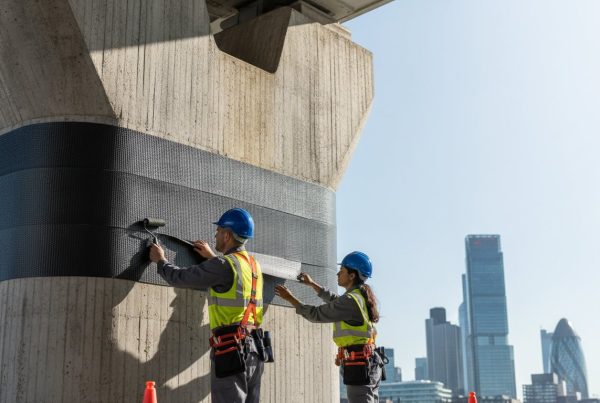
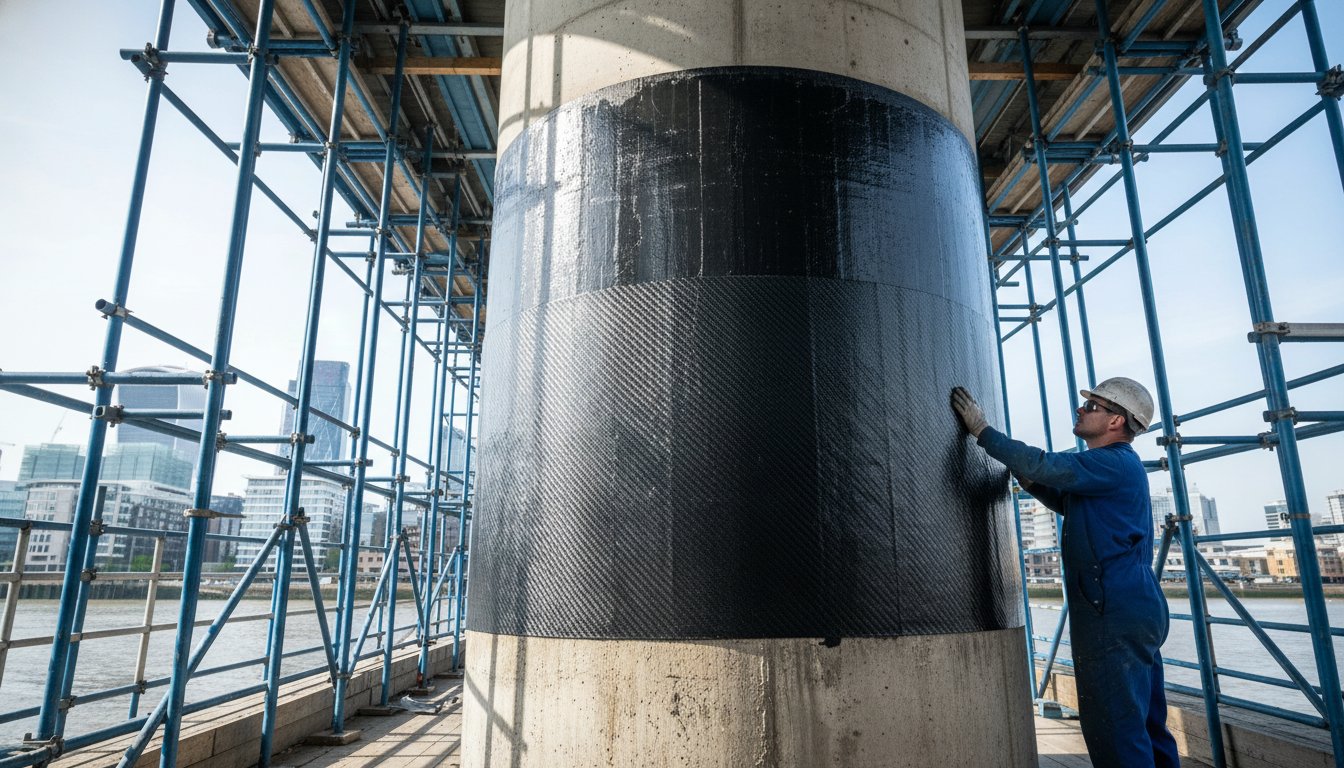
The axial capacity of existing columns can be significantly increased through the application of continuous CFRP wraps. This process creates a triaxial stress state within the concrete core; as the concrete attempts to expand laterally under compressive load, the high-tensile composite provides passive confinement. This confinement restricts micro-cracking and allows the concrete to reach much higher compressive strains than unconfined material. Such upgrades are frequently required when a change of use necessitates higher load capacities on existing supports. Unlike traditional concrete jacketing, which can add 150mm or more to a column’s diameter, CFRP wraps add only millimetres of thickness. For engineers seeking to understand the feasibility of these interventions, a detailed design feature analysis can provide the necessary empirical validation for specific project requirements.

Strengthening Critical Infrastructure: Bridges, Pipelines, and Blast Mitigation
National infrastructure maintenance requires a disciplined shift away from intrusive, weight-heavy solutions. When considering what is CFRP used for in construction, the remediation of bridges and high-pressure pipelines stands as a primary application for technical professionals. These assets are subject to extreme environmental stresses and dynamic loading, necessitating a repair system that offers both chemical resistance and rapid deployment. By utilising composite systems, engineers can restore the structural integrity of vital links without the logistical burden of full-scale reconstruction or the addition of significant dead load.
The rehabilitation of industrial assets extends to specialised environments where safety requirements are non-negotiable. This includes the reinforcement of high-pressure utility lines and the implementation of security measures for sensitive facilities. For technical insights into asset life-extension in these sectors, professionals should consult our Pipeline Rehabilitation Guide. These interventions are designed to be non-invasive, ensuring that critical services remain operational whilst the structural capacity is being upgraded.
Bridge Deck and Girder Strengthening
Bridge soffits and girders are frequently compromised by impact damage from over-height vehicles or the pervasive effects of reinforcement corrosion. CFRP is applied to these elements to restore load-bearing capacity whilst adding negligible mass to the structure. This is a critical consideration for ageing bridges where the existing dead load is already a primary concern. The application process is significantly faster than traditional concrete or steel jacketing, which is essential for minimising traffic disruption on the national highway network. Additionally, the material’s inherent resistance to de-icing salts and carbonation provides a durable barrier that prevents future degradation in harsh roadside environments.
Advanced Blast Mitigation and Seismic Retrofitting
In high-security or industrial settings, what is CFRP used for in construction often focuses on blast mitigation and the prevention of progressive collapse. Composite wraps are engineered to absorb significant kinetic energy and contain concrete debris during an explosive event or seismic tremor. This confinement is vital for ensuring that a structure remains functional, or at least stable enough for evacuation, after a high-impact event. For historic masonry structures, these systems provide the necessary tensile strength to resist lateral forces without compromising the aesthetic or historical integrity of the building. It’s a tailored engineering approach that prioritises both immediate safety and long-term structural resilience.
The Strategic Advantages: Durability, Weight, and Life-Extension
Strategic asset management requires a shift in perspective from immediate capital expenditure to long-term lifecycle value. Determining what is CFRP used for in construction often involves a comparative analysis of lifecycle performance against conventional materials. Whilst traditional methods like concrete jacketing or steel plate bonding have been the historical norm, they introduce significant dead load and require intrusive installation. CFRP systems provide a sophisticated alternative that prioritises the extension of an asset’s functional lifespan without compromising its original design geometry. This methodology is particularly relevant for structures where the cost of demolition and reconstruction is prohibitive.
The economic logic of ‘Repair vs. Replace’ is underpinned by the material’s inherent durability. Carbon fibre is naturally inert, meaning it’s immune to the electrochemical process of corrosion that plagues steel-reinforced structures. By applying these systems, engineers can secure a 50-year life-extension for critical assets at a fraction of the cost of new construction. This approach not only preserves capital but also avoids the massive logistical disruption associated with full-scale replacement. It’s a guardian-led approach to infrastructure that values the preservation of existing utility through advanced materials science. This focus on durability is also essential for exterior finishes; for example, you can learn more about Green Plank and their sustainable WPC systems designed for long-term performance.
CFRP vs. Traditional Steel Strengthening
Installation requirements for composite systems are significantly less demanding than those for steel. CFRP is lightweight and flexible, meaning it can be applied without the need for heavy lifting equipment or complex temporary propping. Steel rusts. Carbon fibre doesn’t. This fundamental difference eliminates the need for the periodic maintenance cycles, such as repainting or corrosion treatment, that are mandatory for steel-based repairs. The tensile modulus of high-strength carbon fibre typically exceeds 230 GPa, which provides a superior stiffness-to-weight ratio compared to the 200 GPa modulus of structural steel.
Sustainability and the Circular Economy in Construction
Extending the life of existing concrete structures is a primary lever for achieving national Net Zero 2050 targets. By opting for Structural Repairs over demolition, the demand for new cement and steel production is drastically reduced. This aligns with circular economy principles by keeping existing materials in use for as long as possible. The revised EU Construction Products Regulation, effective from January 2025, now requires the declaration of environmental indicators like Global Warming Potential (GWP) for construction materials. CFRP applications generate minimal site waste and have a significantly lower carbon footprint than the carbon-intensive processes of demolition and reconstruction. To evaluate the technical feasibility of these sustainable interventions for your asset, you should contact our engineering team for a professional consultation.
Implementing CFRP Solutions: Design, Engineering, and Professional Installation
Successful structural remediation using composites is fundamentally a design-led endeavour rather than a simple material application. When determining what is CFRP used for in construction, it’s vital to recognise that the efficacy of the system depends on the precision of bespoke engineering calculations and feasibility studies. Every project begins with a rigorous assessment of the existing structural state to identify specific load deficits. This data-driven approach ensures that the reinforcement is exactly tailored to the requirements of the asset, providing a level of reliability that off-the-shelf solutions cannot match. The integration of high-modulus materials into an existing frame is a sophisticated process that must be grounded in empirical evidence and structural rigour.
Navigating the complex regulatory landscape and safety standards of the UK construction industry requires the expertise of a Specialist Engineering Contractor. These professionals ensure that every stage of the project, from initial design to final sign-off, adheres to the highest engineering standards and local building codes. Quality control is maintained through rigorous on-site measures, including the production of witness panels for laboratory analysis and the performance of pull-off tests to verify the bond strength of the composite-to-concrete interface. This disciplined approach to quality assurance is what separates professional engineering interventions from standard maintenance activities.
Bespoke Engineering and Design Features
Engineers must calculate the precise number of composite layers and the specific fibre orientation required to address identified structural weaknesses. This analysis considers the current load capacity versus the target service requirements, ensuring the intervention is neither insufficient nor unnecessarily over-engineered. For a detailed exploration of tailored composite engineering, professionals may refer to the CCUK Design Feature. Often, CFRP strengthening is integrated with other remediation techniques, such as resin injection for crack sealing or cathodic protection for corrosion mitigation, to provide a holistic life-extension solution that addresses both the symptoms and the causes of degradation.
The Installation Process and Site Requirements
The long-term performance of a CFRP system is inextricably linked to the quality of substrate preparation. Concrete surfaces must be mechanically prepared through grit blasting or grinding to achieve a specific ‘concrete surface profile’ that facilitates a high-strength bond. Once the substrate is prepared and tested for carbonation or pull-off strength, the installation follows a methodical saturant application and ‘wet lay-up’ process. This is particularly critical for high-performance systems like Tyfo® Fibrwrap®, where the resin must fully encapsulate the fibres to ensure effective load transfer across the entire strengthened area. Asset managers seeking a definitive answer on what is CFRP used for in construction for their specific portfolio are encouraged to Contact CCUK to arrange a comprehensive structural survey and feasibility assessment.
Securing the Future of National Infrastructure
The transition towards sustainable infrastructure management necessitates the adoption of materials that offer both high performance and environmental durability. We’ve explored how Carbon Fibre Reinforced Polymer provides a non-invasive, lightweight alternative to traditional remediation, effectively resolving deficiencies in flexural, shear, and axial capacities. Understanding what is CFRP used for in construction empowers technical professionals to prioritise the life-extension of critical assets over the carbon-intensive cycle of demolition and reconstruction. By leveraging these advanced composites, the structural integrity of bridges, pipelines, and commercial buildings can be secured for decades to come.
As the exclusive UK licensee for the Tyfo® Fibrwrap® system, CCUK maintains a proven track record in the remediation of national infrastructure. Our expert team provides bespoke engineering design and professional installation, ensuring that every intervention is grounded in technical rigour and safety. You’re encouraged to speak to our specialist engineers about your structural strengthening requirements and discover how sophisticated materials science can prolong the utility of your essential infrastructure. We look forward to helping you resolve your structural challenges.
Frequently Asked Questions
Is CFRP more expensive than traditional steel strengthening methods?
The initial material cost of carbon fibre is higher than structural steel; however, the total project expenditure is frequently lower when installation efficiencies are considered. Traditional steel methods require heavy lifting equipment and extensive temporary propping, which increases labour costs and site disruption. CFRP is lightweight and applied manually, which significantly reduces operational downtime. When lifecycle maintenance is factored in, the absence of corrosion in composites provides a superior long-term economic return.
How long does a CFRP structural strengthening system last?
A correctly engineered and installed CFRP system is designed to match or exceed the remaining design life of the host structure, often providing a 50-year life-extension. Because carbon fibre is inherently resistant to environmental degradation and electrochemical corrosion, it doesn’t suffer from the same decay mechanisms as steel. The longevity of the system is primarily dependent on the integrity of the bond to the concrete substrate, which is why professional surface preparation is mandatory.
Can CFRP be used to strengthen historic or masonry buildings?
CFRP is an ideal solution for historic masonry structures because it provides significant tensile reinforcement without altering the building’s aesthetic or adding substantial mass. It’s frequently used for masonry reinforcement to resist lateral forces or to stabilise shifting facades. The non-invasive nature of the application allows for the preservation of original architectural features whilst ensuring the structure meets modern safety standards or seismic requirements without the need for visible steel bracing.
What are the fire resistance requirements for CFRP in UK construction?
CFRP systems must meet specific fire performance standards defined by UK building regulations, typically requiring the application of intumescent coatings or cementitious mortars. The polymer resin matrix is sensitive to high temperatures and can lose its structural integrity if the glass transition temperature is exceeded. Consequently, fire protection is integrated into the design phase to ensure the required fire rating is achieved, maintaining safety for the specified period during a thermal event.
Does CFRP require special maintenance after it has been installed?
One of the primary advantages of these systems is that they’re virtually maintenance-free once the installation is complete. Unlike steel plates, which require periodic inspection for rust and regular repainting, carbon fibre doesn’t corrode. Occasional visual inspections are recommended as part of a standard asset management programme to check for any physical damage or delamination caused by external impacts, but the material properties remain stable over decades without further intervention.
Can CFRP be applied to damp or underwater structural elements?
Specialised systems, such as certain Tyfo® Fibrwrap® configurations, are engineered specifically for application on damp substrates or in submerged environments. These systems utilise moisture-tolerant resins that can achieve a full bond even whilst underwater. This capability is essential for rehabilitating bridge piers, marine jetties, or leaking pipelines where dewatering isn’t feasible. It’s a critical factor when determining what is CFRP used for in construction within the civil engineering and marine sectors.
What is the difference between CFRP plates and CFRP wraps?
CFRP plates are pultruded, rigid elements used primarily for flexural strengthening on flat surfaces like beam soffits or slabs. In contrast, CFRP wraps are flexible fabrics that can be tailored on-site to conform to irregular geometries, such as circular columns or bridge piers. While plates offer higher unidirectional stiffness, wraps provide the versatility required for confinement and shear strengthening. Both systems are essential components of modern structural remediation strategies depending on the specific load requirements.
How does temperature affect the installation and performance of CFRP?
Ambient temperature is a critical variable during the installation process because it dictates the curing rate of the epoxy resin matrix. If temperatures are too low, the resin won’t cure correctly; if they’re too high, the ‘pot life’ of the material is significantly reduced. Once cured, the system’s performance is stable within a specific thermal range, though engineers must account for the glass transition temperature during the initial design phase to ensure long-term structural security under varying environmental conditions.