

The traditional engineering response to structural deficiency has long been the addition of mass, yet the future of UK infrastructure resilience lies in the precision of molecular bonding rather than the weight of steel. It’s widely recognised that ageing assets often fail to meet modern load requirements, particularly as the Building Safety Act 2022 imposes stricter remediation standards on existing portfolios. For many technical professionals, the disruption and weight of heavy-duty steel repairs are no longer deemed viable for critical infrastructure. This article explores how does carbon fibre structural strengthening wor to provide a sophisticated, low-profile solution for rehabilitating concrete and masonry structures.
You’ll discover the mechanical principles of strain compatibility and the engineering logic behind Carbon Fibre Reinforced Polymer (CFRP) systems like Tyfo® Fibrwrap®. The application of updated design codes, including the ACI PRC-440.2-23 and the UK’s TR55 guidance, is examined to demonstrate how composite technology facilitates significant life-extension. From identifying the correct CFRP format for specific failures to mitigating the risks of reinforcement corrosion, this guide provides the technical foundation needed to justify advanced composite interventions over traditional replacement.
Key Takeaways
- Understand the fundamental mechanics of composite action and how high-tensile carbon filaments work in tandem with a polymer resin matrix to redistribute structural loads.
- Gain technical insight into how does carbon fibre structural strengthening work by exploring the role of interfacial shear stress transfer through high-performance epoxy resins.
- Identify the specific engineering criteria required to select between flexible wet-wrap systems for confinement and rigid CFRP plates for flexural beam strengthening.
- Learn why rigorous structural surveys, including carbonation and chloride testing, are essential prerequisites for ensuring the long-term bond integrity of composite upgrades.
- Discover the performance advantages of the Tyfo® Fibrwrap® system and the critical necessity of employing a specialist engineering contractor for high-risk infrastructure projects.
The Fundamental Principles of CFRP Structural Strengthening
Carbon-fiber reinforced polymer (CFRP) is classified as an advanced composite material, engineered through the integration of high-tensile carbon filaments within a protective polymer resin matrix. This synergy creates a reinforcement system that is characterised by its exceptional mechanical properties and chemical resistance. In the context of the UK’s ageing infrastructure, CFRP is increasingly specified to supplement or replace conventional steel reinforcement within concrete elements. The primary advantage of this technology lies in its remarkable strength-to-weight ratio. By applying these systems, the load-bearing capacity of an asset is enhanced without the significant addition of dead weight, which is a critical consideration for structures already operating near their design limits. Understanding how does carbon fibre structural strengthening work requires a focus on the interaction between these high-modulus fibres and the existing structural substrate.
Tensile Strength and Modulus of Elasticity
The mechanical performance of CFRP is dominated by the properties of the carbon filaments, which are capable of carrying tensile loads that far exceed those of traditional structural steel. Whilst mild steel typically exhibits a yield strength of approximately 250 MPa to 450 MPa, high-performance carbon fibres can provide tensile strengths exceeding 3,000 MPa. This disparity allows for the use of incredibly thin profiles to achieve substantial structural gains. The modulus of elasticity is equally vital, as it dictates the stiffness of the composite and how it harmonises with the deformation characteristics of the concrete. CFRP possesses a tensile capacity that is significantly greater than that of mild steel, providing a robust solution for elements subjected to extreme flexural or shear stresses.
Why Traditional Structures Require Strengthening
Infrastructure assets often necessitate structural intervention due to a variety of external and internal triggers. Changes in building occupancy or the introduction of heavier modern plant equipment can exceed the original design parameters of a structure. Additionally, the UK’s legacy of reinforced concrete is frequently plagued by degradation mechanisms such as carbonation and chloride-induced corrosion. These conditions lead to the expansion of internal steel and subsequent spalling of the concrete cover, which compromises the integrity of the reinforcement. It’s in these environments that the question of how does carbon fibre structural strengthening work becomes most pertinent. The composite system is bonded externally to the concrete, where it intercepts tensile forces and prevents the further propagation of structural cracks. This methodology is often integrated into a broader design feature strategy to ensure that the rehabilitation meets the structural safety requirements dictated by modern engineering standards.
The Mechanics of Load Transfer: How the Composite Works
The efficacy of a CFRP system is predicated on the principle of composite action, where the existing structural substrate and the externally bonded reinforcement function as a single, unified section. This is not a superficial repair; it is a fundamental shift in the structural behaviour of the asset. For the reinforcement to be effective, internal stresses must be successfully diverted from the weakened or under-designed concrete into the high-tensile composite layers. To fully comprehend how does carbon fibre structural strengthening wor, one must analyse the transfer of interfacial shear stresses across the bond line, which is the primary mechanism for load redistribution.
The epoxy resin acts as the critical medium for this transfer. It serves as both the adhesive that secures the composite to the structure and the matrix that binds the individual carbon filaments together. High-performance resins are engineered to provide exceptional bond strength, ensuring that the tensile capacity of the carbon fibres is fully utilised. Recent research into strengthening carbon fiber has highlighted the importance of molecular-level interactions in composite performance, reinforcing the need for high-specification materials in critical infrastructure. Without absolute bond integrity, the system is susceptible to premature failure, making substrate preparation a non-negotiable phase of the engineering process.
The Interface: Resin and Substrate Interaction
Successful load transfer requires the epoxy resin to penetrate the capillary pores of the concrete, creating a deep mechanical interlock. This interaction is only possible if the substrate is prepared to a specific profile, typically through grit-blasting or mechanical grinding, to remove laitance and contaminants. Pull-off testing is routinely employed to verify that the tensile strength of the host concrete is sufficient to support the composite system. If the substrate fails at low stress, the CFRP cannot reach its design potential. Engineers must meticulously manage the bond line to prevent delamination, a failure mode where the composite peels away from the concrete under high shear loads.
Strain Compatibility in Engineering Design
In structural engineering, strain compatibility is the assumption that the strain in the CFRP is equal to the strain in the concrete at the same level, provided the bond remains intact. This allows designers to calculate the exact point at which the carbon fibre begins to assume the tensile burden. The system is often designed so that the composite reaches its required strength whilst ensuring the concrete does not exceed its compressive strain limit. Predictable structural behaviour is achieved through these rigorous calculations. For those managing complex assets, engaging with a bespoke structural design feature ensures that these compatibility requirements are met with precision, safeguarding the long-term stability of the infrastructure.
By shifting the tensile load from corroded steel or overstressed concrete to the CFRP, the asset’s functional lifespan is extended. This process effectively halts the progression of structural decline, provided the engineering logic is sound and the installation is executed to the highest standards.

Application Methodologies: Wrapping vs Plate Bonding
Selecting the appropriate methodology is a critical engineering decision that depends on the geometry of the asset and the specific failure mode being addressed. Determining how does carbon fibre structural strengthening wor in a practical environment requires a selection between two primary formats: rigid pultruded plates and flexible textile wraps. Whilst both rely on the same composite principles, their application techniques and mechanical contributions differ significantly. Rigid plates are typically specified for linear elements requiring high flexural reinforcement, whereas flexible systems are indispensable for complex geometries or where confinement is the primary objective.
The Tyfo® Fibrwrap® system represents a versatile hybrid approach, utilising custom-saturated textiles that can be tailored to the unique contours of any structure. This flexibility is particularly advantageous for historic masonry or irregular concrete sections where standardised plates cannot provide a continuous bond. By choosing the correct format, engineers can ensure that the CFRP laminates for structural strengthening are fully integrated into the existing structural frame, providing a seamless upgrade that respects the original design intent.
Flexural Strengthening with CFRP Plates
Rigid CFRP plates are predominantly applied to the tension zone of beams and slabs to enhance their bending capacity. These pultruded sections are bonded to the surface using high-modulus epoxy adhesives, providing a clean and efficient alternative to traditional steel plate bonding. One significant advantage is the potential for Near-Surface Mounted (NSM) reinforcement, where the CFRP is embedded into pre-cut grooves in the concrete cover. This technique offers superior fire protection and enhanced bond performance compared to surface-mounted solutions. Installation is remarkably fast; there’s no need for the heavy lifting equipment or mechanical bolting required for steel, which reduces both labour costs and operational downtime.
Column Confinement and Shear Strengthening
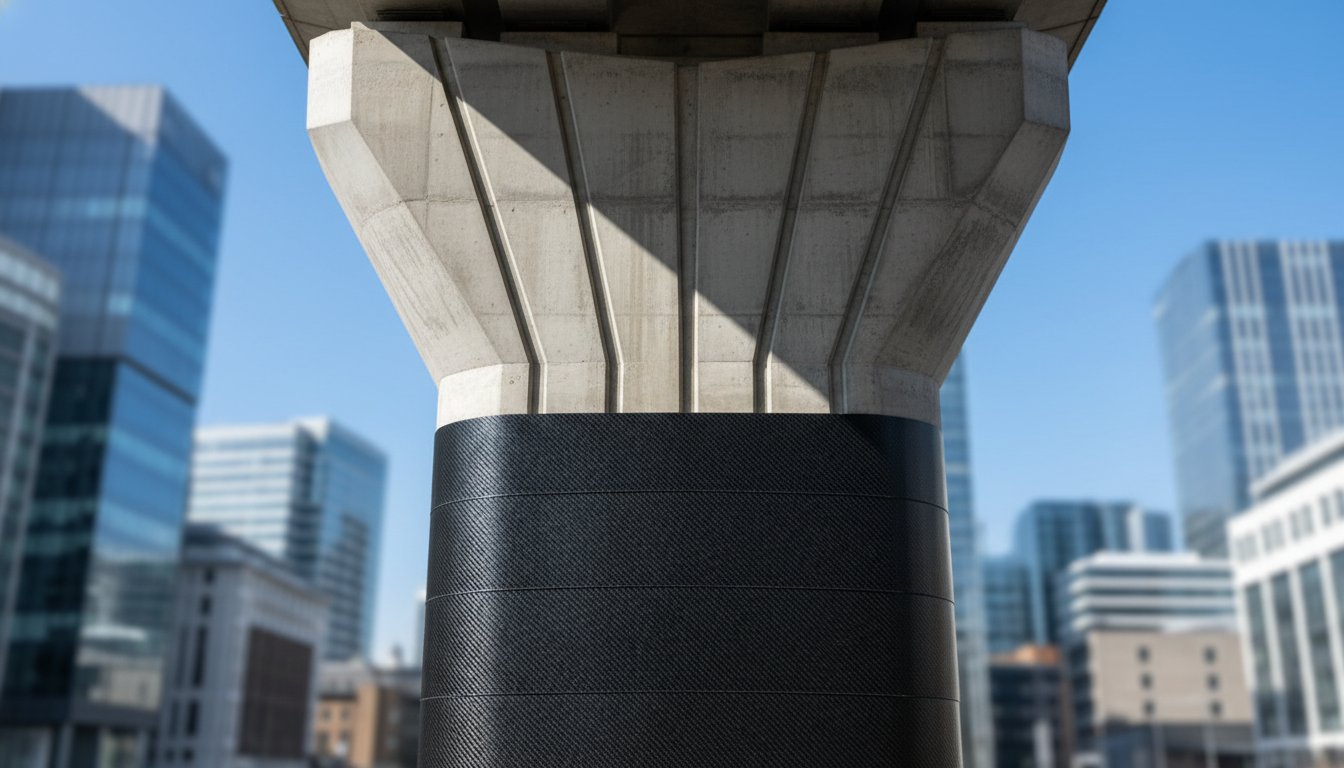
Where columns are subjected to increased axial loads, flexible carbon fibre wrapping is utilised to provide confinement. This process creates a triaxial stress state within the concrete core, effectively boosting its compressive strength and preventing lateral expansion. It’s a highly effective method for seismic retrofitting, as the wrap provides the necessary ductility to withstand cyclic loading without catastrophic failure. For shear strengthening, ‘U-wraps’ are often applied to reinforced concrete T-beams. These wraps act as external stirrups, intercepting potential shear cracks and redistributing the stress across the composite layers. This specific application highlights how does carbon fibre structural strengthening wor to prevent brittle failures in critical structural members.
The Critical Role of Engineering Design and Feasibility
CFRP is often mischaracterised as a universal remedy, yet its success is entirely dependent on site-specific engineering rigour. It’s not a “one-size-fits-all” product. A comprehensive understanding of how does carbon fibre structural strengthening wor requires a commitment to feasibility studies and bespoke design before any material is deployed. Whilst surface-level repairs may offer temporary relief, only a designed composite system addresses the underlying structural deficit. This initial phase involves detailed structural surveys to identify the root cause of deficiency, whether it originates from design errors or material degradation.
Assessing the current state of the asset is non-negotiable. Testing for carbonation depth and chloride ion concentration provides essential data on the internal health of the reinforced concrete. Environmental stressors also dictate the design parameters. High UV exposure, extreme temperature fluctuations, and exposure to aggressive chemicals in industrial zones can all affect the performance of the epoxy matrix. Designers must account for these variables to ensure the composite maintains its integrity over the intended service life. This methodical approach to how does carbon fibre structural strengthening wor ensures that the intervention is both safe and durable.
Assessing Substrate Integrity
The host concrete must possess a minimum tensile strength, typically between 1.0 MPa and 1.5 MPa, to ensure the CFRP can function as designed. If the surface is weak or friable, the bond will fail within the concrete itself, rendering the strengthening ineffective. Pull-off tests are mandatory to validate design assumptions and confirm that the substrate can support the transferred shear stresses. Any existing defects, such as honeycombing or cracking, must be addressed through professional concrete repair before the composite application begins.
Longevity and Life-Extension Strategy
CFRP systems offer a sustainable alternative to the carbon-intensive process of demolition and replacement. They’re exceptionally durable in the harsh UK climate, resisting the corrosion that often plagues traditional steel reinforcement. By prolonging the functional lifespan of an existing asset through composite technology, engineers significantly reduce the total embodied carbon of the structure. This “repair over replace” philosophy aligns technical performance with modern environmental goals.
To ensure your infrastructure meets modern safety standards through tailored engineering, we invite you to contact our specialist team for a structural consultation.
The Tyfo® Fibrwrap® System: A Specialist Approach
The successful deployment of composite technology relies on the use of fully integrated and tested systems rather than the assembly of disparate components. The Tyfo® Fibrwrap® system is a proprietary solution where the carbon fibres and epoxy resins are engineered to function in total synergy. When technical professionals ask how does carbon fibre structural strengthening wor in high-consequence environments, the answer lies in this systemic approach. Every combination of fabric and resin undergoes rigorous testing to ensure that the physical properties used in the design stage are reliably achieved on-site. This level of technical assurance is vital for critical infrastructure, where the margin for error is non-existent.
Deploying these advanced materials requires the expertise of a specialist engineering contractor capable of managing the complexities of high-risk assets. Tyfo® systems are not generic products; they’re specialised tools customised for diverse applications, including bridge reinforcement, pipeline rehabilitation, and blast mitigation. The application process, whether executed via manual hand-layup or automated machine-application, is governed by strict quality control standards. This ensures that the fibre orientation and resin saturation meet the exact specifications required to redistribute structural loads safely.
Comprehensive Asset Rehabilitation
The utility of the Tyfo® system extends far beyond simple flexural or shear strengthening. It’s a primary solution for seismic retrofitting, where the goal is to enhance the ductility of a structure to withstand lateral forces. In the energy and water sectors, the system is utilised for the internal and external rehabilitation of high-pressure pipelines, providing a trenchless alternative to replacement. As the holder of the exclusive UK licensing for Tyfo® Fibrwrap® technology, we provide a level of technical depth that is unique in the regional market. For a detailed breakdown of the application process, engineers should consult our Tyfo® Fibrwrap® Installation guide.
Ensuring Compliance and Safety
Every intervention must adhere to established UK and international engineering standards, such as the Concrete Society’s Technical Report 55 (TR55). These guidelines provide the framework for the design, installation, and inspection of composite systems. Specialist site supervision is essential to guarantee that the installation reflects the design intent, thereby securing the intended design life of the repair. Understanding how does carbon fibre structural strengthening wor in practice means recognising the necessity of this oversight. Rigorous testing, including bond pull-off tests and witness panel analysis, provides the empirical evidence required for final structural sign-off.
If you’re managing an asset that requires a sophisticated, non-disruptive upgrade, we’re here to help. Contact our engineering team for a feasibility assessment to determine the most effective composite strategy for your specific structural challenges.
Securing the Future of UK Infrastructure
The transition from traditional heavy-duty repairs to advanced composite systems represents a fundamental shift in asset management. By understanding how does carbon fibre structural strengthening wor, technical professionals can move beyond reactive maintenance toward proactive life-extension. The integration of high-modulus carbon filaments within a precise resin matrix allows for the redistribution of tensile stresses without the burden of additional mass. This technical synthesis is critical as regulatory requirements demand higher standards of structural reliability across the built environment.
As the exclusive UK licensee for the Tyfo® Fibrwrap® system, we provide a specialist design-and-build engineering team with a proven track record on major UK infrastructure. Our approach prioritises empirical evidence and engineering rigour to ensure every intervention meets the highest safety standards. The sustainability of repairing rather than replacing essential assets offers a clear path toward meeting both economic and environmental objectives. We invite you to Request a Technical Feasibility Study for Your Asset to ensure your structure’s long-term integrity.
Frequently Asked Questions
How much strength can carbon fibre actually add to a concrete beam?
Carbon fibre can increase the flexural capacity of a concrete beam by up to 50% and shear capacity by nearly 100%, provided the substrate integrity is sufficient. The exact gain is determined by the existing reinforcement ratio and the compressive strength of the host concrete. Engineers must ensure the structure remains tension-controlled to prevent brittle failure modes after the upgrade.
Is carbon fibre strengthening more expensive than traditional steel propping?
The material cost of CFRP is typically higher than structural steel, but the total project expenditure is often lower due to reduced labour and equipment requirements. Because the system is lightweight and requires no heavy lifting plant, the indirect savings from minimal operational disruption often justify the investment. It’s a cost-effective solution for complex assets where access is restricted.
How long does a CFRP structural repair typically last?
Structural repairs using CFRP are typically designed to match the remaining functional lifespan of the asset, which is often in excess of 50 years. The composite’s inherent resistance to corrosion ensures that the reinforcement doesn’t degrade in the same manner as traditional steel. This longevity is a primary driver for the use of composite technology in harsh UK environments.
Can carbon fibre be used on structures other than concrete, such as timber or masonry?
Yes, CFRP is frequently utilised for masonry reinforcement and the strengthening of historic timber sections. Its high strength-to-weight ratio makes it an ideal solution for upgrading heritage structures where minimal visual impact is required. The system is bonded to the substrate to intercept tensile forces, effectively prolonging the life of diverse structural materials.
What happens to carbon fibre strengthening in the event of a fire?
Carbon fibre systems require additional fire protection, such as intumescent coatings or cementitious renders, to maintain integrity during a fire event. The epoxy resins used in the matrix possess a specific glass transition temperature, and the design must ensure this limit isn’t exceeded under fire load. Near-surface mounted systems offer inherent protection by utilising the concrete cover as a thermal barrier.
Does the installation of CFRP require the building to be vacated during works?
Vacating the building is seldom necessary because the installation process is quiet, non-vibratory, and involves no hot works. This allows for the rehabilitation of critical infrastructure whilst the facility remains fully operational. The absence of heavy machinery and the low-profile nature of the materials ensure that occupant disruption is kept to an absolute minimum.
How is the bond between the carbon fibre and the concrete tested after installation?
Bond integrity is verified through pull-off testing and the analysis of witness panels created on-site during the application. Acoustic sounding is also employed to detect any interfacial voids or delamination that might compromise the load transfer mechanism. These empirical tests provide the necessary assurance that the system will perform according to the design specifications.
What maintenance is required for a CFRP-strengthened structure?
A CFRP-strengthened structure requires very little maintenance beyond periodic visual inspections to check for mechanical impact or environmental degradation. Understanding how does carbon fibre structural strengthening wor in the long term involves monitoring the bond line for any signs of distress. If the protective coatings remain intact, the composite system requires no specialised ongoing treatment.


