


With cement production accounting for approximately 8% of global CO2 emissions, the traditional impulse to demolish and rebuild is increasingly viewed as an engineering failure rather than a structural necessity. Technical professionals recognise that asset degradation due to reinforcement corrosion and the requirement for increased loading capacity in older structures present significant risks to infrastructure safety. The carbon fibre strengthening of concrete offers a sophisticated, non-intrusive alternative to traditional heavy-duty repair methods, prioritising the preservation of critical assets through advanced materials science.
You likely understand that maintaining compliance with evolving building standards, such as the second generation of Eurocode 8 arriving in 2026, requires a methodical approach to structural reinforcement. This guide provides an expert-led examination of CFRP methodologies, detailing how these systems enhance structural integrity and extend the functional lifespan of concrete assets. We will preview the technical nuances of substrate preparation, the application of proprietary Tyfo® Fibrwrap® systems, and the shift towards performance-based criteria that define modern engineering rigour.
Key Takeaways
- Evaluate the technical advantages of carbon fibre strengthening of concrete over traditional methods to address reinforcement corrosion and increased loading requirements.
- Understand the engineering pedigree and application of Tyfo® Fibrwrap® Systems as a world-leading solution for seismic retrofitting and structural enhancement.
- Discover why the high strength-to-weight ratio of CFRP provides a non-intrusive alternative to heavy-duty steel plate bonding and section enlargement.
- Learn why meticulous substrate preparation and specialist diagnostic testing are critical to the long-term performance of composite reinforcement.
- Align structural maintenance with net-zero targets by prioritising asset life-extension over the carbon-intensive process of demolition and reconstruction.
Understanding Carbon Fibre Strengthening of Concrete
Carbon Fibre Reinforced Polymer (CFRP) is defined as a high-strength composite system where high-modulus carbon fibres are encapsulated within a polymer resin matrix. This material belongs to the wider family of Fibre-reinforced plastic. It’s become fundamental to modern structural engineering and asset remediation. The carbon fibre strengthening of concrete is frequently necessitated by factors such as initial design deficiencies, the requirement to support increased traffic loads on ageing bridges, or the mitigation of reinforcement corrosion. Historically, structural remediation relied upon heavy-duty steel plate bonding or significant section enlargement. These methods often imposed substantial additional dead weight and required intrusive installation processes. The transition towards lightweight composite solutions represents a paradigm shift in asset management.
The Mechanics of CFRP Composites
The efficacy of CFRP as a strengthening medium is derived from the synergistic relationship between the carbon filaments and the epoxy resin. Whilst the fibres provide the primary tensile load-carrying capacity, the resin matrix ensures the efficient transfer of stresses between individual fibres and protects them from environmental degradation. These materials exhibit a tensile strength that can exceed that of traditional structural steel by a factor of ten, yet they possess only a fraction of the density. This exceptional strength-to-weight ratio allows for significant structural upgrades without altering the original geometry of the asset. The system’s integrity is fundamentally dependent on the adhesive bond established at the interface of the composite and the concrete substrate. If this bond is compromised by poor surface preparation, the theoretical performance of the carbon fibre strengthening of concrete cannot be realised.
Primary Applications in UK Infrastructure
Within the context of UK infrastructure, CFRP is deployed across several critical configurations to address specific structural vulnerabilities. Flexural strengthening is commonly applied to the tension face of beams and floor slabs to increase their moment capacity, allowing older buildings to meet modern occupancy requirements. Shear strengthening is utilised to enhance the resistance of structural elements against diagonal tension, thereby preventing catastrophic brittle failure modes. Additionally, column confinement involves wrapping the perimeter of vertical members to provide triaxial compression. This technique increases the axial load capacity and improves seismic resilience, a consideration that is increasingly relevant as building codes evolve. Detailed design features must be calculated for each intervention to ensure the specific performance requirements of the asset are met.
The Tyfo® Fibrwrap® System: Advanced Composite Technology
The Tyfo® Fibrwrap® system is a world-leading, proprietary structural strengthening solution with an engineering pedigree spanning decades of global infrastructure projects. Unlike generic applications of carbon fibre, this system is a carefully engineered suite of tested materials designed to work in unison. It’s used extensively across commercial buildings, transport bridges, and industrial pipelines to restore or enhance load-bearing capacity. The system’s history is rooted in rigorous empirical testing and real-world performance, providing asset controllers with the necessary validation for high-stakes structural interventions. Because the system is delivered through an exclusive licensing model, a higher standard of installation and quality control is maintained, ensuring that the theoretical design parameters are precisely replicated on-site.
The technical superiority of Carbon Fibre-Reinforced Polymer Matrix Composites is well-documented in peer-reviewed literature, particularly regarding their fatigue resistance and long-term durability in aggressive environments. When considering the carbon fibre strengthening of concrete, the selection of a proprietary system like Tyfo® Fibrwrap® provides a level of technical assurance that generic alternatives cannot match. This is particularly critical when addressing complex structural challenges where failure is not an option.
System Components and Material Standards
The system is comprised of specialised carbon, glass, and aramid fabrics, each selected based on the specific mechanical requirements of the project. These high-modulus fibres are saturated with high-performance epoxy resins that have been formulated for optimal wet-out and adhesion. Compliance with international and UK engineering standards, including the Concrete Society’s Technical Report 55, is a prerequisite for every application. The resins don’t just act as a binder; they’re critical to ensuring the long-term structural integrity of the composite by protecting the fibres from moisture ingress and chemical attack.
Compatibility with Diverse Structural Elements
One of the system’s primary advantages is its remarkable versatility. It can be seamlessly applied to:
- Curved surfaces and circular columns where traditional steel plates would be impractical.
- Large-diameter industrial pipelines and silos requiring internal or external reinforcement.
- Complex masonry and timber structures through the use of hybrid composite configurations.
- Underwater structural elements using specialised resins that cure in submerged conditions.
Technical professionals seeking to evaluate specific asset requirements may consult our engineering team for a detailed structural assessment and bespoke design advice.
CFRP vs Traditional Strengthening: A Technical Comparison
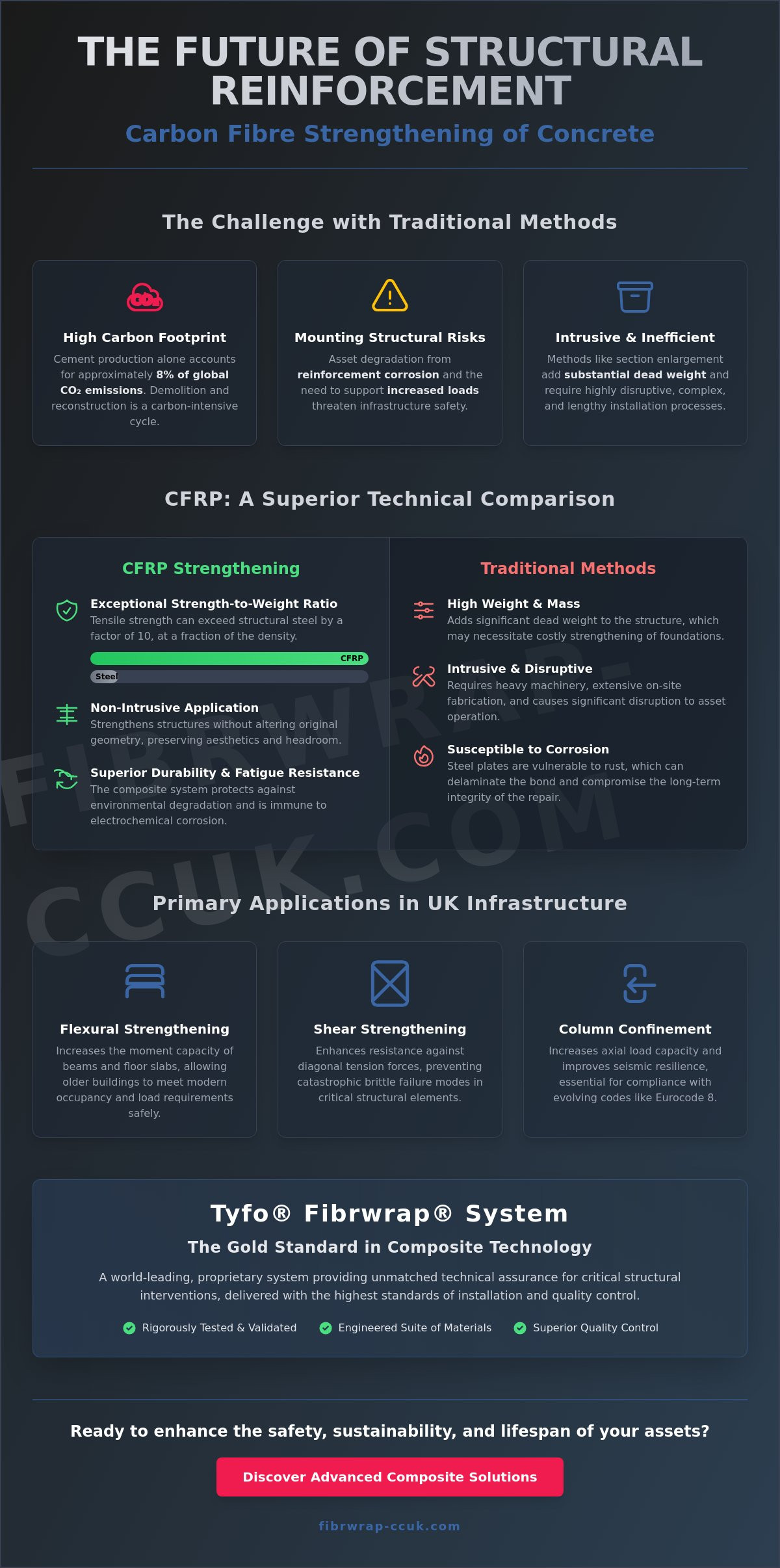
Traditional structural remediation typically relies on steel plate bonding or concrete section enlargement. Whilst these methods are well-understood, they impose significant limitations on the asset. Steel plates are inherently heavy, necessitating the use of mechanical fixings and heavy plant for installation, which adds substantial dead weight to the structure. By contrast, the carbon fibre strengthening of concrete utilises materials with an exceptional strength-to-weight ratio. A CFRP laminate provides equivalent tensile reinforcement to a steel plate whilst being approximately one-fifth of the weight and only a few millimetres thick. This reduction in added mass is critical when the existing structure is already operating near its ultimate limit state.
Logistical advantages also distinguish composite systems from traditional heavy-duty methods. The application of carbon fibre strengthening of concrete typically requires a smaller site footprint and fewer temporary works. Because the materials are lightweight and applied using manual saturation techniques, the need for craneage and extensive scaffolding is often eliminated. This leads to a marked reduction in asset downtime. For transport infrastructure or industrial facilities where operational continuity is paramount, the speed of composite installation provides a clear economic benefit over more intrusive traditional repairs.
Performance and Durability Comparison
Corrosion resistance remains a primary technical driver for selecting CFRP over steel. In coastal or chloride-rich industrial environments, steel reinforcement is susceptible to oxidation, which leads to volumetric expansion and subsequent concrete spalling. CFRP is chemically inert and immune to such degradation, ensuring a longer service life with minimal intervention. The fatigue performance of composites is also superior; they exhibit high resistance to cyclic loading over decades. This durability profile significantly reduces the long-term maintenance burden, as the risk of bond failure due to environmental exposure is effectively mitigated when high-quality epoxy resins are used.
Aesthetic and Spatial Considerations
The low-profile nature of carbon fibre allows for structural upgrades that don’t compromise the original geometry of the asset. In commercial environments, maintaining headroom and floor-to-ceiling heights is often a non-negotiable requirement. CFRP laminates are virtually invisible once a protective coating or architectural finish is applied, making them ideal for the sympathetic retrofitting of historic or premium commercial buildings. This non-intrusive approach ensures that structural capacity is increased without sacrificing usable space or architectural integrity. To understand how these systems are tailored to specific project requirements, you may explore our bespoke design features for structural strengthening.
The Engineering Design and Installation Process
The successful execution of carbon fibre strengthening of concrete is predicated on a disciplined, end-to-end engineering methodology that transcends simple material application. It’s essential that a specialist engineering contractor manages the entire lifecycle of the intervention, ensuring that the theoretical design parameters are precisely translated into on-site performance. This process begins with a comprehensive structural survey to identify existing defects and determine the residual capacity of the asset. Following the diagnostic phase, bespoke engineering calculations are developed to establish the exact quantity, orientation, and layering of the composite materials required to meet the updated load-bearing specifications.
Rigorous quality control remains a constant throughout the delivery period. Every stage, from the environmental conditions during application to the final curing phase, is monitored against strict technical specifications. This methodical approach ensures that the finished system provides the long-term structural security expected by asset controllers and regulatory bodies. Professionals seeking to understand the broader context of these interventions can refer to this guide to structural repairs and asset remediation for further technical insights.
Substrate Preparation and Feasibility
The integrity of the bond between the composite and the concrete is the most critical factor in the system’s performance. Feasibility is determined through meticulous testing, including pull-off tests to verify the substrate’s tensile strength and carbonation depth analysis to assess the condition of the internal reinforcement. Surface preparation is then executed using mechanical abrasion, such as grit blasting or needle gunning, to achieve a specific concrete surface profile. All dust, laitance, and contaminants must be removed to ensure a clean, sound substrate that facilitates optimal adhesive bonding. Without this level of preparation, the carbon fibre strengthening of concrete cannot achieve its intended design life.
Installation Sequence for CFRP Wrapping
Once the substrate is prepared, the installation sequence follows a precise technical protocol. The fibre fabrics are cut to the exact dimensions specified in the engineering design and then saturated with high-performance epoxy resin using specialised impregnation equipment. This ensures a consistent resin-to-fibre ratio, which is vital for the mechanical properties of the finished laminate. The saturated fabric is applied to the concrete in layers, with each layer carefully consolidated to remove air voids and ensure a monolithic bond. After the composite has reached its design strength, protective coatings are applied to provide UV resistance or to meet specific fire protection requirements. For projects requiring specialised technical oversight, you should contact our engineering team for a technical consultation to discuss your specific structural requirements.
Sustainability and Asset Life-Extension
The carbon fibre strengthening of concrete serves as a critical pillar within the modern sustainable construction framework, offering a technically superior alternative to the carbon-intensive cycle of demolition and reconstruction. As cement production remains responsible for approximately 8% of global CO2 emissions, the engineering community is increasingly prioritising the retention and upgrade of existing assets. By utilising high-modulus composite materials, the load-bearing capacity of a structure can be significantly enhanced with minimal material consumption. This approach aligns structural maintenance with global ESG targets and the revised EU Construction Products Regulation, which, as of 2026, necessitates mandatory Global Warming Potential (GWP) declarations for primary construction materials. Choosing life-extension over replacement doesn’t just preserve the architectural fabric; it actively reduces the embodied carbon footprint of the built environment.
Economic advantages often mirror these environmental benefits, as the functional utility of an asset is extended without the prohibitive costs associated with major reconstruction. The carbon fibre strengthening of concrete allows for the rapid restoration of structural integrity, ensuring that critical infrastructure remains operational with minimal disruption to the surrounding economy. This efficiency is paramount for asset controllers who must balance stringent safety requirements with the need for long-term fiscal responsibility.
The Circular Economy in Civil Engineering
Composite technology facilitates a circular economy by allowing buildings and infrastructure to be adapted for entirely new uses rather than being consigned to waste. Structural elements that would otherwise be deemed obsolete due to updated design codes or occupancy changes can be rehabilitated using tailored CFRP systems. This methodology reduces the volume of demolition waste entering landfills and minimises the demand for new raw materials like steel and concrete. For technical professionals managing complex utility networks, this technical guide to pipeline rehabilitation and life-extension provides further evidence of how composite science supports the longevity of essential services.
Future-Proofing Critical Infrastructure
Investing in high-specification engineering solutions like Tyfo® Fibrwrap® ensures that critical infrastructure is prepared for the stressors of the coming decades. These systems are increasingly deployed to:
- Address climate-related stressors on transport bridges and coastal defences where traditional materials might fail.
- Enhance the seismic resilience of historic structures in line with the second generation of Eurocode 8 standards arriving in 2026.
- Provide blast mitigation for high-security assets, ensuring structural stability under extreme loading events.
The long-term value of these interventions lies in their ability to provide a durable, maintenance-free solution that secures the asset’s utility for its entire remaining design life.
Securing the Future of Structural Assets
The strategic application of carbon fibre strengthening of concrete represents a fundamental shift in how critical infrastructure is maintained and upgraded. By prioritising advanced composite science over the carbon-intensive cycle of demolition, asset controllers can achieve significant increases in load capacity whilst ensuring compliance with evolving regulatory standards. The transition from heavy-duty traditional methods to low-profile, high-modulus CFRP systems provides a non-intrusive pathway to structural security that doesn’t compromise original architectural dimensions or operational continuity.
As the exclusive UK licensee for Tyfo® Fibrwrap® systems, we provide a level of technical assurance grounded in decades of proven performance across the commercial and infrastructure sectors. Our specialist engineering team offers national coverage, delivering end-to-end solutions from initial diagnostic testing to precision installation. Ensuring the long-term utility of your essential assets requires a partner committed to engineering rigour and safety. You are invited to request a technical consultation for your structural strengthening project to evaluate the specific requirements of your asset. We look forward to supporting your next structural intervention with science-led expertise.
Frequently Asked Questions
What is the primary benefit of using CFRP for concrete strengthening?
The primary benefit of CFRP is its exceptional strength-to-weight ratio, which allows for substantial increases in load capacity without adding significant dead weight. This is particularly valuable for structures already operating at their limit state where traditional steel reinforcement would be too heavy. Additionally, the non-corrosive nature of the composite ensures a durable repair that resists environmental degradation in aggressive industrial or coastal settings.
How long does a carbon fibre strengthening system typically last?
A correctly installed system is designed to provide structural reinforcement for the remainder of the asset’s functional life, typically exceeding 50 years. The carbon fibres themselves are chemically inert and don’t degrade over time; however, the long-term performance is dependent on the integrity of the epoxy resin and the bond to the substrate. Regular inspections are recommended to ensure that protective coatings remain intact and the concrete remains sound.
Is carbon fibre strengthening more expensive than steel plate bonding?
Whilst the raw material cost of carbon fibre is higher than structural steel, the total project expenditure is frequently lower due to reduced logistical requirements. The absence of heavy machinery and the speed of manual application minimise labour costs and asset downtime. This makes the carbon fibre strengthening of concrete a more economically viable solution for critical infrastructure projects where operational continuity and long-term durability are the primary drivers.
Can CFRP be applied to structures with existing reinforcement corrosion?
CFRP can be applied to structures with a history of reinforcement corrosion, provided that the underlying pathology is addressed first through comprehensive concrete repair. It’s essential that the substrate is returned to a sound condition and that any active corrosion is mitigated before the composite is bonded. This ensures that the strengthening system is anchored to a stable medium capable of transferring structural loads without the risk of future spalling.
What level of disruption should be expected during a Fibrwrap installation?
The level of disruption is significantly lower than traditional section enlargement because the installation requires no heavy plant or extensive demolition. Most equipment is portable and can be deployed in confined spaces with minimal noise and dust generation. This efficiency often allows the facility to remain fully or partially operational during the works, which is a critical consideration for hospitals, data centres, and transport hubs.
Is fire protection required for carbon fibre strengthened elements?
Fire protection is generally required for CFRP systems in buildings to ensure compliance with structural fire ratings. Because the epoxy resins utilised in the composite have a relatively low glass transition temperature, they must be shielded from thermal degradation. This is typically achieved through the application of intumescent coatings or specialised cementitious renders that provide the necessary fire resistance without significantly increasing the thickness of the reinforcement.
Can CFRP be used for underwater structural strengthening?
CFRP is highly effective for underwater structural strengthening when utilised with specialised Tyfo® resins formulated for submerged application. These proprietary resins are designed to displace water at the interface and cure effectively whilst submerged, making them ideal for bridge piers and maritime assets. This capability allows for structural upgrades without the need for expensive and complex cofferdams or dewatering processes.
How do you verify the quality of the bond after installation?
Bond quality is verified through a combination of non-destructive testing and destructive sampling. Acoustic sounding, often referred to as tap testing, is used to identify any subsurface voids or delaminations. Additionally, pull-off tests are performed on witness panels to verify the bond strength between the resin and the concrete substrate. These rigorous quality control measures ensure the carbon fibre strengthening of concrete meets the specified engineering requirements and safety standards.